
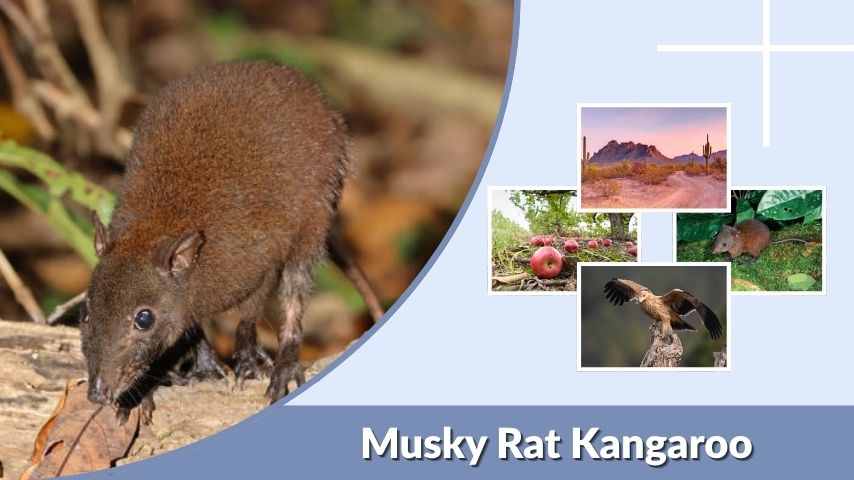
The musky rat kangaroo is a small rainforest marsupial found only in northeastern Australia. Although its name includes both “rat” and “kangaroo,” it is not a rat. It is a tiny member of the kangaroo-like marsupial group, with a pointed face, reddish-brown fur, dark eyes, and a long, scaly tail. This unusual animal spends much of its life moving through dense rainforest leaf litter in search of fruit, fungi, insects, and other small foods.
Also written as musky rat-kangaroo, this species is especially interesting because it is considered one of the most primitive living kangaroo relatives. It is small, secretive, active during the day, and strongly tied to wet tropical rainforest. For anyone learning about Australian wildlife, the musky rat kangaroo is a perfect example of how unique rainforest marsupials can be.
What Is a Musky Rat Kangaroo?
The musky rat kangaroo is a small marsupial with the scientific name Hypsiprymnodon moschatus. It belongs to an ancient lineage of kangaroo-like animals and is the only living species in its genus. Unlike large kangaroos that live in open grasslands or woodlands, the musky rat kangaroo lives on the rainforest floor.
It is often compared with potoroos and bettongs because it has a similar body shape and foraging lifestyle. However, the musky rat kangaroo is distinct in several ways. It is smaller, more rainforest-dependent, and active during daylight hours.
Why Is It Called a Musky Rat Kangaroo?
The name comes from its small size, rat-like tail, kangaroo-like body, and musky smell. Its long, mostly hairless tail can look similar to a rat’s tail, while its hind legs, pouch, and marsupial features connect it to kangaroo relatives.
The name may sound strange, but it describes the animal’s appearance fairly well. It is not a rodent, and it is not a common large kangaroo. It is a small rainforest marsupial with a unique mix of features.
Musky Rat Kangaroo Appearance
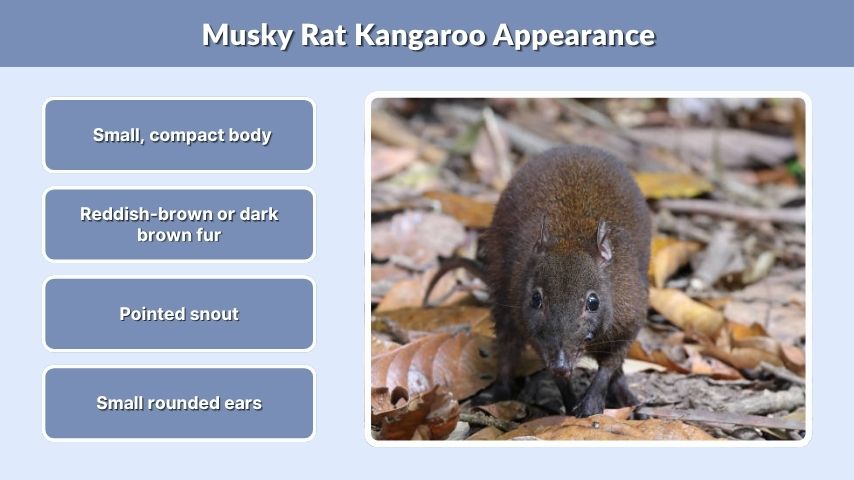
The musky rat kangaroo has a compact body covered in rich brown or reddish-brown fur. Its face is narrow and pointed, with bright dark eyes and small rounded ears. The underside may appear lighter than the back, and the limbs are slim compared with larger kangaroos.
One of its most noticeable features is the tail. The tail is thin, dark, and scaly-looking, with little hair. Unlike large kangaroos that use their tails as powerful supports, the musky rat kangaroo’s tail is more delicate and is often seen trailing behind it as it moves through leaf litter.
Main Features
The musky rat kangaroo can be recognized by:
- Small, compact body
- Reddish-brown or dark brown fur
- Pointed snout
- Small rounded ears
- Dark, alert eyes
- Thin, scaly tail
- Shorter, less powerful hind legs than large kangaroos
- Rainforest-floor lifestyle
Its body shape is closer to a small forest forager than a hopping open-country kangaroo. This helps it move through dense vegetation, roots, fallen leaves, and low rainforest cover.
Musky Rat Kangaroo Size
The musky rat kangaroo is one of the smallest kangaroo relatives. It is often described as roughly bandicoot-sized, though exact size can vary between individuals. It is much smaller than wallabies, tree kangaroos, and familiar open-country kangaroos.
Its small size helps it move through the rainforest understory. Instead of bounding across open land, it slips through low vegetation, searches among leaves, and explores the forest floor for food.
How Big Is a Musky Rat Kangaroo?
A typical musky rat kangaroo has a body length of about 21 to 34 centimeters, with a relatively long tail. Its weight is often around a few hundred grams, commonly reported between about 332 and 680 grams.
This makes it light enough to move through tangled ground cover and leaf litter. Its small body also helps it hide from predators in dense rainforest.
Where Does the Musky Rat Kangaroo Live?
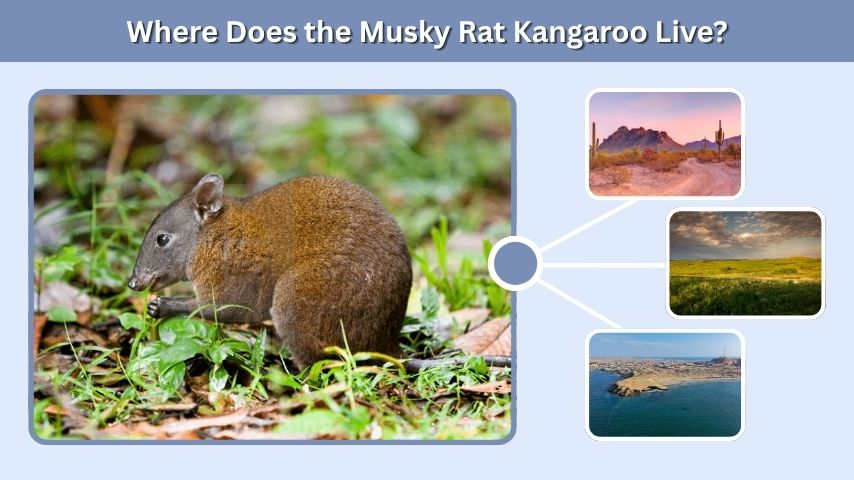
The musky rat kangaroo lives only in northeastern Queensland, Australia. Its range is limited to tropical rainforest areas, especially in the Wet Tropics region. It is not found across all of Australia and does not live in deserts, grasslands, or dry inland habitats.
This narrow range makes the species closely associated with rainforest conservation. It depends on damp, shaded, complex forest environments where fruit, fungi, insects, and shelter are available.
Musky Rat Kangaroo Habitat
The musky rat kangaroo’s habitat includes dense tropical rainforest, especially areas with thick vegetation, streams, lakes, moist leaf litter, and fallen fruit. It is mainly terrestrial, meaning it lives on the ground rather than in trees.
It often shelters in nests hidden among roots, leaves, and rainforest debris. The forest floor gives it food, cover, and protection from extreme heat.
Musky Rat Kangaroo in the Daintree Rainforest
The Daintree Rainforest is one of the best-known places associated with the musky rat kangaroo. This rainforest in far north Queensland is part of the Wet Tropics region and contains ancient, biodiverse habitat. The musky rat kangaroo is one of the small mammals that may be found in this kind of rainforest environment.
In the Daintree, it lives among fallen leaves, roots, damp soil, and dense vegetation. Visitors are unlikely to see one easily because it is shy and small, but it is a special part of the rainforest’s wildlife community.
Why the Daintree Habitat Matters
The Daintree and nearby wet tropical forests provide the kind of habitat the musky rat kangaroo needs. These forests have constant moisture, a rich plant community, fallen fruit, fungi, invertebrates, and cover from predators.
Because the musky rat kangaroo is tied so closely to rainforest, protecting rainforest habitat is the most important way to support its future.
What Does a Musky Rat Kangaroo Eat?
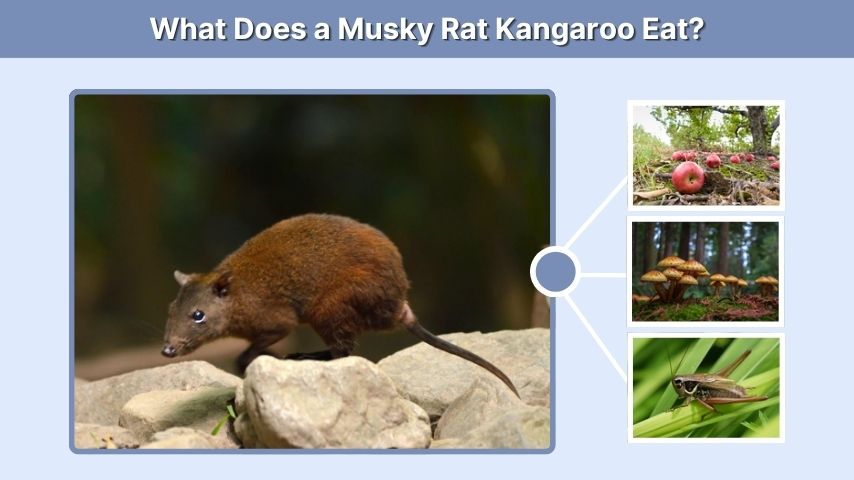
The musky rat kangaroo is omnivorous. This means it eats both plant and animal material. Its diet includes fruit, fungi, seeds, insects, worms, and other small invertebrates. It forages on the forest floor, using its sense of smell and quick movements to locate food in the leaf litter.
Fruit is especially important when available. The animal may help move seeds around the rainforest as it feeds, although larger rainforest animals also play major roles in seed dispersal.
Musky Rat Kangaroo Diet
Common foods include:
- Fallen fruit
- Fungi
- Seeds
- Insects
- Worms
- Small invertebrates
- Soft plant material
This varied diet helps it survive in a complex rainforest environment. Instead of relying on one food source, it takes advantage of what is available on the forest floor.
Musky Rat Kangaroo Adaptations
The musky rat kangaroo has several adaptations that help it survive in dense rainforest. Unlike large kangaroos built for powerful hopping across open land, this animal is built for careful movement through cluttered ground habitat.
Its small size allows it to move beneath leaves, vines, roots, and low plants. Its pointed snout helps it search through leaf litter for food. Its brown fur blends with the forest floor, making it harder for predators to spot.
Useful Rainforest Adaptations
Important adaptations include:
- Small body for moving through dense vegetation
- Brown fur for camouflage in leaf litter
- Strong sense of smell for finding food
- Daytime activity suited to rainforest foraging
- Omnivorous diet for flexible feeding
- Ground-based movement for searching fallen fruit and insects
- Nesting behavior for shelter and safety
One unusual feature is that it often moves on all fours rather than relying only on strong hopping. This makes sense in a dense rainforest where careful movement can be more useful than long leaps.
Musky Rat Kangaroo Locomotion
The musky rat kangaroo moves differently from many better-known kangaroos. Large kangaroos use powerful hind legs and tails to hop across open spaces. The musky rat kangaroo is more of a ground forager. It can hop, but it also uses all four limbs as it moves through the rainforest floor.
This style of locomotion helps it navigate tangled roots, fallen branches, wet leaves, and uneven ground. In thick rainforest, quick low movement can be safer and more practical than big jumps.
Does It Climb?
The musky rat kangaroo is mainly terrestrial, but it can move through low vegetation when needed. It is not a tree kangaroo and does not live high in the canopy. Most of its feeding and sheltering happens close to the ground.
Musky Rat Kangaroo Reproduction and Life Cycle
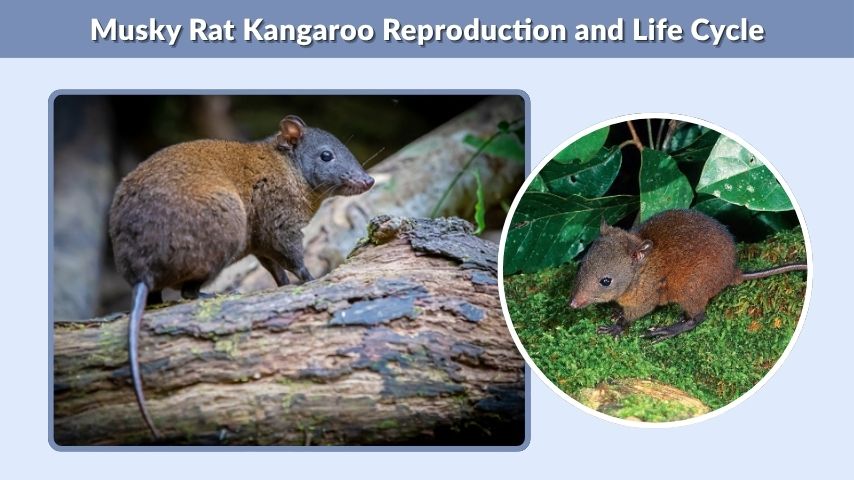
Like other marsupials, the musky rat kangaroo gives birth to tiny, undeveloped young that continue growing in the mother’s pouch. The young, often called joeys, attach to a teat and remain protected while they develop.
Compared with many placental mammals, marsupial young are born at a very early stage. The pouch provides the safe space needed for growth after birth.
Basic Life Cycle
The life cycle includes:
- Mating between adult animals
- Birth of a tiny undeveloped young
- Development inside the pouch
- Gradual growth and independence
- Adult foraging and reproduction
Because the species is shy and lives in dense rainforest, some details of its behavior are harder to observe than those of larger, more open-country kangaroos.
Musky Rat Kangaroo Predators
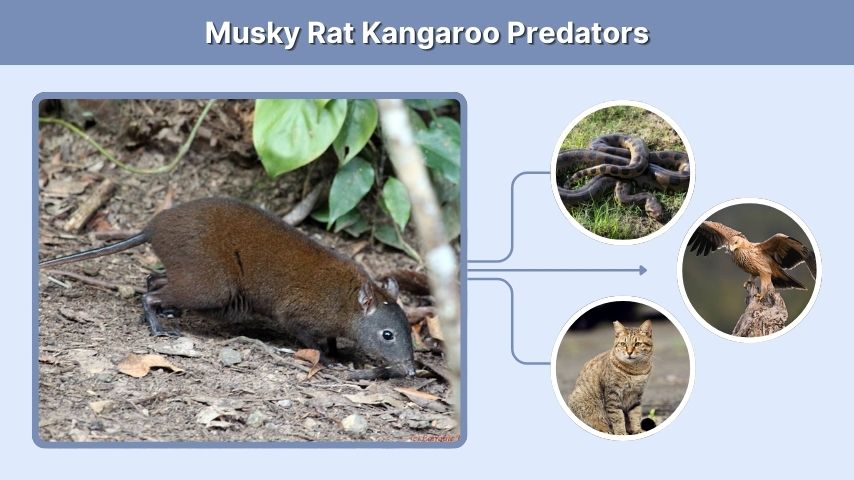
The musky rat kangaroo’s small size makes it vulnerable to predators. Natural predators may include snakes, birds of prey, and carnivorous mammals. In areas where invasive predators occur, cats and dogs can also be threats to small ground-dwelling animals.
Its best defenses are camouflage, dense cover, quick movement, and secretive behavior. By staying low in the rainforest and using thick vegetation, it reduces the chance of being seen.
What Eats Musky Rat Kangaroos?
Potential predators include:
- Large snakes
- Birds of prey
- Quolls or other carnivorous mammals
- Feral cats
- Domestic dogs in disturbed areas
Predation is a natural part of the food web, but introduced predators can create additional pressure on small native mammals.
Is the Musky Rat Kangaroo Endangered?
The musky rat kangaroo is not currently listed as endangered. It is generally listed as Least Concern by the IUCN. This means it is not considered at immediate risk of extinction at the global level.
However, “Least Concern” does not mean the species is unimportant or free from risk. Because it has a limited range and depends on rainforest, habitat protection remains essential. Local habitat loss, fragmentation, climate change, invasive species, and disturbance could still affect populations.
Why People Think It May Be Endangered
People often assume the musky rat kangaroo is endangered because it is rare, small, unusual, and found only in a limited part of Australia. It is also tied to rainforest habitat, and many rainforest species are vulnerable to environmental change.
The better answer is: the musky rat kangaroo is not currently classified as endangered, but conserving its rainforest habitat is still important.
Musky Rat Kangaroo Classification
The musky rat kangaroo belongs to the animal kingdom, phylum Chordata, class Mammalia, and infraclass Marsupialia. Its scientific name is Hypsiprymnodon moschatus.
It is part of the broader kangaroo-like marsupial group, but it is distinct from large kangaroos, wallabies, potoroos, and bettongs. Scientists consider it important because it represents an ancient branch of kangaroo evolution.
Basic Classification
Its classification can be summarized as:
- Kingdom: Animalia
- Phylum: Chordata
- Class: Mammalia
- Infraclass: Marsupialia
- Order: Diprotodontia
- Family: Hypsiprymnodontidae
- Genus: Hypsiprymnodon
- Species: Hypsiprymnodon moschatus
This classification helps show that the musky rat kangaroo is a mammal, a marsupial, and a relative of kangaroo-like animals.
Interesting Facts About the Musky Rat Kangaroo
The musky rat kangaroo is full of surprising details. It may be small, but it has an important place in Australia’s rainforest wildlife.
Interesting facts include:
- It is found only in northeastern Queensland.
- It is one of the smallest kangaroo relatives.
- It is active during the day.
- It has a scaly, rat-like tail.
- It eats fruit, fungi, insects, and other small foods.
- It lives mainly on the rainforest floor.
- It is linked to ancient kangaroo evolution.
- It is not currently listed as endangered.
- It is associated with places like the Daintree Rainforest.
- It is sometimes described as the most primitive living kangaroo relative.
These facts make it a useful animal for teaching children about marsupials, rainforest habitats, adaptation, and conservation.
Why the Musky Rat Kangaroo Is Important
The musky rat kangaroo matters because it is part of a unique rainforest ecosystem. It helps show how diverse marsupials can be beyond the familiar image of large kangaroos and wallabies. Its lifestyle connects it to the forest floor, where fruit, fungi, insects, leaves, and soil organisms interact.
It is also important scientifically. Because it represents an ancient lineage, studying it can help researchers understand the evolution of kangaroo-like marsupials.
FAQs
What is a musky rat kangaroo?
A musky rat kangaroo is a small marsupial found only in the tropical rainforests of northeastern Queensland, Australia. Its scientific name is Hypsiprymnodon moschatus. It has brown fur, a pointed snout, a scaly tail, and a ground-dwelling lifestyle on the rainforest floor.
What does a musky rat kangaroo eat?
A musky rat kangaroo eats a mixed diet of fruit, fungi, seeds, insects, worms, and other small invertebrates. It forages through leaf litter on the rainforest floor and uses its sense of smell to find food. This flexible diet helps it survive in dense tropical rainforest.
Where does the musky rat kangaroo live?
The musky rat kangaroo lives only in northeastern Queensland, Australia. It is strongly associated with tropical rainforest, including wet forest floors, dense vegetation, streams, lakes, and areas such as the Daintree Rainforest and the broader Wet Tropics region.
Is the musky rat kangaroo endangered?
The musky rat kangaroo is not currently classified as endangered and is generally listed as Least Concern. However, it has a limited rainforest range, so habitat protection is still important. Threats such as habitat fragmentation, climate change, and invasive predators can affect rainforest wildlife.
How big is a musky rat kangaroo?
The musky rat kangaroo is very small compared with most kangaroos. Its body is roughly 21 to 34 centimeters long, and it usually weighs only a few hundred grams. Its small size helps it move through thick rainforest leaf litter and low vegetation.