
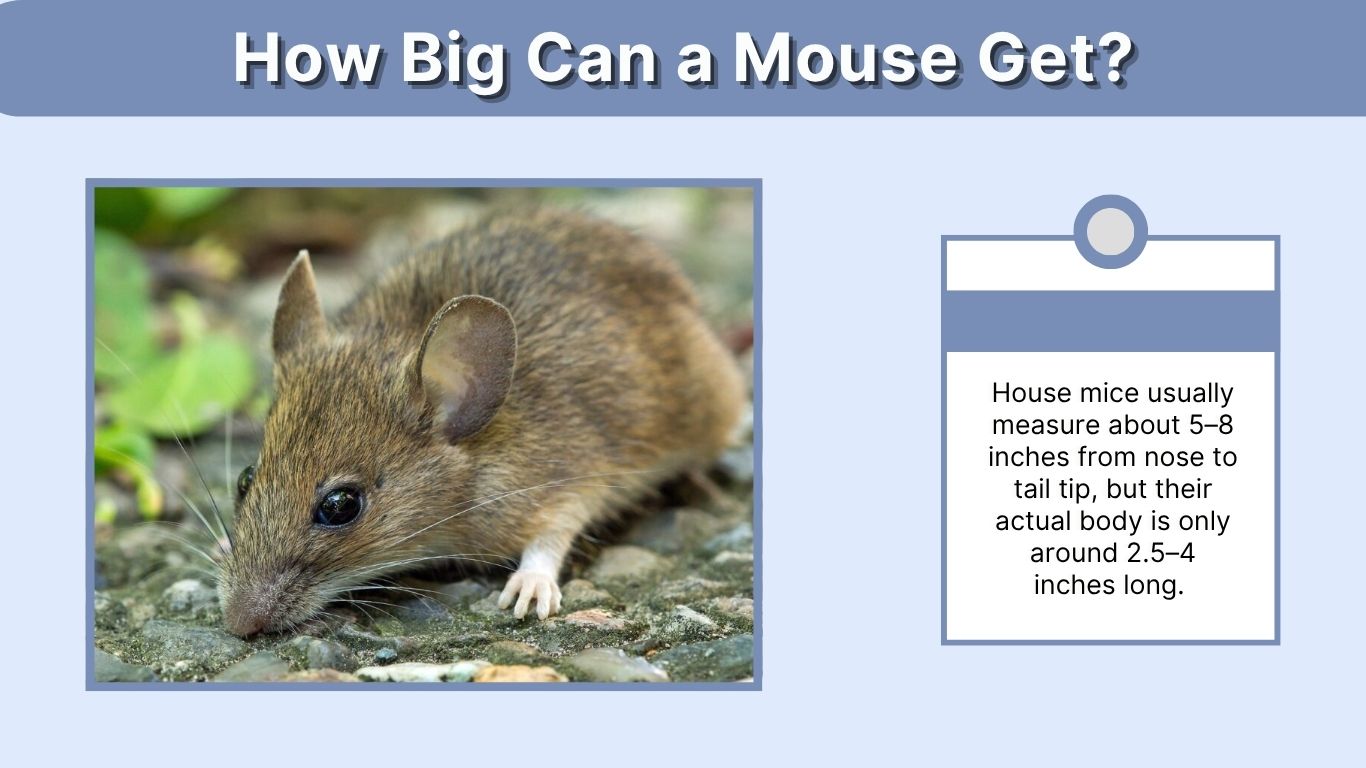
A typical adult mouse is much smaller than it may appear when it suddenly runs across a floor. House mice usually measure about 5–8 inches from nose to tail tip, but their actual body is only around 2.5–4 inches long. Most weigh less than one ounce. Size varies among house mice, deer mice, field mice, and domesticated fancy mice. A rodent considerably larger than these measurements may be a young rat, vole, or another mouse-like species rather than an unusually large house mouse.
How Big Is a Mouse?
The word “mouse” describes many small rodent species rather than one animal with a fixed adult size. Measurements can also be confusing because some sources give body length only, while others include the tail.
A common house mouse generally has a:
- Body length of about 2.5–3.75 inches
- Tail length of approximately 2.4–4 inches
- Total length of around 5–8 inches
- Weight of approximately 0.4–1 ounce
The long, thin tail may be as long as the head and body combined. Therefore, a mouse described as eight inches long does not have an eight-inch body.
| Type of mouse | Approximate total length | Typical weight |
| House mouse | 5–8 inches | 0.4–1 ounce |
| Deer mouse | 4.7–8.7 inches | 0.35–0.85 ounce |
| Oldfield mouse | 4.3–5.9 inches | 0.35–0.53 ounce |
| California mouse | 8.7–11.2 inches | Larger than most Peromyscus mice |
| Fancy mouse | Usually similar to a house mouse | Varies by sex and breeding |
How Big Can a House Mouse Get?
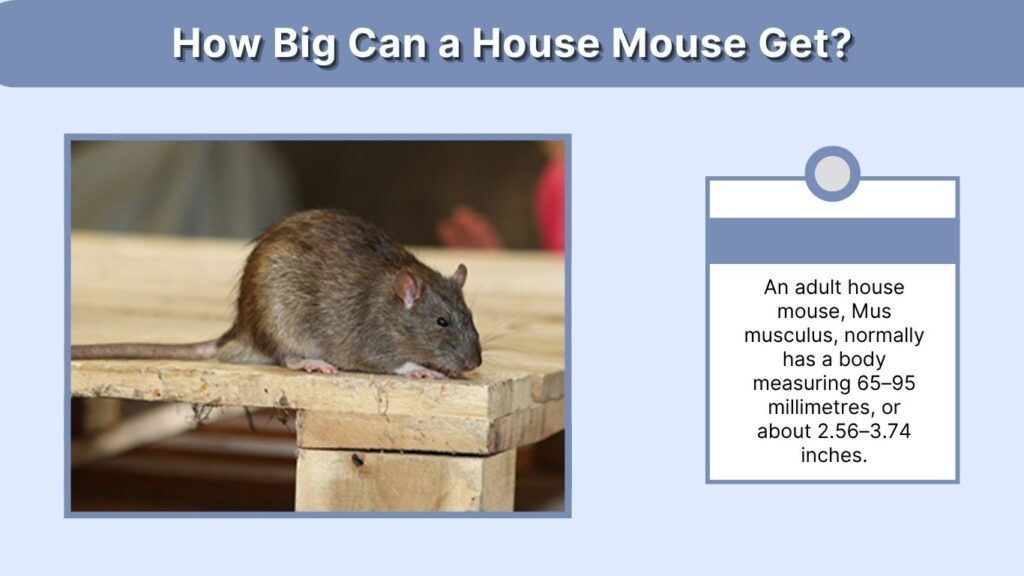
An adult house mouse, Mus musculus, normally has a body measuring 65–95 millimetres, or about 2.56–3.74 inches. Its tail adds another 60–105 millimetres, bringing its total length to roughly 5–8 inches. Adults normally weigh 12–30 grams.
Males may be somewhat heavier and broader than females, especially when they have access to abundant food. However, food alone will not cause a normal house mouse to grow to the size of an adult rat.
Is a Very Large Mouse in the House Actually a Rat?
A rodent measuring 10 inches or more from nose to tail may be a young rat rather than a house mouse. House mice generally have:
- A small, slender body
- Large ears relative to the head
- A pointed nose
- A long, thin tail
- Small, pointed droppings
Rats are heavier-bodied, with proportionally smaller ears, larger feet, and thicker tails. Rats commonly measure around 13–18 inches when the tail is included, making them substantially larger than house mice.
A large rodent with a short tail and rounded body could also be a vole. Voles are frequently called field mice, although they belong to a different group of rodents.
How Big Do Field Mice Get?
“Field mouse” is an informal name that can refer to deer mice, white-footed mice, oldfield mice, voles, and other small rodents found in grasslands, farms, and woodland edges. Consequently, there is no single field-mouse size.
Deer Mouse Size
The deer mouse, Peromyscus maniculatus, generally measures 4.69–8.74 inches in total length and weighs approximately 0.35–0.85 ounce. Its tail alone may measure 1.8–4.1 inches.
Woodland deer mice often have longer bodies, tails, and feet than populations living in open prairies. Deer mice typically have brown or grey upperparts, white underparts, a sharply two-toned tail, and prominent eyes and ears.
White-Footed Mouse Size
White-footed mice resemble deer mice and are difficult to separate by size alone. They generally have brown upperparts, white feet and underparts, relatively large ears, and dark eyes.
Their body shape and colouring often make them look larger than house mice, even when their measurements overlap. Geographic variation further complicates identification.
Vole Size
Voles have stockier bodies, short legs, small ears, and much shorter tails than true mice. Depending on the species, the body may be about 4–6 inches long.
Because most of that measurement consists of the body rather than a long tail, a vole may appear unusually large and heavy when compared with a house mouse.
What Is the Biggest Mouse?

Some species called mice are noticeably larger than the common house mouse. For example, the California mouse, Peromyscus californicus, is the largest member of its genus. It measures approximately 220–285 millimetres, or 8.7–11.2 inches, including a long tail measuring 4.6–6.1 inches.
However, common names can be misleading. Some very large animals called “mice” belong to different rodent groups and should not be used to estimate how large a household mouse can grow.
A genuine house mouse will not normally grow to guinea-pig size. Reports of giant indoor mice usually involve:
- Young rats
- Voles
- Cotton rats
- Woodrats
- Other regional rodents
- Misjudged size caused by low light or rapid movement
How Big Do Pet and Fancy Mice Get?
Fancy mice are domesticated forms of the house mouse. Their size varies with genetics, sex, age, diet, and breeding line, but most remain within or close to the general house-mouse range.
Adult males are often broader and heavier than females. Long-bodied show lines may look considerably larger than wild house mice without approaching rat size.
Domestic mice also occur in many colours and coat types, including white, black, brown, spotted, satin, curly-haired, and long-haired forms. Despite these differences, they belong to the same species as the common house mouse.
Overfeeding can make a pet mouse overweight, but excess fat should not be confused with healthy skeletal growth. A pet mouse with sudden weight gain, abdominal swelling, or an unusual lump should be examined by a veterinarian.
Why Do Some Mice Have Big Eyes?
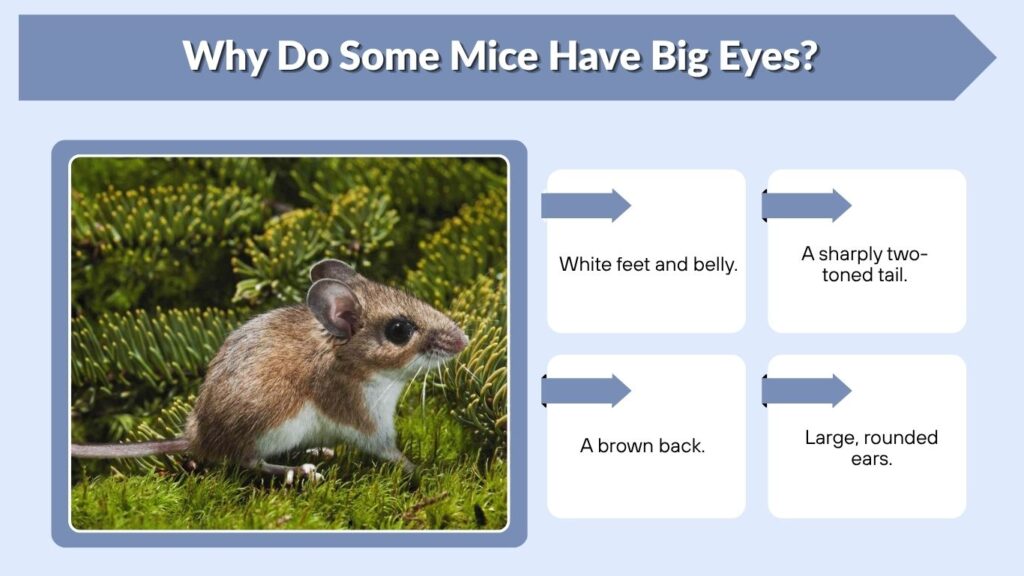
Deer mice and white-footed mice are frequently described as mice with big eyes. Their dark, rounded eyes and large ears are useful identification features and are associated with their nocturnal lifestyle.
A big-eyed mouse with:
- White feet and belly
- A brown back
- A sharply two-toned tail
- Large, rounded ears
may be a deer mouse rather than a house mouse. The CDC describes deer mice as having conspicuously large eyes and ears.
House mice also have prominent ears, but their eyes generally appear smaller relative to the head. Their belly is usually buff or grey rather than sharply white.
How Small a Hole Can a Mouse Fit Through?
A mouse’s entry ability depends on the size of its skull rather than its apparent body width. Its ribs and soft tissues can compress, but the skull must still pass through the opening.
House mice can enter through gaps approximately the size of a dime or the diameter of a pencil. Young mice may use openings close to ¼ inch wide.
Common entry points include:
- Gaps beneath exterior doors
- Openings around pipes and cables
- Damaged foundation vents
- Cracks where siding meets masonry
- Unscreened attic or roof vents
- Holes behind cabinets and appliances
Seal small gaps with durable rodent-resistant materials such as metal mesh, hardware cloth, sheet metal, or suitable sealant combined with metal backing. Soft foam alone may be easily gnawed.
How Big Is a Mouse Litter?

A house mouse commonly produces five or six young in one litter, although litters may range from three to twelve. Newborn mice are tiny, hairless, blind, and entirely dependent on their mother.
Under favourable indoor conditions, females may produce multiple litters throughout the year. Young mice develop quickly, open their eyes at around two weeks, and are usually weaned at approximately three weeks.
Deer-mouse litters often contain four to six young, although reported litters range from one to eleven. Their breeding frequency varies with climate, food supply, and habitat.
Does Finding a Big Mouse Mean There Are More?
One large mouse does not reveal the exact size of an infestation. It may be an adult male, a pregnant female, a field mouse that entered accidentally, or a young rat.
Signs that suggest continuing rodent activity include fresh droppings, gnawed food packaging, shredded nesting materials, scratching sounds, tracks, and greasy marks near holes. Because mice reproduce quickly, early identification and exclusion are more effective than waiting to see additional animals.
FAQs
What is the maximum size of a house mouse?
A house mouse usually reaches approximately 5–8 inches when its tail is included. Its actual head-and-body length is normally under four inches, and it generally weighs no more than about one ounce.
Can a mouse grow as big as a rat?
A common house mouse cannot grow as large as an adult rat. An apparently giant mouse is more likely to be a juvenile rat, vole, woodrat, or another mouse-like rodent.
How big is a field mouse?
The answer depends on the species. Deer mice may measure approximately 4.7–8.7 inches including the tail, while short-tailed voles often have bodies measuring around 4–6 inches.
Can mice fit through a ¼-inch hole?
Young mice may enter through openings close to ¼ inch, while adult house mice can commonly use dime-sized or pencil-width gaps. Sealing every small exterior opening is essential for prevention.
Is a mouse with big eyes dangerous?
Large eyes do not indicate aggression or venom. However, big-eyed deer mice can enter buildings and may carry pathogens, so avoid handling wild rodents or cleaning contaminated areas without appropriate precautions.