
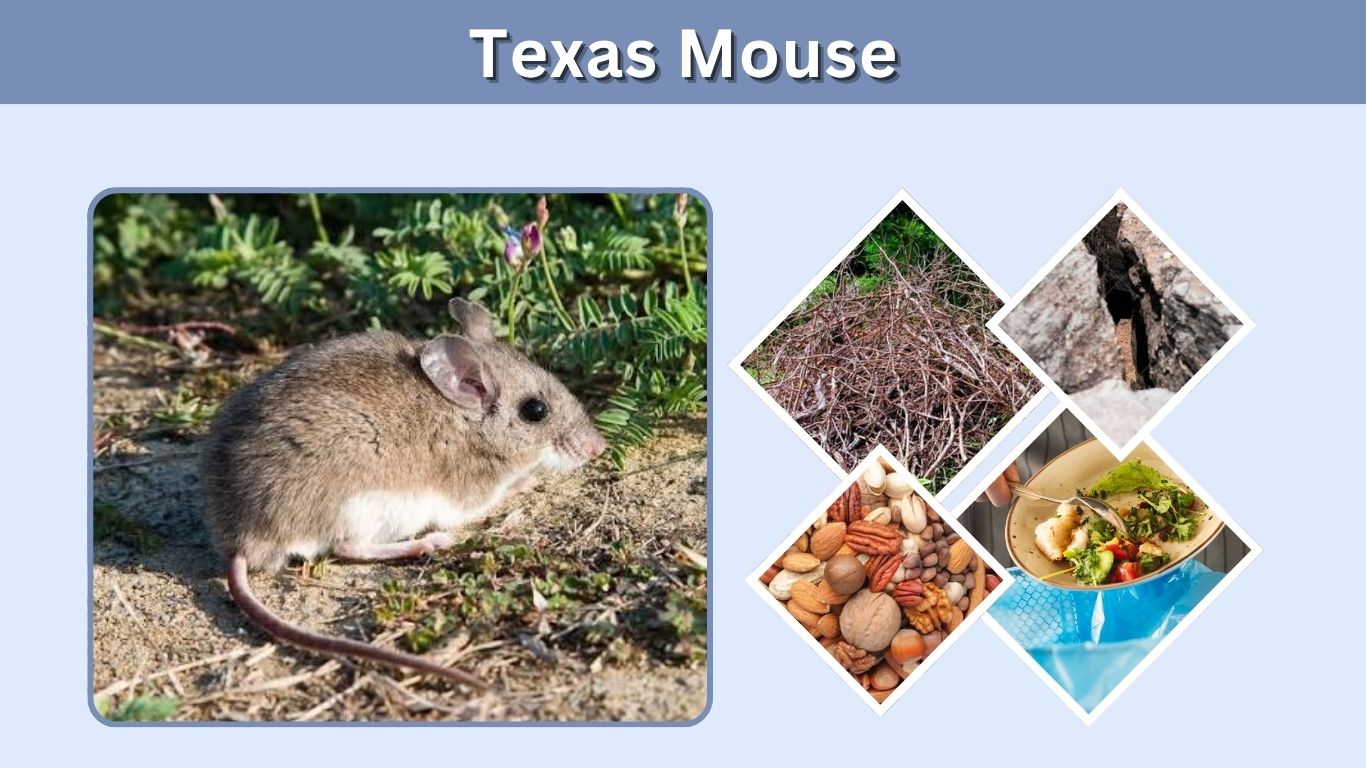
The Texas mouse, also called the Texas deermouse or Attwater’s mouse, is a native North American rodent scientifically named Peromyscus attwateri. It lives mainly in rocky woodlands and brushy slopes rather than inside urban homes. However, people searching for a “Texas mouse” may also be referring generally to house mice, deer mice, cotton mice, and other small rodents found across Texas. Correct identification helps determine whether the animal is a harmless outdoor species or a household pest requiring control.
Texas Mouse Quick Facts
| Feature | Description |
| Scientific name | Peromyscus attwateri |
| Other names | Texas deermouse, Attwater’s mouse |
| Family | Cricetidae |
| Average total length | About 198 mm |
| Average weight | Approximately 25–35 grams |
| Color | Brown-gray above and white below |
| Habitat | Rocky slopes, cliffs, juniper, and oak woodland |
| Diet | Acorns, seeds, fruits, nuts, and insects |
| Activity | Nocturnal and active throughout the year |
| Native status | Native to the south-central United States |
The Texas mouse occurs primarily in central and northern Texas, with its range extending into Oklahoma, southeastern Kansas, southwestern Missouri, and northwestern Arkansas.
What Does a Texas Mouse Look Like?
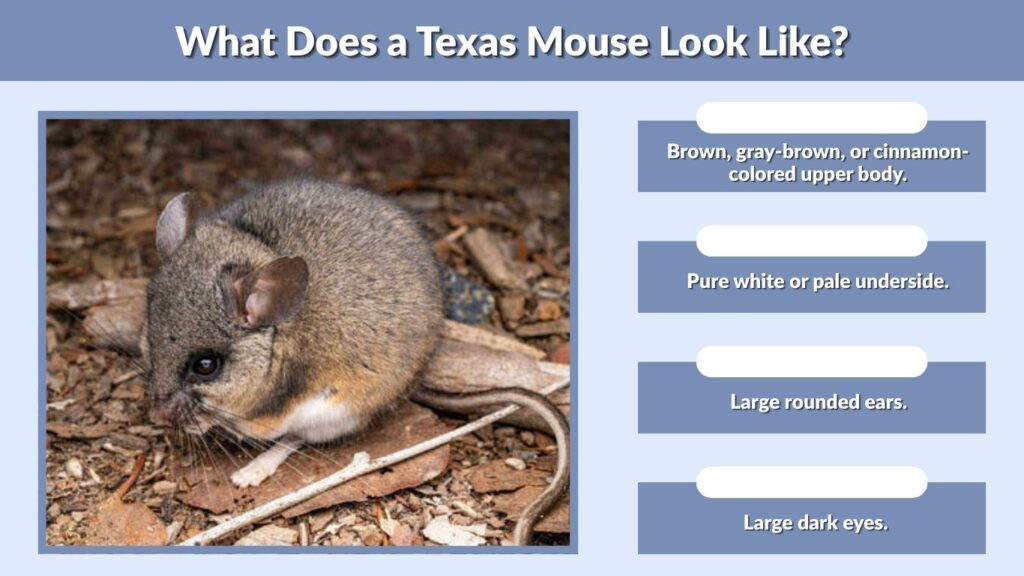
The Texas deermouse is a medium-sized member of the genus Peromyscus. It has a brown or gray-brown back, lighter sides, white underparts, large ears, prominent eyes, and a long tail.
Texas Mouse Identification
- Brown, gray-brown, or cinnamon-colored upper body
- Pure white or pale underside
- Large rounded ears
- Large dark eyes
- Long whiskers
- White feet with darker ankles
- Tail about as long as the head and body
- Moderately hairy tail, often with a small terminal tuft
- Adult weight of approximately 25–35 grams
An adult averages about 198 mm in total length, including a tail of approximately 103 mm. Its hind feet are relatively large, helping it climb over rocks, fallen logs, and tree branches.
The upper and lower colors are not always divided as sharply as they are on some other deer mice. Identification from color alone can therefore be difficult, especially where several Peromyscus species occur together.
Where Do Texas Mice Live?
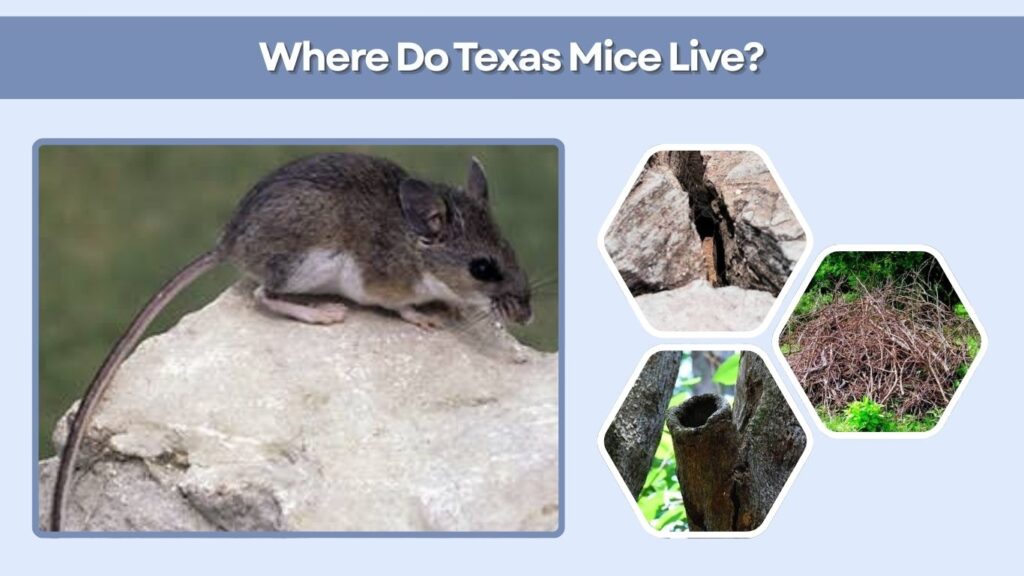
Texas mice are strongly associated with rugged, rocky habitats. They commonly live around cliffs, limestone outcrops, rocky slopes, cedar glades, juniper stands, and oak woodland.
Preferred Habitat
Texas mice may shelter in:
- Rock crevices
- Cavities beside trees
- Fallen logs
- Spaces beneath rocks
- Brush piles
- Hollow trees
- Dry plant nests near cliffs
- Juniper and oak woodland
They are skilled climbers and may move through trees and shrubs as well as across rocky ground. Their tails help provide balance while they travel over uneven surfaces.
Although the species is called the Texas mouse, its natural range is not limited to Texas. Within the state, it is especially associated with the Edwards Plateau and rocky areas extending west, north, and south from central Texas.
What Do Texas Mice Eat?

Texas mice are omnivores, although plant foods make up an important portion of their diet.
Common foods include:
- Acorns
- Other nuts
- Grass and plant seeds
- Berries and fruits
- Green plant material
- Beetles and other insects
- Insect larvae
Acorns are particularly important where oak trees are abundant. The mice may carry food into protected crevices or cavities where they can eat without being exposed to predators.
Texas mice also contribute to woodland ecosystems. They consume insects, move seeds, and provide food for owls, hawks, snakes, foxes, and other predators.
Texas Mouse Behavior and Life Cycle
Texas mice are primarily nocturnal. They spend daylight hours inside rocky crevices, tree cavities, fallen logs, or nests made from grasses and other dry plant material.
Unlike some small mammals that become inactive during cold periods, Texas mice remain active throughout the year. Their rocky shelters protect them from predators and extreme weather.
Reproduction
Relatively little is known about their reproduction compared with the common house mouse. Reported litters contain approximately two to six young.
Wild individuals often live for less than one year because small rodents experience heavy predation. Those surviving favorable conditions may live for about two years in the wild.
Common Types of Mice in Texas
“Field mouse” is an informal expression rather than the name of one particular species. Several mice may be encountered in Texas fields, woodlands, farms, and buildings.
House Mouse
The house mouse, Mus musculus, is an introduced species found throughout Texas. It has a mostly uniform gray-brown coat, a lightly haired scaly tail, and relatively small eyes. It commonly lives in houses, barns, stores, warehouses, and agricultural buildings.
North American Deermouse
The North American deermouse, Peromyscus maniculatus, has a brown upper body, white underside, white feet, and a distinctly two-colored tail. It occurs across Texas but is less common in eastern, coastal, and southern parts of the state.
White-Footed Deermouse
The white-footed deermouse, Peromyscus leucopus, is widespread across most of Texas. It resembles a deer mouse but usually has a less sharply divided tail and slightly different body proportions.
Cotton Deermouse
The cotton deermouse, Peromyscus gossypinus, is relatively large and heavy-bodied. It has brown upperparts, creamy-white underparts, white feet, and a tail noticeably shorter than its head and body.
Grasshopper Mouse
Grasshopper mice occur primarily in western and southern Texas. Unlike most seed-eating mice, they are active predators that consume insects and other small animals. The northern grasshopper mouse has a stout body, white underside, and unusually short tail.
Texas Mouse vs House Mouse
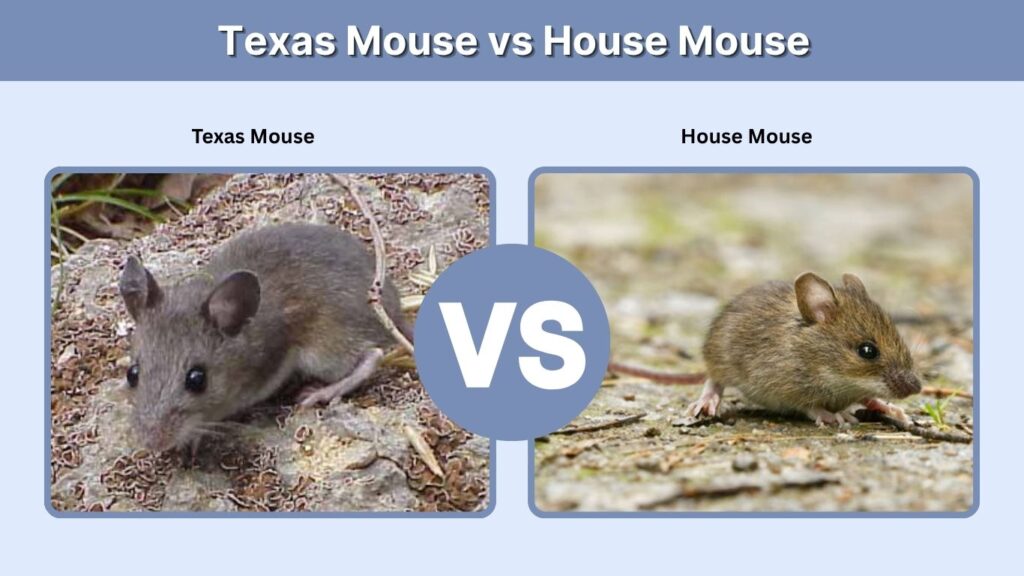
The true Texas deermouse is mainly a wild, rocky-habitat species, while the house mouse is strongly associated with human structures.
| Feature | Texas Deermouse | House Mouse |
| Scientific name | Peromyscus attwateri | Mus musculus |
| Body color | Brown above and white below | More uniformly gray or brown |
| Eyes | Large | Comparatively smaller |
| Tail | Hairy and about body length | Scaly and lightly haired |
| Adult weight | About 25–35 grams | About 17–25 grams |
| Main habitat | Rocky woodland and cliffs | Buildings, farms, and fields |
| Household pest | Uncommon | Very common |
A house mouse has a nearly uniform coat and a mostly bare-looking tail. Deer mice and related species generally have larger eyes, white feet, pale underparts, and more fur on their tails.
Texas Mouse vs Rat
Mice are generally smaller and more lightly built than rats. They usually have pointed snouts, proportionally larger ears, and smaller droppings. Adult rats have heavier bodies, larger feet, thicker tails, and blunter heads.
Young rats can be mistaken for adult mice. A juvenile rat usually has oversized feet and a thicker tail relative to its body. Correct identification is important because rat and mouse trap placement may differ.
Texas Mice in the House
The true Texas deermouse can occasionally enter cabins, garages, sheds, or rural homes near rocky habitat, but house mice are much more likely to establish permanent indoor infestations.
Signs of mouse activity include:
- Small dark droppings
- Gnawed food packages
- Shredded nesting material
- Scratching noises at night
- Greasy marks along walls
- Chewed wires or insulation
- Musky odors
- Small footprints in dusty areas
Food, water, shelter, and accessible entry points attract mice. Pet food, birdseed, grain, rubbish, clutter, and gaps around pipes or doors can support an infestation.
Are Texas Mice Dangerous?
The Texas deermouse normally avoids people and is not aggressive. However, any wild rodent can bite when trapped or handled, and its urine, saliva, droppings, fleas, or nesting material may carry pathogens.
The North American deer mouse is the primary carrier of the virus responsible for most hantavirus pulmonary syndrome cases in the United States. This does not mean every deer mouse is infected or that the Texas deermouse is automatically a carrier, but all unidentified rodent waste should be handled cautiously.
Never sweep or vacuum dry rodent droppings. That can stir contaminated particles into the air. Wear gloves, soak the material with disinfectant, allow the required contact time, and wipe it up with paper towels.
How to Get Rid of Mice in a Texas Home

Begin by determining whether the animal is living inside or merely entering from outdoors.
1. Remove Food Sources
Store cereal, grain, pet food, birdseed, and rubbish in tightly sealed containers. Clean crumbs, spills, and food residue, particularly beneath appliances.
2. Seal Entry Points
Inspect doors, foundations, rooflines, vents, utility openings, and spaces around pipes. Close gaps using durable, rodent-resistant materials rather than soft material that can easily be chewed.
3. Use Traps
Place snap traps along walls, behind appliances, and near fresh droppings or gnaw marks. Position the trigger toward the wall because mice commonly travel along edges. Keep traps away from children and pets.
Continue trapping until no rodents are captured and no new signs appear for at least one week.
4. Clean Safely
Wear rubber or plastic gloves. Wet droppings, urine, and nests thoroughly with a registered disinfectant, wait according to the label, and wipe them up. Double-bag dead rodents and nesting material before disposal.
5. Call a Professional
Professional control is appropriate when mice are inside ducts or walls, droppings are widespread, identification is uncertain, or activity continues despite trapping and exclusion.
FAQs
Is the Texas mouse a real species?
Yes. The Texas mouse is Peromyscus attwateri, also called the Texas deermouse or Attwater’s mouse. It is a native woodland rodent associated with rocky slopes and cliffs.
Are there field mice in Texas?
Yes, although “field mouse” is not a precise species name. Deer mice, white-footed mice, cotton mice, house mice, harvest mice, and other small rodents may live in Texas fields.
Do Texas mice enter houses?
The native Texas deermouse may occasionally enter rural structures, but the introduced house mouse is much more likely to establish an indoor infestation.
What is the difference between a deer mouse and a house mouse?
A deer mouse normally has white feet, a white underside, large eyes, and a two-toned, hairy tail. A house mouse has a more uniformly gray-brown body and a relatively bare, scaly tail.
Should I touch a wild mouse?
No. Avoid handling wild mice with bare hands. They may bite, and their waste or parasites may expose people to disease. Use safe trapping and disinfection procedures instead.