

A hooded rat is a domesticated fancy rat recognized by its distinctive two-color coat pattern. The head, neck, and shoulders are colored like a “hood,” while most of the body is white and a colored stripe usually extends along the spine toward the tail. Hooded rats can appear in black, agouti, blue, beige, champagne, cinnamon, and many other colors. Despite the name, a hooded rat is not a separate rat breed. It is a coat-marking pattern that can occur alongside different ear and coat types, including Dumbo and Rex rats.
What Is a Hooded Rat?
The term hooded rat describes a specific marking on domesticated fancy rats, which descend from the brown or Norway rat (Rattus norvegicus).
According to the American Fancy Rat and Mouse Association (AFRMA), an ideal hooded rat has a colored area covering the head, neck, and shoulders, followed by an uninterrupted colored stripe running down the spine. The sides, legs, and feet should otherwise be clean white.
Pet hooded rats do not need perfect show markings. Their stripe may be broken, crooked, wide, narrow, or spotted without affecting their ability to make good companion animals.
What Does a Hooded Rat Look Like?
The contrast between its colored head and white body makes the hooded pattern easy to recognize.
Hooded Rat Identification
- Colored head, neck, and shoulders
- Mostly white body
- Colored stripe running along the back
- White legs and feet
- Long, nearly hairless tail
- Large ears and prominent whiskers
- Dark, ruby, or pinkish eyes depending on color genetics
- Adult body typically around 8–10 inches long, excluding the tail
Show standards favor a continuous, moderately wide dorsal stripe with clean edges, although ordinary pet rats frequently have irregular variations.
Black Hooded Rat
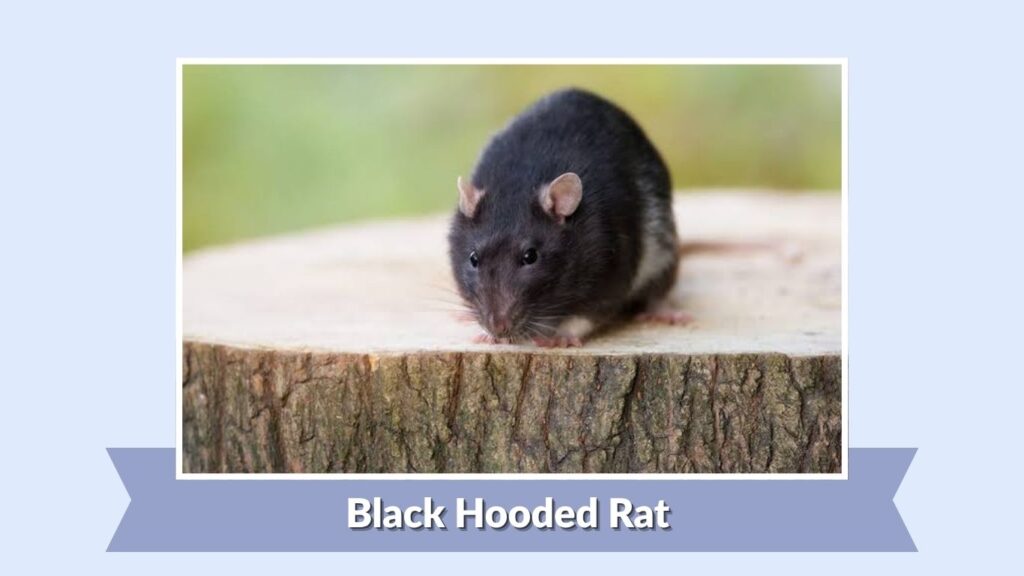
The black hooded rat is probably the most familiar version.
These rats have a deep black hood covering the head and shoulders, with a black stripe extending down an otherwise white back. Their eyes are typically dark.
A black-and-white hooded rat may sometimes have an interrupted or irregular stripe. Such a rat may be described informally as broken hooded if the back marking is incomplete.
Black hooded rats are not behaviorally different from other fancy rats simply because of their color.
Agouti Hooded Rat
An agouti hooded rat has the same basic white-and-colored pattern, but the colored sections are agouti instead of black.
Agouti hairs contain bands of different pigments, producing the brownish, ticked appearance associated with the natural coloration of wild Norway rats.
The contrast between warm agouti coloring and white sides can make these rats especially distinctive.
Blue, Grey, Beige and Champagne Hooded Rats
The hooded marking can occur with many recognized fancy-rat colors because the marking determines where pigment appears, while other genes influence what color that pigment is. AFRMA specifically allows hooded rats in recognized colors.
This can produce varieties commonly described as:
- Blue hooded rat
- Russian blue hooded rat
- Grey hooded rat
- Beige hooded rat
- Champagne hooded rat
- Cinnamon hooded rat
- Mink hooded rat
- Fawn hooded rat
- Chocolate hooded rat
Exact color terminology can vary somewhat among rat-fancy organizations and countries.
Hooded Fancy Rat vs Fancy Rat
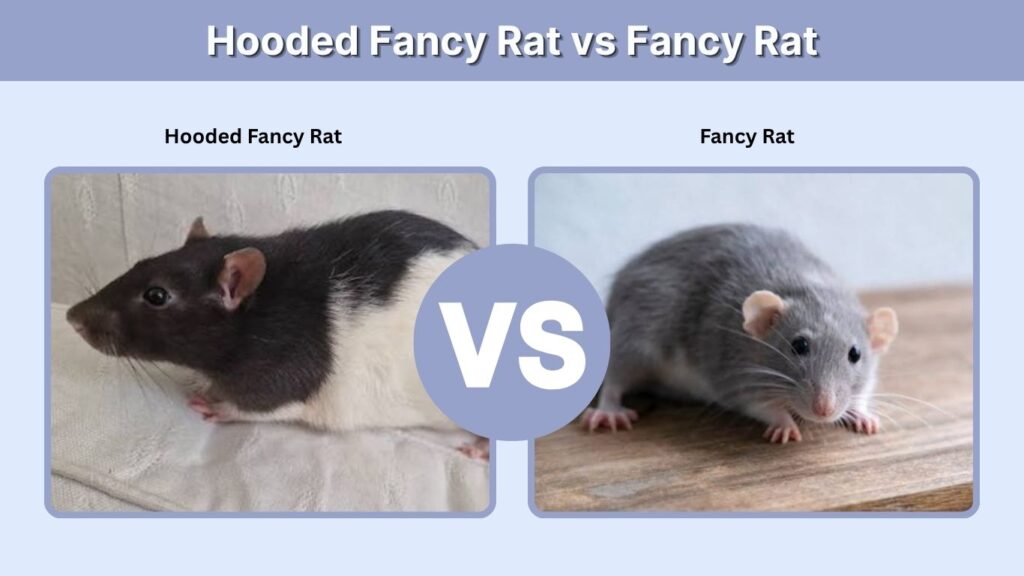
A fancy rat is the general term used for domesticated rats kept as pets or bred for exhibition.
A hooded rat is simply a fancy rat with the hooded marking.
Therefore:
Fancy rat = domesticated pet/show rat
Hooded rat = fancy rat with a particular coat pattern
Rats are generally categorized by combinations of color, markings, coat type, and ear/body characteristics rather than into breeds in the way dogs are. AFRMA specifically notes that fancy rats do not have “breeds” in that sense.
Hooded Dumbo Rat
A hooded Dumbo rat combines two independent physical traits.
“Hooded” describes its color pattern, while “Dumbo” describes the ears.
Dumbo rats have relatively large, rounded ears positioned lower on the sides of the head than standard-eared rats. They can occur with any recognized color or marking, so black hooded Dumbo rats, blue hooded Dumbo rats, and other combinations are possible.
Dumbo does not mean that the rat is a different species.
Hooded Rex Rat
A hooded Rex rat combines the hooded marking with a Rex coat.
Rex rats have noticeably curly or wavy fur and curled whiskers instead of the smooth coat seen in standard fancy rats.
A rat can even combine several characteristics, such as being a black hooded Dumbo Rex rat—black describing color, hooded describing markings, Dumbo describing ears, and Rex describing coat.
Broken Hooded Rat
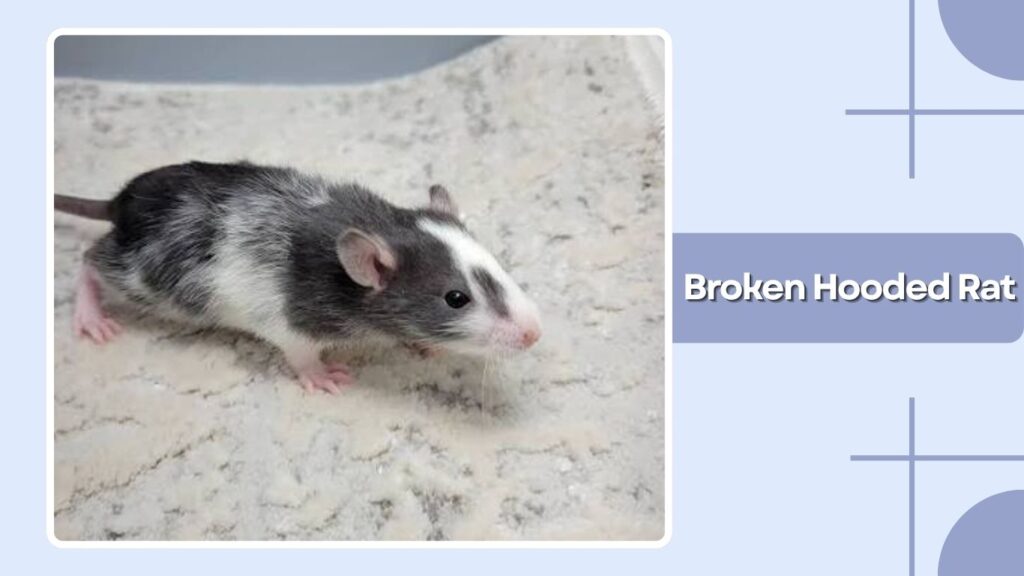
A perfectly marked show hooded rat should have a continuous stripe from the hood toward the tail.
When the stripe is interrupted or reduced to separate patches, owners may refer to the animal as a broken hooded rat.
Irregular markings are extremely common in pet populations. They are mainly cosmetic and do not make the rat unhealthy or less suitable as a companion.
Producing perfectly symmetrical hooded markings can actually be challenging because the distribution of pigment is influenced genetically during development.
Hooded Rat Temperament
Coat pattern does not determine a rat’s personality.
Like other domesticated rats, hooded rats can be intelligent, curious, playful, and highly social. Well-socialized rats may learn to recognize their caregivers, explore new objects, accept gentle handling, and learn simple behaviors or tricks.
Individual temperament depends more on genetics, early socialization, health, environment, and previous experiences than on whether the coat is black, blue, agouti, or hooded.
Do Hooded Rats Make Good Pets?
Yes. A well-socialized hooded fancy rat can make an engaging companion.
However, rats should not normally be kept alone. They are strongly social animals and benefit from living with compatible rats, commonly in same-sex pairs or groups unless animals are appropriately neutered.
They also need regular human interaction, enrichment, climbing opportunities, hiding areas, chewable objects, and safe time outside their enclosure.
Hooded Rat Lifespan
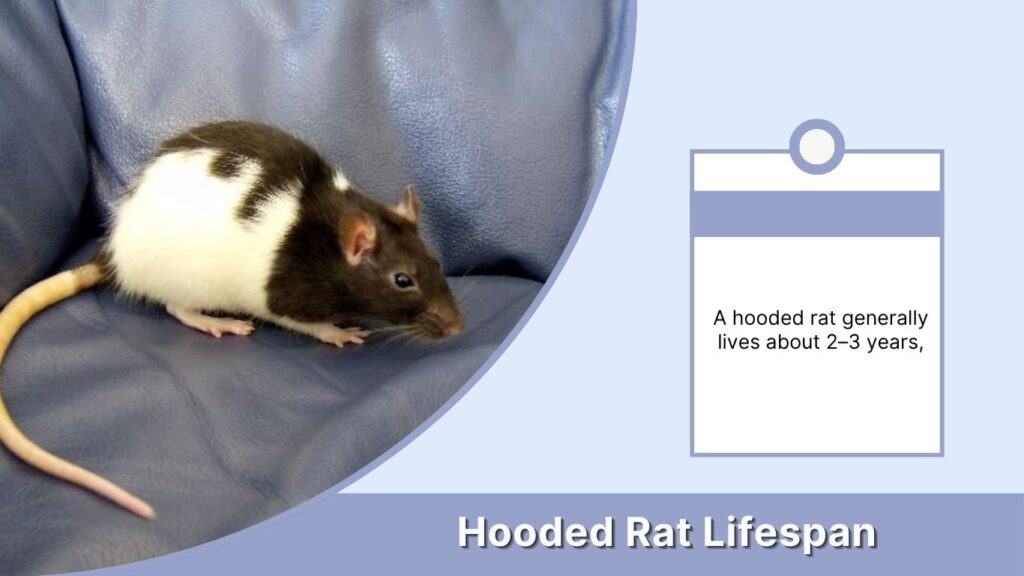
A hooded rat generally lives about 2–3 years, similar to other pet rats. Some individuals live longer, while disease, genetics, diet, husbandry, and veterinary care can influence lifespan.
Being black hooded, blue hooded, or another color does not by itself give the rat a substantially different expected lifespan.
Pet rats age relatively quickly, so owners should watch for changes in weight, breathing, activity, appetite, mobility, and the development of lumps as the animal grows older.
How to Care for a Hooded Rat
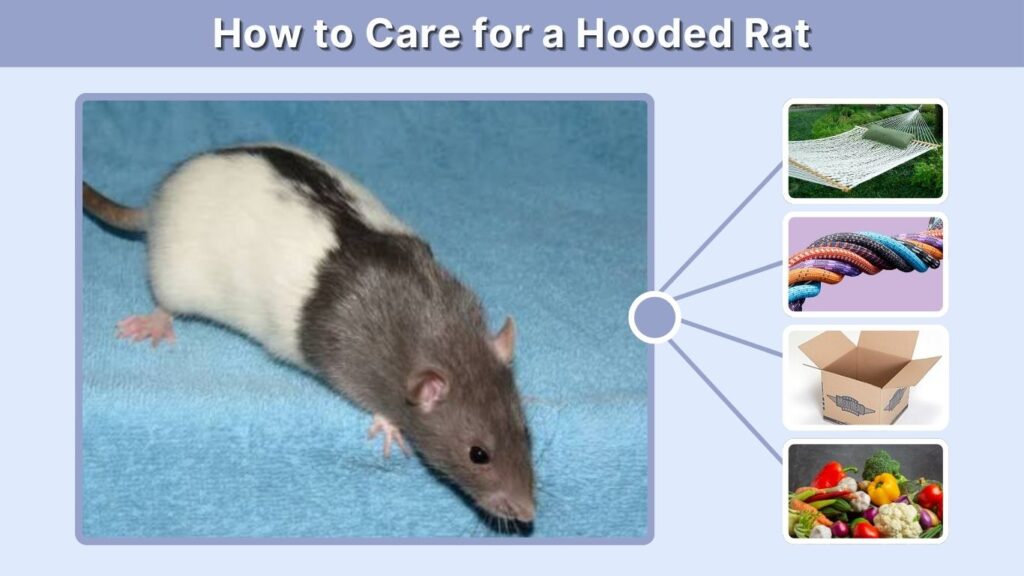
Hooded rats have essentially the same care requirements as other fancy rats.
Housing
Provide a large, well-ventilated enclosure with a solid floor and plenty of vertical space for climbing.
Hammocks, tunnels, ropes, platforms, boxes, and hiding places encourage natural exploration. Glass aquarium-style housing is generally unsuitable because ventilation is inadequate compared with an appropriate rat cage.
Diet
Provide a nutritionally balanced rat diet along with suitable fresh foods. Rats can eat a varied diet including grains, vegetables, and appropriate protein sources.
Fresh drinking water should always be available.
Exercise and Enrichment
Rats are active and intelligent animals that require stimulation.
They benefit from supervised exercise outside the cage, climbing structures, tunnels, digging opportunities, food puzzles, and objects they can safely chew.
Blue Cross recommends at least an hour of exercise outside the enclosure each day.
Male vs Female Hooded Rats
Male rats are called bucks, while females are called does. Young rats may be called kittens.
Adult males are generally larger and heavier, while females are often lighter and may be particularly active and exploratory. However, personality varies considerably among individuals.
The hooded pattern occurs in both sexes and does not provide a way to determine whether a rat is male or female.
Baby Hooded Rat
Baby hooded rats are born mostly hairless and develop visible pigmentation and fur as they mature.
As their coat grows, the colored hood and dorsal markings become increasingly obvious. The basic pattern remains, although the appearance can change somewhat as the rat grows and its coat develops.
When obtaining young pet rats, appropriate age, health, sex identification, and socialization are more important than choosing a particular marking. Blue Cross advises that young rats should be at least six weeks old before going to a new home.
Interesting Hooded Rat Facts
Hooded rats have played an important role in the history of both the pet-rat fancy and laboratory genetics. Researchers have studied the inheritance and development of the hooded pattern for more than a century, including how genes influence the distribution of pigmentation.
Perhaps the most important fact for pet owners is that “hooded” describes appearance—not temperament, species, or a completely separate breed.
FAQs
What is a hooded rat?
A hooded rat is a domesticated fancy rat with a colored head and shoulders, a mostly white body, and usually a colored stripe running along its back.
Are hooded rats good pets?
Yes. Properly socialized fancy rats are intelligent and interactive companions. They should generally live with compatible rat companions rather than alone.
How long do hooded rats live?
Most pet rats, including hooded rats, live approximately 2–3 years.
Is a hooded Dumbo rat different from a hooded rat?
A hooded Dumbo rat has the same hooded coat pattern but also carries the Dumbo ear trait, which produces large, low-set ears.
What colors can hooded rats be?
Hooded rats can occur in many colors, including black, agouti, blue, beige, champagne, cinnamon, mink, and other fancy-rat colors. The defining characteristic is the distribution of the colored markings rather than the color itself.