
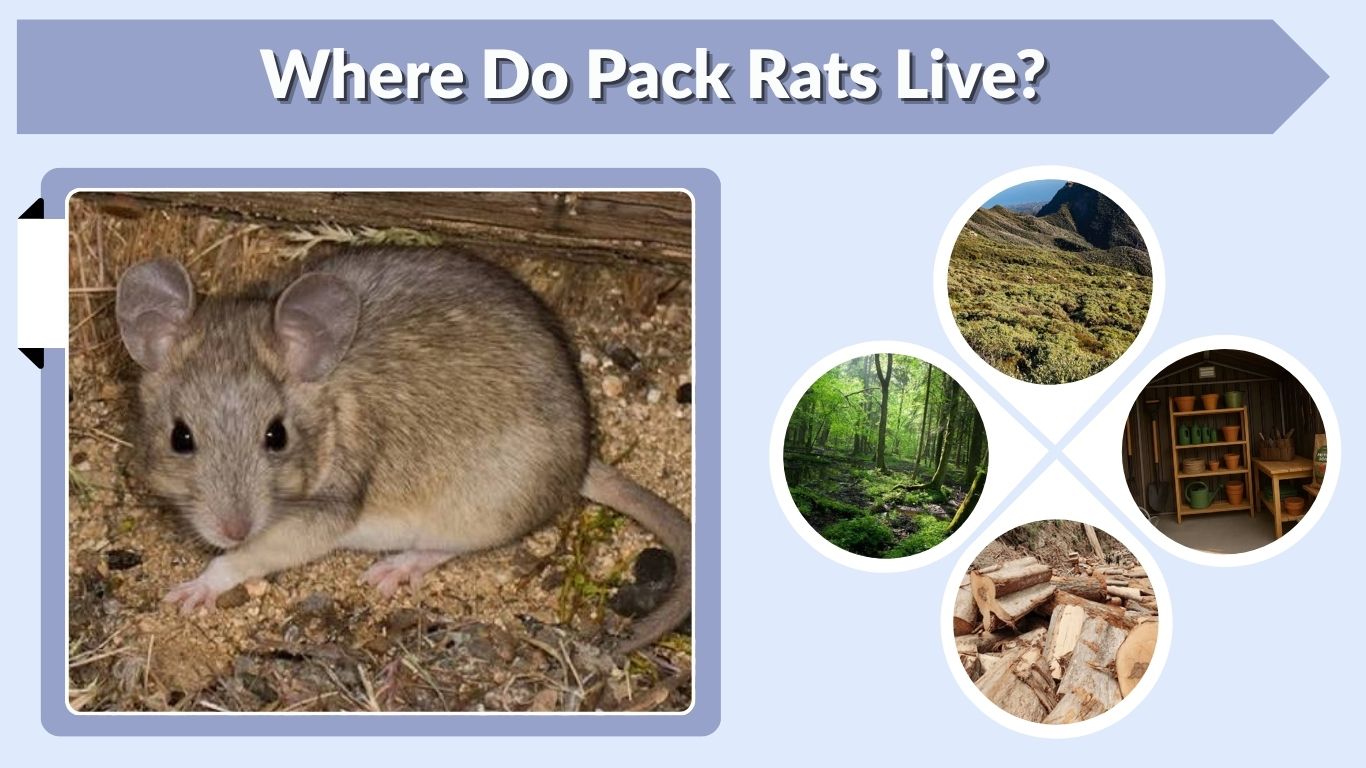
Pack rats, also called woodrats, live across much of North America in habitats ranging from hot deserts and dry shrublands to rocky mountains, forests, chaparral, and tropical hardwood hammocks. They usually choose locations that provide abundant food, dense cover, and protected places for building their large nests, or middens. Depending on the species, a pack rat may live among cactus, beneath shrubs, inside rock crevices, in trees, or occasionally around human buildings. Despite their name, pack rats generally do not live in large packs. Most are solitary and territorial animals.
Where Do Pack Rats Live?
Pack rats belong to the genus Neotoma, a group of native North American rodents commonly known as woodrats. Different species occupy a surprisingly wide geographic range. Pack rats occur through much of the United States, western Canada, Mexico, and parts of Central America, with individual species adapted to very different environmental conditions.
Some pack rats thrive in dry deserts filled with cactus and rocky outcrops, while others prefer oak woodland, chaparral, forest, or dense vegetation. The University of Arizona notes that woodrats are especially common in pinyon-juniper woodland, chaparral, and desert scrub communities.
Their exact home depends heavily on species. Desert woodrats are associated with arid environments, while dusky-footed woodrats commonly live in dense vegetation and oak woodland in western North America. Allegheny woodrats, meanwhile, favor rocky forests and cliffs in eastern North America.
Where Do Desert Pack Rats Live?
Desert pack rats are especially well adapted to dry landscapes in the southwestern United States and northern Mexico. They often establish their homes where rocks, cactus, shrubs, or trees provide protection from predators and extreme daytime temperatures.
Desert woodrats frequently construct houses from sticks, cactus pieces, rocks, and other available materials. Preferred locations include rock crevices, cactus bases, and low tree branches. These protected sites give them shade during hot days and convenient access to nearby vegetation after dark.
In desert regions, cholla cactus can provide particularly valuable shelter. Its dense network of sharp spines makes it difficult for many predators to reach a woodrat living beneath or within the plant. Pack rats may also establish dens underneath prickly pear, mesquite, shrubs, or rocky overhangs.
This ability to use available vegetation and rocky shelter helps pack rats survive in environments where temperatures, moisture, and food availability can change dramatically throughout the year.
What Does a Pack Rat Nest Look Like?
One of the easiest signs of pack rat activity is a large pile of sticks and assorted debris. These structures are often called dens, houses, nests, or middens, although technically the midden can refer to accumulated material associated with the living area.
Pack rats gather twigs, cactus pieces, leaves, bones, paper, plastic, stones, and many other objects and arrange them around a protected central nest. Some ground dens can become several feet wide and high. Inside may be sleeping chambers, food-storage spaces, passageways, and protected areas for raising young.
Pack rats are famous for collecting unusual objects. Coins, pieces of metal, shiny materials, and other small human-made items sometimes end up in their nests. Their collecting behavior is one reason the term “pack rat” became associated with people who accumulate many possessions.
A well-protected nest site can remain useful long after an individual animal has disappeared. Some woodrat locations are used repeatedly across generations, causing accumulated midden material to become extremely old. Scientists even study ancient pack rat middens to reconstruct vegetation and environmental conditions from thousands of years ago.
Do Pack Rats Live Underground?
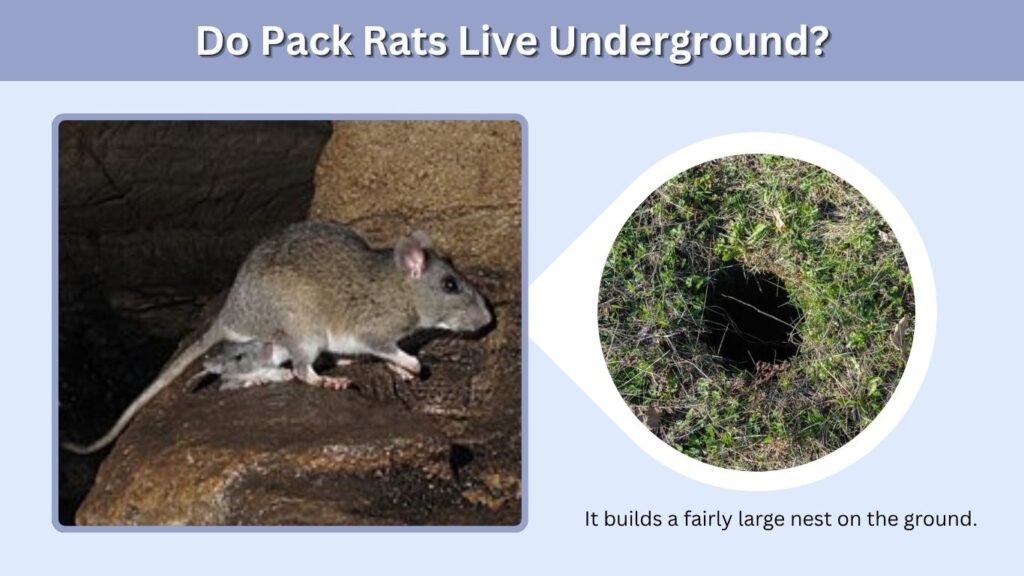
Pack rats can use underground spaces, but most species should not be thought of as strictly underground rodents.
Many construct substantial above-ground nests beneath cactus, shrubs, trees, rocks, or other protective structures. They may also use natural cavities, abandoned burrows, caves, rock fissures, or shallow underground chambers as part of their shelter system.
The exact arrangement depends on habitat. In rocky country, a narrow crevice may provide the main protected chamber. In desert scrub, the pack rat may create a large stick structure beneath vegetation. Some dens have several entrances and may include tunnels extending below ground.
Around people, pack rats can also occupy places that imitate natural protected cavities. Attics, garages, spaces beneath buildings, wall voids, sheds, woodpiles, and even the engine compartments of vehicles that remain parked for long periods can provide shelter.
Do Pack Rats Live Alone or in Groups?
Pack rats are generally solitary animals. Their name does not mean they normally travel or live as a pack.
Most adults maintain their own home area and spend much of their time alone except during mating and when females are raising young. Desert woodrats can be particularly territorial, and some species aggressively defend resources from other members of their species.
Pack rats may nevertheless live relatively close to one another when food and shelter are abundant. Several separate dens can occur within the same favorable habitat, creating what looks like a small community. Their home ranges may also overlap. This does not necessarily mean all the animals share one nest.
How Many Pack Rats Live in One Nest?
Usually, a pack rat nest is associated with one adult animal, although the situation changes during breeding.
A female may share her nest temporarily with her dependent young. In some species and circumstances, an adult male and female may also occupy the same den during the breeding period. Research on southern plains woodrats, for example, describes them as predominantly solitary and territorial but notes occasional observations of adult males and females sharing a nest.
Therefore, discovering one large midden does not automatically mean dozens of rats are living inside it. A very large structure can result from repeated construction and long-term use rather than a large colony.
One woodrat may even use more than one nest within its territory, making the number of visible structures larger than the actual number of animals living nearby.
Where Do Pack Rats Live Around Homes?

Pack rats generally prefer natural habitat, but houses and yards can provide the same three resources they seek in the wild: shelter, food, and nesting material.
They may establish nests under decks, inside sheds, around stored lumber, underneath homes, in garages, attics, wall spaces, or near piles of brush and debris. Vehicles that remain unused can also attract them because the engine compartment provides an enclosed and protected space.
Properties next to desert scrub, woodland, rocky slopes, or other natural habitat may be particularly likely to experience pack rat activity.
Vegetation can also influence where they settle. Dense shrubs, cactus, woodpiles, and cluttered areas provide hiding places, while fallen fruit, garden plants, seeds, and other accessible foods give the animals a reason to remain nearby.
Do Pack Rats Live in Florida?
Yes. Woodrats occur in Florida.
The eastern woodrat (Neotoma floridana) occurs in parts of the state, and Florida also supports the endangered Key Largo woodrat, a subspecies found in tropical hardwood hammock habitat in northern Key Largo. These animals construct large stick nests around tree bases, rocks, and natural holes around tree-root systems.
This illustrates how broad the term “pack rat” can be. Although pack rats are commonly associated with southwestern deserts, some species live in humid forests and subtropical environments far from desert habitat.
Do Pack Rats Live in San Diego?
Yes. Pack rats occur in the San Diego region and elsewhere in California.
The San Diego Natural History Museum identifies the San Diego desert woodrat among the region’s native rodents, while woodrats more generally occur throughout California and Baja California.
Around San Diego County, woodrats can occupy chaparral, coastal scrub, rocky areas, oak woodland, and other habitats with enough vegetation and shelter. Research following wildfires has also shown that woodrats return as dense shrub vegetation recovers, demonstrating how strongly their habitat use is tied to protective plant cover.
How Long Do Pack Rats Live?
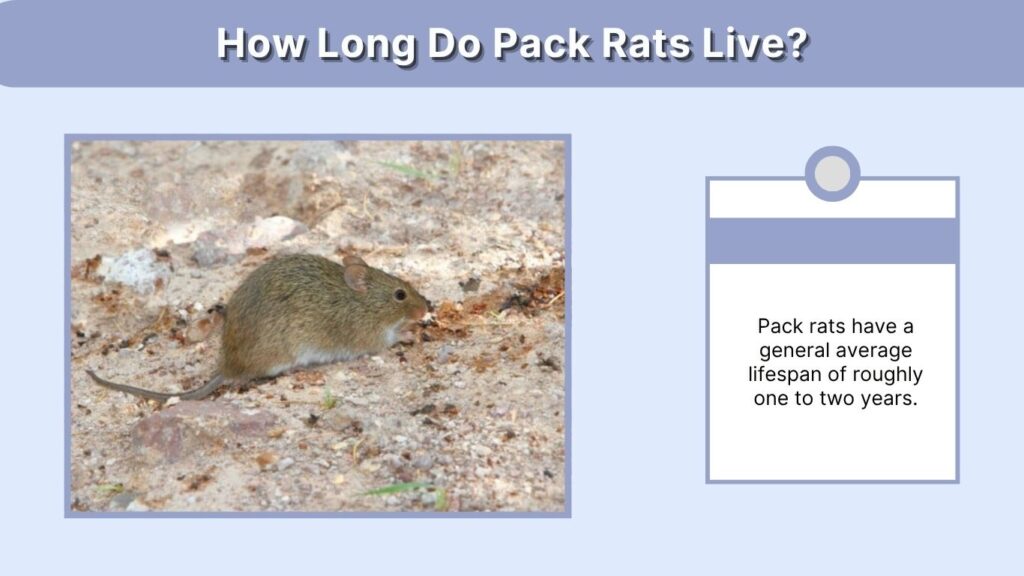
Pack rat lifespan varies considerably by species and conditions.
Many wild woodrats have relatively short lives because they face predation, food shortages, disease, extreme weather, and other hazards. University of Arizona information gives a general average of roughly one to two years for pack rats.
Some species can live longer. Desert woodrats have been reported to live around three years in the wild, while studies of southern plains woodrats found much shorter average survival because many young animals die before reaching adulthood.
Captive animals can survive much longer because they are protected from many natural causes of mortality. Therefore, there is no single lifespan that accurately describes every species of pack rat.
Where Are You Most Likely to Find Pack Rats?
Pack rats can live in many environments, but suitable shelter is one of the most consistent features of their habitat. Rocky crevices, cactus patches, thick shrubs, woodland, caves, and other protected areas allow them to hide during daylight hours and avoid predators.
In human environments, the same preference can lead them into attics, garages, sheds, crawl spaces, woodpiles, and parked vehicles.
Most importantly, pack rats are generally solitary rather than group-living rodents. A large midden can look as though it houses an entire colony, but it commonly belongs to one adult or a female temporarily living with her offspring.
From Arizona desert cactus to California chaparral and Florida hardwood hammocks, pack rats are remarkably adaptable. Their ability to construct elaborate shelters and take advantage of different habitats is one reason woodrats have successfully occupied such a large portion of North America.