

The Allegheny woodrat is a native North American rodent known for its rocky mountain habitat, long whiskers, large eyes, and secretive nighttime behavior. Although it may look like a common rat at first glance, this species is very different from city rats and plays an important role in forest ecosystems. Today, the Allegheny woodrat is a conservation concern across much of its range because of habitat loss, food shortages, parasites, and population decline.
What Is an Allegheny Woodrat?
The Allegheny woodrat is a medium-sized rodent with the scientific name Neotoma magister. It belongs to a group of rodents often called woodrats or pack rats. These animals are known for collecting natural objects, building nests in protected spaces, and living close to rocky shelters.
Unlike the Norway rat, which is commonly found around cities, sewers, farms, and human buildings, the Allegheny woodrat is a wild species that depends on forested cliffs, talus slopes, caves, rock ledges, and boulder fields. It is mostly active at night and is rarely seen by people.
Allegheny Woodrat Scientific Name and Classification
The scientific name of the Allegheny woodrat is Neotoma magister. It was once treated as closely connected to the eastern woodrat, but it is now recognized as its own species. The genus name Neotoma includes several woodrat species found in North America.
This animal is a mammal, a rodent, and a member of the family Cricetidae. That family also includes many native mice, voles, and other small rodents. Although people may call it a “rat,” the Allegheny woodrat is not the same as the invasive Norway rat or black rat.
Allegheny Woodrat Identification
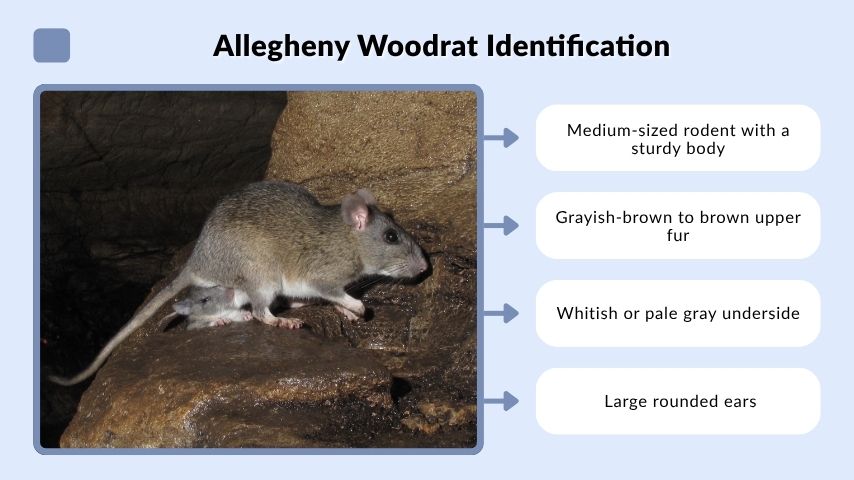
The Allegheny woodrat has a soft grayish-brown body, white underparts, large ears, large dark eyes, and a long furry tail. Its appearance is adapted for a nocturnal life among rocks and forest edges.
Key Characteristics
- Medium-sized rodent with a sturdy body
- Grayish-brown to brown upper fur
- Whitish or pale gray underside
- Large rounded ears
- Big dark eyes for nighttime activity
- Long whiskers used for sensing narrow spaces
- Fur-covered tail, unlike the scaly tail of a Norway rat
- Strong climbing ability on rocks and ledges
- Secretive behavior and mostly nocturnal habits
The fur-covered tail is one of the easiest ways to separate an Allegheny woodrat from a Norway rat. Norway rats have thick, mostly hairless, scaly tails. Allegheny woodrats have softer, hairier tails that match their wild woodland lifestyle.
Allegheny Woodrat Size
The Allegheny woodrat is larger than many native mice but usually smaller and less bulky than a large Norway rat. It has a compact body with a long tail that adds noticeably to its total length.
| Feature | Allegheny Woodrat |
| Scientific name | Neotoma magister |
| Animal group | Native rodent |
| Body covering | Fur |
| Tail type | Long and hairy |
| Main habitat | Rocky forests, cliffs, caves, ledges |
| Activity pattern | Mostly nocturnal |
| Diet type | Mainly plant-based |
| Conservation concern | Declining in many areas |
Adult woodrats can appear squirrel-like in size, especially when seen moving among rocks. Their large eyes, soft fur, and hairy tail give them a very different look from common pest rats.
Allegheny Woodrat Habitat
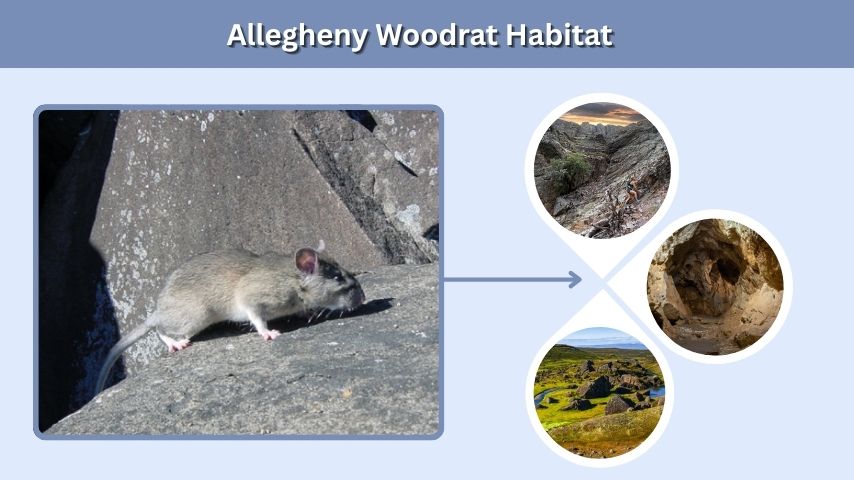
Allegheny woodrats are strongly tied to rocky habitats. They often live in cliffs, caves, rock outcrops, talus slopes, boulder fields, and forested ridge systems. These places provide shelter from predators, nesting spaces, and cool hidden areas for storing food.
Preferred Habitat Features
- Large rock piles or boulder fields
- Cliffs with cracks and crevices
- Caves and cave entrances
- Forested slopes with nut-producing trees
- Rocky ledges near oak, hickory, or other mast trees
- Areas with low human disturbance
- Connected habitat corridors between colonies
Rocky shelter is very important because Allegheny woodrats do not dig deep burrows like some rodents. Instead, they use natural cracks, crevices, and protected spaces between rocks. These spaces help them avoid predators, raise young, store food, and survive bad weather.
Allegheny Woodrat Range and Distribution
The Allegheny woodrat is native to the Appalachian and nearby mountain regions of the eastern United States. Its range has included parts of states such as Pennsylvania, West Virginia, Virginia, Maryland, Ohio, Indiana, Kentucky, Tennessee, North Carolina, New Jersey, and Alabama.
The species was once found more widely in the northeastern part of its range, but it has disappeared from some areas and declined in many others. In some states, remaining populations are isolated in rocky mountain habitats.
Where Do Allegheny Woodrats Live?
Allegheny woodrats live mainly in rugged, forested, rocky areas. They are not animals of open fields, city streets, or wetland marshes. Their strongest populations are often linked to large rock systems where food and shelter are close together.
In Pennsylvania, West Virginia, Virginia, and surrounding Appalachian regions, they may be found in remote rocky slopes and forested ridges. In places like Maryland, New Jersey, Ohio, and Indiana, they are more localized and often closely monitored by wildlife agencies.
Allegheny Woodrat Diet
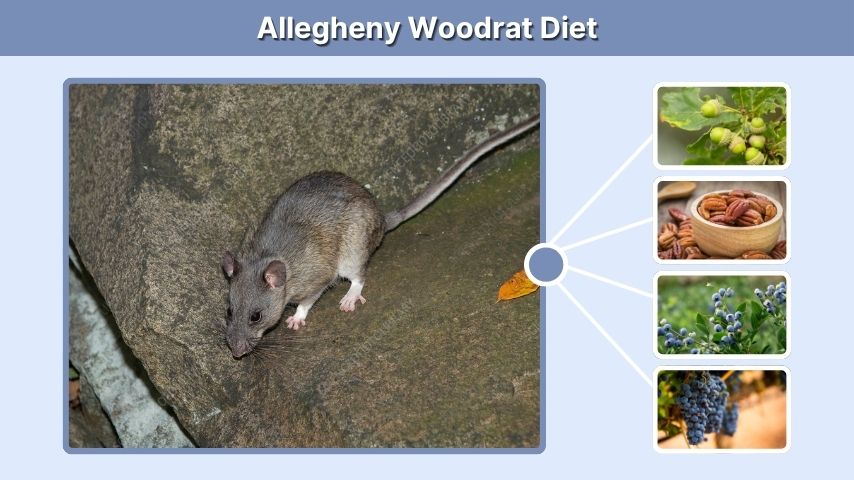
The Allegheny woodrat eats mostly plant material. Its diet changes with the season and depends on what is available near its rocky home. Nuts, fruits, seeds, berries, leaves, fungi, and other forest foods may all be part of its diet.
What Do Allegheny Woodrats Eat?
- Acorns
- Hickory nuts
- Seeds
- Berries
- Grapes
- Persimmons
- Green leaves
- Ferns
- Fungi
- Roots and plant stems
- Stored mast from nearby trees
Historically, American chestnuts were an important food source in parts of the woodrat’s range. After chestnut blight greatly reduced American chestnut trees, woodrats had to depend more on other foods such as acorns, hickory nuts, berries, and fungi. When oak crops fail or forests become fragmented, food shortages can become a serious problem.
Allegheny Woodrat Behavior
Allegheny woodrats are mostly nocturnal, meaning they are active at night. During the day, they stay hidden in rock shelters, nests, or crevices. At night, they come out to search for food, collect nesting material, and move around their rocky territory.
They are sometimes called pack rats because they may collect and store objects. In the wild, these collections are usually natural materials such as sticks, leaves, nuts, bones, shells, or other found items. These materials may be added to nests or stored in protected areas.
Daily and Seasonal Behavior
Allegheny woodrats do not truly hibernate. They remain active through the year but may reduce movement during harsh weather. In colder months, stored food becomes especially important. Their rock shelters help protect them from winter conditions and predators.
They are also territorial. A woodrat may use the same den site for a long time if food, shelter, and safety remain suitable. Because they depend on rocky habitat patches, populations can become isolated when roads, development, or unsuitable forest conditions separate one rocky area from another.
Allegheny Woodrat Nest
Allegheny woodrats build nests in protected rocky spaces. A nest may be placed deep inside a crevice, under a boulder, in a cave-like opening, or along a cliffside shelter. These nests are often made from sticks, bark, leaves, grasses, and other plant materials.
Nesting Sites
- Rock crevices
- Boulder gaps
- Cave entrances
- Cliff ledges
- Talus slopes
- Protected spaces under rock piles
- Hollow spaces near forested ridges
A good nest site must be hidden, dry, and close to food. Since the animal is vulnerable to predators, the nest location is one of the most important parts of its survival strategy.
Allegheny Woodrat Reproduction and Life Cycle
Allegheny woodrats usually breed during warmer months, although timing can vary by region and local conditions. Females give birth to small litters of young after a short gestation period. The young are born helpless and depend on the mother for warmth, milk, and protection.
As they grow, young woodrats begin exploring near the nest and later search for their own rocky shelter. Dispersal can be risky because safe habitat may be scattered. If young animals cannot move safely between rocky patches, local populations may become smaller and more isolated over time.
Allegheny Woodrat Adaptations
The Allegheny woodrat has several adaptations that help it survive in rocky Appalachian habitats. Its body, senses, and behavior all support a secretive life among cliffs and boulders.
Important Adaptations
- Large eyes help with night vision
- Long whiskers help it move through dark crevices
- Strong feet help it climb rocky surfaces
- Fur-covered tail helps with balance and protection
- Nocturnal activity reduces daytime predator risk
- Food storing helps it survive seasonal shortages
- Rock shelter use protects it from weather and predators
These adaptations make the Allegheny woodrat well suited to rugged mountain landscapes. However, they also make it dependent on a specific habitat type. When rocky forest habitat becomes fragmented, the species has fewer options for survival.
Allegheny Woodrat Predators
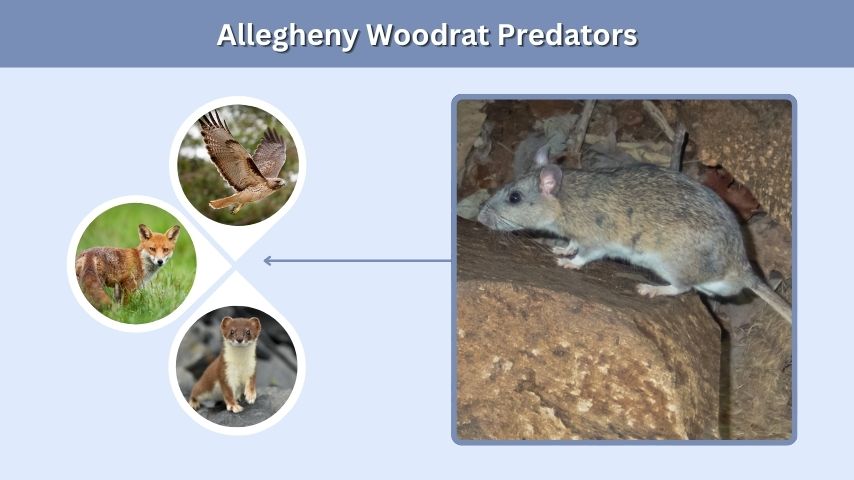
Allegheny woodrats are prey for several forest predators. Their rocky homes give them some protection, but they are still hunted when they leave shelter to feed or move between den sites.
Common predators may include owls, hawks, foxes, bobcats, snakes, weasels, and other carnivores. Young woodrats are especially vulnerable. Predation is a normal part of the ecosystem, but it can become more serious when woodrat populations are already small or isolated.
Allegheny Woodrat vs Norway Rat
The Allegheny woodrat is often confused with the Norway rat because both are medium-sized rodents. However, they are very different animals. The Norway rat is an introduced species that often lives near humans, while the Allegheny woodrat is a native forest rodent.
Main Differences
- Allegheny woodrats are native; Norway rats are introduced
- Allegheny woodrats live in rocky forests; Norway rats live near people
- Allegheny woodrats have hairy tails; Norway rats have scaly tails
- Allegheny woodrats are usually shy and remote; Norway rats often use human structures
- Allegheny woodrats depend on natural foods; Norway rats eat many human-related foods
- Allegheny woodrats are conservation concerns; Norway rats are common pest species
This comparison is important because the Allegheny woodrat should not be treated like a household pest. It is a native wildlife species and is protected or monitored in several states.
Why Is the Allegheny Woodrat Endangered or Declining?
The Allegheny woodrat is not equally listed everywhere, but it is declining in many parts of its range. Some states list it as threatened, endangered, or a species of concern. Its decline is linked to several overlapping problems.
Major Causes of Decline
- Habitat fragmentation from roads and development
- Loss of rocky forest corridors
- Reduced food supply from chestnut loss and poor acorn crops
- Raccoon roundworm infection
- Small isolated colonies
- Low genetic diversity
- Forest changes caused by pests, disease, or disturbance
- Human activity near sensitive habitat
One of the most serious threats is raccoon roundworm, a parasite carried by raccoons. Woodrats may become infected when they encounter contaminated raccoon feces while searching for seeds or plant material. The infection is often deadly to woodrats.
Food loss is another major problem. The disappearance of many American chestnut trees removed an important food source. When acorn crops are poor or oak forests decline, woodrats may struggle to store enough food.
How Many Allegheny Woodrats Are Left?
There is no simple single number for how many Allegheny woodrats are left across their entire range. The species is difficult to count because it is nocturnal, secretive, and lives in hard-to-reach rocky habitats. Wildlife biologists often monitor colonies by using trail cameras, live traps, genetic samples, and signs such as nests or food caches.
What is clear is that the species has declined sharply in parts of its range. Some historic populations have disappeared, while others survive in smaller, isolated colonies. Because of this, conservation work often focuses on protecting known sites, improving habitat, reducing parasite risk, and helping isolated populations remain connected.
Allegheny Woodrat in Pennsylvania, Ohio, Maryland, and Other States
The Allegheny woodrat has different conservation status depending on the state. In Pennsylvania, it is listed as threatened. In Maryland and New Jersey, it has also received conservation attention because of serious decline. In Ohio, Indiana, Virginia, West Virginia, Kentucky, Tennessee, and North Carolina, the species may occur in suitable rocky habitats, but local abundance varies.
State wildlife agencies often survey rock outcrops, cliffs, and cave areas to confirm whether woodrats are still present. Because the animal is hard to detect, trail cameras and baited monitoring stations are useful tools.
Conservation and Protection
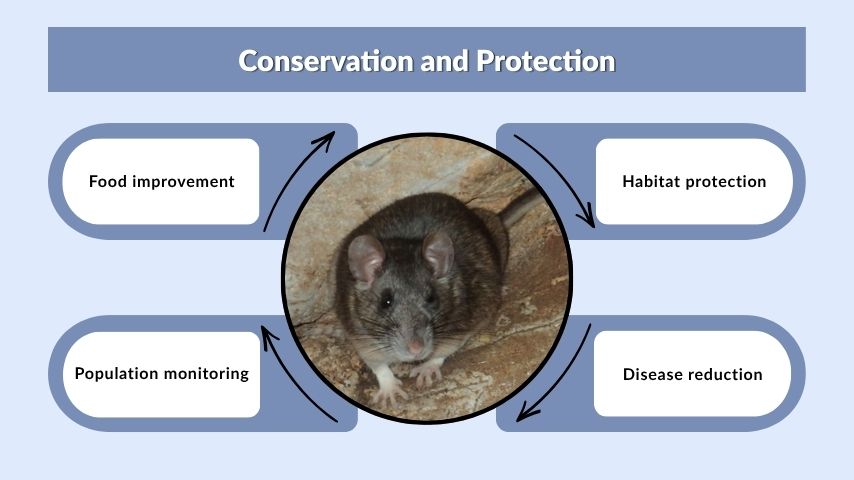
Conservation work for the Allegheny woodrat focuses on habitat protection, disease reduction, food improvement, and population monitoring. Protecting rocky forest habitat is the first step. Without safe cliffs, boulder fields, and connected forest corridors, populations cannot survive long term.
Some conservation plans also encourage planting or restoring mast-producing trees such as oaks, hickories, and disease-resistant chestnut hybrids. These trees provide important seasonal food. Reducing raccoon roundworm exposure near woodrat sites can also help lower mortality risk.
Wildlife experts may also study genetic diversity and movement between colonies. If populations become too isolated, they may suffer from inbreeding and reduced survival. In some regions, carefully managed translocation or captive breeding may be used to support recovery.
Are Allegheny Woodrats Dangerous?
Allegheny woodrats are not aggressive animals and are not considered dangerous to people. They avoid humans and spend most of their lives hidden in rocky forest habitat. They should not be handled, trapped, or disturbed unless by trained wildlife professionals with proper permission.
Like all wild mammals, they should be respected from a distance. If one is seen near a trail, cave, or rocky overlook, the best response is to leave it alone and avoid disturbing its shelter.
Why the Allegheny Woodrat Matters
The Allegheny woodrat is more than a rare mountain rodent. It is part of the Appalachian forest ecosystem. By feeding on nuts, seeds, berries, and fungi, it helps move plant material through the landscape. It also serves as prey for native predators such as owls, foxes, bobcats, and snakes.
Its decline can also signal larger problems in forest health. When woodrat colonies disappear, it may reflect habitat fragmentation, food loss, disease pressure, or reduced forest quality. Protecting this species helps protect rocky mountain ecosystems and the many other animals that depend on them.
FAQs
What is the scientific name of the Allegheny woodrat?
The scientific name of the Allegheny woodrat is Neotoma magister. It is a native North American rodent in the woodrat group. Although it is called a rat, it is different from invasive city rats such as the Norway rat and is closely tied to natural rocky forest habitats.
Where can Allegheny woodrats be found?
Allegheny woodrats are found mainly in the Appalachian and nearby mountain regions of the eastern United States. They live in rocky forests, cliffs, caves, ledges, and boulder fields. Their range includes parts of states such as Pennsylvania, West Virginia, Virginia, Maryland, Ohio, Kentucky, Tennessee, and North Carolina.
What do Allegheny woodrats eat?
Allegheny woodrats eat mostly plant-based foods, including acorns, hickory nuts, seeds, berries, grapes, persimmons, leaves, ferns, roots, and fungi. They may store food in protected rocky shelters for later use, especially during seasons when fresh food is harder to find.
Why are Allegheny woodrats declining?
Allegheny woodrats are declining because of habitat fragmentation, loss of important food sources, raccoon roundworm, small isolated colonies, and reduced genetic diversity. Roads, development, forest changes, and disease pressure can all make it harder for local populations to survive.
Is the Allegheny woodrat the same as a Norway rat?
No, the Allegheny woodrat is not the same as a Norway rat. The Allegheny woodrat is a native wild rodent that lives in rocky forests, while the Norway rat is an introduced species often found near people. Allegheny woodrats also have hairy tails, unlike the scaly tails of Norway rats.