
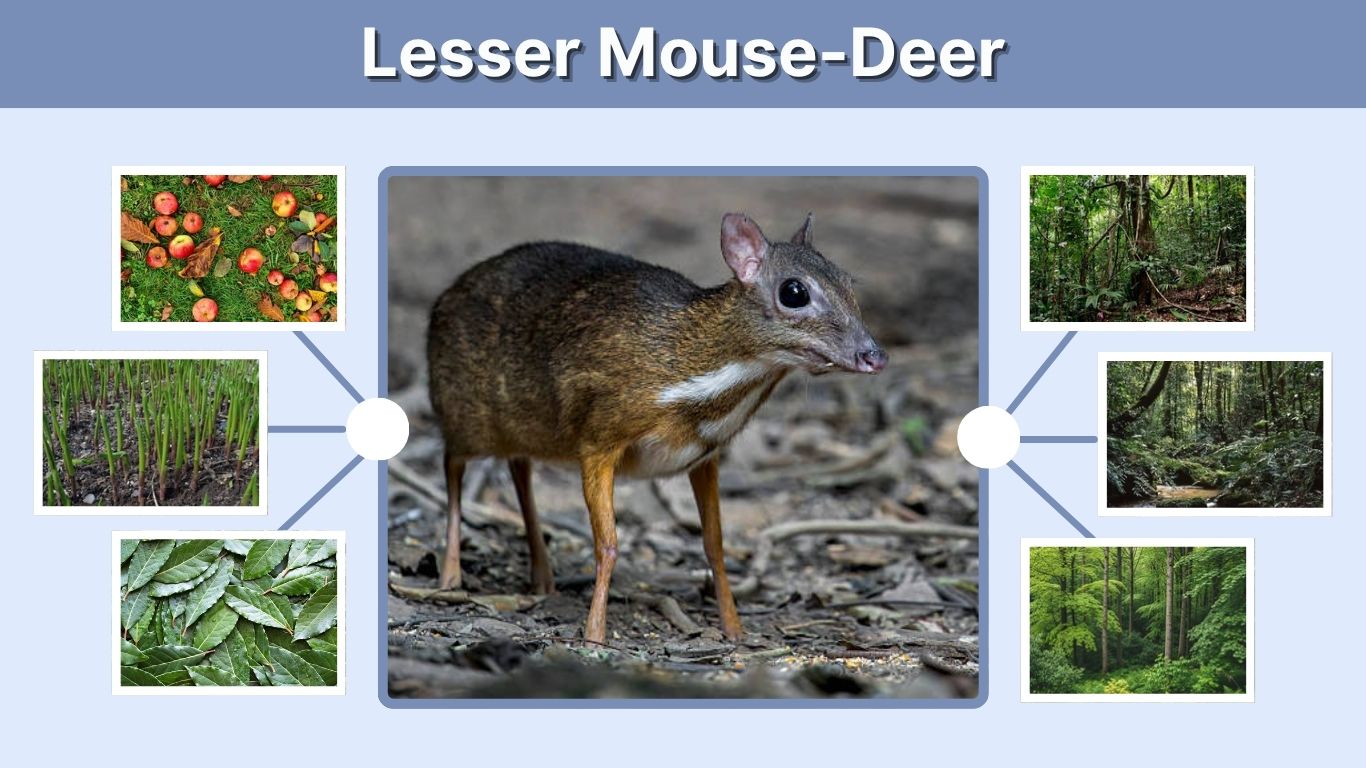
The lesser mouse-deer, Tragulus kanchil, is a tiny hoofed mammal native to Southeast Asia. Despite its name, it is neither a mouse nor a true deer. It belongs to the chevrotain family and is one of the smallest hoofed animals in the world. Its reddish-brown coat, pencil-thin legs, large eyes, white throat stripes, and pointed face help it move almost unnoticed through dense forest vegetation. This guide covers its identification, size, habitat, diet, behavior, reproduction, lifespan, and suitability as a pet.
What Is a Lesser Mouse-Deer?
The lesser mouse-deer is also called the lesser mousedeer, lesser Malay mouse-deer, lesser Indo-Malayan chevrotain, or kanchil. Its scientific name is Tragulus kanchil, and it belongs to the family Tragulidae within the order Artiodactyla. It is therefore a hoofed mammal and distant relative of deer, cattle, antelopes, and other ruminants, but it is not a member of the true-deer family Cervidae.
| Feature | Description |
|---|---|
| Scientific name | Tragulus kanchil |
| Family | Tragulidae |
| Other names | Kanchil, lesser chevrotain |
| Body length | Approximately 42–55 cm |
| Shoulder height | Approximately 20–25 cm |
| Weight | Approximately 1.5–2.5 kg |
| Diet | Leaves, shoots, fungi, and fruit |
| Native region | Southeast Asia |
| Lifestyle | Usually solitary |
The phrase “lesser deer mouse” can be misleading. A deer mouse is a North American rodent in the genus Peromyscus, whereas the lesser mouse-deer is a small Southeast Asian ungulate with true hooves.
Lesser Mouse-Deer Identification
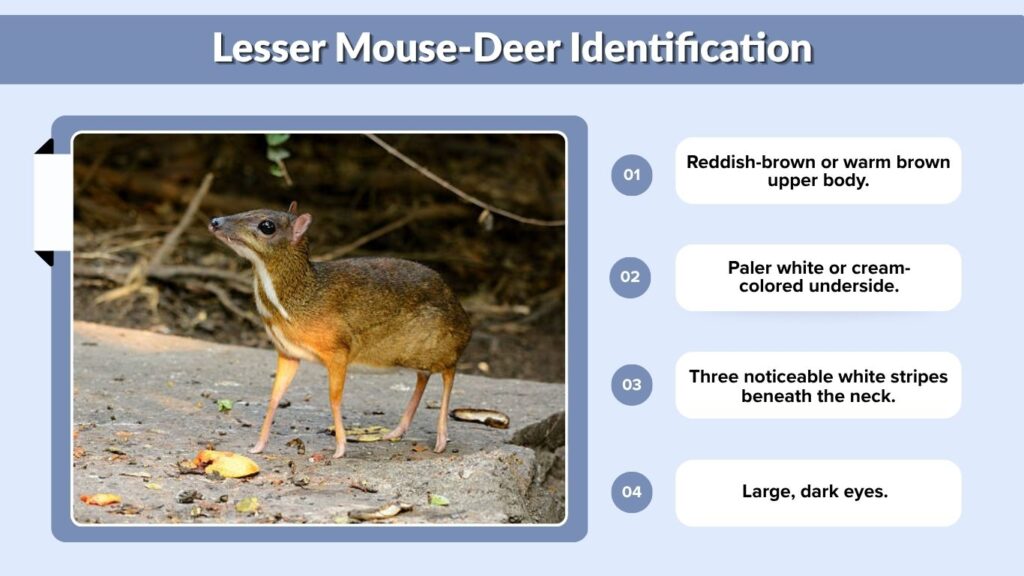
The lesser mouse-deer has a compact, rounded body supported by very slender legs. Its mouse-like face and deer-like posture explain its unusual common name.
Key Identification Features
- Reddish-brown or warm brown upper body
- Paler white or cream-colored underside
- Three noticeable white stripes beneath the neck
- Large, dark eyes
- Small, rounded ears
- Long, pointed snout
- Very short tail
- Thin yellowish-brown legs
- Four toes on each foot, including two main hooves
- No antlers or horns
- Long upper canine teeth in adult males
Males use their elongated upper canines during competition and defensive encounters. These teeth can extend below the lips and resemble small tusks. Females lack the same strongly developed protruding canines.
How Big Is a Lesser Mouse-Deer?
The lesser mouse-deer is one of the world’s smallest living ungulates. Adults generally measure 42–55 centimetres from head to body, stand about 20–25 centimetres at the shoulder, and weigh approximately 1.5–2.5 kilograms. This makes one roughly comparable in weight to a small house cat, although its body is supported by much thinner legs.
Despite occasional online claims, a normal lesser mouse-deer does not have an 11-inch foot or a body measuring several feet. The animal’s total body length is usually under two feet.
Lesser vs Greater Mouse-Deer
The greater mouse-deer, Tragulus napu, is a related but larger species. Appearance and location must be considered together because both have brown coats, delicate legs, and pale neck markings.
| Feature | Lesser mouse-deer | Greater mouse-deer |
| Scientific name | Tragulus kanchil | Tragulus napu |
| Size | Smaller and more delicate | Larger and more robust |
| Neck markings | Usually three white stripes | Two pairs of white markings |
| Typical weight | About 1.5–2.5 kg | Generally heavier |
| Body build | Slender | Broader and stronger |
Singapore’s National Parks Board describes the greater species as more robust, with a body length of approximately 52–57 centimetres.
Where Do Lesser Mouse-Deer Live?
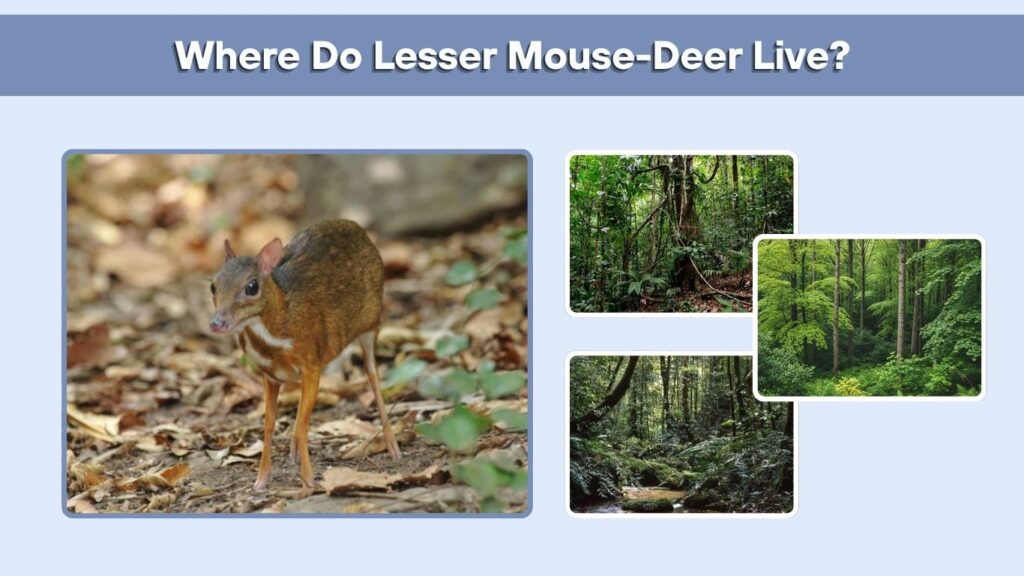
The lesser mouse-deer occurs across parts of Southeast Asia, including Myanmar, Thailand, Cambodia, Laos, Vietnam, southern China, Malaysia, Brunei, Singapore, Sumatra, Borneo, and several smaller islands.
It mainly inhabits:
- Mature tropical forest
- Dense forest undergrowth
- Lowland rainforest
- Secondary forest
- Vegetation near streams or wetlands
- Areas with thick leaf litter and fallen fruit
Its small body allows it to pass through narrow openings beneath plants and tangled vegetation. The reddish-brown coat also provides effective camouflage against leaves, soil, roots, and shaded forest floors.
Lesser Mouse-Deer in Singapore
In Singapore, lesser mouse-deer are associated with mature forests in and around the Central Catchment and Bukit Timah nature reserves. They are native to the country and are usually observed alone, although pairs are occasionally recorded.
Singapore’s population was estimated at fewer than 50 animals during the 1990s. More recent research cited by NParks estimated approximately 160–200 individuals and reported that the species’ local status improved from Critically Endangered to Endangered. Habitat restoration, forest protection, and reduced nighttime disturbance were identified as likely contributors to the recovery.
What Do Lesser Mouse-Deer Eat?
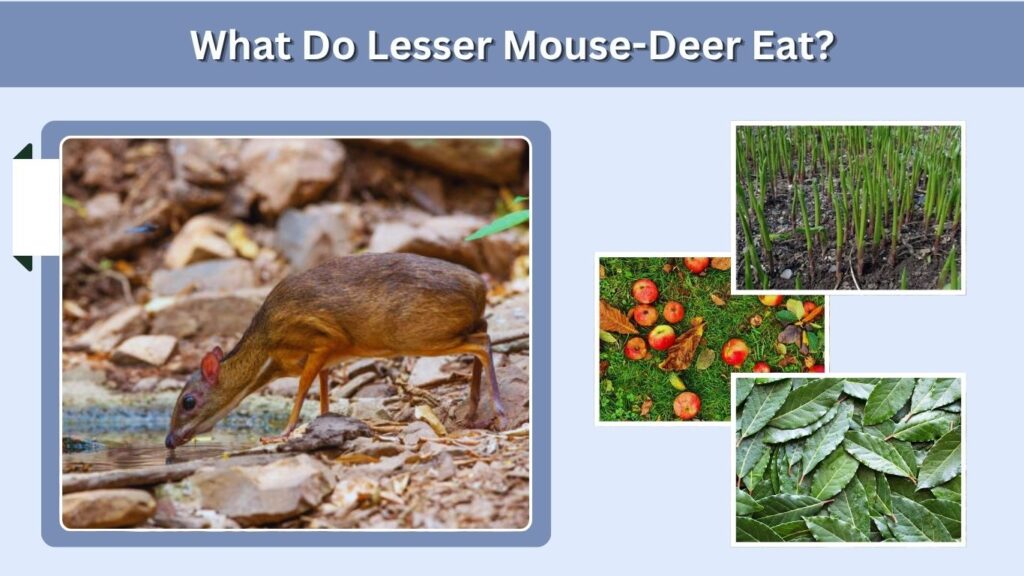
Lesser mouse-deer are mainly plant eaters. They forage close to the forest floor, selecting soft, moisture-rich foods that can be easily chewed and digested.
Their diet includes:
- Fallen fruit
- Fresh leaves
- Young shoots
- Plant buds
- Fungi
- Soft vegetation
They may occasionally consume small animal matter, but fruit and tender plant material form the most important parts of the natural diet. In forest ecosystems, eating fallen fruit may also help move seeds away from parent trees.
Behavior and Adaptations
Lesser mouse-deer are shy and usually solitary. Their activity pattern can vary by habitat and disturbance level. They may move during the day and night, although they are frequently most active around dusk, dawn, and after dark.
How Do They Escape Predators?
Their main defenses are camouflage, alertness, and speed. Large eyes help them detect movement under dim forest light, while their small bodies allow them to disappear quickly into thick vegetation.
When alarmed, a mouse-deer may:
- Freeze to avoid detection
- Run through dense undergrowth
- Hide beneath roots or vegetation
- Stamp its hooves
- Use sharp canine teeth when cornered
Likely predators include large snakes, monitor lizards, wild cats, birds of prey, and other forest carnivores. Habitat loss, hunting, illegal trapping, and attacks by free-ranging dogs can also threaten local populations.
Lesser Mouse-Deer Life Cycle
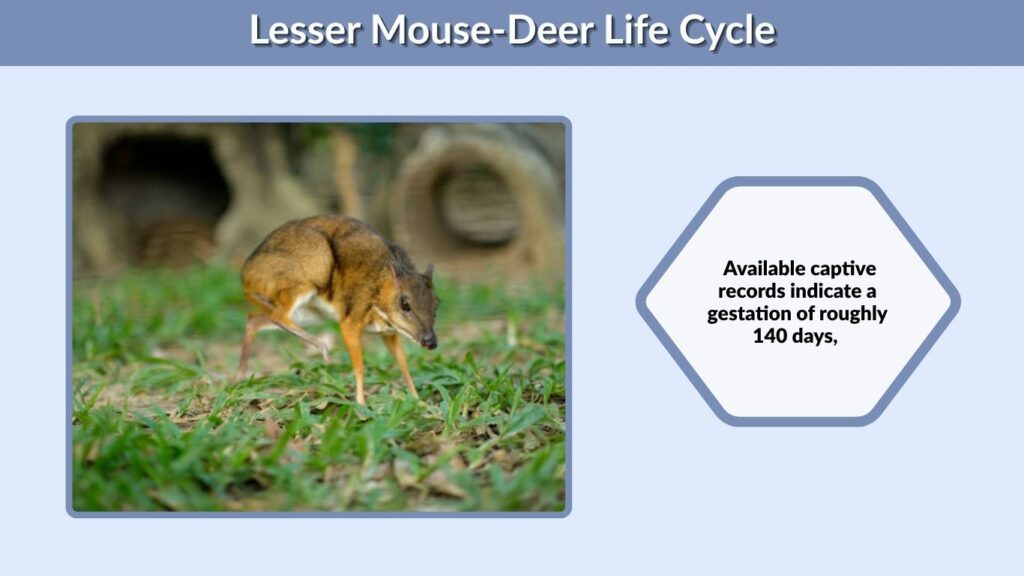
Lesser mouse-deer can reproduce throughout the year under favorable conditions. Available captive records indicate a gestation of roughly 140 days, although estimates vary among sources and historically similar mouse-deer species were sometimes classified under different scientific names.
A female normally gives birth to one well-developed baby. Newborn mouse-deer are precocial, meaning they can stand and begin moving shortly after birth rather than remaining completely helpless in a nest.
The mother hides the newborn in protected vegetation and returns to nurse it. This reduces the chances of predators finding both mother and young together.
Lesser Mouse-Deer Lifespan
Zoo records indicate that lesser mouse-deer may live for around 12 years under managed care. Wild individuals may have shorter lives because they face predators, injuries, food shortages, disease, hunting, and habitat disturbance.
Are Lesser Mouse-Deer Endangered?
The IUCN assessment referenced in scientific literature classifies Tragulus kanchil as Least Concern globally because it has a broad distribution and remains locally common in parts of its range. However, the assessment also notes uncertainty about population trends, hunting pressure, species identification, and the loss of lowland forest.
Global status does not mean every population is secure. The species can be rare or endangered locally, as demonstrated by its protected status in Singapore. Major threats include:
- Forest clearing and fragmentation
- Hunting for meat
- Illegal wildlife trapping
- Disturbance of feeding habitat
- Attacks by feral or free-ranging dogs
Protecting connected forest, preventing poaching, and reducing disturbance in nature reserves are important for long-term survival.
Can You Keep a Lesser Mouse-Deer as a Pet?
A lesser mouse-deer is not a suitable conventional pet. It is a shy wild ungulate with specialized dietary, environmental, veterinary, and behavioral requirements. Handling, household noise, unsuitable flooring, limited hiding space, and close human contact can create considerable stress.
People searching for a lesser mouse-deer for sale should consider that:
- Wildlife ownership rules vary by country and region.
- Wild-caught animals may be illegally traded.
- They require secure, naturalistic forest-like enclosures.
- Their thin legs can be injured on unsuitable surfaces.
- Appropriate veterinary care may be difficult to find.
- They should not be kept in small cages or ordinary homes.
Seeing the species at an accredited zoo, protected reserve, or responsible wildlife facility is safer for both the animal and the observer.
FAQs
Are lesser mouse-deer actually deer?
They are hoofed ruminant mammals but not true deer. True deer belong to the family Cervidae, while mouse-deer belong to Tragulidae. They are sometimes considered primitive relatives within the broader ruminant evolutionary group.
Is a lesser mouse-deer a mouse?
No. It is not a rodent and is unrelated to common house mice and North American deer mice. The word “mouse” refers only to its small size and pointed, mouse-like face.
What is the scientific name of the lesser mouse-deer?
Its accepted scientific name is Tragulus kanchil. Older references may use Tragulus javanicus for some populations because the taxonomy of Southeast Asian mouse-deer has been revised over time.
What does a baby lesser mouse-deer look like?
A baby resembles a tiny version of the adult, with slender legs, brown fur, a pointed face, and pale underside markings. It is born relatively well developed and can stand soon after birth.
Where can you see lesser mouse-deer?
They occur in Southeast Asian forests and may be seen in protected habitats in Malaysia, Singapore, Thailand, Indonesia, and neighboring countries. Because they are small, shy, and often active in low light, sightings in the wild are uncommon.