
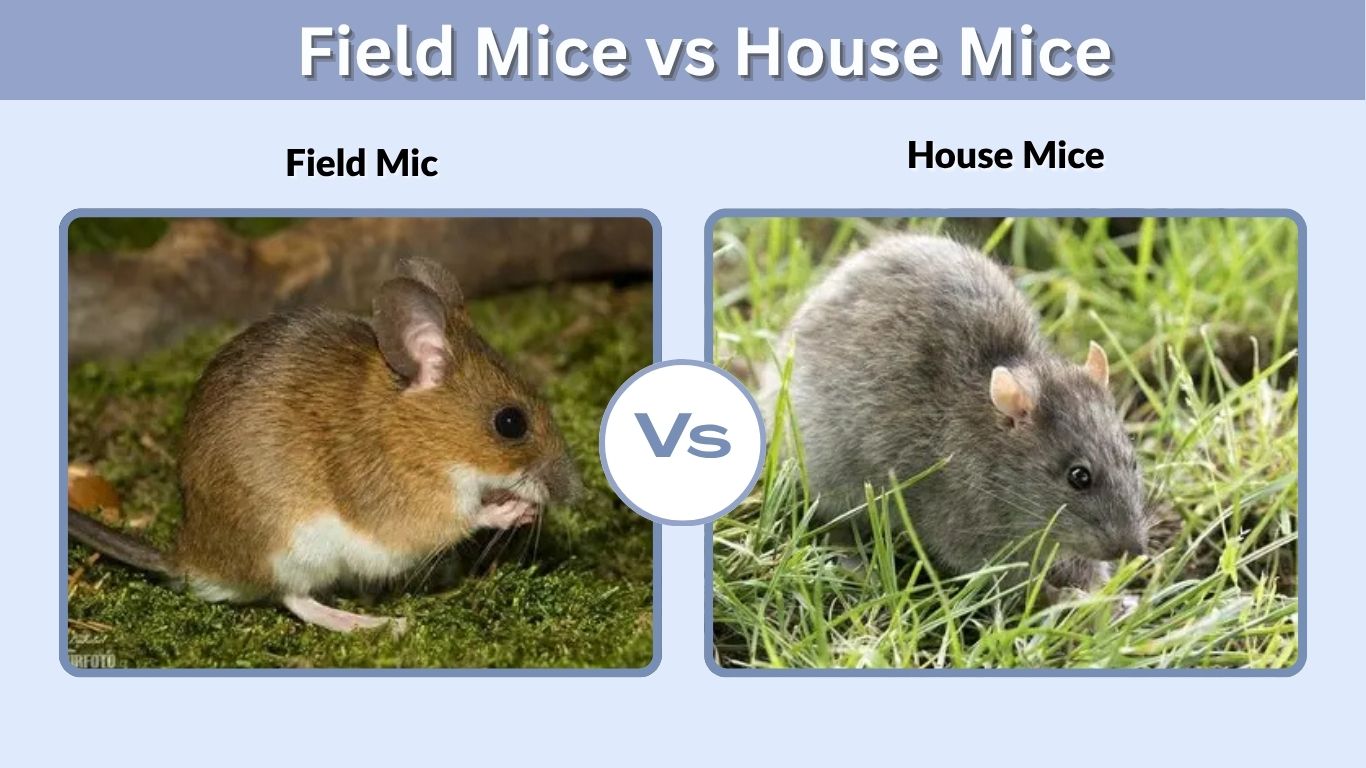
Field mice and house mice may look similar, but their appearance, preferred habitat and relationship with buildings are different. A house mouse is a specific species, Mus musculus, that is highly adapted to living around people. “Field mouse,” however, is an informal term used for several outdoor species. In North America, it commonly refers to deer mice, while in Britain it may describe wood mice. Identifying the mouse correctly helps you understand why it entered your house and how to prevent another infestation.
Field Mouse vs. House Mouse at a Glance
The most noticeable differences involve body color, tail appearance, eye size and preferred habitat. Deer mice typically have contrasting white underparts, while house mice are more uniformly gray or brown.
| Feature | Field or deer mouse | House mouse |
| Scientific group | Often Peromyscus species | Mus musculus |
| Back color | Brown, reddish brown or gray | Dusty gray or gray-brown |
| Belly | Clearly white or cream | Slightly lighter than the back |
| Tail | Usually furry and two-toned | Thin and mostly one color |
| Eyes | Relatively large | Smaller |
| Ears | Prominent and rounded | Rounded but proportionally smaller |
| Natural habitat | Fields, farms and woodland | Buildings and areas around people |
| Indoor activity | Often seasonal | Can remain indoors year-round |
| Hantavirus concern | Deer mice can be carriers | Not the main U.S. HPS carrier |
What Is a Field Mouse?
“Field mouse” is not a precise scientific name. It may refer to several small rodents living in fields, woodland edges, gardens, pastures and agricultural areas.
In North America, people frequently use the name for the deer mouse, Peromyscus maniculatus. Deer mice have brown or gray upper fur, white feet and a white belly. Their furry tails commonly have a dark upper surface and a pale underside.
Field mice normally live outdoors, where they nest in burrows, hollow logs, sheds, brush piles and protected spaces beneath vegetation. They may enter rural homes, cabins, barns and garages during cold weather or when outdoor food becomes limited.
What Is a House Mouse?
The house mouse is a small rodent that has adapted exceptionally well to human environments. It may live in homes, restaurants, warehouses, farms and other buildings throughout the year.
House mice usually have dusty-gray or brownish fur with a belly that is only slightly lighter. Their tails are thin, mostly uniform in color and less furry than those of deer mice. They commonly build nests in walls, cabinets, attics, appliances, insulation and stored materials.
Unlike most mice called field mice, house mice do not need to return outdoors. A population can feed, nest and reproduce entirely inside a heated building when food and water are available.
Appearance and Identification
Looking at several physical features together provides a better identification than relying on color alone.
Field Mouse Identification
A deer mouse commonly has:
- Brown, reddish-brown or gray upper fur
- A sharply contrasting white belly
- White feet
- Large, dark eyes
- Prominent ears
- A furry, two-colored tail
- An agile, lightweight body
The strong contrast between the darker back and white underside is one of the clearest clues.
House Mouse Identification
A house mouse usually has:
- Grayish-brown fur
- A belly only slightly lighter than its back
- A thin, nearly hairless-looking tail
- Smaller eyes
- A pointed nose
- Rounded ears
- More uniform body coloration
Young rats can occasionally be confused with large mice. However, rats generally have thicker bodies, larger feet and heavier tails.
Are Field Mice Bigger Than House Mice?
Their sizes overlap, so body length alone cannot provide a reliable identification. Deer mice often appear slightly larger because of their big eyes, prominent ears and longer-looking tails. A well-fed house mouse may be as large as some wild mice.
When comparing two mice, pay closer attention to belly color, tail pattern and overall body shape. A brown mouse with a white underside and two-toned furry tail is more likely to be a deer mouse than a house mouse.
Field Mouse vs. House Mouse Droppings
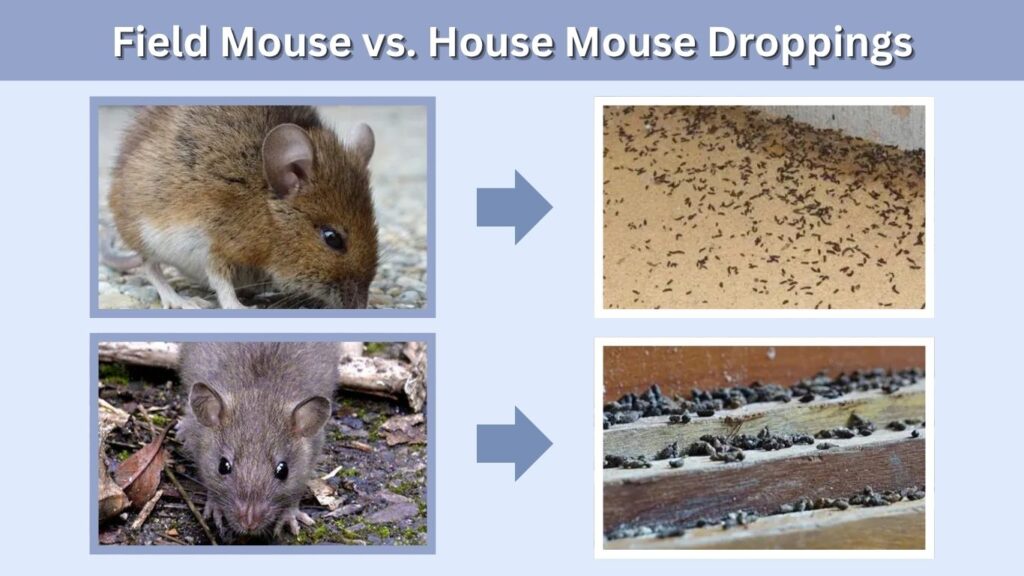
The droppings of both mice are small, dark and shaped somewhat like grains of rice. Differences in size may occur, but droppings alone usually cannot confirm the species.
Fresh droppings are dark and may appear moist or shiny. Older droppings become dry, faded and brittle. Finding new droppings after cleaning indicates continued mouse activity.
Do not sweep or vacuum dry mouse droppings. The CDC advises wetting droppings and nesting material thoroughly with disinfectant before wiping them up because disturbing dry waste can release contaminated particles into the air.
Habitat and Indoor Behavior
Field mice and house mice differ most clearly in where they normally live.
Where Field Mice Live
Field mice commonly occupy:
- Grasslands and meadows
- Crop fields
- Woodland edges
- Farms and barns
- Gardens
- Brush piles
- Stone walls
- Sheds and seasonal cabins
They often enter buildings in autumn or winter while looking for warmth, food and protected nesting sites.
Where House Mice Live
House mice are closely associated with buildings and commonly occupy:
- Kitchen cabinets
- Wall and ceiling voids
- Attics and basements
- Garages
- Food-storage rooms
- Warehouses
- Farm buildings
- Spaces behind appliances
A house mouse population may remain indoors through every season, whereas a wild field mouse is more likely to be a seasonal intruder.
What Do Field Mice and House Mice Eat?

Both are opportunistic omnivores, but their natural diets differ.
Field mice mainly eat seeds, grains, nuts, berries, vegetation and insects. They may also collect and store food in hidden spaces.
House mice consume grains and seeds but readily eat human food, including cereal, bread, rice, pet food and crumbs. Accessible food and water allow them to survive indefinitely inside buildings.
Remove food sources by storing dry goods, birdseed and pet food in hard containers with tight lids. Clean spills promptly and avoid leaving pet bowls out overnight. The EPA recommends eliminating food, water and shelter as part of rodent prevention.
Why Do Field Mice Come into Houses?
Field mice generally enter because a building offers:
- Warmth during cold weather
- Protection from predators
- Dry nesting sites
- Stored food
- Pet food or birdseed
- Water from leaks
- Cardboard, paper or insulation for nesting
Common entrances include foundation cracks, spaces under doors, damaged vents and openings around pipes or cables. Once inside, a field mouse may stay if food and shelter remain available.
Are Field Mice More Dangerous Than House Mice?
Both can contaminate food and surfaces with urine, droppings and nesting material. They can also damage packaging, insulation and electrical wiring.
In the United States, deer mice deserve additional caution because they are the principal carriers of Sin Nombre virus, the hantavirus most commonly associated with hantavirus pulmonary syndrome. A mouse cannot be judged as infected or safe simply by looking at it.
This does not mean every deer mouse carries the virus. The safest response is to avoid direct contact, control rodents promptly and follow proper cleaning procedures for all mouse waste.
How to Get Rid of Field Mice or House Mice

The main control steps work for either type of mouse.
Seal Entry Points
Inspect foundations, doors, windows, vents, pipes and the roofline. Seal openings with durable materials such as metal mesh, copper mesh, sheet metal, mortar or appropriate sealant. Removing mice without closing entrances may allow new animals—or released mice—to return.
Set Snap Traps
Place multiple snap traps along walls, behind appliances and near fresh droppings. Position the trigger end toward the wall because mice commonly travel along edges.
Keep traps inaccessible to children and pets. CDC guidance recommends traps as an initial control method and reserving poison or bait stations for infestations that continue.
Remove Food and Clutter
Store food securely, clean crumbs, empty rubbish regularly and remove cardboard or fabric that mice can use for nests. Outside, move firewood away from walls and remove dense vegetation near the foundation.
Continue Monitoring
Keep trapping until no mice are caught and no new droppings or gnaw marks appear. Continue checking sealed entrances because small gaps can reopen as buildings shift or materials deteriorate.
FAQs
Are field mice and house mice the same?
No. A house mouse is the species Mus musculus. “Field mouse” is an informal name for various outdoor mice, commonly including deer mice in North America and wood mice in Britain.
Do field mice infest houses?
They can enter, nest and reproduce inside houses, particularly during cold weather. However, they are generally more closely associated with outdoor habitats than house mice, which can live permanently inside buildings.
How can I tell which mouse is in my house?
Look at the belly and tail. A brown mouse with a white belly and furry two-toned tail is likely a deer mouse. A uniformly gray-brown mouse with a thin, single-colored tail is more likely a house mouse.
Can field mice find their way back to a house?
Yes. A mouse released nearby may return when the original entry points remain open. Permanent prevention requires sealing gaps, removing food sources and monitoring for renewed activity.
How do I clean mouse droppings safely?
Do not sweep or vacuum them while dry. Wear gloves, wet the droppings thoroughly with disinfectant, allow the required contact time and wipe them up with paper towels before disinfecting the surface again.