
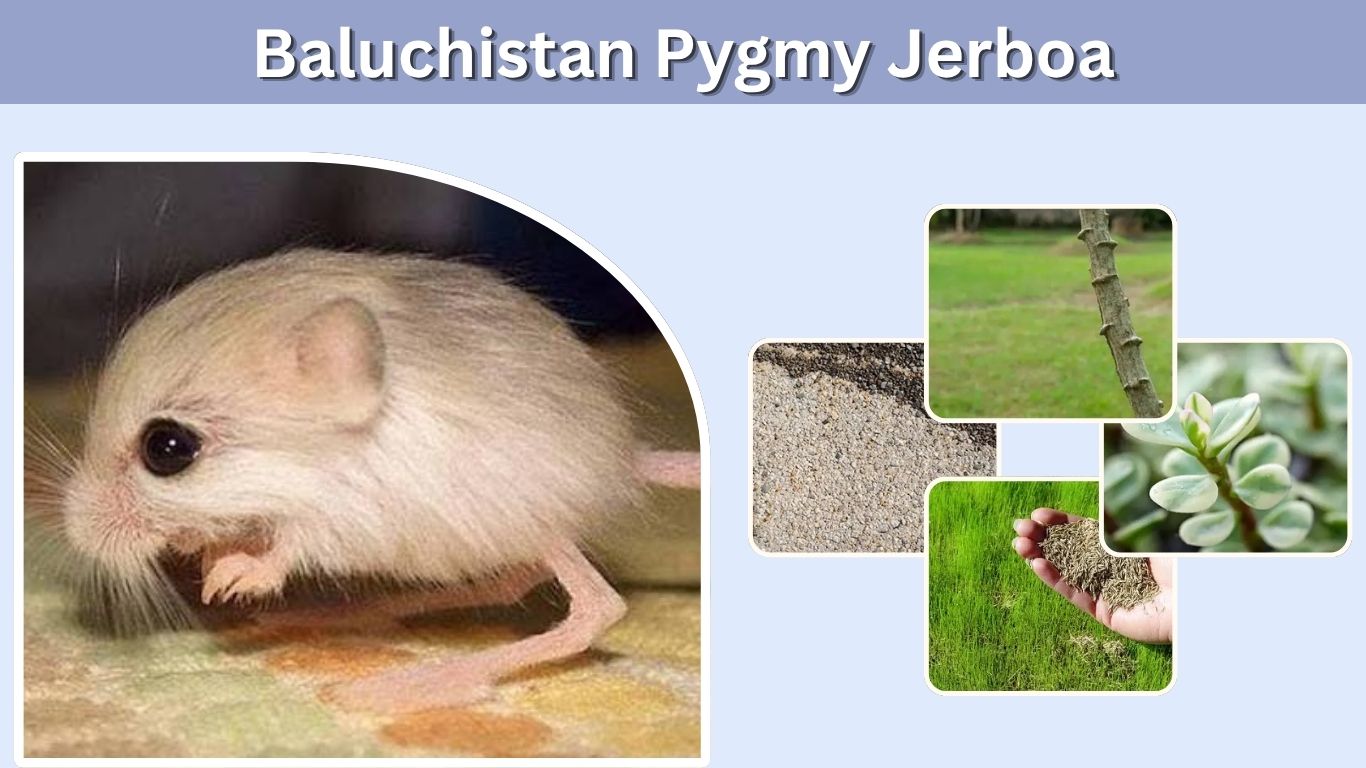
The Baluchistan pygmy jerboa is an exceptionally small desert rodent recognized by its round body, large dark eyes, long hind legs, and tail that is roughly twice its body length. It lives in the dry landscapes of Pakistan’s Balochistan region, where it remains hidden in underground burrows during the day and searches for food after dark. Also called the dwarf three-toed jerboa, this poorly studied mammal has several adaptations that allow it to hop across loose desert soil and survive extreme temperatures.
Baluchistan Pygmy Jerboa Overview
“Baluchistan” is an older English spelling of Balochistan, the province in southwestern Pakistan from which the animal takes its name. Current Mammal Diversity Database taxonomy places the species in the genus Salpingotus and treats Salpingotulus as a subgenus. However, the name Salpingotulus michaelis remains widely used, including in the IUCN assessment.
| Characteristic | Details |
| Common name | Baluchistan or Balochistan pygmy jerboa |
| Other name | Dwarf three-toed jerboa |
| Current scientific name | Salpingotus michaelis |
| Widely used synonym | Salpingotulus michaelis |
| Family | Dipodidae |
| Order | Rodentia |
| Native country | Pakistan |
| Activity pattern | Nocturnal |
| Main food | Seeds, stems and other plant material |
| Conservation assessment | Data Deficient under the IUCN-used name |
The species was scientifically described in 1966 from animals associated with the Nushki desert plateau in northwestern Balochistan. The type locality was recorded at approximately 1,067 metres above sea level.
What Does a Baluchistan Pygmy Jerboa Look Like?
The Baluchistan pygmy jerboa resembles a tiny mouse standing on unusually long back legs. Its head appears large compared with its rounded body, while its short front feet are usually held close to the chest. Large eyes help it function in low light, and its pale coat blends with dry desert soil.
Size and Weight
Adults are generally reported to have a head-and-body length of approximately 3.6–4.7 centimetres. Their tail can measure about 7.2–9.4 centimetres, meaning it is close to twice the length of the body. Adult weight is commonly reported at only around 3–4 grams.
Because of these measurements, the species is often described as one of the smallest rodents in the world. Size figures can vary slightly between references because very few individuals have been measured and studied.
Color and Body Shape
The upper fur is generally pale sandy, yellowish, pinkish-brown or light tan. The underside is white or cream. This contrast is common among desert rodents, whose upper coloration provides camouflage while the lighter belly is less visible from above.
The hind feet are greatly elongated and end in three functional toes. Fringes of hair along the toes help increase contact with loose sand. Its narrow tail is covered with short hairs and normally ends in a slightly longer tuft.
Identification Features
- Extremely small, rounded body
- Large black or dark-brown eyes
- Short muzzle and visible whiskers
- Small, rounded ears
- Pale sandy or pinkish-brown fur
- White belly
- Four toes on each front foot
- Three toes on each elongated hind foot
- Tail approximately twice the body length
- Short, rapid hopping movement
Where Does the Baluchistan Pygmy Jerboa Live?
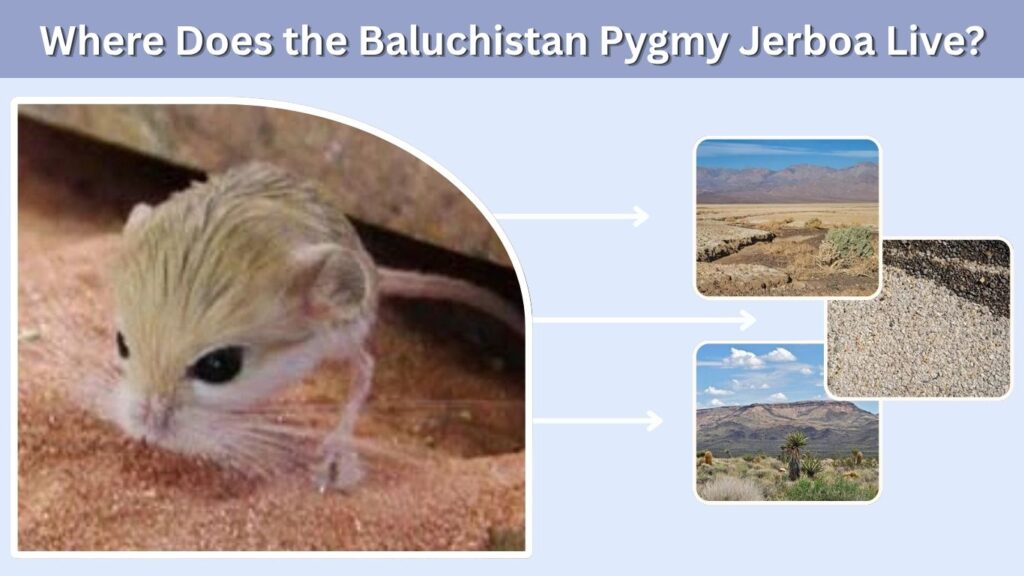
The Mammal Diversity Database lists Pakistan as the species’ confirmed country of occurrence. Records are concentrated in Balochistan, particularly around Nushki and the Chagai Desert. Some older accounts suggest that it might also occur in neighbouring Afghanistan, but its presence there has not been established as firmly as its Pakistani range.
Desert Habitat
The Baluchistan pygmy jerboa occupies hot, dry habitats that may include:
- Sandy desert plains
- Sand dunes
- Gravel flats
- Stony desert ground
- Areas with scattered shrubs
- Dry plains with limited vegetation
A field study of mammals in the Chagai Desert captured three Baluchistan pygmy jerboas during 430 trap-nights. The low number demonstrates how difficult the species is to locate, although it does not by itself prove that the animal is extremely rare.
Underground Burrows
This jerboa shelters inside underground burrows, often dug beneath desert vegetation. The burrow protects it from direct sunlight, dry winds, predators and sudden changes between daytime and nighttime temperatures.
Burrows also provide protected places for sleeping and raising young. Some accounts indicate that several individuals may occasionally rest together, although the social structure of wild populations has not been studied thoroughly.
What Does a Baluchistan Pygmy Jerboa Eat?
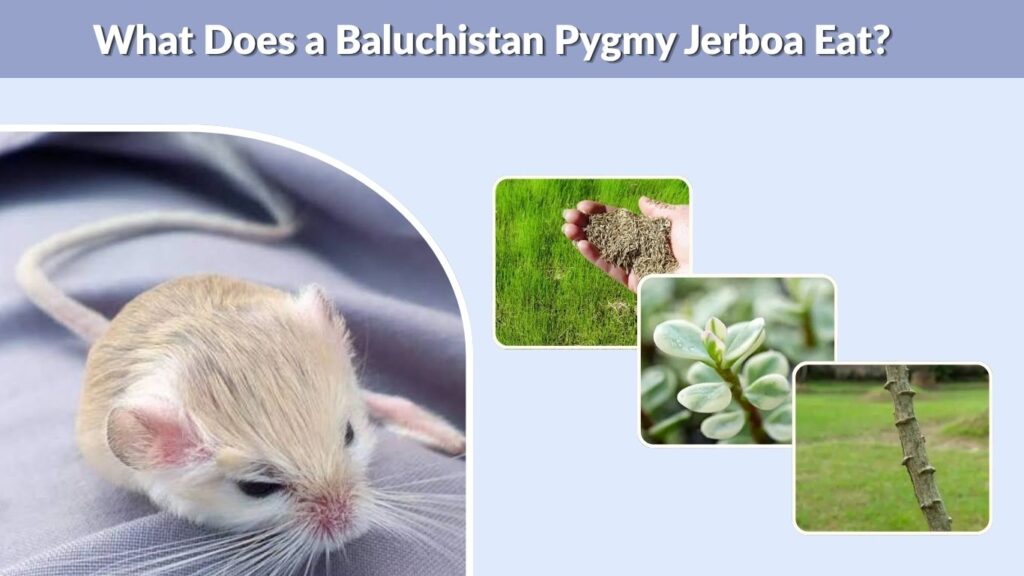
The Baluchistan pygmy jerboa is generally described as primarily herbivorous. Its reported foods include windblown seeds, grass seeds, stems, succulent leaves and other available parts of desert plants. During particularly dry periods, it may dig around plants to reach roots or remaining edible material.
It can hold small pieces of food in its front paws and raise them to its mouth. Seeds are particularly valuable because they are compact, can remain available after surface vegetation dries, and contain more energy than many fibrous desert plants.
Some sources describe the animal as opportunistically omnivorous, but detailed dietary studies of this exact species are lacking. Claims that it regularly eats insects, carrion or other animals should therefore be treated cautiously rather than presented as established feeding behaviour.
Baluchistan Pygmy Jerboa Adaptations
Its entire body is suited to living in a dry environment where food is scattered, ground temperatures can be extreme and predators have few obstacles blocking their view.
Long Hind Legs
The enlarged back legs allow the jerboa to travel by hopping. Hopping can move a small animal efficiently across open ground while keeping much of its body away from hot soil.
Rapid jumps and unpredictable changes in direction may also make it harder for a predator to catch. Its front legs are much shorter because they are mainly used for handling food and digging rather than supporting the body during fast movement.
Three-Toed Feet
Each hind foot has three elongated toes. The toes and surrounding hairs spread the animal’s weight over a larger area, reducing how deeply its feet sink into loose sand.
This explains the alternative name “three-toed Baluchistan pygmy jerboa” or “dwarf three-toed jerboa.”
Long Balancing Tail
The long tail functions as a counterbalance. When the jerboa jumps, turns or lands, the tail helps stabilize its tiny body. It can also provide support while the animal sits upright to inspect its surroundings or handle food.
Nocturnal Activity
The species is active mainly at night. Nocturnal behaviour allows it to avoid the most intense daytime temperatures and reduces water loss. Large eyes improve vision under dim conditions, while sensitive whiskers help detect nearby surfaces and movement.
Daily Torpor
During cold or food-limited conditions, the Baluchistan pygmy jerboa may enter torpor. In this temporary state, its metabolism and body temperature fall, reducing the amount of energy needed to survive. It is not necessarily the same as remaining in deep hibernation throughout an entire season.
Reproduction and Babies
Information about reproduction is based on limited observations. Breeding has been reported during the warmer months, with possible breeding periods around late June and again in August. A female may produce two to four babies in a litter and potentially raise two litters during a favourable year.
Newborn Baluchistan pygmy jerboas are believed to be blind, hairless and completely dependent on their mother. They remain protected inside the nesting burrow while developing fur, stronger legs and coordinated movement.
There is not enough field research to determine the exact gestation period, weaning age or age at which young animals begin breeding.
Baluchistan Pygmy Jerboa Lifespan

The exact lifespan of the Baluchistan pygmy jerboa has not been reliably established. Figures of approximately two to three years are sometimes published online, but these numbers are frequently borrowed from studies of other pygmy jerboa species.
Until long-term observations or carefully documented captive records become available, its true average and maximum lifespan should be regarded as unknown.
Predators and Threats
Likely predators include desert snakes, owls, small foxes, sand cats and monitor lizards. The jerboa’s main defences are camouflage, nighttime activity, rapid hopping and immediate retreat into a burrow.
Broader threats to wildlife in Balochistan include habitat degradation, development, mining, weak management of protected areas and disturbance of desert ecosystems. The Baluchistan pygmy jerboa is localized enough to require special attention, but researchers lack sufficient information to determine how these pressures are affecting its population.
Is the Baluchistan Pygmy Jerboa Endangered?
The IUCN Red List classifies the species as Data Deficient under the name Salpingotulus michaelis. Data Deficiency does not mean that the animal is safe or endangered. It means there is insufficient information about its population size, distribution, trends and threats to assign a more precise category.
The current Mammal Diversity Database uses the combination Salpingotus michaelis and displays the species as Not Evaluated under that taxonomic arrangement. This apparent difference is largely connected to taxonomy and database treatment rather than evidence of a sudden change in the animal’s population.
Can You Keep a Baluchistan Pygmy Jerboa as a Pet?
The Baluchistan pygmy jerboa is not a conventional domestic pet. It is a specialized wild rodent that needs suitable soil for burrowing, space for hopping, carefully controlled temperatures, an appropriate natural diet and a nocturnal routine.
Reliable captive-care information is extremely limited. Animals advertised as Baluchistan pygmy jerboas may also be another jerboa species or may have been collected from the wild. Buying one could involve wildlife-import, ownership and welfare restrictions that differ by country. Keeping this poorly studied species as a novelty pet is therefore inappropriate.
FAQs
Is the Baluchistan pygmy jerboa the smallest rodent?
It is widely described as one of the world’s smallest rodents. Adults are only about 3.6–4.7 centimetres long excluding the tail and weigh approximately 3–4 grams. Its position as the absolute smallest depends on which measurements and competing species are compared.
Why is it called a three-toed jerboa?
The name refers to its elongated hind feet, each of which has three functional toes. These toes support its hopping movement and help spread its weight over loose desert sand. Its front feet have four toes and are mainly used for digging and handling food.
Does the Baluchistan pygmy jerboa drink water?
Direct information about its drinking habits is limited. It probably obtains a substantial amount of moisture from seeds, succulent leaves and other plant material. However, it should not automatically be assumed that the animal never drinks water when water becomes available.
How high can a Baluchistan pygmy jerboa jump?
There is no well-supported maximum jumping height or distance for this species. Its long hind legs clearly allow rapid hopping across desert ground, but precise jumping claims commonly repeated online have not been confirmed through published measurements.
Where is the Baluchistan pygmy jerboa found?
Confirmed records come from Balochistan in southwestern Pakistan, particularly the Nushki and Chagai desert areas. It may occur across the border in Afghanistan, but available databases currently identify Pakistan as its confirmed country of distribution.