
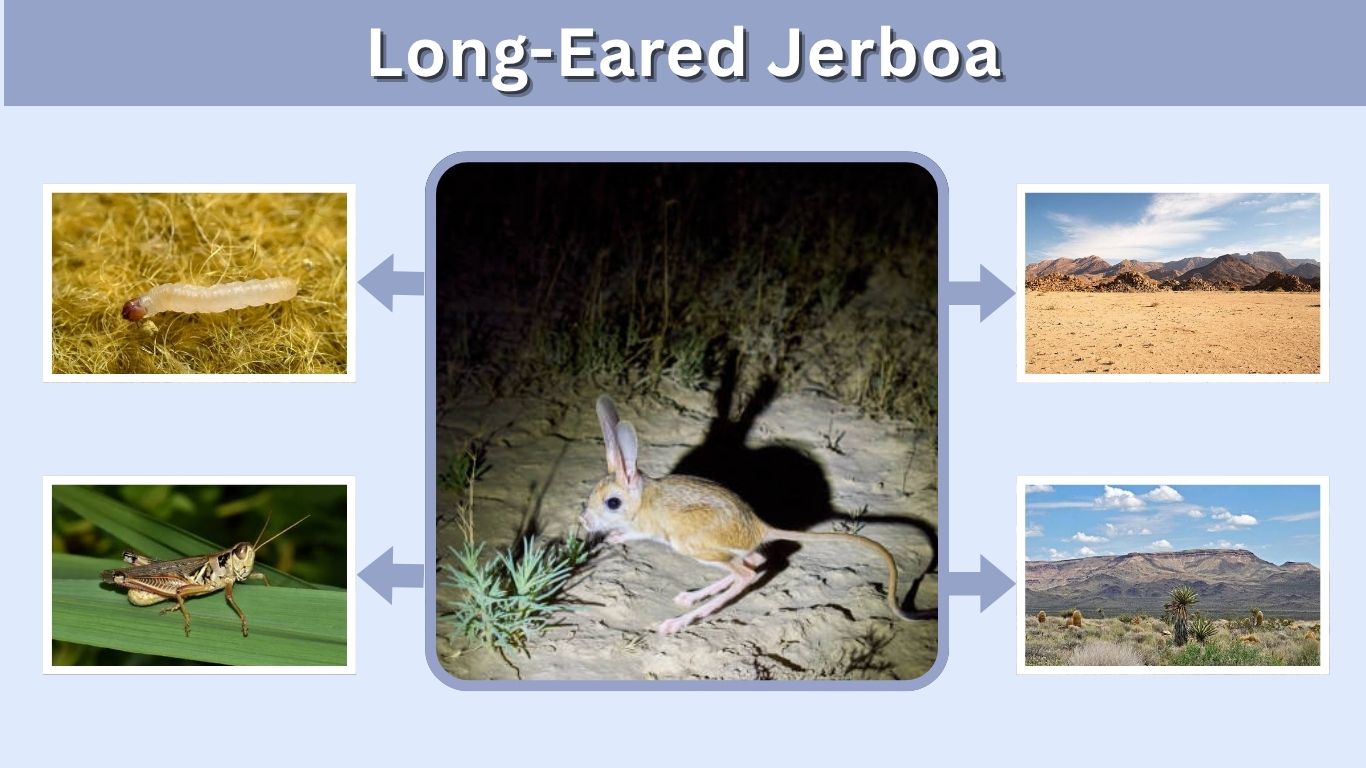
The long-eared jerboa is a tiny desert rodent famous for its enormous ears, powerful hind legs, and kangaroo-like movements. Native to remote parts of China and Mongolia, this nocturnal animal spends the day inside a burrow and emerges after dark to search for insects. Its unusual body is specially adapted to sandy, dry environments where temperatures can change dramatically. Although it resembles a mouse, the long-eared jerboa belongs to a distinctive group of jumping rodents known as jerboas.
Long-Eared Jerboa Overview
The scientific name of the long-eared jerboa is Euchoreutes naso. It belongs to the rodent family Dipodidae and is the only living species placed in the genus Euchoreutes. Its combination of oversized ears, long back legs, tiny front feet, and an exceptionally long tail makes it one of the most recognizable desert rodents.
| Characteristic | Details |
| Common name | Long-eared jerboa |
| Scientific name | Euchoreutes naso |
| Animal group | Rodent |
| Family | Dipodidae |
| Body length | About 7–9 cm |
| Tail length | About 15–16.2 cm |
| Primary diet | Insects |
| Activity | Mainly nocturnal |
| Native range | China and Mongolia |
| Conservation status | Least Concern |
What Does a Long-Eared Jerboa Look Like?
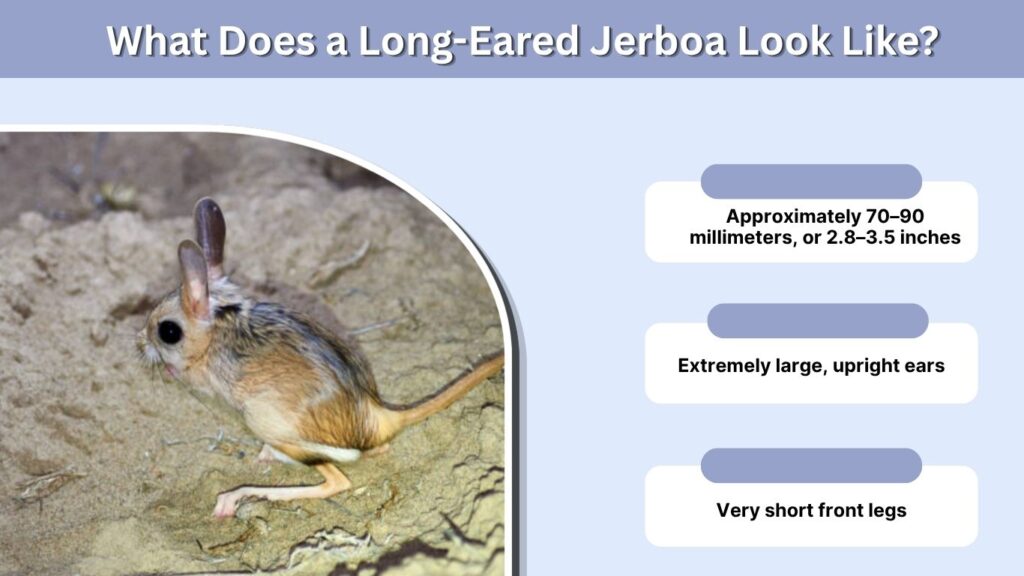
A long-eared jerboa looks like a combination of a mouse, a rabbit, and a miniature kangaroo. It has a small head and body, very long ears, elongated hind legs, short forelimbs, and a thin tail that is considerably longer than its body.
Size and Weight
The animal’s head-and-body length is approximately 70–90 millimeters, or 2.8–3.5 inches. Its tail measures roughly 150–162 millimeters, making it almost twice as long as the body. The hind feet are about 40–46 millimeters long. Reported adult weights are generally around 24–38 grams.
Color and Markings
Its upper fur ranges from pale reddish-yellow to light russet or sandy brown. This coloring helps the animal blend into desert soil. The belly is white, while the end of the tail has a noticeable black-and-white tuft. The tail tuft may make the tail easier to control and could also confuse predators during rapid movement.
Identification Features
- Extremely large, upright ears
- Small mouse-like head and pointed snout
- Pale sandy or reddish-brown upper fur
- White underside
- Very short front legs
- Long, powerful hind legs
- Thin tail nearly twice the body length
- Black-and-white tuft at the end of the tail
- Bristly hairs around the feet
Why Does the Long-Eared Jerboa Have Such Big Ears?
The ears are the animal’s most striking feature. They can measure approximately 3.8–5 centimeters and may equal 40–50 percent of the animal’s head-and-body length. This gives the long-eared jerboa one of the most remarkable ear-to-body proportions found among mammals.
Detecting Insects
Excellent hearing is particularly valuable because this jerboa feeds heavily on insects. It is thought to listen for the sounds made by insects moving or flying nearby. Once prey is detected, the jerboa can leap quickly toward it and capture it with its mouth or front paws.
Avoiding Predators
Large ears may also help the jerboa notice approaching nocturnal predators. Desert hunters such as owls can move quietly, so detecting faint wing beats, footsteps, or movements in the sand may give the rodent enough warning to escape.
Managing Desert Heat
Large, thin ears provide a wide surface through which body heat can potentially escape. This may help the animal regulate its temperature during warm nights. However, hearing and prey detection are considered especially important functions of the ears.
Where Does the Long-Eared Jerboa Live?
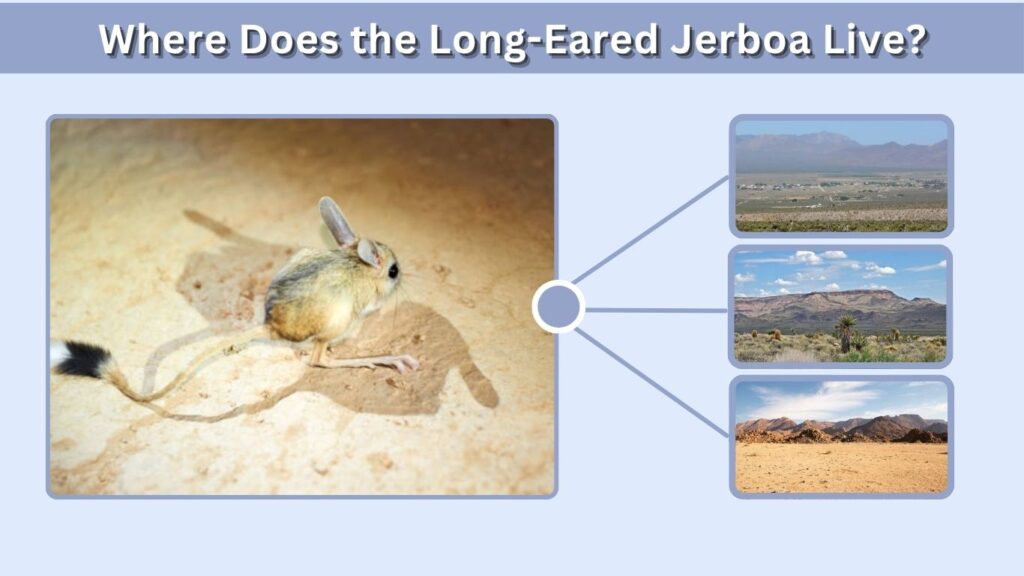
Long-eared jerboas are native to Central and East Asia. Their documented distribution includes southern Mongolia and several regions of northwestern and northern China, including Xinjiang, Inner Mongolia, Qinghai, Gansu, and Ningxia.
Desert and Semi-Desert Habitat
The species occupies deserts, semi-deserts, sandy valleys, gravel plains, and areas with scattered low-growing shrubs. It has also been recorded in cold, high-elevation desert landscapes. Vegetation is generally sparse, and water may be difficult to find for much of the year.
Its pale coat provides camouflage against sand and stones. Bristly hairs on its feet may improve traction on loose soil, while its long legs allow it to cross open ground without keeping its body close to the hot surface.
What Does a Long-Eared Jerboa Eat?
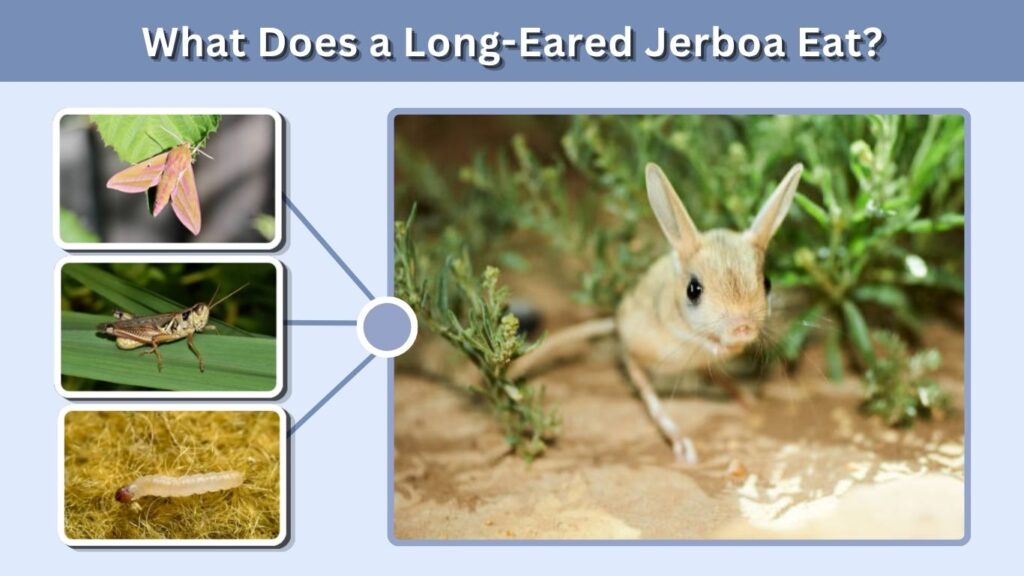
The long-eared jerboa is primarily insectivorous. Instead of relying mainly on seeds and plants like many desert rodents, it actively hunts small invertebrates.
Its likely foods include:
- Flying insects
- Beetles and other ground insects
- Moths
- Grasshoppers
- Insect larvae
- Other small invertebrates
The animal can use its sensitive hearing to locate prey before making a fast jump toward it. Because it forages at night, it can hunt when many desert insects become active and temperatures are cooler.
Food also provides some of the moisture needed for survival. This is particularly useful in habitats where open water is scarce, although the exact water requirements of wild long-eared jerboas have not been studied thoroughly.
Long-Eared Jerboa Adaptations
Life in a desert requires animals to survive heat, cold, dry conditions, limited vegetation, and numerous predators. Nearly every part of the jerboa’s body contributes to survival.
Powerful Jumping Legs
The hind legs are much larger and stronger than the front legs. The jerboa moves mainly by hopping rather than walking on all four feet. Its jumping style allows it to travel quickly and change direction suddenly when chased.
Extra-Long Tail
The tail acts as a counterbalance while the jerboa jumps. It helps stabilize the body during takeoff, landing, and sharp turns. When resting upright, the tail may also provide additional support.
Hairy Feet
Tufts of stiff hair around the feet increase the area contacting the ground. This can help prevent the feet from sinking deeply into loose sand and may improve grip during rapid movement.
Nocturnal Behavior
Remaining underground during the day protects the jerboa from intense sunlight and high daytime temperatures. It becomes active after sunset, when the desert is cooler and insects are easier to find.
Camouflage
Its sandy coat closely matches the colors of its habitat. When the animal remains still, this coloration can make it difficult for predators to detect against gravel, dry soil, and pale vegetation.
Burrows and Daily Behavior
Long-eared jerboas are mainly active at night and rest underground during daylight. Their burrows provide shelter from temperature extremes, predators, and dry desert winds. Information about this species’ exact burrow structure remains limited, but related jerboas commonly maintain temporary shelters and deeper seasonal burrows.
The animals are believed to forage mostly alone. Their movements can include short hops, long bounds, sudden stops, and unpredictable changes in direction. This uneven escape pattern makes it difficult for a predator to anticipate where the jerboa will land.
Reproduction and Babies
The reproductive behavior of the long-eared jerboa has not been studied in enough detail to provide a complete life cycle. Much of the available information is based on closely related jerboa species rather than direct observations of Euchoreutes naso.
Related jerboas may breed after emerging from winter dormancy. Females of some species produce two litters during the warmer season, with approximately two to six young after a gestation of around 25–35 days. These figures should not be treated as fully confirmed for the long-eared jerboa.
Newborn jerboas are expected to be small and dependent on their mother. The female nurses and protects them inside a nesting burrow until they are developed enough to begin exploring and feeding independently.
Predators and Defense
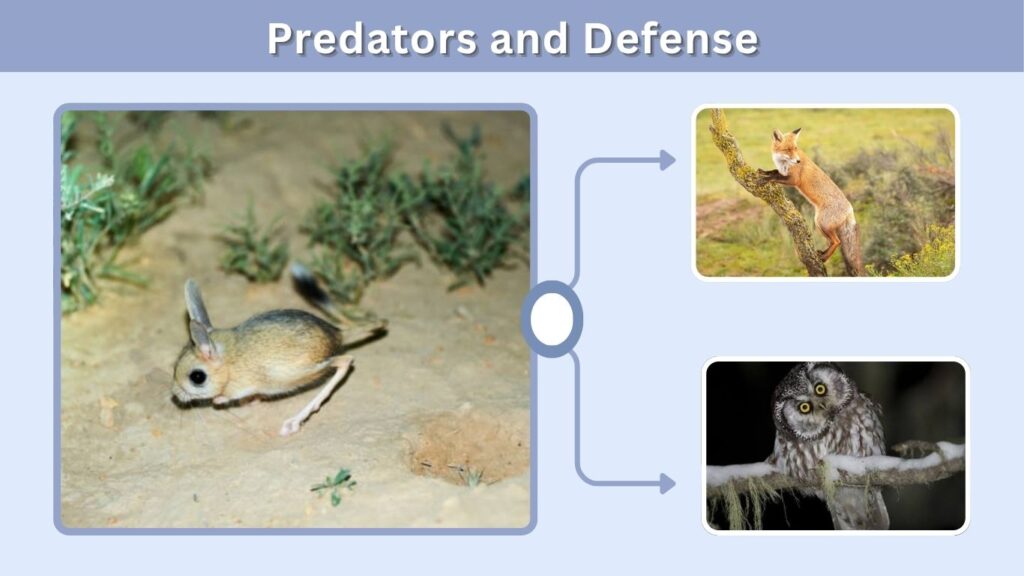
Potential predators include owls, snakes, foxes, and other small desert carnivores. Little owls are known to prey on jerboas and similar rodents in parts of Central Asia.
The long-eared jerboa does not have powerful claws or teeth for fighting large attackers. Its main defenses are:
- Detecting danger with excellent hearing
- Blending into the desert background
- Remaining hidden during daylight
- Escaping through sudden, rapid jumps
- Retreating into underground burrows
Is the Long-Eared Jerboa Endangered?
The long-eared jerboa is currently categorized as Least Concern on the IUCN Red List, according to the Mammal Diversity Database. Its known range covers parts of China and Mongolia. However, the species remains poorly studied, so detailed population estimates are not available.
Habitat disturbance, livestock grazing, mining, road construction, and other development could affect some local populations. Continued field surveys are important because remote desert animals can be difficult to observe and count accurately.
Can You Keep a Long-Eared Jerboa as a Pet?
A long-eared jerboa is not considered a suitable household pet. It is a specialized wild animal with demanding environmental, dietary, and behavioral requirements. It needs space for powerful jumping, suitable soil for burrowing, live insect prey, controlled temperatures, and a natural nighttime routine.
Listings claiming to offer a long-eared jerboa for sale should be approached cautiously. Wildlife ownership and international trade rules vary by location, and animals advertised online may be misidentified, illegally collected, or kept under unsuitable conditions. Observing and protecting the species in its natural habitat is far more appropriate than attempting to keep one privately.
FAQs
Is a long-eared jerboa a mouse?
No. It may resemble a mouse, but it belongs to the jerboa family, Dipodidae. Jerboas are rodents adapted for hopping, with elongated hind legs, short front limbs, and long balancing tails.
How high can a long-eared jerboa jump?
A reliable maximum jumping height has not been documented for this species. Its powerful hind legs allow it to make quick, high leaps when catching insects or escaping predators.
Where does the long-eared jerboa live?
It lives in desert and semi-desert regions of China and Mongolia. Typical habitats include sandy valleys, gravel plains, shrub-covered deserts, and cold, high-elevation desert landscapes.
What does the long-eared jerboa eat?
Its diet consists mainly of insects and other small invertebrates. It can listen for moving or flying insects and capture them by making sudden jumps through the air.
How long does a long-eared jerboa live?
Its exact lifespan is unknown. General estimates for some jerboa species are around two to three years, but there is insufficient research to confirm the typical lifespan of wild long-eared jerboas.