
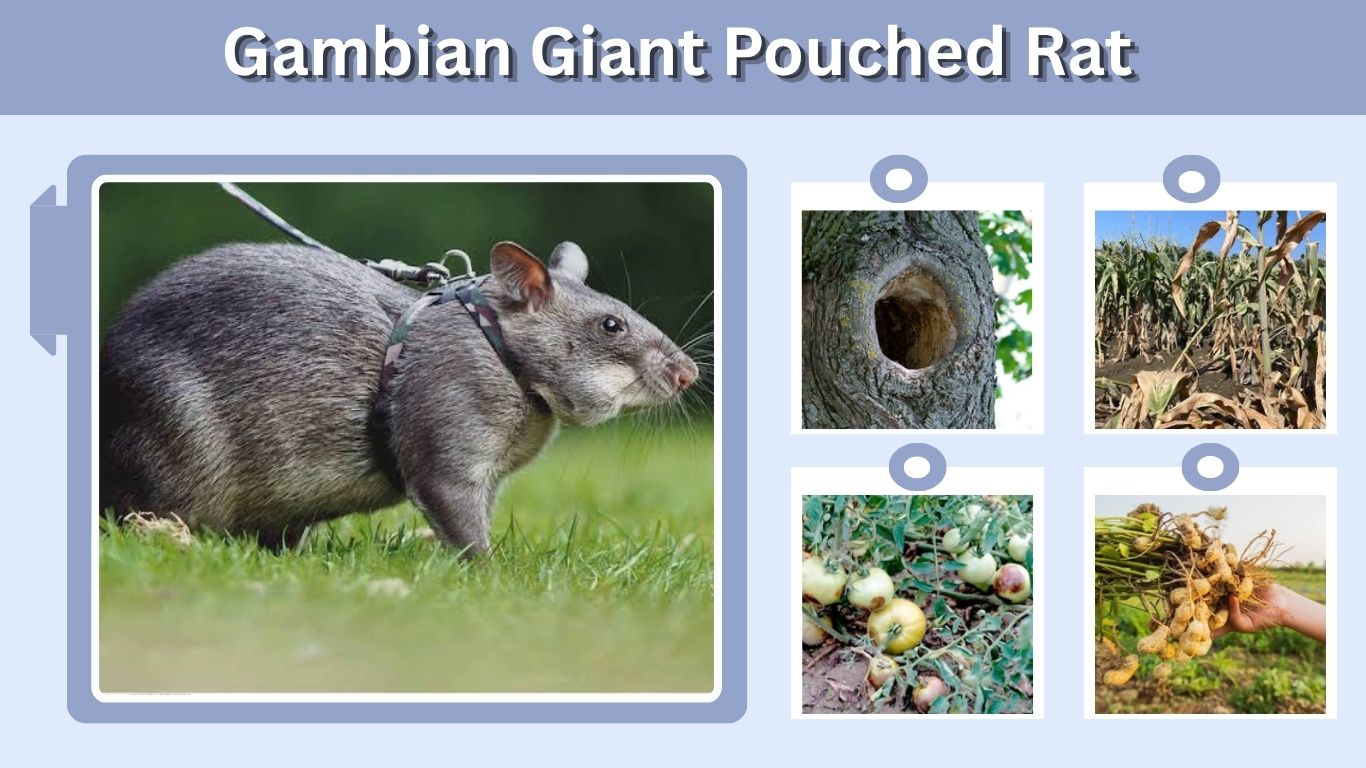
The Gambian giant pouched rat is an unusually large African rodent recognized by its long tail, powerful sense of smell, and expandable cheek pouches. Although its name contains “rat,” it is not simply an oversized version of the common pet rat. This intelligent, mostly nocturnal animal has specialized behaviors, demanding care requirements, and a controversial history in Florida. It has also gained attention for helping humans detect landmines and disease samples.
What Is a Gambian Giant Pouched Rat?
The Gambian giant pouched rat, scientifically known as Cricetomys gambianus, belongs to the family Nesomyidae. It is one of several African giant pouched-rat species, so the broader name “African giant pouched rat” is sometimes used for related animals as well.
Appearance and Identification
A Gambian pouched rat can be identified by the following characteristics:
- Grayish-brown or dark brown upper fur
- Cream, gray or off-white underside
- Large, rounded ears
- Pointed muzzle with long whiskers
- Large internal cheek pouches
- Long, nearly hairless tail
- Pale or off-white coloring on the last part of the tail
- Strong feet adapted for digging and climbing
Its expandable cheek pouches are used to carry food back to a burrow or hiding place. This behavior resembles that of a hamster, although the two animals are not closely related.
How Big Does It Get?
The Gambian giant pouched rat is among the world’s largest rat-like rodents. An average adult weighs approximately three pounds and measures about 20 to 35 inches from its nose to the end of its tail. Exceptional individuals may be considerably heavier.
| Feature | Typical Description |
| Total length | Approximately 20–35 inches |
| Average weight | Around 3 pounds |
| Maximum reported weight | Up to 9 pounds |
| Tail | About 14–18 inches |
| Coat | Gray to brown with a lighter belly |
| Activity pattern | Primarily nocturnal |
Despite comparisons to a house cat, much of its impressive total length comes from its tail.
Gambian Giant Pouched Rat Natural Habitat and Range
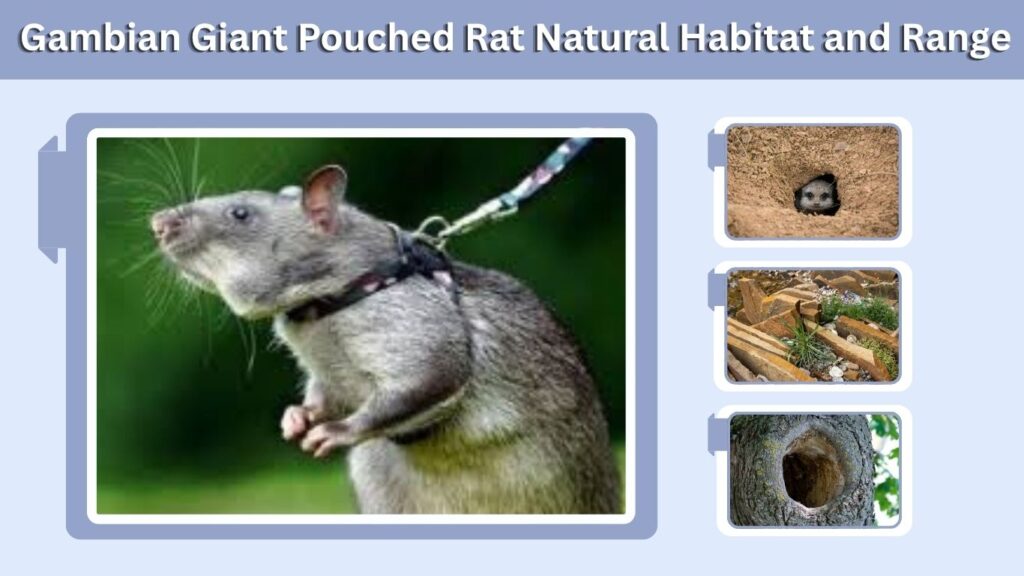
Gambian giant pouched rats are native to parts of sub-Saharan Africa. They are adaptable rodents that can occupy forests, thickets, savannas, agricultural areas and places near human settlements.
Where Do They Live?
In their native range, these rats shelter in:
- Underground burrows
- Natural rock crevices
- Hollow trees
- Abandoned termite mounds
- Spaces beneath buildings
- Dense vegetation near food sources
They are capable climbers and swimmers, but they spend much of their active time foraging on or near the ground. They are mainly nocturnal and normally leave their shelters after dark.
Behavior
Gambian pouched rats are intelligent, cautious and strongly influenced by scent. Wild individuals are often solitary and territorial, especially around their nests. They can climb more than six feet and quickly adjust their behavior when introduced to unfamiliar surroundings.
Their excellent sense of smell is one reason related African giant pouched rats can be trained for scent-detection work.
What Do Gambian Giant Pouched Rats Eat?
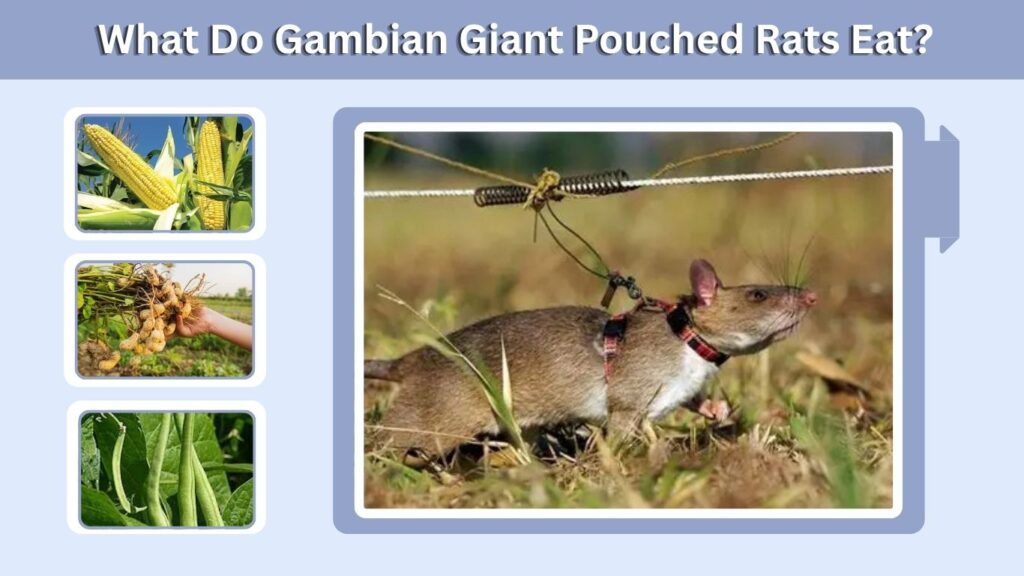
The Gambian giant pouched rat is an omnivore with a varied diet. It gathers food in its cheek pouches, returns to a protected location and stores the food for later consumption.
Natural Diet
Common foods include fruits, nuts, seeds, roots, tubers, insects, termites, snails and other small invertebrates. Individuals living near people may also consume livestock feed, garbage or pet food left outdoors.
| Food category | Examples |
| Fruits | Bananas and locally available fruits |
| Vegetables | Sweet potatoes, cassava and other roots |
| Seeds and grains | Maize, beans, nuts and seeds |
| Animal protein | Insects, termites, snails and fish |
| Opportunistic foods | Pet food and discarded human food |
Captive working rats managed by APOPO receive a balanced diet containing grains, maize, vegetables, fruits, fish, nuts and formulated rodent pellets.
Gambian Giant Pouched Rat Lifespan
A well-managed Gambian giant pouched rat generally lives much longer than a domesticated fancy rat. Captive animals commonly reach approximately seven or eight years of age, although individuals can occasionally live longer.
APOPO reports that its trained pouched rats live around eight years on average, with one recorded individual reaching 11 years. Working rats are usually retired when age or declining health affects their performance.
Lifespan is influenced by diet, genetics, exercise, enclosure quality, stress and access to veterinary treatment.
Can Gambian Giant Pouched Rats Be Pets?
Some captive-raised individuals can become comfortable around people, but that does not make the species suitable for an average household. They are powerful, intelligent exotic rodents with requirements that are significantly different from those of domesticated rats.
Pet Care Challenges
A potential owner would need to consider:
- A very large, escape-resistant enclosure
- Strong materials that cannot be easily chewed
- Daily exercise and mental stimulation
- Protection from unsuitable temperatures
- A varied and nutritionally balanced diet
- Access to a veterinarian experienced with exotic mammals
- Safe handling and early socialization
- A commitment that may last eight years or longer
Although socialized pouched rats may accept handling, they remain strong animals capable of delivering a serious bite when frightened, territorial or improperly restrained.
Are Gambian Giant Pouched Rats for Sale Legally?
Laws vary significantly by country, state and municipality. Buyers should never assume that an online advertisement is legal or that the seller is reputable.
Florida classifies Cricetomys gambianus as a prohibited nonnative species. Possession there is generally limited to qualified entities involved in research, educational exhibition, eradication or control. It therefore cannot normally be purchased as a personal pet in Florida.
Prospective owners outside Florida should consult wildlife, agricultural and public-health authorities before contacting a breeder or seller.
Gambian Giant Pouched Rats in Florida
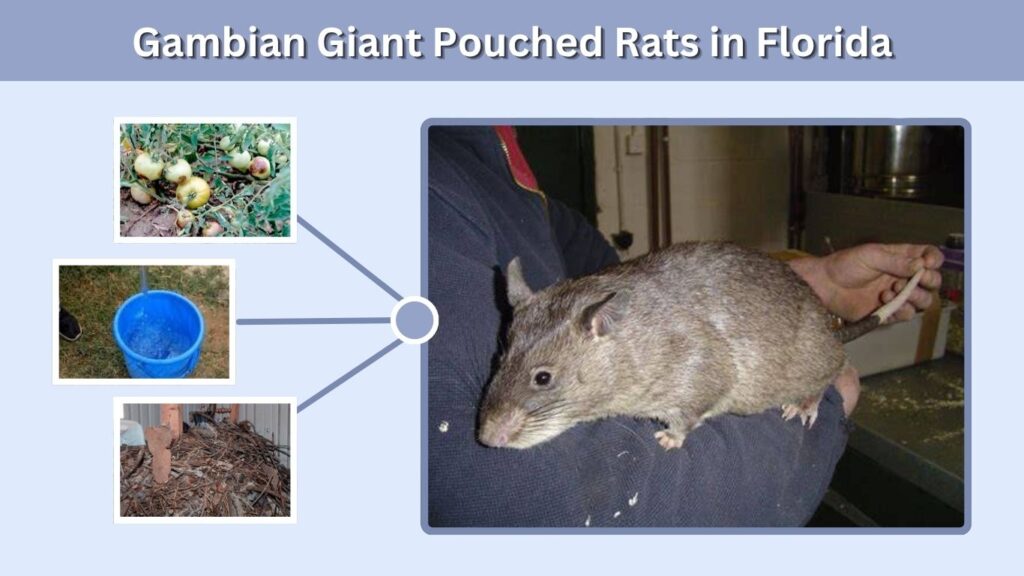
A reproducing population was documented on Grassy Key in the Florida Keys after animals associated with the exotic-pet trade escaped or were released. Researchers confirmed North America’s first established breeding population in 2004.
Why Are They a Concern?
Wildlife authorities are concerned that these rats could:
- Damage fruit, vegetable and other agricultural crops
- Compete with smaller native rodents
- Eat food intended for pets or wildlife
- Damage buildings while seeking shelter
- Spread to additional islands or mainland Florida
- Introduce parasites or diseases
Confirmed Florida sightings have been concentrated in the Florida Keys, with breeding documented on Grassy Key. Florida authorities continue to classify the animal as nonnative and prohibited.
People should not capture, transport or keep a suspected Gambian pouched rat. A sighting in Florida should be reported to the Florida Fish and Wildlife Conservation Commission.
How to Make a Gambian Giant Pouched Rat Drawing
Begin a Gambian giant pouched rat drawing with a long oval for the body and a smaller tapered shape for the head. Add large rounded ears, a pointed nose and long whiskers. Draw short but sturdy legs beneath the body.
The tail should be almost as long as the body and relatively hairless. Add a lighter section near its tip. Finish the drawing with gray-brown shading on the back, a pale belly and subtle lines around the cheeks to suggest its expandable food pouches.
How Do Giant Pouched Rats Help People?
African giant pouched rats have an exceptional sense of smell and can be trained through positive reinforcement. APOPO trains pouched rats to identify target scents associated with explosives or tuberculosis samples.
Their relatively light weight allows trained rats to search areas containing pressure-activated landmines without normally being heavy enough to trigger them. APOPO states that its operational males generally weigh no more than about 1.5 kilograms.
FAQs
Are Gambian giant pouched rats aggressive?
They are generally shy and cautious, but they can become defensive around a nest, food supply or hiding place. A frightened or poorly socialized animal may bite. Their large size and strength mean they require more careful handling than an ordinary domesticated rat.
Is a Gambian pouched rat the same as a regular rat?
No. It belongs to a different family from common brown rats and domesticated fancy rats. It also has larger cheek pouches, a much greater body size, a longer lifespan and different housing, dietary and behavioral requirements.
How much food can it carry in its cheek pouches?
The exact amount varies according to the rat’s size and the food being collected. Its pouches can expand considerably, allowing it to gather several pieces during one trip before returning to a burrow to store or eat them.
Can Gambian giant pouched rats climb?
Yes. They are strong and capable climbers that can scale trees, branches, cages and rough structures. Animal Diversity Web reports that they can climb more than two meters, which makes a secure roof and escape-resistant enclosure essential in captivity.
Are Gambian giant pouched rats endangered?
The species is not generally discussed as a critically endangered animal. However, local populations may face hunting and habitat pressures. Its conservation situation should not be confused with Florida, where it is considered a harmful nonnative species rather than protected native wildlife.