
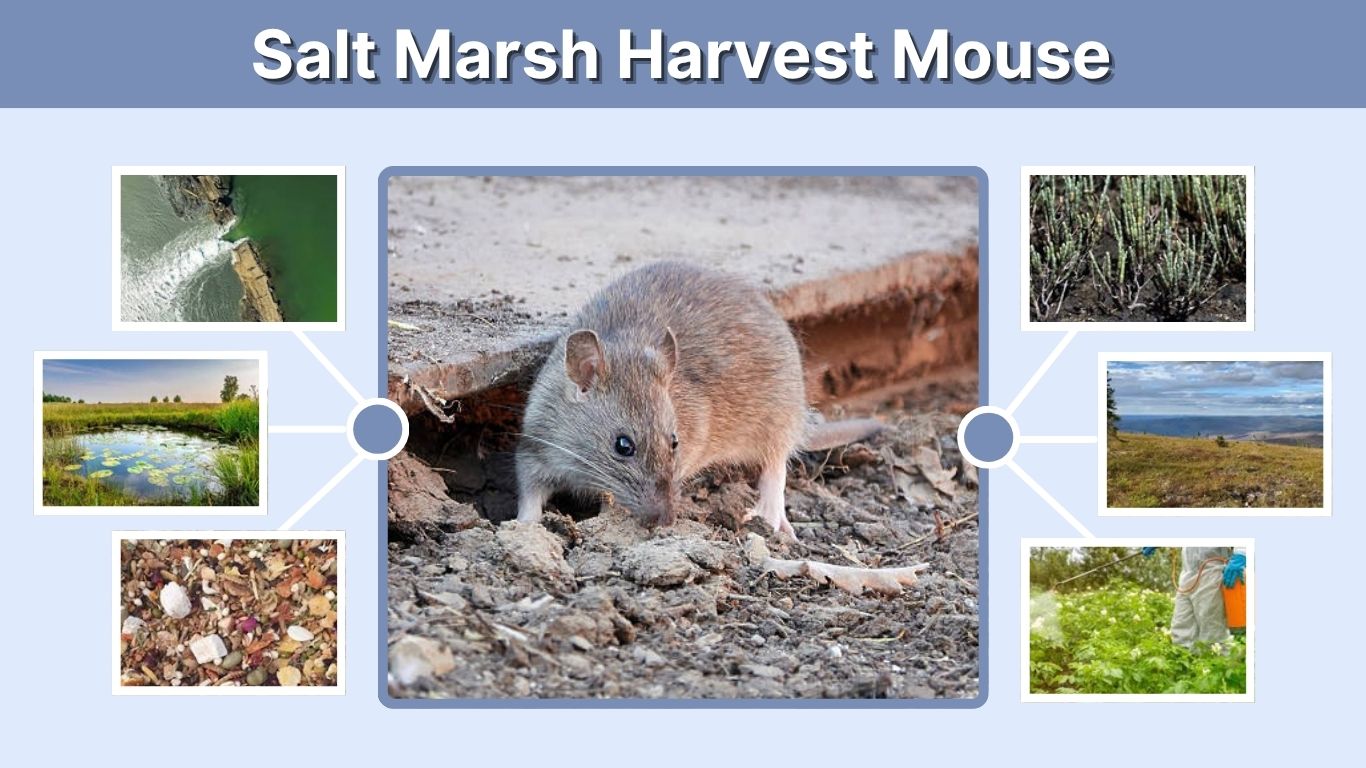
The salt marsh harvest mouse is one of the most specialized mammals in California. Tiny, secretive, and closely tied to pickleweed marshes, this endangered rodent lives only in the San Francisco Bay region. Although it may look like an ordinary mouse, its habitat, diet, adaptations, and conservation story make it an important symbol of wetland survival and restoration.
What Is the Salt Marsh Harvest Mouse?
The salt marsh harvest mouse, also called the red-bellied harvest mouse, is a small native rodent with the scientific name Reithrodontomys raviventris. It belongs to the mammal group and is part of the harvest mouse genus. Unlike common house mice, this species is not a household pest. It is a rare wild animal adapted to tidal marshes, brackish wetlands, and pickleweed-dominated vegetation.
There are two recognized subspecies. The northern salt marsh harvest mouse lives around San Pablo Bay and Suisun Bay, while the southern subspecies occurs around parts of central and South San Francisco Bay, including marshes near Corte Madera, Richmond, and the South Bay. Both are protected because their habitat has been greatly reduced.
Salt Marsh Harvest Mouse Characteristics
This mouse is small, usually only a few inches long, with brownish fur and a darker back. One of its most recognizable features is its underside. The southern subspecies often has a cinnamon or reddish belly, which is why people sometimes call it the red-bellied harvest mouse. The northern subspecies may have a paler or whitish belly.
It can be difficult to identify in the field because it closely resembles the western harvest mouse. This is why trained biologists often use careful field methods, measurements, and sometimes genetic tools to confirm identification.
Salt Marsh Harvest Mouse Habitat
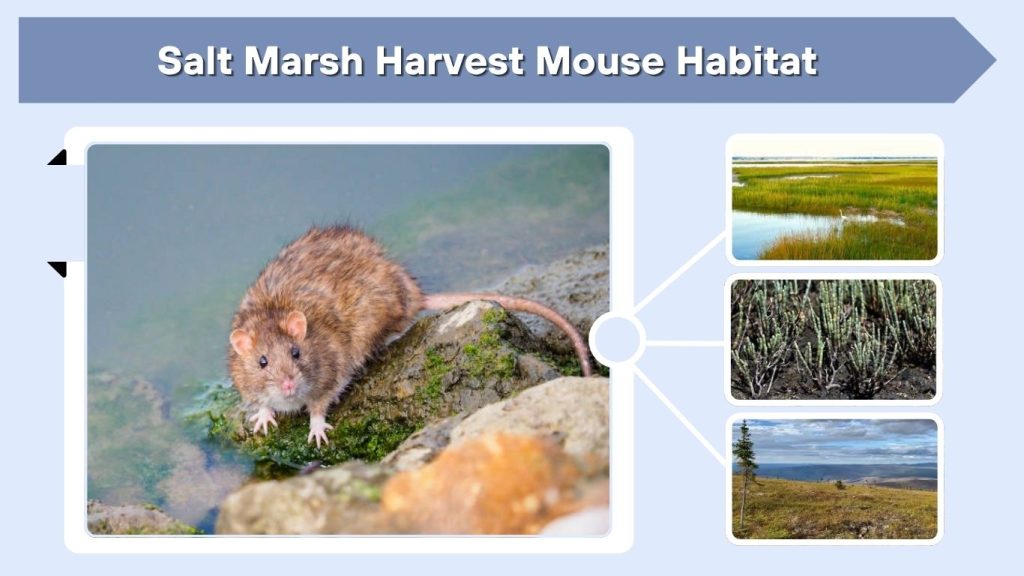
The salt marsh harvest mouse habitat is very specific. It depends on coastal marshes, especially areas with dense pickleweed, bulrush, gumplant, and other wetland plants. These marshes are found where freshwater and saltwater mix around the San Francisco Bay Estuary.
This habitat is important because it provides food, cover, nesting material, and protection from predators. Pickleweed is especially valuable because it forms thick vegetation where mice can move, hide, climb, and feed.
Why Pickleweed Matters
Pickleweed is one of the most important plants in the salt marsh harvest mouse’s life. Dense pickleweed helps shelter the mouse from predators such as owls, hawks, snakes, and cats. It also provides food and a structure for movement during daily activity.
During high tides, marsh areas can flood. The mouse needs nearby high-tide refuge, such as taller vegetation, gumplant, or upland edges where it can escape rising water. Marshes that flood completely without escape cover are less suitable, even if they contain some vegetation.
Range and Distribution
The salt marsh harvest mouse range is limited to the San Francisco Bay Area and nearby estuarine marshes. Historically, it likely occupied much larger areas of tidal marsh around San Francisco Bay, San Pablo Bay, and Suisun Marsh. Today, many of those wetlands have been filled, diked, drained, converted to salt ponds, developed, or isolated.
Because of this, the species now occurs in smaller and more fragmented populations. Fragmentation is a major problem because mice may not be able to safely move between isolated marsh patches.
Salt Marsh Harvest Mouse Diet
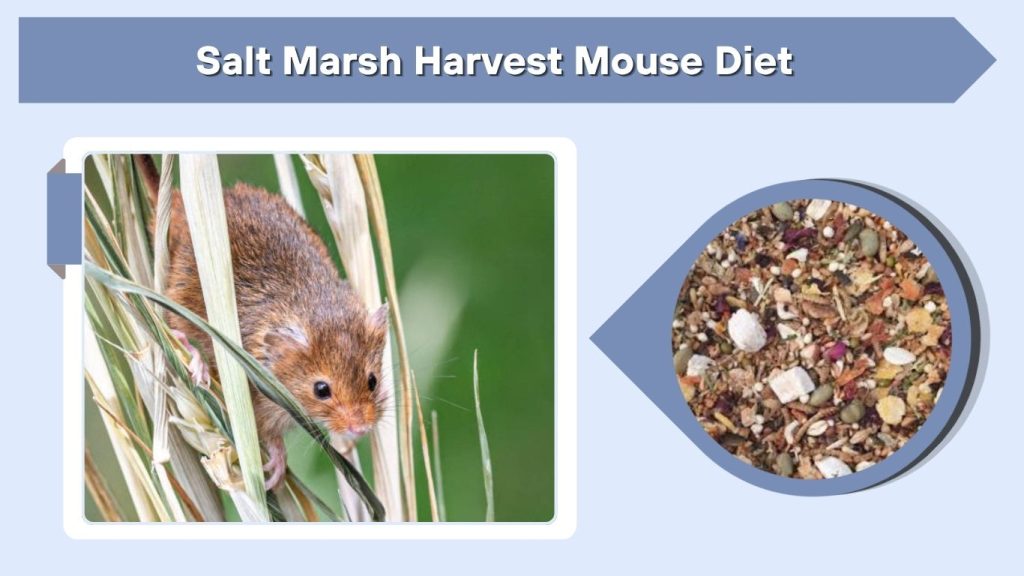
The salt marsh harvest mouse diet is mostly plant-based. It feeds on pickleweed and other marsh plants, along with grasses, seeds, forbs, and sometimes insects. Its ability to live in salty habitats is one of its most important adaptations.
Unlike many rodents, this mouse can tolerate salty food and water better than many potential competitors. This helps it survive in marshes where salinity can be high and where other small mammals may struggle.
Food Chain and Food Web Role
In the salt marsh harvest mouse food chain, the mouse acts as both a plant consumer and prey animal. It eats marsh vegetation and seeds, then becomes food for larger predators.
In a simple salt marsh harvest mouse food web:
- Pickleweed, grasses, and seeds provide food for the mouse.
- The mouse helps transfer plant energy into the animal food web.
- Predators such as owls, hawks, snakes, foxes, and cats may prey on it.
- Marsh plants provide shelter that helps the mouse avoid predation.
- Wetland health affects every part of the food web.
This makes the mouse an important indicator species. When salt marsh harvest mouse populations decline, it can signal deeper problems in the marsh ecosystem.
Salt Marsh Harvest Mouse Adaptations
The salt marsh harvest mouse has several special adaptations that help it survive in a difficult wetland environment. Its world includes tides, salty water, thick vegetation, predators, and changing marsh conditions.
Three Special Adaptations
The first major adaptation is salt tolerance. The mouse can handle salty food and water better than many other small mammals. This helps it live in brackish and saline marshes.
The second adaptation is climbing ability. When tides rise, the mouse can climb vegetation to avoid floodwater. Dense pickleweed, bulrush, and gumplant can provide escape routes.
The third adaptation is swimming. Although it prefers vegetation cover, the mouse can swim when needed. This is useful in a habitat where water levels change with tides and storms.
Behavioral Adaptations
The salt marsh harvest mouse is often most active at night, which helps reduce exposure to predators and heat. It moves through plant cover rather than open ground. It also nests above ground instead of burrowing, using loose grasses and sedges.
These behavioral adaptations work only when suitable marsh vegetation remains intact. If marsh plants are removed, thinned, or flooded too often, the mouse loses both food and shelter.
Salt Marsh Harvest Mouse Reproduction and Life Cycle
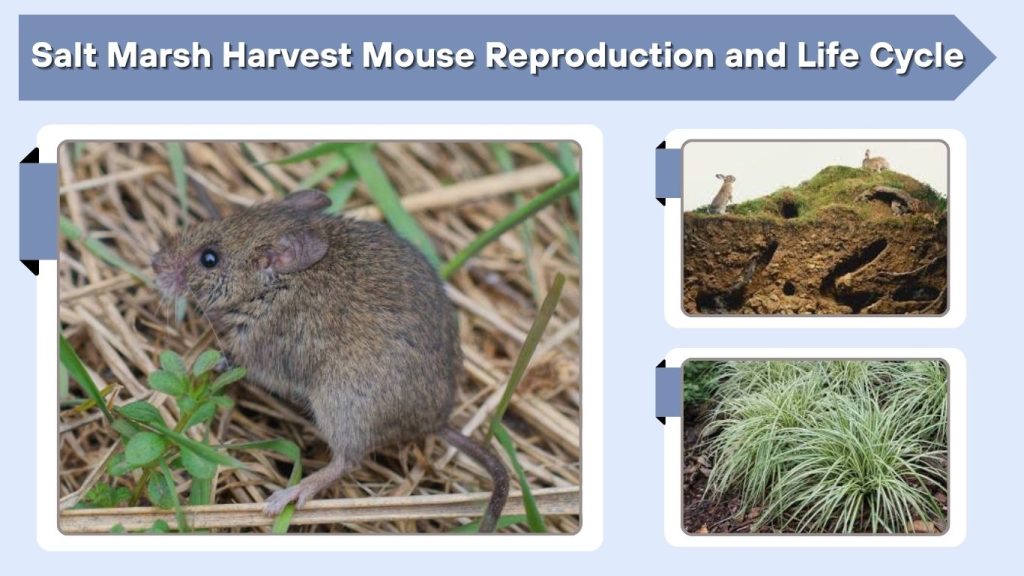
The salt marsh harvest mouse breeding season generally runs from spring through fall. Females can produce litters during the breeding period, with typical litters of around four young. Baby salt marsh harvest mice are born helpless and depend on the mother in their early development.
The salt marsh harvest mouse lifespan is short, often around 8 to 12 months in the wild. Because individuals do not live long, successful reproduction each year is important for population survival. If habitat conditions are poor for even one season, local populations can suffer.
Nesting and Maturation
The salt marsh harvest mouse nest is usually a loose structure made of dry grasses and sedges. Unlike many rodents, it does not dig burrows. This makes dense vegetation and dry refuge areas especially important.
Young mice mature quickly, as many small rodents do. However, survival depends heavily on weather, tides, predators, and available cover. In fragmented marshes, young mice may have difficulty dispersing safely to new habitat.
Why Is the Salt Marsh Harvest Mouse Endangered?
The salt marsh harvest mouse is endangered mainly because its habitat has been lost, degraded, and fragmented. Around San Francisco Bay, many tidal wetlands were historically converted for agriculture, urban growth, salt production, roads, levees, and other human uses.
Today, the species faces both old and new threats. Some marshes are too small, too isolated, or too frequently flooded. Others lack high-tide refuge. Climate change and sea-level rise add more pressure by threatening to drown marshes that cannot migrate inland.
| Main Threat | How It Affects the Mouse |
| Habitat loss | Removes pickleweed marshes needed for food and shelter |
| Fragmentation | Isolates populations and limits safe movement |
| Sea-level rise | Increases flooding and reduces dry refuge areas |
| Pollution | Degrades wetland quality and food sources |
| Invasive plants | Changes marsh structure and native vegetation |
| Predators | Cats and other predators can be a serious risk near developed areas |
Endangered Species Status
The salt marsh harvest mouse is listed as endangered under federal and California endangered species protections. It was listed decades ago, making it one of the long-recognized endangered mammals of the Bay Area.
A common question is whether salt marsh harvest mouse critical habitat has been designated. Although the species is endangered, federal critical habitat has not been designated. This makes habitat protection, restoration planning, and careful land management especially important.
Salt Marsh Harvest Mouse Recovery Plan
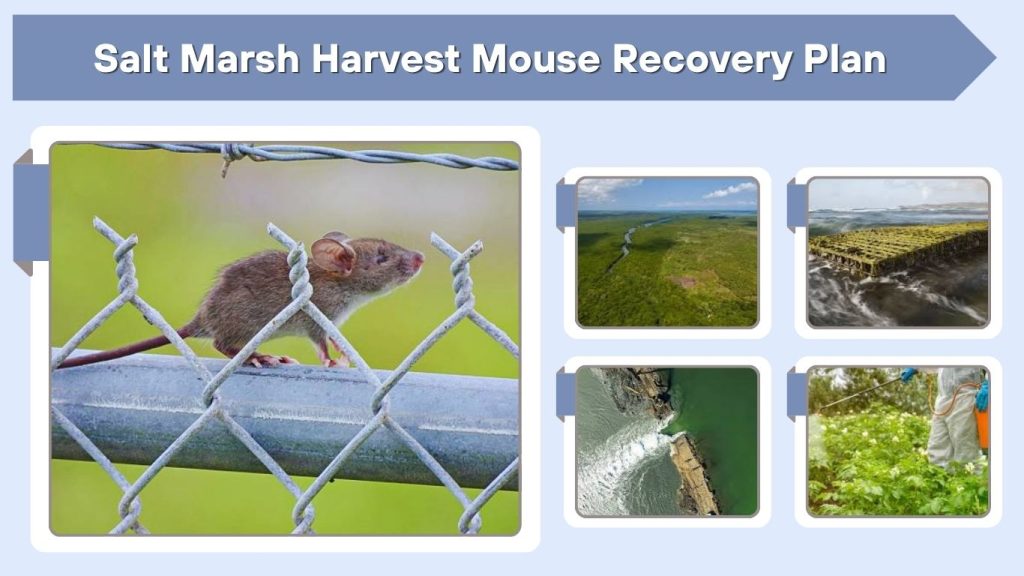
The salt marsh harvest mouse recovery plan focuses on protecting, restoring, and managing tidal marsh ecosystems. Recovery is not just about saving individual mice. It requires rebuilding connected marsh landscapes that include dense vegetation, high-tide refuge, natural tidal processes, and room for marshes to respond to sea-level rise.
Recovery Goals
Important recovery actions include:
- Protecting existing marsh habitat from development and degradation.
- Restoring former salt ponds and diked wetlands where possible.
- Creating high-tide refuge with suitable vegetation.
- Reducing habitat fragmentation between marsh patches.
- Monitoring populations through surveys and genetic tools.
- Managing invasive plants and predator pressure.
- Planning for sea-level rise and future marsh migration.
Large wetland restoration projects in the San Francisco Bay region are important because they can create more habitat for the salt marsh harvest mouse and other native species. However, restoration must be designed carefully. A restored marsh may take time to develop the dense vegetation and refuge structure the mouse needs.
Population, Surveys, and Current Outlook
The salt marsh harvest mouse population is difficult to estimate. The animal is small, secretive, and hard to distinguish from similar species. Traditional live-trapping surveys require expertise, permits, and careful handling. Newer genetic methods, including noninvasive DNA sampling, are helping scientists better understand where the species occurs.
The current outlook is cautious. The species remains endangered, and habitat loss is still the central issue. However, Bay Area wetland restoration, improved research, and stronger conservation planning offer hope. If marshes are restored with enough elevation, vegetation, and connectivity, the mouse has a better chance of long-term survival.
Cool Facts About the Salt Marsh Harvest Mouse
The salt marsh harvest mouse may be tiny, but it has many interesting features. These facts make it a popular subject for students, wildlife projects, and conservation education.
- It is found only in the San Francisco Bay region.
- It is one of the few mammals strongly tied to coastal salt marsh habitat.
- It can tolerate salty food and water.
- It can climb marsh plants to escape high tides.
- It can swim when needed.
- It does not live like a house mouse and should never be kept as a pet.
- It plays a role in the salt marsh food web.
- Its survival depends heavily on pickleweed and high-tide refuge.
- It is difficult to identify without expert training.
- It is a symbol of Bay Area wetland conservation.
Salt Marsh Harvest Mouse vs House Mouse
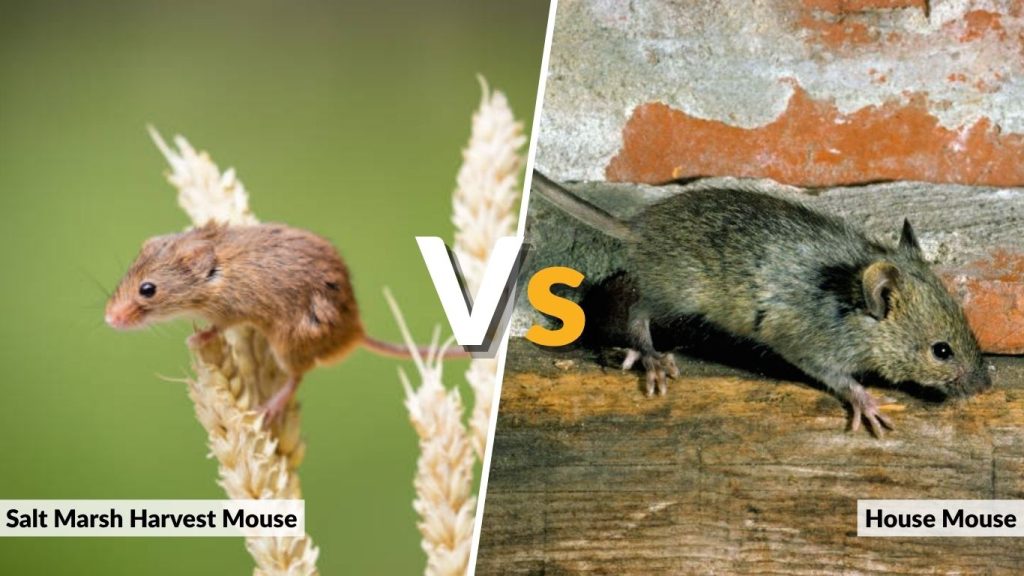
People sometimes compare the salt marsh harvest mouse pet vs house mouse idea, but these animals are very different. A house mouse can live near people, inside buildings, and around stored food. The salt marsh harvest mouse is a protected wild species that belongs in marsh habitat.
It is illegal and harmful to capture or keep endangered wildlife as a pet. The salt marsh harvest mouse needs a complex wetland ecosystem, not a cage. Its food, shelter, behavior, and survival are tied to natural marsh conditions.
How to Help the Salt Marsh Harvest Mouse
Protecting the salt marsh harvest mouse means protecting the wetlands it depends on. Even people who never see one can support its recovery by helping conserve Bay Area marshes.
Practical Ways to Help
You can help by supporting wetland restoration groups and public agencies that protect tidal marshes. Staying on trails in wildlife refuges also reduces disturbance to sensitive habitat. Keeping cats indoors near marsh areas can protect small wildlife. Reducing pollution, pesticides, and trash helps improve wetland health.
Students can help by learning about endangered species, creating accurate food web projects, and sharing facts about why marshes matter. Community members can attend local planning meetings when wetland restoration, shoreline development, or sea-level rise adaptation projects are discussed.
FAQs
What is the salt marsh harvest mouse?
The salt marsh harvest mouse is a small endangered rodent native to the San Francisco Bay Area. Its scientific name is Reithrodontomys raviventris. It lives mainly in salt and brackish marshes, especially areas with dense pickleweed and nearby high-tide refuge.
What does the salt marsh harvest mouse eat?
The salt marsh harvest mouse diet is mostly plant-based. It eats pickleweed, grasses, seeds, forbs, and other marsh vegetation. It may also eat some insects. Its ability to tolerate salty food and water helps it survive in saline marsh habitat.
Why is the salt marsh harvest mouse endangered?
The salt marsh harvest mouse is endangered because much of its wetland habitat has been lost, diked, filled, fragmented, or degraded. Sea-level rise, pollution, invasive plants, lack of high-tide refuge, and isolated marsh patches continue to threaten its survival.
Where does the salt marsh harvest mouse live?
It lives only in the San Francisco Bay region of California, including salt and brackish marshes around San Francisco Bay, San Pablo Bay, and Suisun Bay. Its range is closely linked to pickleweed marshes and other dense tidal wetland vegetation.
Can you keep a salt marsh harvest mouse as a pet?
No. The salt marsh harvest mouse is an endangered wild animal and is protected by law. It should never be captured, handled, or kept as a pet. It belongs in natural marsh habitat where it can feed, reproduce, and support the wetland food web.