
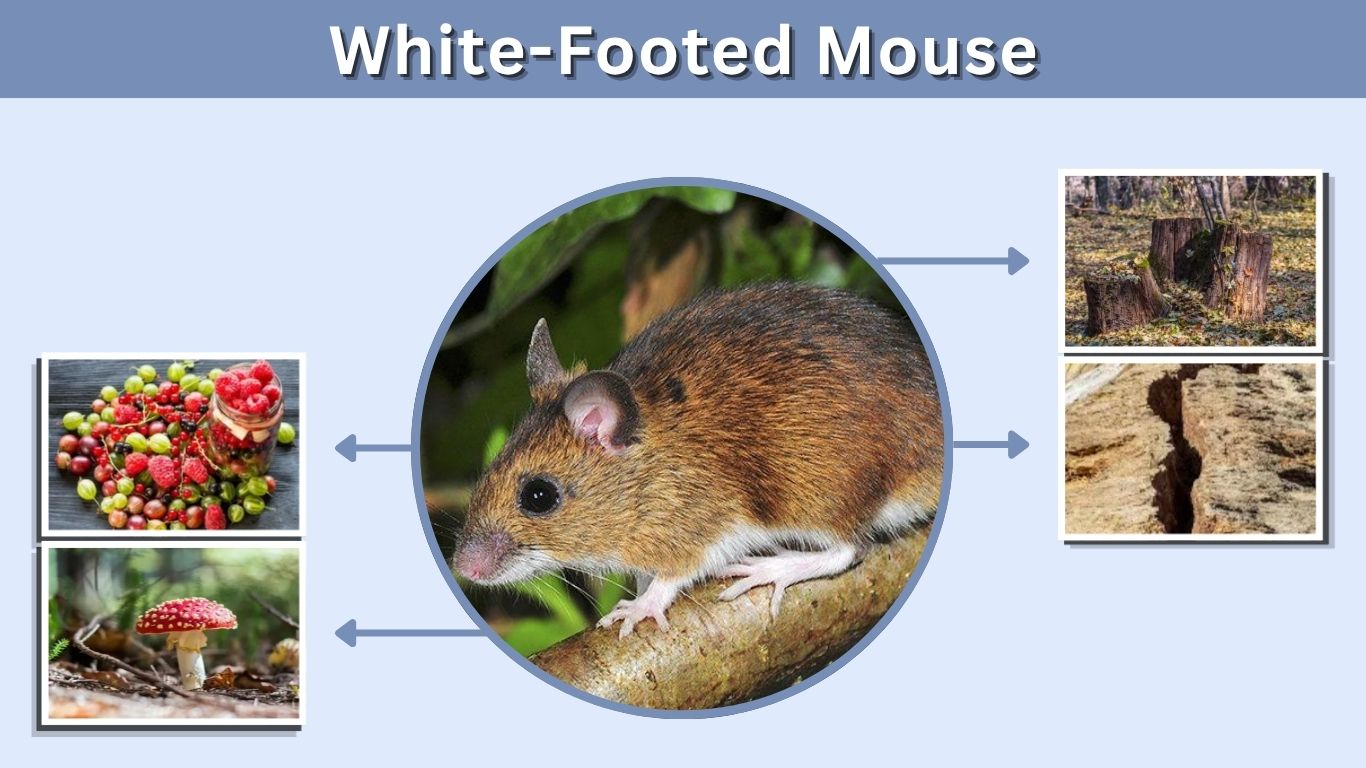
The white-footed mouse is a small North American rodent named for its bright white feet and pale underside. With large black eyes, rounded ears, and brown upper fur, it closely resembles the deer mouse. Although it usually lives in forests and brushy habitats, it may enter houses, garages, sheds, and cabins in search of warmth, food, and nesting material.
What Is a White-Footed Mouse?
The white-footed mouse, scientifically known as Peromyscus leucopus, belongs to the same genus as deer mice. It is not a true house mouse, even though it occasionally lives near people.
This species is widespread across much of eastern and central North America, extending from southern Canada through large portions of the United States and into Mexico. It is especially common in mixed forests, woodland edges, brushland, farmland borders, and suburban areas.
Scientific Classification
| Classification | Name |
| Kingdom | Animalia |
| Class | Mammalia |
| Order | Rodentia |
| Family | Cricetidae |
| Genus | Peromyscus |
| Species | Peromyscus leucopus |
The terms “white-footed deer mouse” and “white-footed field mouse” are sometimes used informally, but the standard common name is white-footed mouse.
White-Footed Mouse Identification
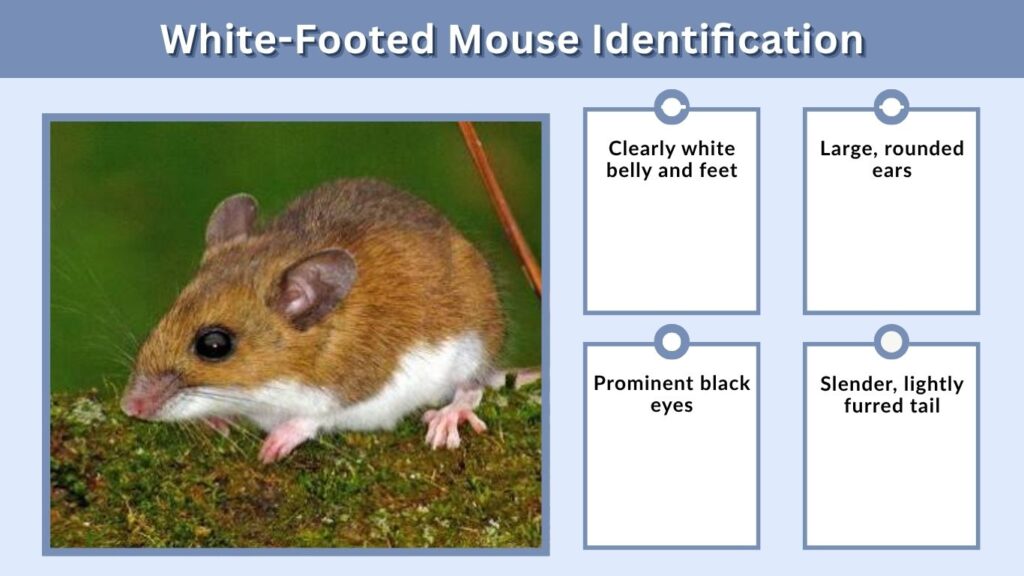
White-footed mice have a neat, two-toned appearance. Their backs and sides are usually reddish-brown, tan, or grayish-brown, while their bellies, feet, and lower legs are white.
Physical Characteristics
- Reddish-brown or warm brown upper fur
- Clearly white belly and feet
- Large, rounded ears
- Prominent black eyes
- Pointed nose and long whiskers
- Slender, lightly furred tail
- Sharp division between the brown back and white underside
Adults generally measure about 5.9 to 8.1 inches from the nose to the end of the tail. The tail accounts for approximately 2.6 to 3.7 inches of that length. Most adults weigh between 15 and 25 grams.
White-Footed Mouse Droppings
Their droppings are small, dark, and usually shaped like grains of rice, often with one pointed end. Droppings may be discovered in drawers, cabinets, attics, storage boxes, garages, or along walls.
Droppings alone cannot reliably identify the exact mouse species. However, fresh droppings appearing after an area has been cleaned usually indicate active rodent activity.
White-Footed Mouse vs Deer Mouse
White-footed and deer mice look so similar that identification from a photograph can be difficult. Both have large eyes, brown upper fur, white bellies, and white feet.
| Feature | White-footed mouse | Deer mouse |
| Scientific name | Peromyscus leucopus | Peromyscus maniculatus |
| Upper fur | Often reddish or orangish-brown | Often grayish or cooler brown |
| Tail | Usually shorter and less sharply divided | Often longer and strongly two-toned |
| Preferred habitat | Woodlands and brushy areas | Forests, grasslands and open country |
| Range | Mainly eastern and central North America | Distributed widely across North America |
The deer mouse commonly has softer gray-brown fur and a strongly bicolored tail that may equal or exceed its head-and-body length. White-footed mice often appear warmer or more reddish in color. However, coat color varies, and professional examination may be required for a certain identification.
White-Footed Mouse vs House Mouse

A house mouse usually has more uniform gray or brown fur without a sharply white belly. Its eyes and ears also appear smaller relative to its head, and its tail looks more naked and scaly.
White-footed mice generally have:
- Larger, darker eyes
- More noticeable rounded ears
- A distinctly white belly
- White feet and lower legs
- A clearer contrast between upper and lower fur
House mice are strongly associated with buildings throughout the year. White-footed mice are primarily wild woodland animals, although they may enter buildings when outdoor conditions become unfavorable.
White-Footed Mouse Habitat and Range

White-footed mice favor warm, dry forests and brushy habitats. They are also found along woodland edges, in overgrown fields, around farms, beside streams, and in suburban yards with dense vegetation.
They commonly build nests in:
- Hollow trees
- Fallen logs and stumps
- Rock crevices
- Abandoned bird nests
- Underground burrows
- Woodpiles and brush piles
- Attics, wall spaces and storage buildings
Their ability to climb allows them to use elevated nest sites that are unavailable to many other ground-dwelling rodents.
What Does a White-Footed Mouse Eat?

The white-footed mouse is an omnivore. Its diet changes according to season and local food availability.
Common Foods
White-footed mice eat:
- Acorns
- Seeds and grains
- Nuts
- Berries
- Fruits
- Fungi
- Beetles
- Caterpillars
- Other insects
- Spiders
- Occasional animal remains
They often collect excess seeds and nuts and store them in hidden caches for later use. This habit helps them survive winter and other periods when fresh food is scarce.
White-footed mice are important members of woodland food webs. They consume seeds and insects while providing food for owls, hawks, foxes, snakes, weasels, bobcats, and other predators.
Behavior and Drumming
White-footed mice are mainly nocturnal, so they are most active after sunset. During the night, they search for food, defend nesting areas, and move through vegetation.
They are capable climbers and swimmers and possess a strong ability to return to familiar territory. They are generally solitary, although their home ranges may overlap.
Why Do White-Footed Mice Drum?
One of their most unusual behaviors is drumming. A mouse may rapidly tap its front feet against a dry leaf, hollow stem, or similar surface, producing a buzzing or vibrating sound.
Researchers have documented this behavior, but its precise purpose remains uncertain. It may be associated with communication, territorial behavior, excitement, or warning signals.
Life Cycle and Reproduction
White-footed mice may reproduce several times during favorable seasons. Breeding periods vary by region, climate, and food availability.
After a short pregnancy, the female gives birth in a protected nest. A litter often contains several babies, although the number can vary.
Baby White-Footed Mouse
Newborn mice are:
- Blind
- Hairless
- Pink
- Unable to regulate themselves effectively
- Completely dependent on their mother
Their ears usually open at about 10 days, followed by their eyes at approximately 12 days. The mother nurses and protects them until they are weaned. She may carry babies individually to another nest when danger threatens.
White-Footed Mouse Lifespan
Most white-footed mice live for approximately one year in the wild. Predators, severe weather, parasites, disease, and limited food all contribute to their short natural lifespan.
Individuals protected in captivity may survive several years, with lifespans of around three years recorded.
White-Footed Mouse Ticks and Lyme Disease
White-footed mice are important reservoir hosts for the bacteria responsible for Lyme disease in parts of eastern North America. Young blacklegged ticks may acquire the bacteria while feeding on infected mice and later transmit them during another blood meal.
People do not normally contract Lyme disease by touching a mouse. Human infection occurs primarily through the bite of an infected tick. Nevertheless, yards with abundant mice may support the tick life cycle, particularly where leaf litter, brush, stone walls, and dense vegetation provide shelter.
Can White-Footed Mice Carry Hantavirus?
White-footed mice can carry New York orthohantavirus, a virus associated with rare human infections in parts of the northeastern United States. However, the deer mouse is more strongly associated with Sin Nombre virus, the leading cause of hantavirus pulmonary syndrome in the United States.
Because it is impossible to determine whether a mouse carries disease by looking at it, avoid touching wild rodents, nests, urine, or droppings with bare hands.
White-Footed Mouse in the House
These mice may enter homes during autumn and winter or whenever they need a safe nesting location. Common signs include nighttime scratching, gnawed packaging, stored seeds, nesting material, and droppings.
To discourage them:
- Seal openings around pipes, vents, doors and foundations.
- Store food and pet food in hard, sealed containers.
- Remove clutter from attics, garages and basements.
- Keep firewood and brush away from exterior walls.
- Repair damaged screens and door sweeps.
- Use properly placed snap traps where mice are active.
Do not sweep or vacuum dry rodent waste. Safe cleanup and disinfection are important because contaminated dust can expose people to rodent-borne pathogens.
Can You Keep a White-Footed Mouse as a Pet?
Wild white-footed mice should not be kept as pets. They are easily stressed, may bite when handled, and can carry ticks, parasites, or infectious organisms. They also have specialized behavioral and environmental needs.
A healthy wild mouse should normally be left outdoors. An injured or truly orphaned baby should be handled as little as possible and transferred to a licensed wildlife rehabilitator.
FAQs
Are white-footed mice dangerous?
They are shy and normally avoid people, but they may contaminate food and surfaces with urine or droppings. They can also host ticks and certain disease-causing organisms. Avoid direct contact and use appropriate safety measures when cleaning an infested area.
How can you identify white-footed mouse tracks?
Tracks show four toes on the front feet and five on the hind feet. Their bounding movement may leave paired prints in snow or mud, sometimes accompanied by a thin tail mark. Tracks alone rarely allow certain species identification.
Do white-footed mice live in fields?
They may occupy brushy field edges, farmland borders and overgrown land, but they are particularly associated with wooded areas. This is why “white-footed field mouse” is descriptive rather than an official species name.
How many babies do white-footed mice have?
A female usually produces several babies in each litter and may raise multiple litters when weather and food conditions are favorable. Litter size and breeding frequency vary according to location, age, season and food availability.
What predators eat white-footed mice?
Common predators include owls, hawks, snakes, foxes, weasels, raccoons and domestic cats. Because they are abundant and reproduce quickly, white-footed mice are an important food source for many woodland predators.