

The striped field mouse is a small rodent recognized by the dark stripe running along the center of its back. The name usually refers to Apodemus agrarius, also called the black-striped field mouse. It occurs across large parts of Europe and Asia, including Korea and sections of China. However, people in South Africa may use the same name for a different animal—the four-striped grass mouse.
What Is a Striped Field Mouse?
The true striped field mouse belongs to the family Muridae and the genus Apodemus, a group of Old World field mice. Its scientific name is Apodemus agrarius. It is closely associated with grasslands, agricultural areas, woodland edges, wetlands, and other places where thick ground vegetation provides food and protection.
Scientific Classification
| Classification | Name |
| Kingdom | Animalia |
| Class | Mammalia |
| Order | Rodentia |
| Family | Muridae |
| Genus | Apodemus |
| Species | Apodemus agrarius |
The common names striped field mouse and black-striped field mouse both refer to this species.
Striped Field Mouse Identification
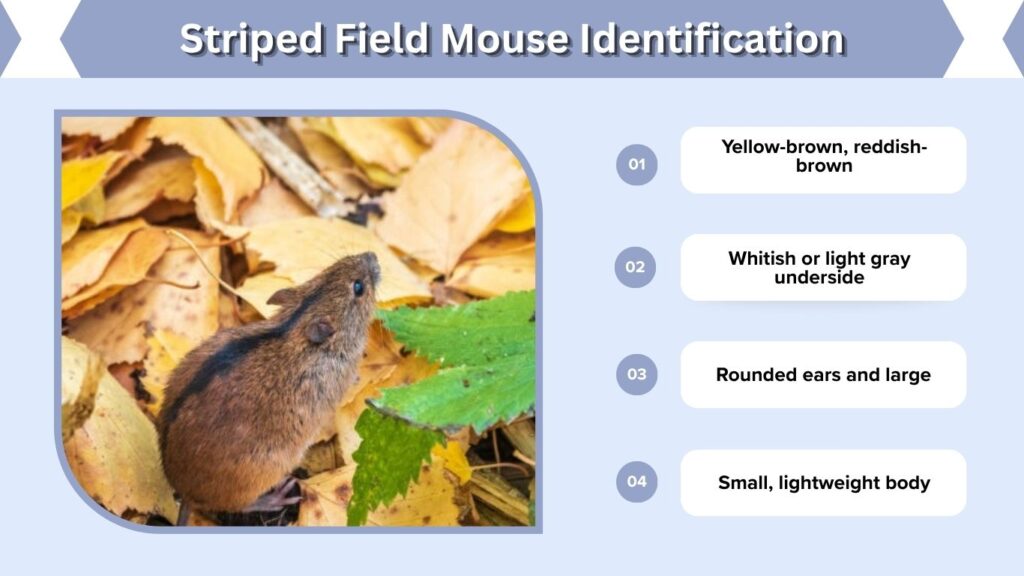
The most distinctive characteristic is a narrow, dark brown or black stripe extending from the head along the spine toward the base of the tail. This stripe contrasts strongly with the mouse’s yellowish-brown or reddish-brown upper coat.
Physical Characteristics
- Prominent black stripe down the middle of the back
- Yellow-brown, reddish-brown, or gray-brown upper fur
- Whitish or light gray underside
- Rounded ears and large, dark eyes
- Pointed snout with long whiskers
- Small, lightweight body
- Tail generally shorter than the head-and-body length
Published species descriptions report an average body mass of approximately 21.5 grams. Exact measurements vary geographically and among individual mice.
Field Mouse With Stripes vs Other Mice
Several rodents can appear striped, so the markings must be examined carefully. A true Apodemus agrarius normally has one solid stripe along its back. Juvenile mice may have less vivid coloring, but the dorsal stripe becomes easier to recognize as their coat develops.
Wood mice and house mice do not normally have such a sharply defined stripe. However, shadows, wet fur, coat variations, or unusual markings can sometimes make an ordinary mouse appear striped.
Where Do Striped Field Mice Live?

Striped field mice have a wide but somewhat separated distribution. They occur in Central and Eastern Europe, parts of Central Asia, southern Siberia, Korea, Manchuria, southeastern China, and Taiwan. Populations have also expanded into some new areas of Europe over recent decades.
Preferred Habitat
Striped field mouse habitats commonly include:
- Grassy fields and meadows
- Rice paddies and cultivated farmland
- Woodland edges
- Shrubby areas
- Wetlands and riverbanks
- Gardens and overgrown urban land
- Areas with dense weeds or ground vegetation
These mice are adaptable and can survive in both natural and human-modified environments. Agricultural fields provide seeds and crops, while thick vegetation gives them protection from predators.
Striped Field Mouse in South Korea and Jeju
The striped field mouse is widespread on the Korean Peninsula. Researchers have traditionally recognized several Korean populations or subspecies. The Jeju striped field mouse has historically been described as Apodemus agrarius chejuensis, although classification can differ among taxonomic sources.
Are Striped Field Mice Found in the UK?
The natural range of Apodemus agrarius does not normally include the United Kingdom. A striped mouse found in a British garden or field is more likely to be a wood mouse, house mouse, escaped captive rodent, or an individual with unusual coat markings. The striped field mouse is mainly distributed farther east in continental Europe and Asia.
Striped Field Mouse in South Africa
In South Africa, the term “striped field mouse” usually refers to an African striped mouse rather than Apodemus agrarius. The best-known example is the four-striped grass mouse of the genus Rhabdomys.
Four-Striped Field Mouse
The four-striped grass mouse has several dark lines running lengthwise along its back. It is commonly seen in grasslands, shrublands, fynbos, farmland, gardens, and protected areas in southern Africa.
Unlike the single-striped Apodemus agrarius, the African mouse displays four noticeable dark stripes separated by lighter fur. South African populations have a complicated taxonomy, and mice previously grouped under Rhabdomys pumilio may be classified differently depending on their location.
| Feature | Striped field mouse | Four-striped grass mouse |
| Scientific group | Apodemus agrarius | Rhabdomys species |
| Main range | Europe and Asia | Southern Africa |
| Back markings | One dark central stripe | Four dark stripes |
| Typical activity | Often active around dusk or night | Commonly active during daylight |
| Common habitat | Fields, wetlands and woodland edges | Grassland, shrubland, fynbos and farmland |
What Do Striped Field Mice Eat?

Striped field mice are opportunistic omnivores. Their diet changes according to location, season, and available food. Plant material usually forms a major part of their food supply, but they also consume small invertebrates.
Common Foods
Their diet can include:
- Grass seeds
- Cereal grains
- Nuts
- Berries and other fruits
- Roots
- Green plant material
- Beetles and insect larvae
- Caterpillars
- Other small invertebrates
- Agricultural crops and stored food
This flexible diet allows them to live near farms and towns. Unfortunately, it can also bring them into conflict with people when they feed on crops or enter food-storage areas.
Role in the Food Web
Striped field mice are both consumers and prey. They help disperse some seeds and consume insects, but they also provide food for owls, hawks, foxes, snakes, weasels, and other predators.
Their abundance can influence local ecosystems. Research from expanding European populations suggests that high striped field mouse numbers may affect the abundance and composition of other small-mammal communities.
Behavior and Eating Habits
Striped field mice spend much of their active time searching through vegetation and ground litter for food. They can run, jump, climb, and swim when necessary.
They create or occupy sheltered nesting places, including underground burrows. Individual mice generally remain relatively close to where they were born, although young animals may disperse when searching for territory.
Their activity patterns can vary with temperature, food supply, predators, and human disturbance. Korean research has also documented daily torpor—a temporary reduction in body temperature and metabolism—under conditions such as low temperature and food shortage.
Reproduction and Striped Field Mouse Babies
Striped field mice can reproduce rapidly when food and weather conditions are favorable. Females may produce several litters during a breeding season.
Breeding Facts
The average pregnancy lasts approximately 22 days, and a litter commonly contains around five or six babies. Young mice are born small, blind, hairless, and completely dependent on their mother. Their fur, dorsal stripe, eyes, and mobility develop as they mature.
Some populations may breed for much of the year, while those in colder climates usually show stronger seasonal breeding. Food availability and weather heavily influence reproductive success.
How Long Do Striped Field Mice Live?
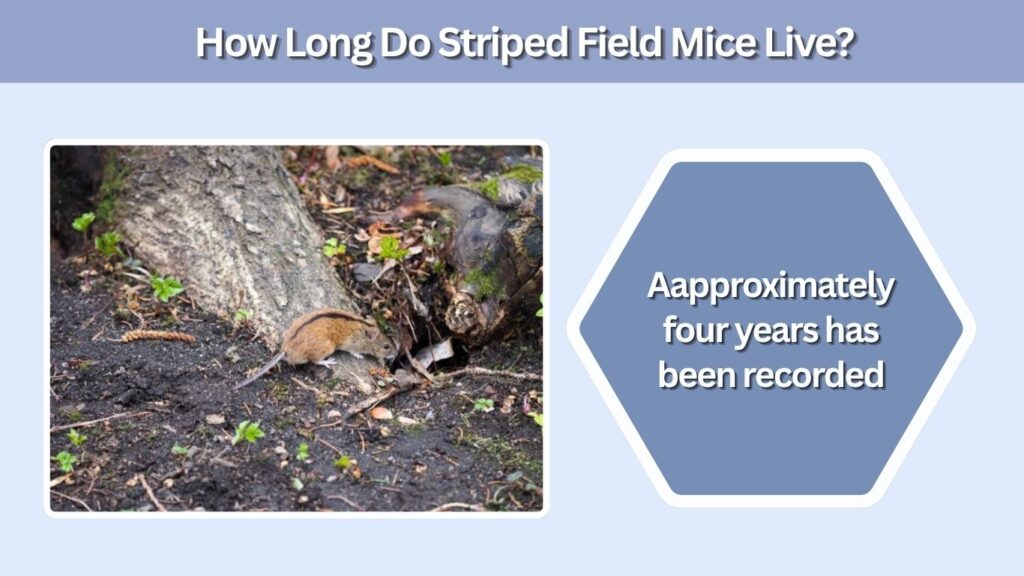
Life in the wild is usually brief because these mice face predation, severe weather, parasites, disease, food shortages, and agricultural disturbance. Many wild individuals do not survive beyond their first year.
A captive lifespan of approximately four years has been recorded, but this should not be considered typical for a wild striped field mouse. Animals living outdoors generally have much shorter lives.
Can You Keep a Striped Field Mouse as a Pet?
A wild striped field mouse is not a suitable pet. Wild mice are easily stressed, may bite when frightened, and can carry parasites or pathogens. They also need species-appropriate shelter, food, exercise, and environmental conditions that are difficult to reproduce indoors.
Do not handle a wild mouse with bare hands. A healthy mouse found outdoors should normally be left alone. An injured or genuinely orphaned baby should be placed in a secure, ventilated container and taken to a qualified wildlife rehabilitator or veterinarian.
FAQs
Is a striped field mouse dangerous?
Striped field mice normally avoid people and are not aggressive. However, any frightened wild rodent may bite. They can also contaminate stored food and potentially carry parasites or infectious organisms, so direct handling should be avoided.
Why does a field mouse have a black stripe?
A single strong stripe is a natural characteristic of Apodemus agrarius. It helps distinguish this species from wood mice and many other field rodents. African striped mice have multiple stripes and belong to a different genus.
What is a tiger-striped field mouse?
“Tiger-striped field mouse” is not usually an official species name. People may use it informally for the four-striped grass mouse or another rodent with several dark lines across its brown coat.
What does a baby striped field mouse look like?
Newborn babies are pink, blind, and nearly hairless. As they grow, brown fur covers their bodies and the dark dorsal stripe becomes visible. A young mouse found alone may still have a mother nearby.
Do striped field mice enter houses?
They may enter sheds, barns, storage buildings, or homes when looking for shelter and food, especially during cold weather. Sealing small openings and storing grains and pet food in hard containers can reduce the chance of an infestation.