
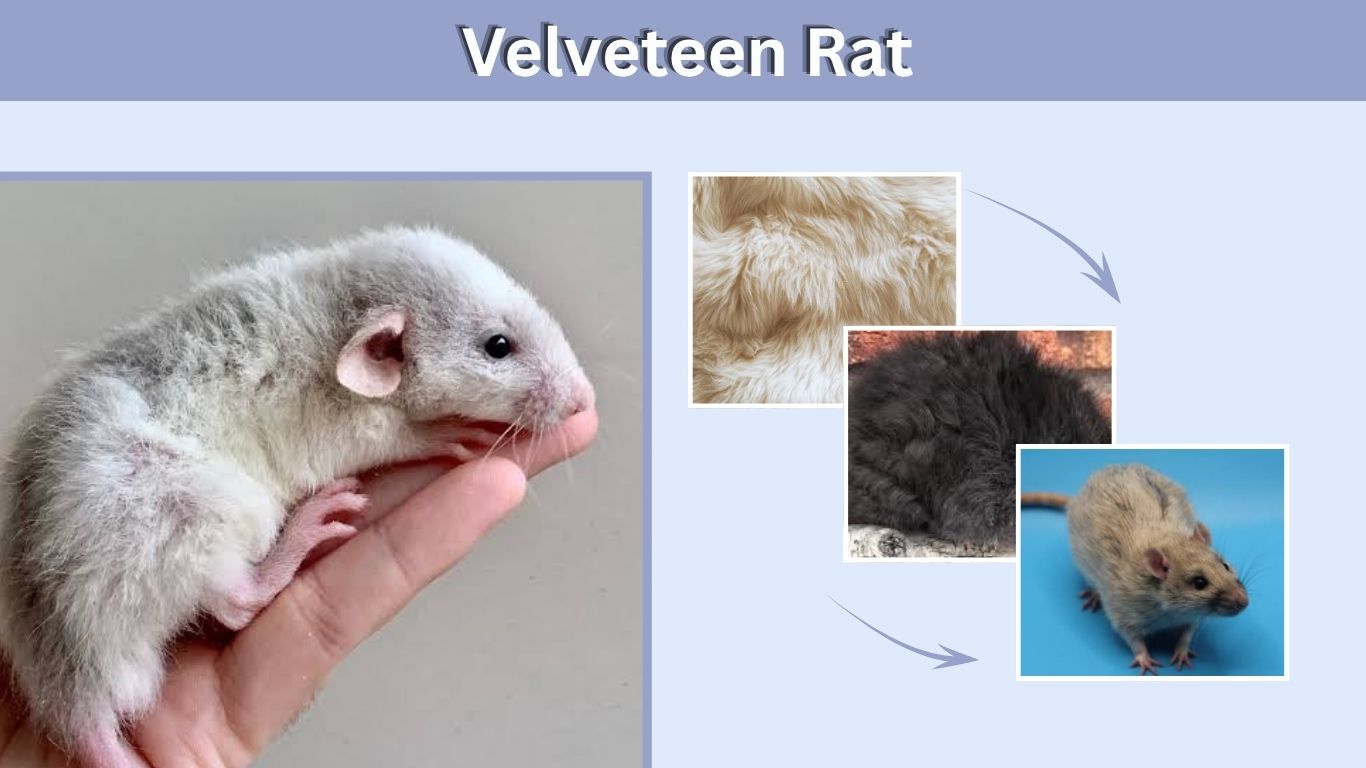
The Velveteen rat is a fancy rat distinguished by its unusually soft, wavy coat and gently curled whiskers. Rather than being a separate rat breed, Velveteen describes a coat variety that can occur alongside many colors, markings, and ear types. Young Velveteens often have especially noticeable waves or curls that may become softer with age. They are commonly compared with Rex rats, although a good Velveteen coat should feel softer and less tightly curled. Like other fancy rats, they are intelligent, social pets requiring companionship and daily enrichment.
What Is a Velveteen Rat?
A Velveteen is a domesticated fancy rat selected for a distinctive rexoid coat. The hairs develop waves rather than lying flat like those of a Standard-coated rat. Whiskers are also usually softly curled or wavy. Velveteen can occur independently of color and ear placement, which is why terms such as Dumbo Velveteen, Mink Velveteen, or Siamese Velveteen may describe the same rat.
Velveteen Rat Characteristics
Common characteristics include:
- Soft, plush-feeling fur
- Wavy or loose curly hair
- Gently curled or wavy whiskers
- A coat usually less tightly curled than Rex
- Particularly noticeable waves in young rats
- Coat texture that may change with age
- Availability in many colors and markings
- Standard or Dumbo ears
- Normal fancy-rat body shape
RatsPacNW describes the desired Velveteen coat as even, preferably dense, wavy, and soft, with correspondingly softly curled whiskers.
Is Velveteen a Breed?
No. A Velveteen rat is still a fancy rat, the domesticated form of the brown rat.
“Velveteen” describes its coat rather than a separate species or breed. The same animal can therefore simultaneously be Dumbo, Velveteen, and a particular color or marking.
This explains names such as Russian Blue Velveteen, Siamese Velveteen, Mink Velveteen, or Marten Velveteen.
What Does a Velveteen Rat Coat Feel Like?
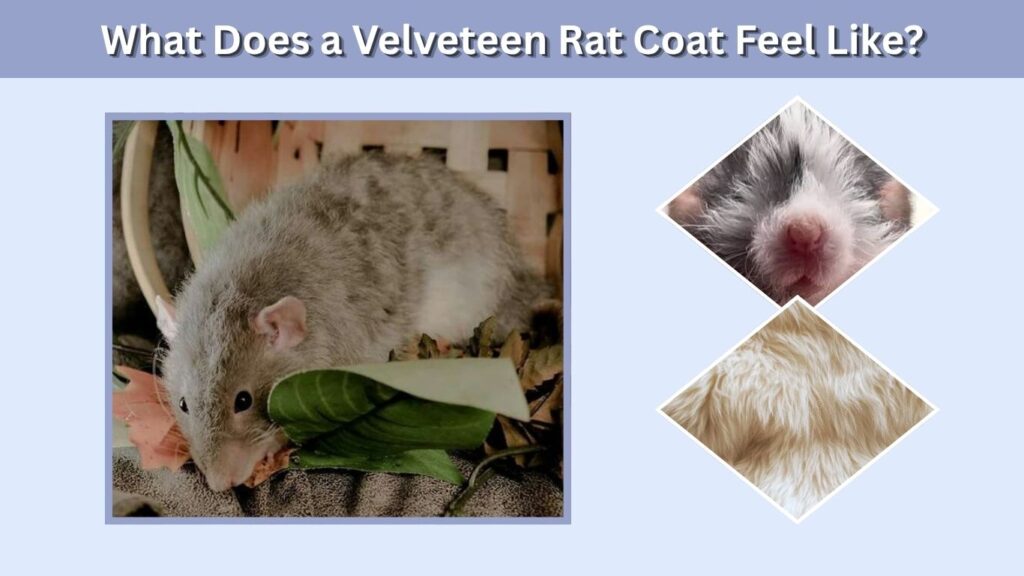
The coat is named for its soft texture. Instead of the smooth, straight hairs found on Standard rats, the hairs develop gentle waves that create a plush appearance. The amount of curl differs among individuals and breeding lines. Young animals can sometimes appear much curlier than adults because the juvenile coat changes as the rat matures.
Velveteen Coat and Whiskers
A typical coat shows:
- Soft waves across the back and sides
- Slightly tousled appearance
- Plush texture when gently touched
- Wavy rather than straight whiskers
- More obvious curls in some babies
- Possible thinning in older animals
Coat quality can differ substantially between individual rats. Even within a litter, some may have much more noticeable waves.
Show standards may consider considerable age-related thinning undesirable, although coat changes do not automatically mean a pet has a health problem.
Velveteen Rat Babies
Velveteen characteristics can become noticeable while pups are young. Their developing fur may look fuzzy, rippled, or tightly waved, making some babies particularly distinctive.
As the juvenile coat is replaced, its appearance can change. An eight-week-old Velveteen therefore may not have exactly the same degree of curl as the same rat several months later.
Temperament should not be predicted from coat type. Socialization, genetics, handling, health, and individual personality are much more important.
Velveteen vs Rex Rat
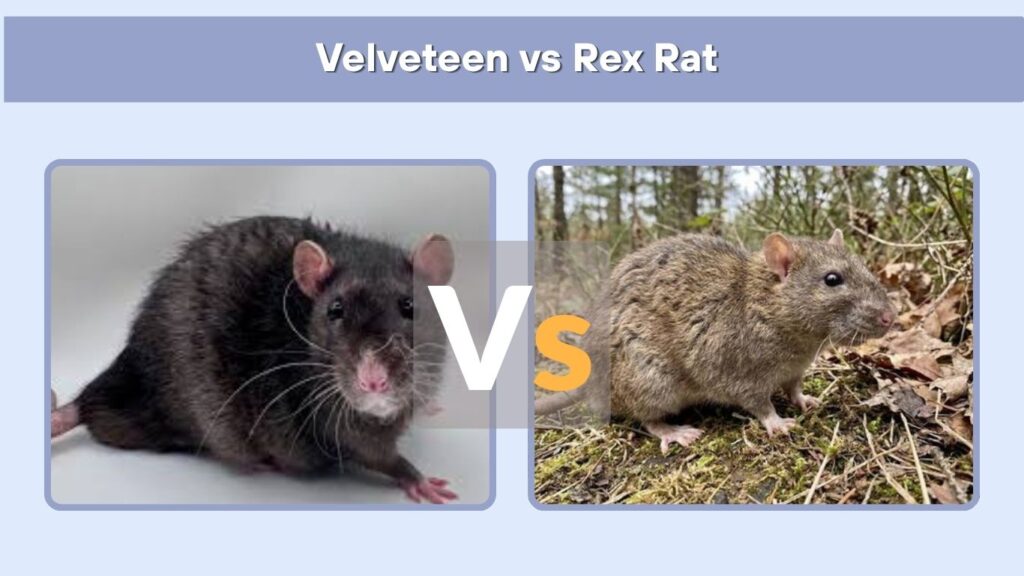
Velveteen and Rex are both curly-coated fancy rat varieties, so confusing them is easy. Their most useful difference is generally the character of the coat. Rex fur tends to have a stronger curl and a somewhat coarser texture, whereas Velveteen is selected for softer, looser waves. Their whiskers also tend to reflect these differences.
Rex vs Velveteen Differences
Velveteen rat:
- Softer coat
- Loose waves or curls
- Softly curled or wavy whiskers
- Plush appearance
- Curl may become less dramatic with maturity
Rex rat:
- More obviously curly coat
- Typically rougher texture
- More strongly curled whiskers
- Coat may thin with age
- Double Rex can become thin or patchy
RatsPacNW treats Rex and Velveteen as genetically distinct varieties, identifying Rex as a semi-dominant Rex trait and Velveteen as a separate semi-dominant curly trait.
Can a Rat Be Rex and Velveteen?
In breeding terminology, combinations of different coat genes can occur. Some breeders use names such as Velveteen Rex or “Teddy” for rats combining rexoid traits.
However, fancy-rat coat genetics are not equally standardized worldwide. AFRMA notes that the genetic basis of Velveteen has historically been less certain and lists it as possibly associated with the Curly-1 mutation. Therefore, genetics should be interpreted according to the documented lineage rather than relying only on a seller’s label.
What Is a Double Velveteen Rat?
“Double Velveteen” generally refers to a rat inheriting the Velveteen trait from both parents in lines where the coat behaves as a semi-dominant gene. This is especially interesting because doubling a rexoid coat gene does not necessarily produce the same appearance across different mutations.
Double Velveteen vs Double Rex
The commonly described differences are:
- Single Velveteen: soft, wavy coat.
- Double Velveteen: often described by breeders as denser or more plush.
- Single Rex: curly, somewhat coarser coat.
- Double Rex: commonly develops thin, patchy, or temporarily hairless areas.
RatsPacNW describes Double Rex as having thin or patchwork fur. In contrast, some established Velveteen breeders report that doubling their Velveteen line increases plushness rather than producing the patchy appearance typical of Double Rex.
Because breeder lines may use different rexoid mutations under similar names, knowing the ancestry is important when predicting a litter.
Velveteen Rat Genetics
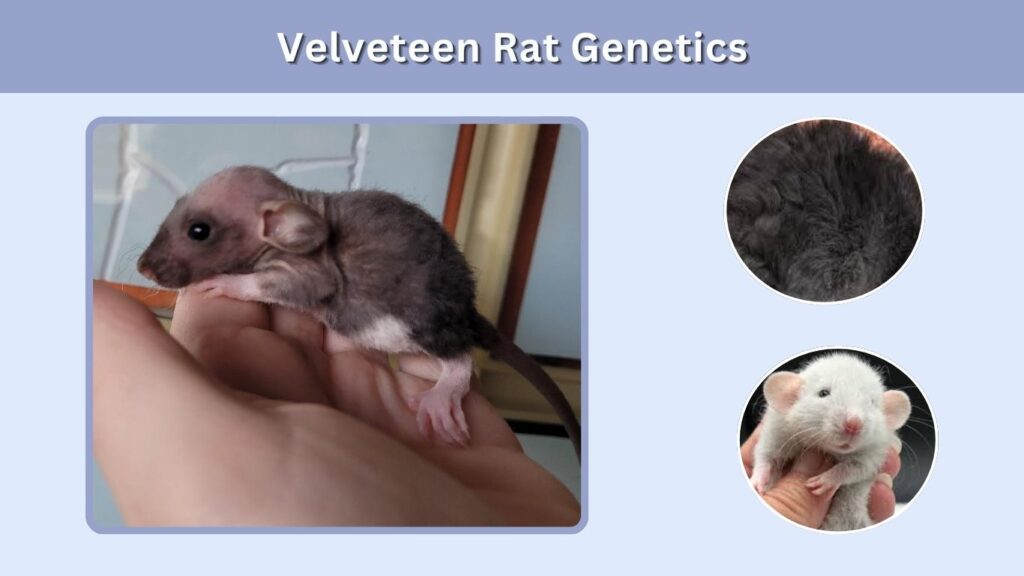
Rat coat genetics can become complicated because multiple mutations produce curly, wavy, long, satin, sparse, or unusual fur. Terminology also varies between clubs and countries. Some organizations describe Velveteen using a semi-dominant curly gene, while genetic references emphasize that the exact identity of several historical curly mutations has not always been firmly established.
How Is Velveteen Inherited?
Under the RatsPacNW standard, Velveteen is represented as Cu/cu and described as an autosomal semi-dominant trait.
This model means a rat with one copy can visibly express the Velveteen coat rather than simply carrying it invisibly.
However, AFRMA lists Velveteen as possibly Cu1, highlighting uncertainty around the exact correspondence between breeder varieties and historically documented laboratory curly mutations.
For pet owners, the practical point is simple: ask the breeder about the actual family line instead of assuming every rat labeled Velveteen has identical genetics.
Dumbo and Other Velveteen Rat Varieties
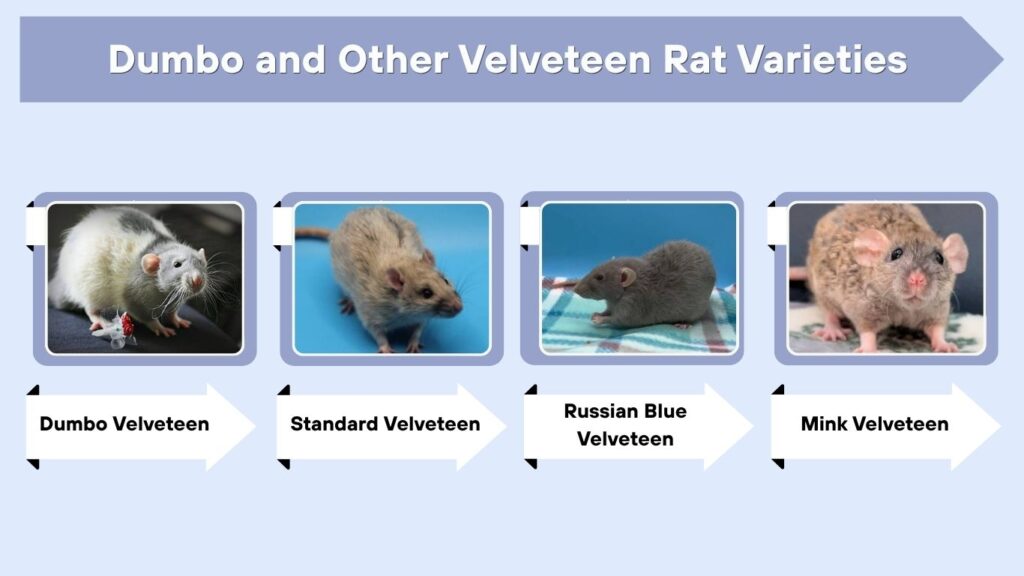
Because Velveteen describes fur, it can be combined with ear type, body size, colors, and markings. This creates many visually different rats that share the same characteristic wavy coat.
Common Velveteen Combinations
Examples include:
- Dumbo Velveteen: Velveteen coat with low-set rounded Dumbo ears
- Standard Velveteen: ordinary ear placement with Velveteen fur
- Russian Blue Velveteen: blue-gray coloration with a wavy coat
- Mink Velveteen: mink coloration combined with Velveteen
- Siamese Velveteen: temperature-sensitive Siamese pattern and wavy fur
- Marten Velveteen: Marten coloration combined with the coat
- Harley Velveteen: combination involving long Harley fur and Velveteen
- Dwarf Velveteen: dwarf size combined with Velveteen in lines carrying a dwarf trait
Dumbo ears themselves are genetically separate from coat texture; AFRMA lists Dumbo as its own ear-placement trait.
Does Color Change the Coat?
Colors such as Russian Blue, Mink, Siamese, Russian Silver, or Platinum change pigmentation rather than turning a Standard coat into Velveteen.
However, color and additional coat genes can influence how texture looks to the eye. Waves can appear especially noticeable when highlights and shadows fall across a pale or silvery coat.
Are Velveteen Rats Good Pets?
Velveteen rats have the same fundamental needs as other healthy fancy rats. Their coat can make them visually unusual, but they remain highly social, intelligent animals. Choosing a pet should therefore prioritize temperament, responsible breeding, health, and good early socialization rather than coat appearance alone.
Basic Velveteen Rat Care
Provide:
- At least one compatible rat companion
- A large, well-ventilated enclosure
- Safe bedding with minimal dust
- Hides, hammocks, ropes, and climbing opportunities
- A nutritionally balanced rat diet
- Constant access to clean drinking water
- Daily interaction and exercise
- Regular health checks
- Veterinary attention for breathing problems, lumps, injuries, or behavioral changes
Rats should not normally be housed alone. Blue Cross recommends keeping them with other rats and providing daily social interaction and at least an hour of exercise outside their enclosure.
Velveteen Rat Lifespan
Coat type does not create a separate expected lifespan.
Pet rats typically live around two to three years, with Blue Cross giving an average of roughly two and a half years.
Good husbandry cannot prevent every age-related illness, but appropriate nutrition, clean housing, companionship, enrichment, and prompt veterinary care can support quality of life.
FAQs
Velveteen rats attract interest because their coat looks very different from the familiar smooth fancy-rat coat. Most confusion involves whether Velveteen is a breed, how it differs from Rex, whether Dumbo Velveteens are different animals, and what “Double Velveteen” means genetically.
1. What is a Velveteen rat?
A Velveteen is a fancy rat with a soft, wavy coat and gently curled whiskers. Velveteen describes its coat variety, not a separate species.
2. What is the difference between Velveteen and Rex rats?
Velveteen coats are generally softer with looser waves, while Rex coats tend to have stronger curls and a rougher texture.
3. What is a Double Velveteen rat?
In lines where Velveteen behaves as a semi-dominant trait, Double Velveteen refers to inheriting the trait from both parents. Some breeders report a denser, more plush coat rather than the patchiness typical of Double Rex.
4. What is a Velveteen Dumbo rat?
It is simply a rat combining a Velveteen coat with Dumbo ears, which sit lower and more toward the sides of the head.
5. How long do Velveteen rats live?
Their lifespan is similar to other pet rats, generally around two to three years. Coat type itself does not make them a longer- or shorter-lived species.