
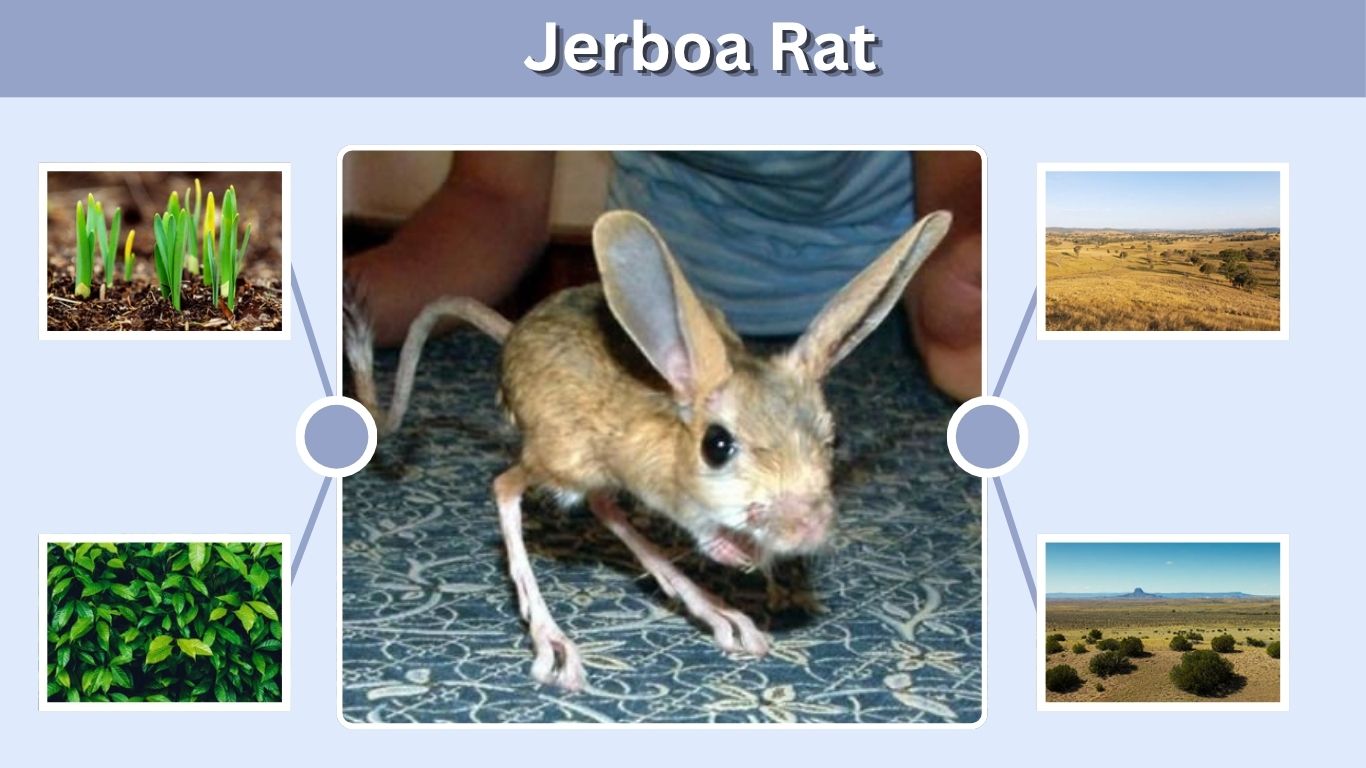
The jerboa rat is a small desert rodent recognized by its long hind legs, tiny front feet, large eyes, and lengthy tail. Despite its nickname, a jerboa is not a true rat and is not the same animal as a kangaroo rat. Jerboas belong to the family Dipodidae and occur naturally across parts of Africa and Asia. Their unusual bodies allow them to jump quickly, change direction suddenly, and survive in dry environments where food and water can be difficult to find.
What Is a Jerboa Rat?
“Jerboa rat” is an informal term used for jerboas because they have small, mouse-like heads and live in desert environments. Scientifically, jerboas are specialized jumping rodents rather than true rats.
Their family, Dipodidae, also includes jumping mice and birch mice. Jerboas are the most strongly adapted members of this group for two-legged movement. Their hind legs may be several times longer than their front legs, while some foot bones are fused to create greater leverage when jumping.
Jerboa Rat Identification
A typical jerboa has:
- Long and powerful hind legs
- Very short front limbs
- Large, dark eyes
- Sandy brown or gray fur
- A pale underside
- A long tail, often with a tuft
- Large or moderately sized ears
- Three or five hind toes, depending on the species
The animal’s appearance varies considerably among species. Long-eared jerboas have enormous ears, while pygmy jerboas are extremely small and have more compact bodies.
Is a Jerboa a True Rat?
No. True rats generally belong to the family Muridae, whereas jerboas belong to Dipodidae. Both are rodents, but they represent separate evolutionary groups.
Calling a jerboa a “desert rat” describes its general appearance and habitat. It does not indicate that it is closely related to familiar brown, black, or domestic rats.
Where Do Jerboa Rats Live?
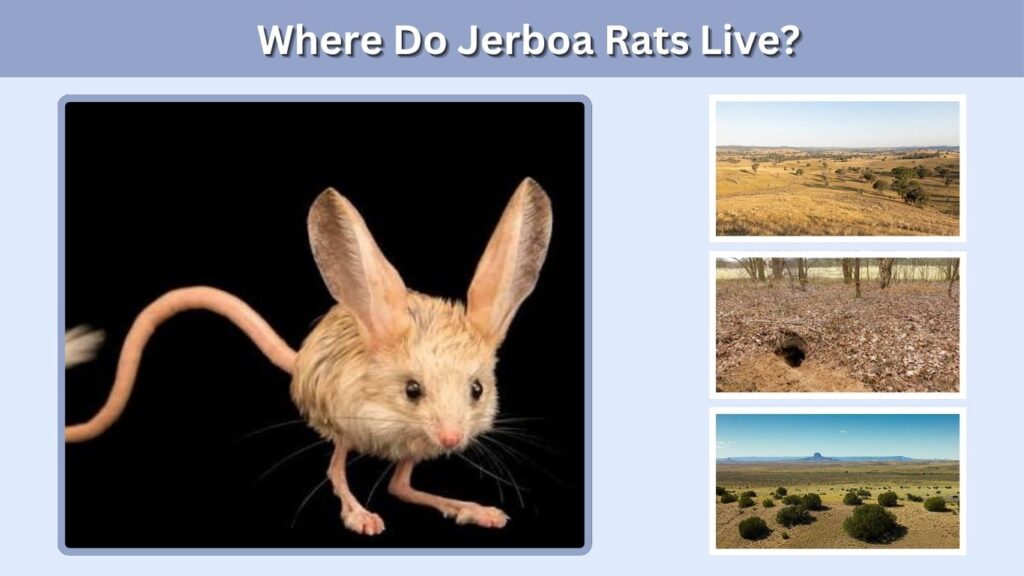
Jerboas are native to dry regions of northern Africa and Asia. Depending on the species, they may live in deserts, semi-deserts, dry grasslands, rocky plains, steppes, or sparsely vegetated valleys.
Their sandy or grayish coats help them blend into the ground. This camouflage is especially useful because jerboas must cross open areas while searching for food.
Underground Burrows
Jerboa rats spend much of the day inside underground burrows. These shelters protect them from high daytime temperatures, cold desert nights, wind, and predators.
Their short front feet are used to loosen soil and handle nesting material. The powerful hind feet may push excavated sand away from the tunnel. Some jerboas close their burrow entrances during the day, helping maintain a more stable temperature and humidity level underground.
Nocturnal Activity
Most jerboas are nocturnal. They leave their burrows after sunset when the ground is cooler and many daytime predators are inactive.
Large eyes improve vision in low light, while sensitive hearing helps a jerboa detect owls, foxes, snakes, and other threats. Nocturnal activity also limits moisture loss during the hottest hours of the day.
What Do Jerboa Rats Eat in the Desert?
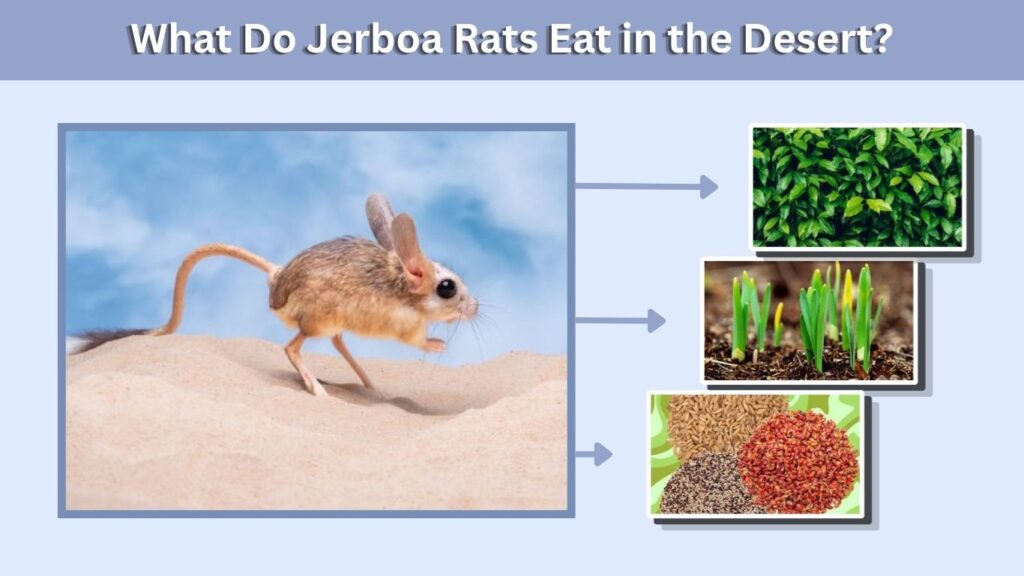
A jerboa’s diet depends on its species, habitat, season, and available food. Jerboas as a group eat seeds, plant material, and insects, but some species rely more heavily on vegetation while others consume a greater proportion of animal prey.
Common Jerboa Foods
Jerboa rats may eat:
- Grass seeds
- Desert plant seeds
- Grains
- Green shoots
- Leaves
- Roots and tubers
- Succulent plants
- Berries
- Beetles and other insects
- Desert fungi
Some dwarf jerboas are omnivores that eat vegetation, berries, and small insects. Other desert jerboas shift between fresh plants during wetter seasons and seeds, grains, or succulent roots when conditions become drier.
How Do Jerboas Obtain Water?
Many jerboas obtain much of their moisture from food rather than visiting open water sources. Succulent plants, roots, and insects contain valuable moisture, while digestion also produces a small amount of metabolic water.
This ability is important in deserts where pools and streams may be absent for long periods. However, water requirements and physiological adaptations differ among species, so not every jerboa should be assumed to survive under identical conditions.
How Does a Jerboa Rat Jump?
Jerboas normally move using their two hind legs. They may use small hops while feeding and longer, faster bounds when traveling or escaping danger.
Their long hind legs produce powerful forward movement, while the tail helps control balance and body position. The tail may also touch the ground when the jerboa sits upright, acting as an additional point of support.
Jumping as a Defense
A fleeing jerboa does not always follow a straight path. It can make sharp turns and change the length or direction of its jumps, making its movement difficult for a predator to predict.
Hair beneath the feet of some sand-dwelling jerboas improves traction and prevents the animal from sinking deeply into loose sand. Their small front limbs are not normally used for running; they are more useful for digging, grooming, and handling food.
Jerboa vs Kangaroo Rat
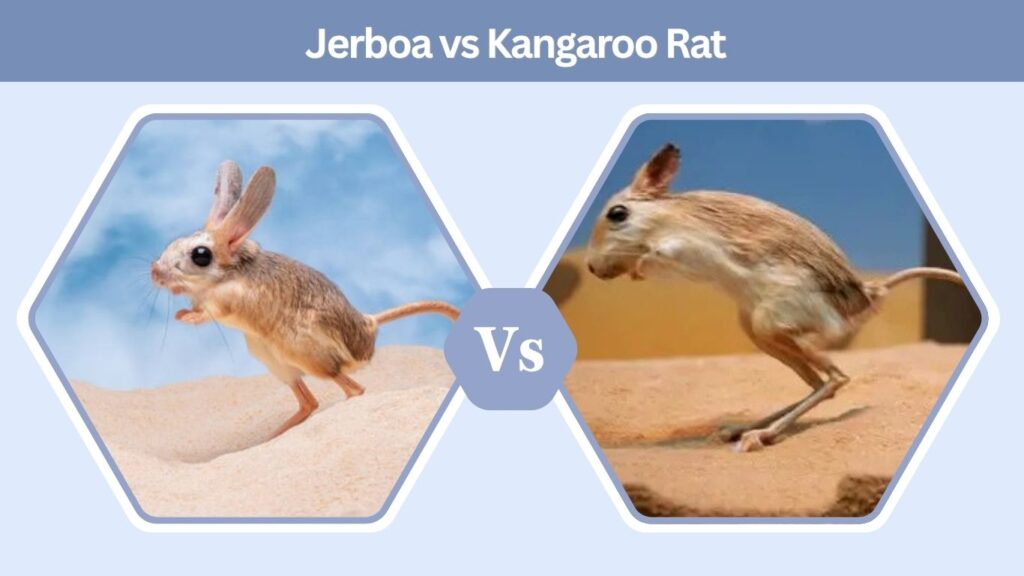
Jerboas and kangaroo rats look similar because both have long hind legs, small front feet, lengthy tails, and hopping movement. However, they are not the same animal.
Jerboas belong to the family Dipodidae and live naturally in Africa and Asia. Kangaroo rats belong to the family Heteromyidae and are native to North America. Their similar appearances developed independently as adaptations to comparable dry environments.
| Feature | Jerboa | Kangaroo rat |
| Family | Dipodidae | Heteromyidae |
| Natural range | Africa and Asia | North America |
| Main movement | Two-legged hopping | Two-legged hopping |
| Ears | Small to extremely large | Usually relatively small |
| Cheek pouches | No external fur-lined pouches | External fur-lined pouches |
| Typical diet | Seeds, plants, roots, or insects | Primarily seeds |
| Tail | Long and often tufted | Long and commonly tufted |
| Main shelter | Underground burrow | Underground burrow |
Cheek Pouches
One of the clearest differences is that kangaroo rats have external, fur-lined cheek pouches. They use these pouches to transport seeds back to underground stores. Jerboas do not possess the same specialized external food-carrying pouches.
Diet Differences
Kangaroo rats are mainly seed eaters. They forage at night, carry seeds in their cheek pouches, and store surplus food inside their burrows. Some species occasionally eat insects or vegetation.
Jerboa diets are more diverse. One species may primarily consume seeds and roots, while another may rely heavily on insects. Therefore, descriptions of a jerboa’s diet should account for the particular species.
Legs and Ears
Both animals have powerful hind limbs, but jerboas often appear more delicate and long-legged. Some jerboa species also have dramatically larger ears than any kangaroo rat.
Kangaroo rats generally have heavier bodies, broad heads, large hind feet, and smaller ears. They also possess recognizable cheek pouches that may not be obvious until the animal begins gathering food.
Pygmy Jerboa vs Kangaroo Rat
Pygmy jerboas are much smaller and lighter-looking than most kangaroo rats. They usually have rounded bodies, extremely thin hind legs, small front limbs, and long tails.
Despite their tiny size, pygmy jerboas are efficient hoppers. Their diets commonly include seeds, vegetation, berries, and small insects, although feeding habits vary by species.
A kangaroo rat is generally larger and more robust. Its external cheek pouches and North American distribution are the most reliable clues for distinguishing it from a pygmy jerboa.
Can a Jerboa Rat Be Kept as a Pet?
Jerboas are wild exotic animals rather than domesticated pets. Their nocturnal lifestyle, powerful jumping, burrowing instinct, and specialized environmental needs make them difficult to care for properly.
A suitable enclosure would need substantial horizontal space, secure walls, deep digging material, hiding areas, and careful temperature management. Small cages designed for hamsters or mice would not provide enough room for normal jumping and foraging behavior.
Ownership, breeding, sale, and importation may be restricted by national or local wildlife laws. Anyone considering a jerboa should consult the appropriate wildlife authority and an experienced exotic-animal veterinarian. Wild-caught animals should not be purchased because capture and transport can create serious welfare and conservation problems.
FAQs
Is a jerboa a kangaroo rat?
No. Jerboas belong to the family Dipodidae and are native to Africa and Asia. Kangaroo rats belong to Heteromyidae and live naturally in North America. Their similar long legs and jumping movement evolved independently in response to dry, open habitats.
Why is a jerboa called a desert rat?
The nickname comes from its small rodent body, pointed face, and desert habitat. It does not mean that the jerboa is a true rat. Jerboas form a separate group of specialized jumping rodents.
How does a jerboa rat run?
A jerboa moves mainly by hopping on its two hind legs. It uses small jumps while moving slowly and longer bounds while escaping danger. Its tail provides balance and helps control the body during turns and landings.
What do jerboa rats eat?
Jerboas may eat seeds, grains, roots, shoots, leaves, succulent plants, berries, insects, and fungi. The exact diet varies by species and season. Some jerboas are mainly plant eaters, while others consume significant amounts of insects.
Are jerboa rats dangerous?
Jerboas are not considered dangerous predators and normally avoid people. Like other wild rodents, however, they may bite when frightened or handled. They should be observed from a respectful distance rather than captured or treated like domesticated animals.