
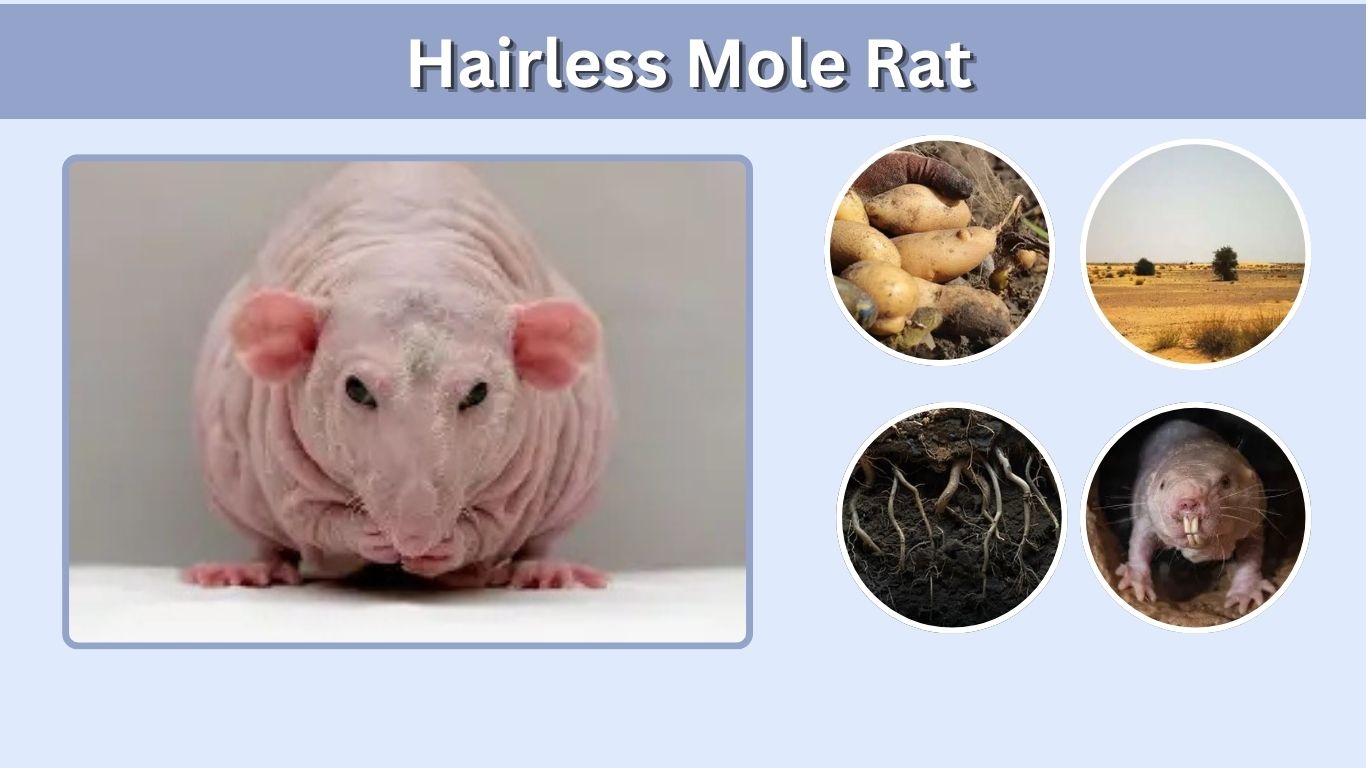
The “hairless mole rat” is usually the naked mole-rat, a strange-looking underground rodent with wrinkled skin, tiny eyes, large front teeth, and only a few scattered hairs. Although people often search for hairless mole rat pictures because of its unusual appearance, this animal is more than just odd-looking. It is famous for living in large colonies, surviving low oxygen, resisting many signs of aging, and showing rare cancer resistance that scientists continue to study.
What Is a Hairless Mole Rat?
A hairless mole rat is most commonly called a naked mole-rat. Its scientific name is Heterocephalus glaber. Despite the common name, it is not completely hairless, and it is not a true mole. It is a burrowing rodent adapted for life underground.
Identification
- Wrinkled pink, grayish, or pale skin
- Very little visible fur
- Small eyes and poor eyesight
- Large front teeth that stick out
- Long, tube-shaped body
- Short legs and small feet
- Sparse whiskers on the face and body
- Hairs between the toes that help move soil
- Almost blind, but highly adapted to tunnels
Smithsonian’s National Zoo notes that naked mole-rats are not completely hairless; they have sensory whiskers and hairs between their toes that help them sweep soil while digging.
Why Are They Called Hairless?
They are called hairless because they lack the thick fur coat found on most rodents. Their nearly bare skin helps them move through tight underground tunnels. However, the word “hairless” is not fully accurate because they still have important sensory hairs. These hairs help them feel their surroundings in dark tunnels where vision is not very useful.
Is It the Same as a Naked Mole-Rat?
Yes, in most searches, “hairless mole rat” means naked mole-rat. People also search for “hairless pink mole rat,” “African hairless mole rat,” “blind hairless mole rat,” and “hairless naked mole rat.” These usually point to the same animal: the naked mole-rat.
Where Do Hairless Mole Rats Live?
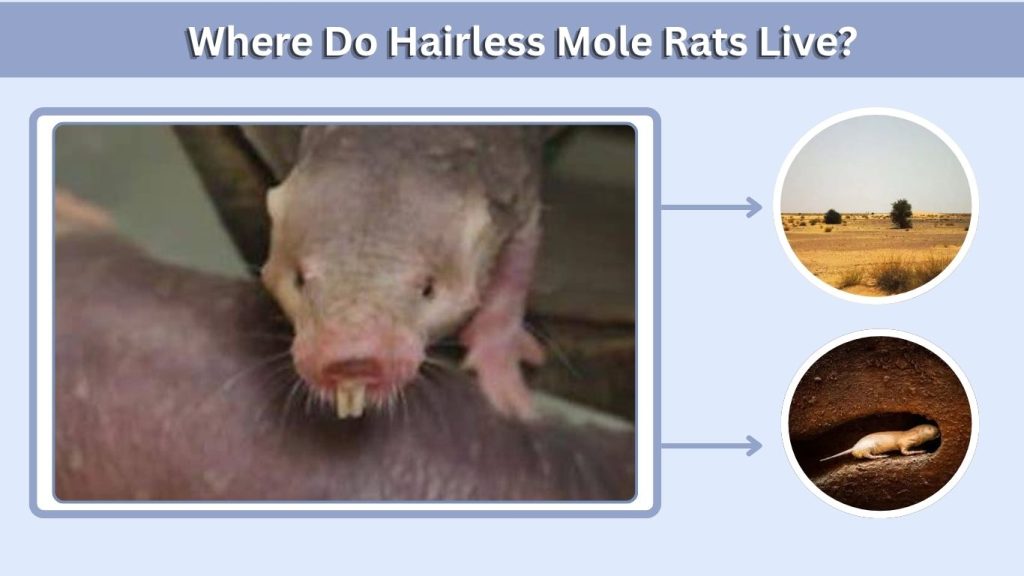
Hairless mole rats live underground in parts of eastern Africa. They spend almost their entire lives in tunnel systems, where they search for underground roots and tubers.
Habitat and Range
Naked mole-rats are native to dry regions of eastern Africa. They live in underground colonies where the soil allows tunnel-building and where plants have large underground roots or tubers. San Diego Zoo Wildlife Alliance explains that naked mole-rats are found where plants have large underground roots and tubers, which provide food and moisture.
Life Underground
Living underground shapes almost everything about their bodies. Their eyes are tiny because they do not need strong vision in dark tunnels. Their teeth are large because they use them for digging and chewing tough underground foods. Their bodies are narrow and flexible so they can move forward and backward through tunnels.
What Do They Eat?
Naked mole-rats eat underground plant parts, especially roots and tubers. These foods can be tough, so their large front teeth are useful. San Diego Zoo also notes that they get enough moisture from their diet, so they do not need to dig for water.
Hairless Mole Rat Appearance
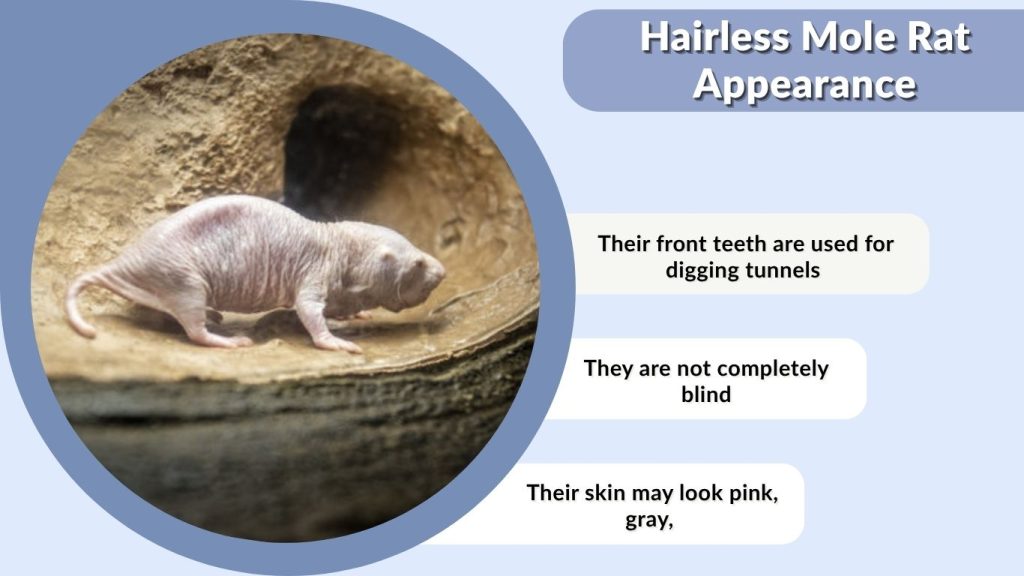
The hairless mole rat is one of the most unusual-looking mammals. It may look pink, wrinkled, blind, and toothy, but each feature helps it survive underground.
Why Do They Have Big Teeth?
Their front teeth are used for digging tunnels and biting through underground roots. These teeth sit outside the lips, which helps prevent dirt from entering the mouth while digging. The teeth may look oversized, but they are one of the animal’s most important survival tools.
Are They Completely Blind?
They are not completely blind, but their eyesight is poor. In dark tunnels, smell, touch, sound, and vibration are more useful than vision. Their small eyes are enough to detect light and movement, but they do not rely on sight the way many above-ground animals do.
Why Are They Pink and Wrinkled?
Their skin may look pink, gray, or pale because they have little hair covering the body. The wrinkles are useful because loose skin allows easier movement through narrow tunnels. This appearance may look strange to people, but it is practical for a burrowing animal.
Hairless Mole Rat Colony Life
Hairless mole rats are famous for living in highly organized colonies. Their social system is often compared to bees, ants, and termites because only a few members reproduce while others work for the colony.
Queen and Workers
A naked mole-rat colony usually has one breeding female, often called the queen. She mates with a small number of males, while most other colony members work as diggers, tunnel defenders, nest helpers, and food gatherers. Smithsonian Magazine describes naked mole-rats as living in large underground colonies in eastern Africa.
Eusocial Behavior
Naked mole-rats are one of the best-known eusocial mammals. Eusocial animals live in cooperative groups with division of labor and limited breeding roles. This makes them very different from common pet rats, mice, or hamsters.
How Big Are Colonies?
Colonies can include many individuals, though the exact number varies. Some colonies are small, while others can be very large. In a colony, individuals cooperate to dig tunnels, find food, raise young, and protect the group from threats.
Hairless Mole Rat Cancer and Aging
One of the biggest reasons scientists study naked mole-rats is their unusual biology. They are known for long lifespans, strong resistance to cancer, and tolerance of harsh underground conditions.
Why Are Scientists Interested?
Naked mole-rats live much longer than most rodents of similar size. Smithsonian notes that they can live more than 30 years, which is extraordinary for small rodents. Researchers study them to understand healthy aging, cancer resistance, pain response, and oxygen tolerance.
Do Hairless Mole Rats Get Cancer?
Naked mole-rats are highly resistant to cancer, but it is not accurate to say they can never get cancer. Scientific reviews describe them as important models for studying longevity and cancer resistance. A 2023 review in PubMed summarizes research on naked mole-rat ecology, hypoxia tolerance, longevity, delayed aging, and cancer resistance.
Why Don’t They Get Cancer Easily?
Scientists have studied several possible reasons, including unusual cellular defenses, DNA repair, protein maintenance, and special forms of hyaluronan, a large sugar-like molecule involved in tissue structure. Research is still ongoing, so it is better to say they are remarkably cancer-resistant, not cancer-proof.
Can a Hairless Mole Rat Be a Pet?
A hairless mole rat is not a normal pet. Searches like “hairless mole rat pet” or “hairless mole rat for sale” are common, but naked mole-rats are specialized colony animals, not simple cage pets.
Why They Are Not Good Pets
They need a colony, warm underground-style housing, special humidity and temperature control, a proper diet, and expert care. Their social system is complex, and a single naked mole-rat would not live like a normal hamster or guinea pig. Zoos and research facilities are much better suited to care for them than private homes.
Are They Legal to Own?
Rules vary by country, state, and local area. Even where exotic animals are legal, naked mole-rats are not commonly available as pets. Anyone thinking about exotic animal ownership should check local law and animal welfare requirements first.
Better Pet Alternatives
If someone wants a small pet, domestic rats, mice, gerbils, hamsters, or guinea pigs are more realistic choices. For people who specifically want a hairless-looking pet, hairless guinea pigs or hairless rats may be available from responsible breeders, but they still need proper care, warmth, and veterinary support.
Rufus the Hairless Mole Rat from Kim Possible
Many people search for “Rufus the hairless mole rat” because of the Disney show Kim Possible. Rufus is a fictional naked mole-rat and one of the reasons many viewers first learned about this animal.
Rufus and Real Naked Mole-Rats
Disney’s official Kim Possible page describes Ron Stoppable’s pet as a naked mole-rat named Rufus. However, the cartoon character is very different from a real naked mole-rat. Real naked mole-rats live in colonies underground, do not behave like pocket pets, and require specialized care.
Why Rufus Became Popular
Rufus made the naked mole-rat more recognizable in pop culture. Because he is small, pink, funny, and hairless, many people remember him as the “hairless mole rat from Kim Possible.” This explains why keywords like “hairless mole rat Kim Possible,” “hairless mole rat rap,” and “Rufus the hairless mole rat” appear in searches.
Cartoon vs Real Animal
| Feature | Rufus in Kim Possible | Real Naked Mole-Rat |
| Role | Fictional pet and sidekick | Wild underground rodent |
| Lifestyle | Lives with humans | Lives in colonies underground |
| Behavior | Human-like and expressive | Social but not pet-like |
| Care needs | Cartoon logic | Specialized colony care |
| Appearance | Cute and simplified | Wrinkled, toothy, nearly hairless |
Are Hairless Mole Rats Ugly or Cute?
People search for both “ugly hairless mole rat” and “cute hairless mole rat.” The answer depends on perspective. Their wrinkled skin, teeth, and tiny eyes may look strange, but those same features make them fascinating.
Why People Call Them Ugly
They do not fit the usual idea of a cute mammal. They lack fluffy fur, have exposed teeth, and look wrinkled. Their small eyes and pale skin can make them seem unusual or even alien-like.
Why Others Find Them Cute
Many people find them cute because they are small, social, and oddly charming. Their colony life, strange biology, and survival skills make them one of the most interesting mammals in the world.
Their Looks Have a Purpose
Their appearance is not random. Their teeth help them dig, their whiskers help them feel in darkness, their sparse hair helps them move through tunnels, and their loose skin helps them squeeze through tight spaces.
Hairless Mole Rat Facts
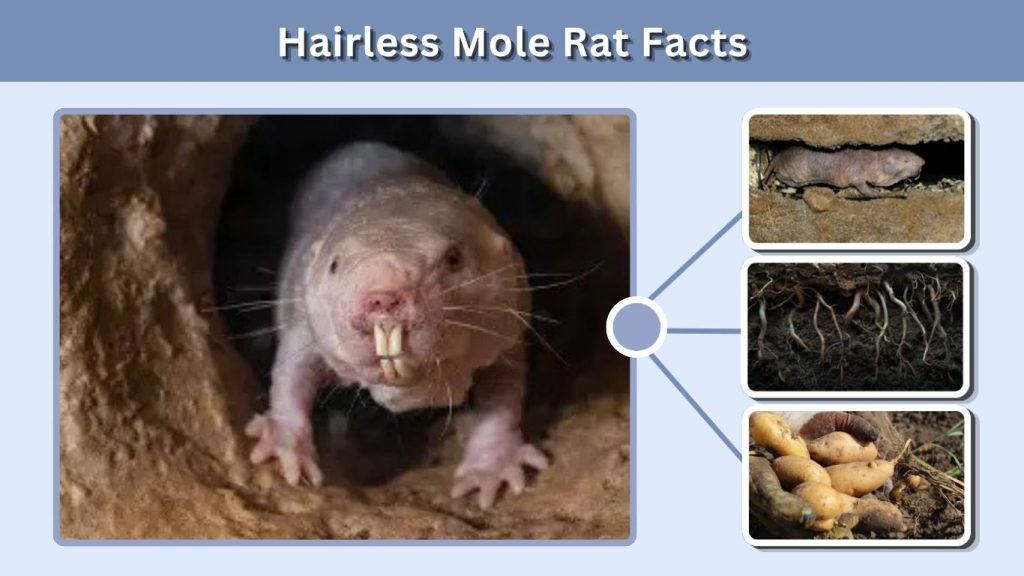
Here are quick facts that match many search questions about hairless mole rats.
| Fact | Answer |
| Common name | Naked mole-rat |
| Scientific name | Heterocephalus glaber |
| Main habitat | Underground tunnels in eastern Africa |
| Diet | Roots, tubers, and underground plant parts |
| Hairless? | Nearly hairless, but not completely |
| Blind? | Poor eyesight, but not fully blind |
| Lifespan | Can live more than 30 years |
| Pet? | Not a normal pet |
| Famous character | Rufus from Kim Possible |
| Research interest | Cancer resistance, aging, low-oxygen survival |
Naked mole-rats are also known for tolerating low-oxygen conditions. Smithsonian Magazine reports that they can survive extreme low-oxygen environments and are studied for traits linked to oxygen tolerance and disease resistance.
FAQs
Are naked mole-rats completely hairless?
No. Naked mole-rats are not completely hairless. They have sensory whiskers and small hairs between their toes, which help them feel their surroundings and move soil while digging.
Why does the hairless mole rat not get cancer easily?
Naked mole-rats have unusual cancer resistance linked to several biological traits, including special cellular defenses and tissue molecules such as high-molecular-weight hyaluronan. They are not guaranteed to be cancer-free, but cancer is rare in them compared with many mammals.
How long do hairless mole rats live?
Naked mole-rats can live more than 30 years, which is extremely long for a small rodent. This long lifespan is one reason scientists study them for aging research.
Where do hairless mole rats live?
They live in underground tunnel systems in parts of eastern Africa. They are found in dry regions where underground roots and tubers provide food and moisture.
Can you keep a hairless mole rat as a pet?
A naked mole-rat is not a practical pet. It needs colony living, specialized housing, temperature control, humidity control, and expert care. Domestic rats, hamsters, or guinea pigs are much better pet options for most people.