

The Himalayan rat is an attractive fancy rat recognized for its pale body and darker coloring on the nose, ears, feet, and tail. Its appearance is often compared with a Himalayan rabbit or Siamese cat, but Himalayan rats are simply domesticated Norway rats with a particular inherited color pattern. They can also have Dumbo ears, Rex coats, and other fancy-rat features. Intelligent, social, and highly interactive, Himalayan rats require companionship, good nutrition, enrichment, and appropriate housing just like other pet rats.
What Is a Himalayan Rat?
A Himalayan rat is a fancy-rat color variety rather than a separate species or breed. Fancy-rat organizations generally describe rats according to coat, ear type, color, and markings. In the classic Himalayan pattern, the body is predominantly white while distinctly darker “points” develop on cooler areas of the body, including the face, ears, feet, and tail.
Himalayan Rat Identification
Typical Himalayan characteristics include:
- White or nearly white body
- Dark nose or facial point
- Darker ears
- Colored feet
- Dark coloration along part of the tail
- Red or pinkish eyes in the traditional variety
- Smooth body coloration without extensive dark shading
- Standard fancy-rat body shape
The classic point color is a rich dark sepia, although other genetic combinations can produce different point shades.
Himalayan Rat Color
Himalayan coloration develops because pigment expression differs across parts of the body. The extremities normally become much darker than the warm central body.
A well-defined Himalayan therefore has a strong contrast between a pale body and colored points rather than gradual dark shading across the back.
Young rats may not immediately show their final point intensity. The coloration can become more obvious as the animal matures.
Types of Himalayan Rats
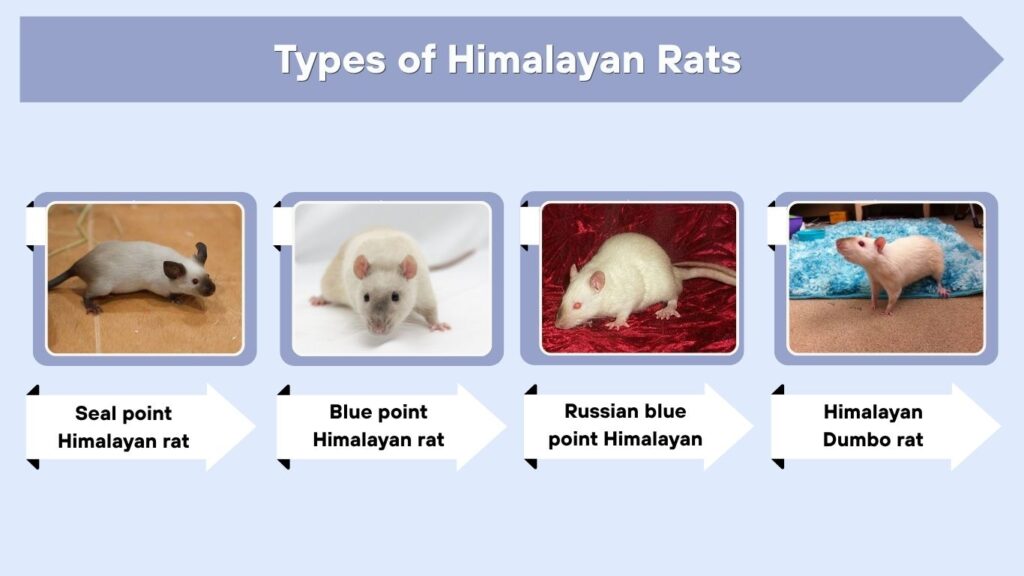
“Himalayan” describes color rather than coat texture or ear placement. As a result, Himalayan coloration can appear alongside other fancy-rat traits. A rat may therefore be described as Himalayan Dumbo, Himalayan Rex, or another combination without becoming a different species.
Common Himalayan Rat Variations
Names you may encounter include:
- Seal point Himalayan rat
- Blue point Himalayan rat
- Russian blue point Himalayan
- Himalayan Dumbo rat
- Himalayan Rex rat
- Standard-coat Himalayan
- Black-eyed Himalayan varieties
- Golden Himalayan rat
Fancy-rat genetics can create many combinations, although not every color or combination is recognized as a standardized show variety by every organization.
Seal Point Himalayan Rat
The classic seal point Himalayan has a nearly white body with deep sepia-colored points.
The darker areas are concentrated around the nose, ears, legs, feet, and tail. In show standards, the point color is expected to remain relatively restricted rather than spreading extensively across the body.
Himalayan Dumbo Rat
A Himalayan Dumbo rat combines Himalayan coloration with Dumbo ears.
Dumbo ears are larger and positioned lower on the sides of the head compared with standard rat ears. The Dumbo trait affects ear placement rather than personality or Himalayan coloration. AFRMA lists Dumbo as an ear variety rather than a separate rat breed.
Himalayan Rex Rat
A Himalayan Rex combines Himalayan coloration with the curly Rex coat.
Rex rats generally have wavy or curly fur and curled whiskers. A Himalayan Rex therefore may have the familiar pale body and dark points while also displaying textured fur.
Its basic husbandry requirements remain similar to those of other healthy fancy rats.
Himalayan Rat vs. Siamese Rat
Himalayan and Siamese rats can look remarkably similar because both display darker points. However, examining the body coloration usually reveals an important difference. Himalayan rats have much whiter bodies with relatively defined points, while Siamese rats display more noticeable body shading.
Himalayan vs. Siamese Rat Differences
A Himalayan rat generally has:
- White or nearly white body
- Clearly concentrated dark points
- Less shading over the back
- Strong contrast between body and points
A seal point Siamese generally has:
- Beige body coloration
- Gradual shading toward the hindquarters
- Dark nose, ears, feet, and tail
- Points that blend more gradually into body color
AFRMA’s standards describe Himalayan rats as white-bodied with restricted dark points, while seal point Siamese rats have a medium beige body with gradual shading and dark sepia points.
Which One Do You Have?
Look first at the body rather than just the nose.
If the rat remains predominantly white while having strongly contrasting points, Himalayan is more likely. If beige or darker shading spreads noticeably over the body and hindquarters, Siamese coloration is more likely.
Age, genetics, temperature, and individual variation can sometimes make identification less obvious.
Himalayan Rat Temperament and Behavior
Color does not determine a rat’s entire personality. Himalayan rats have the same broad behavioral characteristics as other domesticated fancy rats. Individual temperament is influenced more strongly by genetics, early handling, socialization, health, and living conditions.
Are Himalayan Rats Friendly?
Well-socialized Himalayan rats can be:
- Curious
- Playful
- Intelligent
- Social
- Affectionate with familiar people
- Interested in exploring
- Capable of learning routines
- Comfortable with gentle handling
Rats are highly social animals and should normally have compatible rat companionship rather than spending their lives alone. Human interaction is valuable, but another rat provides forms of communication, grooming, play, and companionship that people cannot completely replace.
Himalayan Rat Care

Himalayan rats do not require a radically different care routine because of their coloration. Like all pet rats, they need enough space to move, climb, sleep, forage, and interact with companions. Housing should also be clean, dry, secure, and properly ventilated.
Basic Care Requirements
Provide:
- A spacious enclosure
- Compatible same-species companions
- Solid resting and walking surfaces
- Comfortable nesting areas
- Hammocks and hiding places
- Climbing opportunities
- Safe chew materials
- Daily enrichment
- Fresh drinking water
- Nutritionally balanced food
- Regular cage cleaning
- Routine health checks
Proper enrichment helps prevent boredom and encourages natural behaviors such as exploring, climbing, nesting, and searching for food.
Grooming and Coat Care
Healthy rats are generally excellent self-groomers and rarely require routine bathing.
Inspect the skin and coat regularly for scratches, parasites, lumps, unusual hair loss, or sores. Rex-coated Himalayans may have a different coat texture, but they still generally maintain themselves through normal grooming.
What Do Himalayan Rats Eat?

Himalayan coloration does not create special nutritional requirements. Their diet should be the same balanced diet appropriate for other domesticated rats. Commercial food formulated specifically for rats provides a more reliable nutritional foundation than feeding random mixtures of seeds and human foods.
Himalayan Rat Diet
A suitable diet can include:
- Complete formulated rat pellets
- Small amounts of suitable vegetables
- Occasional safe fruit
- Appropriate healthy treats
- Constant access to clean water
Treats should remain a relatively small part of the overall diet.
Rats are omnivores, so balanced nutrition includes nutrients from multiple food sources rather than relying exclusively on seeds, vegetables, or high-protein foods.
Do Himalayan Rats Need Himalayan Salt?
No. A Himalayan rat does not require Himalayan salt simply because of its name.
“Himalayan” refers to the rat’s coloration and genetics, not a need for Himalayan salt. A nutritionally complete rat diet should provide appropriate minerals. Unnecessary salt supplements should not be added to the diet without veterinary guidance.
Himalayan Rat Lifespan and Health

Himalayan rats generally have the same expected lifespan as other domesticated rats. Their point coloration itself does not mean they naturally live longer or shorter lives. Genetics, diet, housing, veterinary care, and disease prevention all influence longevity.
How Long Do Himalayan Rats Live?
Pet rats generally live around two to three years, although some individuals may live longer.
Providing good care cannot prevent every age-related disease, but maintaining healthy body weight, good nutrition, clean housing, companionship, and prompt veterinary treatment can improve quality of life.
Signs of Health Problems
Watch for:
- Persistent sneezing
- Noisy or difficult breathing
- Loss of appetite
- Sudden weight loss
- Lumps or swelling
- Excessive scratching
- Eye or nose discharge
- Poor coat condition
- Difficulty walking
- Reduced activity
Because rats sometimes hide illness until it becomes more advanced, noticeable behavioral changes deserve attention.
Himalayan Rat Facts
Himalayan rats are particularly interesting because their appearance combines an almost white body with dramatic dark extremities. Although people sometimes refer to fancy rats as different breeds, recognized organizations more commonly classify them by varieties, colors, markings, coats, and ears.
Interesting Himalayan Rat Facts
- Himalayan is primarily a color pattern.
- The traditional body is nearly white.
- Dark areas are known as points.
- Points appear on the face, ears, feet, and tail.
- Classic Himalayans commonly have red eyes.
- Seal point is a familiar Himalayan coloration.
- Himalayan rats can have Dumbo ears.
- They can also occur with Rex coats.
- Himalayan and Siamese rats are not identical patterns.
- Their care requirements are similar to those of other fancy rats.
FAQs
What is a Himalayan rat?
A Himalayan rat is a domesticated fancy rat characterized by a pale or white body with darker points on the nose, ears, feet, and tail. Himalayan describes its coloration rather than a separate species.
What color is a Himalayan rat?
Classic Himalayan rats have a white body with dark sepia points. Other genetic combinations may produce different point colors, including blue-based shades.
What is the difference between a Himalayan and Siamese rat?
Himalayan rats generally have much whiter bodies and sharply defined points. Siamese rats have beige body coloration with gradual shading that blends toward darker points.
What is a Himalayan Dumbo rat?
A Himalayan Dumbo rat combines Himalayan point coloration with large, low-set Dumbo ears. Dumbo refers to ear type, while Himalayan refers to color.
How long do Himalayan rats live?
Himalayan rats generally have the same lifespan as other pet rats, averaging around two to three years, although individual longevity varies with genetics, health, diet, and care.