
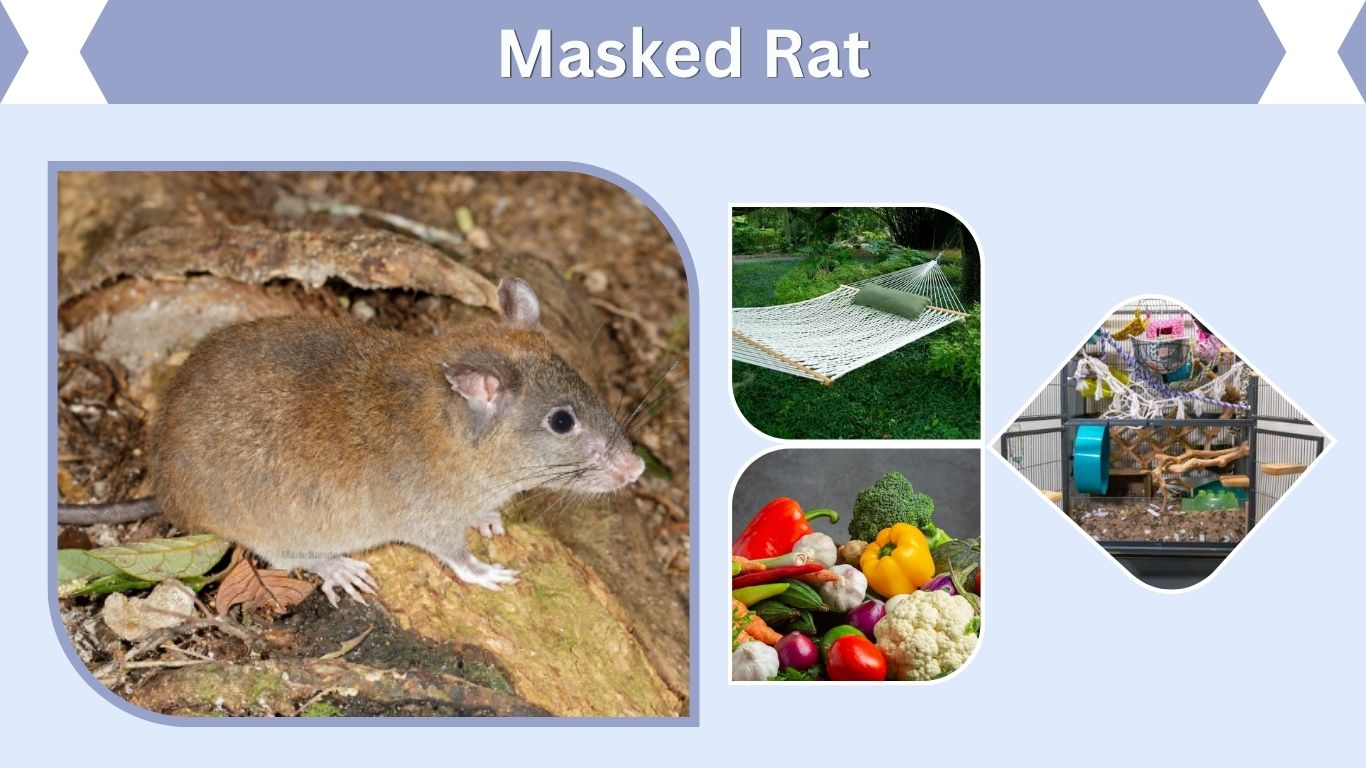
A masked rat is a fancy rat with a distinctive facial marking that looks like a small colored mask around the eyes and across the upper nose. The rest of the body is predominantly white. Masked rats can occur in black, blue, agouti, and other recognized colors, and the marking can be combined with traits such as Dumbo ears or a Rex coat. “Masked” describes the coat pattern, not a separate rat breed. These intelligent, social animals have the same general personality, lifespan, and care requirements as other domesticated fancy rats.
What Is a Masked Rat?
A masked rat is a domesticated fancy rat with a specific marked coat pattern. Under the American Fancy Rat and Mouse Association standard, the body should be clean white while pigment is restricted to a mask covering the face, particularly around the eyes and above the nose.
The colored area should not extend far down the sides of the face, onto the jowls, or beneath the chin in an ideally marked show animal. AFRMA standardized the Masked marking in 1992.
Pet rats do not need perfect show markings. Slightly oversized, uneven, or incomplete masks have no effect on their suitability as companions.
What Does a Masked Rat Look Like?
The dramatic contrast between a white body and colored face makes this pattern relatively easy to recognize.
Masked Rat Identification
- Predominantly white body
- Colored marking across the face
- Pigment surrounds both eyes
- Mask extends above or toward the nose
- White jowls and chin are preferred in show-standard animals
- No large colored patches elsewhere on an ideally marked rat
- Long tail with little visible hair
- Large eyes and prominent whiskers
- Standard or Dumbo ears depending on variety
AFRMA states that Masked rats can be shown in any recognized color, meaning “masked” identifies the distribution of pigment rather than its specific color.
Black Masked Rat
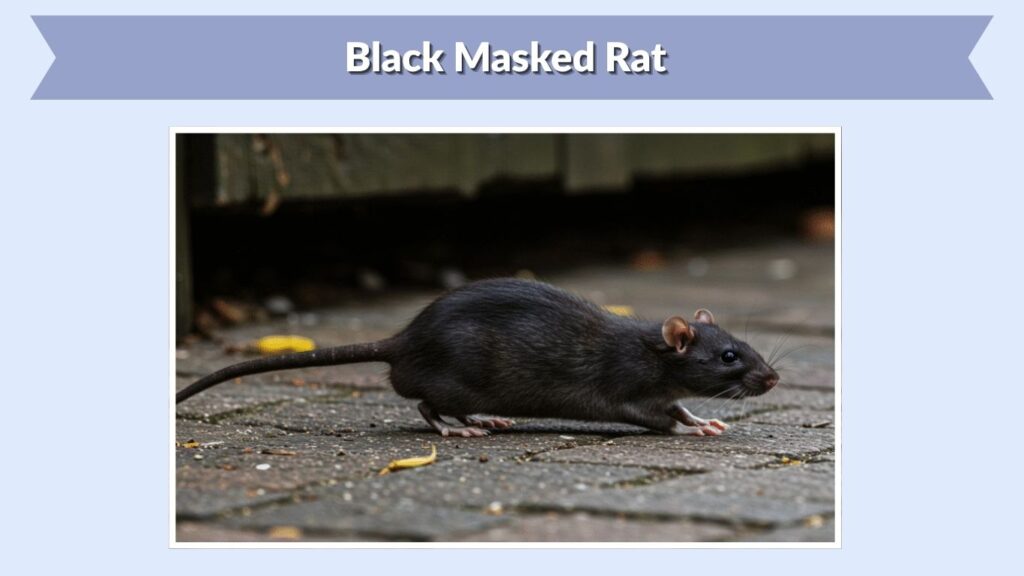
The black masked rat has a white body with a deep black facial mask.
The black marking usually surrounds both eyes and spreads across the area between them, producing a striking contrast with the white coat. Dark eyes are common with black coloration.
The mask can vary naturally in shape. Some animals have a neat, symmetrical marking while others have patches that are uneven, too narrow, or extended farther across the head.
These differences are mainly cosmetic.
Blue Masked Rat
A blue masked rat follows the same pattern, but the facial pigment is blue-gray rather than black.
Fancy-rat “blue” is not bright blue. It generally describes a diluted slate or gray-blue coat color. AFRMA recognizes several genetically distinct blue-related colors, so terminology can vary according to the exact variety.
Against a white body, the cool gray facial mask can appear especially noticeable.
Masked Dumbo Rat
A masked Dumbo rat combines two different characteristics.
“Masked” refers to the coat marking, while “Dumbo” refers to the ear type. Dumbo rats have large, rounded ears positioned lower on the sides of the head than those of standard-eared rats.
Therefore, a blue masked Dumbo rat could have:
- A white body
- Blue-gray facial mask
- Large, low-set Dumbo ears
These characteristics can occur together because color, markings, ear type, and coat type are separate aspects of fancy-rat appearance.
Masked Rex Rat
A masked Rex rat combines the masked facial pattern with the Rex coat type.
Rex rats have curly or noticeably wavy fur and typically curled whiskers. A masked Rex therefore retains the white body and facial mask but has a textured coat rather than standard straight fur.
A rat can combine even more traits—for example, a blue masked Dumbo Rex rat could simultaneously have blue facial markings, Dumbo ears, and curly Rex fur.
“Masked,” “Dumbo,” and “Rex” should not be treated as three separate species or breeds. They describe different physical characteristics of the same domesticated rat.
Mismarked Masked Rat
Not every masked rat develops a perfectly symmetrical facial marking.
A mismarked masked rat may have:
- An uneven mask
- Pigment extending onto the cheeks
- Color underneath the chin
- A mask covering only part of one eye
- White breaks inside the colored area
- Small colored spots elsewhere on the body
These features may prevent an animal from matching a particular show standard, but they generally have no significance for its health or personality.
In pet homes, an unusual mask can simply make an individual easier to recognize.
Masked Rat vs Hooded Rat
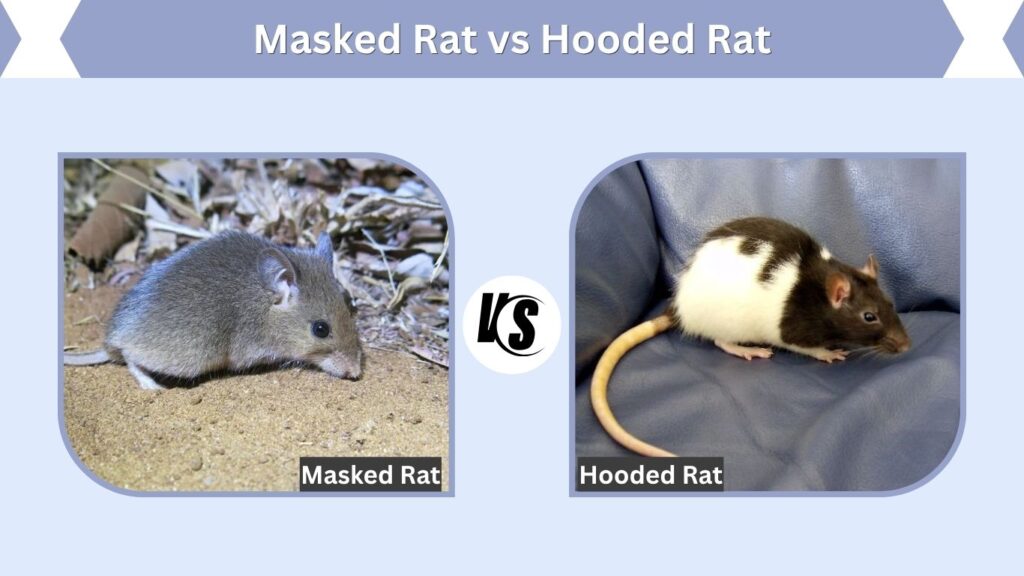
Masked and hooded rats are easy to distinguish once you understand how their markings are distributed.
A masked rat is mostly white with color restricted largely to the face.
A hooded rat has a colored head, neck, and shoulders, usually accompanied by a colored stripe running along the back.
Therefore, a rat with a completely dark head and colored dorsal stripe is more accurately described as hooded rather than masked.
Both belong to the marked varieties of fancy rats.
Masked Rat vs Capped Rat
Capped rats are another similar-looking variety.
A capped rat has color covering a larger part of the top of the head, generally extending toward the ears while leaving the rest of the body white.
In a masked rat, the colored area is concentrated specifically around the eyes and upper nose, creating the characteristic mask effect.
This makes facial distribution more important than simply asking whether the rat has a colored head.
Are Masked Rats Good Pets?
The mask pattern does not determine temperament.
Like other pet rats, masked fancy rats can be intelligent, curious, affectionate, and interactive when appropriately socialized. They often enjoy exploring, solving simple food puzzles, climbing, and interacting with familiar caregivers.
Rats are also highly social and should generally live with compatible rat companions rather than being housed alone. Blue Cross recommends pairs or groups and emphasizes regular human interaction and daily exercise.
Personality varies between individuals regardless of whether a rat is black masked, blue masked, hooded, or another color.
Masked Rat Lifespan
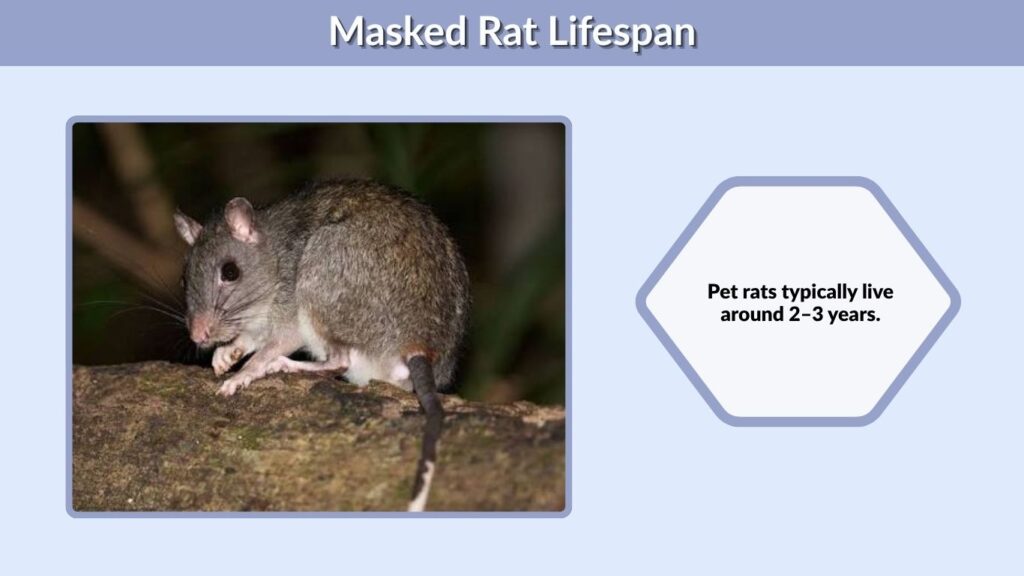
A masked rat has approximately the same lifespan as any other healthy domesticated fancy rat.
Pet rats typically live around 2–3 years, although some individuals may live longer. Genetics, diet, housing, disease, weight, and veterinary care can influence longevity.
The facial marking itself does not provide a longer or shorter expected lifespan.
How to Care for a Masked Pet Rat

Masked rats have no special care requirements based on their coat pattern.
Housing
Provide a spacious, well-ventilated wire enclosure with a solid floor. Rats enjoy climbing, so vertical space, ropes, platforms, tunnels, hammocks, and hiding boxes are useful.
Blue Cross recommends a cage measuring at least 90 × 60 × 120 cm for two to five rats, with additional space for larger groups.
Companionship
Rats should have compatible rat companions. Same-sex pairs or groups are commonly kept together to avoid unplanned breeding.
Diet
Provide a nutritionally appropriate rat diet together with suitable vegetables and other balanced foods. Fresh drinking water should always be available.
Exercise and Enrichment
Rats need opportunities to explore outside their enclosure in a safe, rat-proofed space. Blue Cross recommends at least an hour of supervised exercise outside the cage each day.
Cardboard boxes, tunnels, climbing ropes, hammocks, chewable materials, and hidden food can provide valuable enrichment.
What Is a Masked White-Tailed Rat?
The masked white-tailed rat is completely different from a masked fancy rat.
The masked white-tailed rat, Uromys hadrourus, is a wild Australian rodent found in northeastern Queensland’s Wet Tropics. It is also known as the Masked White-tailed Uromys or Thornton Peak Uromys.
It is a distinct wild species, whereas the masked fancy rat is a domesticated form of the Norway rat with a selectively bred facial marking.
The two should not be confused simply because both names contain the word “masked.”
Interesting Masked Rat Facts
The Masked marking is more specific than simply having a dark face. An ideally marked animal has pigment concentrated immediately around the eyes and above the nose while the rest of its body remains clean white.
The pattern can also appear with many colors and physical varieties. This means two masked rats may look remarkably different—one could be a smooth-coated black Standard rat, while another could be a blue Dumbo Rex.
AFRMA genetic information associates the Masked marking with the marked-rat genetic system and lists it separately from Hooded, Berkshire, Capped, and other established patterns.
FAQs
What is a masked rat?
A masked rat is a fancy rat with a mostly white body and a colored facial marking surrounding the eyes and extending above the nose.
Is a masked rat a separate breed?
No. “Masked” describes a coat-marking pattern rather than a separate species or conventional breed.
Can masked rats be black or blue?
Yes. Masked rats can occur in recognized colors including black, blue, agouti, and others. The mask describes where the color appears, not which color it must be.
How long does a masked rat live?
Most pet rats live approximately 2–3 years, and masked rats have the same general lifespan.
Is a masked white-tailed rat the same animal?
No. The masked white-tailed rat (Uromys hadrourus) is a wild Australian species, while a masked fancy rat is a domesticated pet rat with a facial marking.