
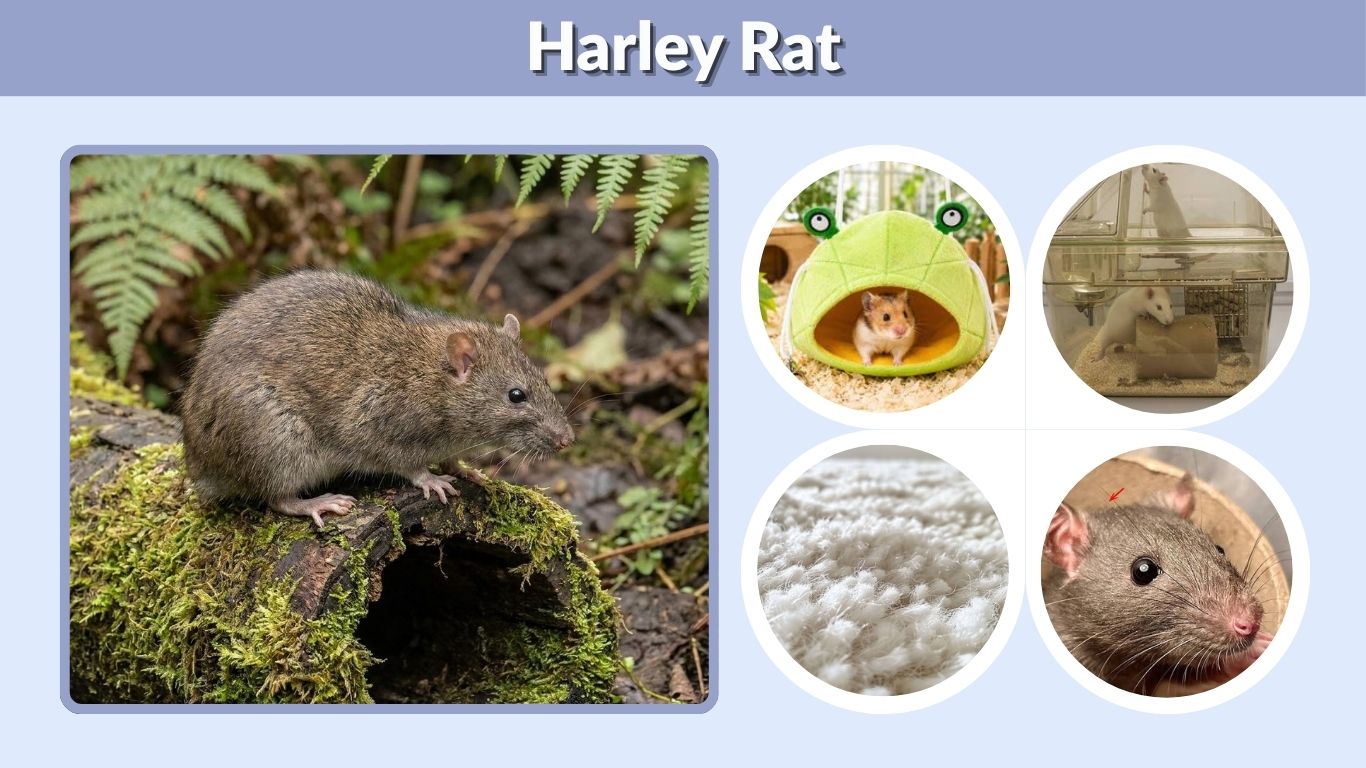
The Harley rat is a distinctive fancy-rat variety known for its soft, wispy coat and unusually fluffy appearance. Harley describes a coat type, not a separate rat species or breed, so it can occur alongside Dumbo ears, dwarf size, Rex coats, Silvermane coloring, and many different patterns. The trait first appeared in the U.S. fancy-rat community in 2002. Harley coats are often called long-haired, although their appearance may partly result from lacking the dense undercoat found on standard rats.
What Is a Harley Rat?
A Harley is a domesticated fancy rat carrying a recessive coat trait that produces fine, soft-looking fur. Some individuals have luxurious fluffy coats, while others appear thinner or more wispy. Because Harley affects the coat rather than overall body type, these rats otherwise have the same basic anatomy, behavior, social needs, and general care requirements as other domestic rats.
Harley Rat Characteristics
Typical features include:
- Fine, wispy fur
- Soft or ruffled appearance
- Little or no typical undercoat
- Fur that stands away from the body
- Delicate or slightly irregular whiskers
- Variable coat thickness
- Many possible colors and markings
- Standard or Dumbo ears
- Standard or dwarf body size
- Normal fancy-rat personality and behavior
RatsPacNW describes Harley coats as soft and wispy with an overall longer-looking appearance, while AFRMA describes them as sparse, fine coats lacking an undercoat.
Are Harley Rats Really Long-Haired?
They are commonly called long-haired rats, but the description is more complicated.
AFRMA notes that the apparent length may result partly from the absence of an undercoat. Without dense shorter hairs underneath, the remaining coat stands out and creates a flowing, longer-looking appearance. The individual hairs may therefore not always be dramatically longer than those of a standard rat.
For everyday pet descriptions, however, “long-haired Harley rat” remains widely used.
Harley Rat Coat and Whiskers
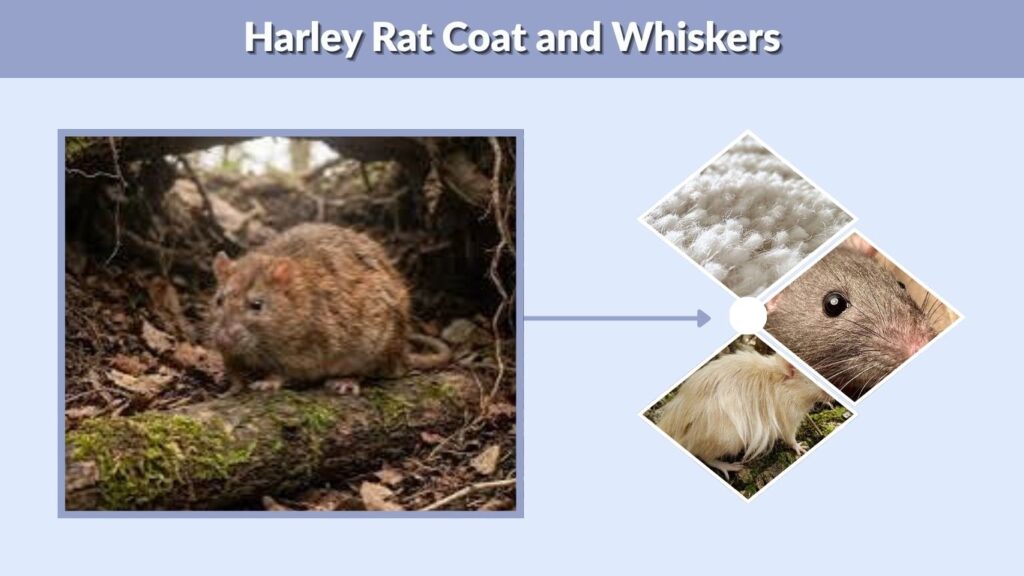
The coat is the main feature separating a Harley from an ordinary fancy rat. Quality varies considerably between genetic lines. Some rats develop dense, attractive coats, while others have thin patches or easily damaged hairs. Young Harley rats may also change appearance as they molt and mature, so an eight-week-old animal may look different several months later.
What Does the Harley Coat Feel Like?
A good coat is generally:
- Soft
- Fine
- Light and wispy
- Slightly ruffled
- Longer-looking than standard fur
- Relatively delicate
- Sometimes shiny
The absence or reduction of a typical undercoat makes the skin easier to see on thinner-coated individuals.
Harley whiskers may look somewhat crimped, shortened, bent, or “singed.” AFRMA suggests that these whisker changes may reflect the same structural weakness affecting the coat hairs.
Do Harley Rats Lose Their Fur?
Some shedding and coat changes are normal, particularly while a young rat matures. However, Harley fur can be more fragile than Standard fur and may break or thin more easily.
Persistent bald patches, redness, excessive scratching, sores, dandruff, or sudden hair loss should not automatically be blamed on the Harley gene. Parasites, infection, nutritional problems, barbering by cage mates, allergies, and other conditions can also cause hair loss and may require veterinary evaluation.
Harley Rat Genetics
Harley genetics are somewhat unusual because the trait is well established among breeders but has not been completely characterized scientifically. AFRMA lists Harley as a recessive trait with unknown exact genetic coding, while RatsPacNW uses the breeder notation haha. Both agree that two copies are generally required for the classic Harley phenotype.
What Is a Harley Carrier Rat?
A carrier has inherited one copy of the recessive Harley allele but does not possess the two copies generally required to produce the obvious Harley coat.
In simplified breeding terms:
- Harley × Harley can produce Harley offspring.
- Harley × non-carrier normally produces carriers rather than visible Harleys.
- Harley × carrier can potentially produce both Harley and carrier offspring.
- Carrier × carrier can potentially produce Harley offspring.
Because the precise molecular mutation has not been fully established, pedigree information remains especially important when breeding Harley rats.
Where Did Harley Rats Come From?
The recognized U.S. Harley line traces back to a rat discovered in a pet shop on September 1, 2002, by Debbi J. Needham of Odd Fellows Rattery in Washington.
The unusual coat was subsequently bred to determine how it was inherited. The trait proved recessive and was gradually established within fancy-rat breeding populations.
Harley Rat vs Rex Rat
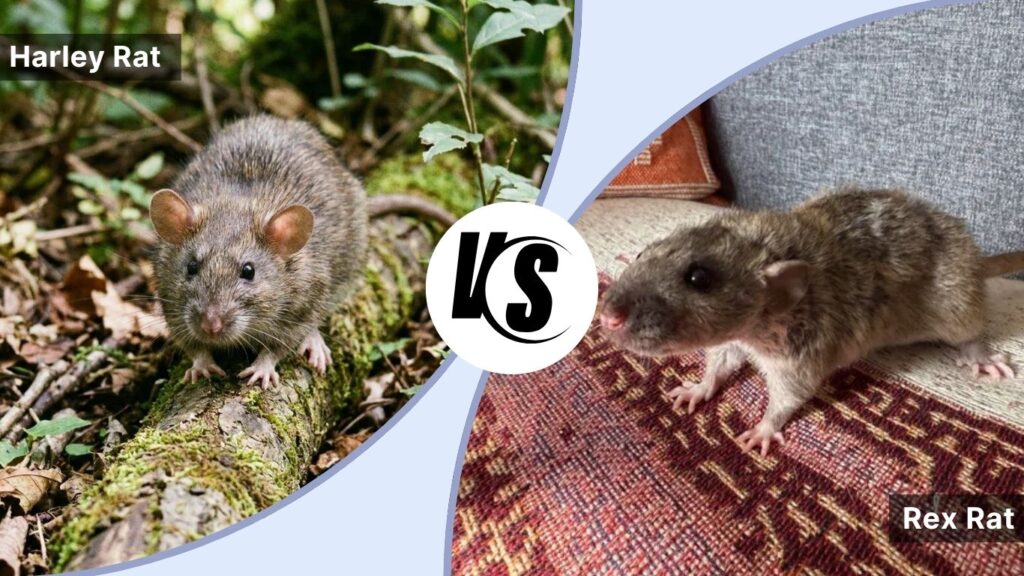
Harley and Rex are different coat traits. A Rex rat has distinctly curled or crimped fur and curly whiskers, whereas a Harley typically has finer, straighter, wispy fur. Because separate coat genes can occur in the same rat, breeders can sometimes produce animals combining Harley with Rex or other rexoid traits.
Harley vs Rex Differences
Harley rat:
- Fine, wispy coat
- Little or no normal undercoat
- Longer-looking fur
- Fragile hairs possible
- Harley trait is recessive
Rex rat:
- Clearly curled fur
- Curly whiskers
- Shorter, textured appearance
- Coat may thin with age
- Rex is genetically distinct from Harley
AFRMA currently lists Rex as Re/re, while Harley remains genetically unidentified beyond its recessive inheritance pattern.
What Is a Harley Rex Rat?
A Harley Rex is a rat in which Harley and a curly-coat trait occur together.
Depending on genetics and breeding line, the coat may appear longer, wavy, tousled, or curly. RatsPacNW recognizes both straight and curly forms within its Harley descriptions.
Terminology is not perfectly standardized between rat clubs and breeders, so pedigree information is more reliable than appearance alone.
Dumbo, Dwarf and Silvermane Harley Rats
Since Harley is primarily a coat trait, it can be combined with other independent fancy-rat characteristics. This creates many names that sound like different breeds but actually describe several traits occurring in one animal.
Common Harley Combinations
Examples include:
- Harley Dumbo rat: Harley coat with low-set Dumbo ears
- Dwarf Harley rat: Harley coat combined with dwarf size
- Silvermane Harley: Harley coat combined with Silvermane/D’Argent coloring
- Black Harley: Black pigmentation with Harley fur
- Agouti Harley: Wild-type agouti coloring with Harley fur
- Chocolate Harley: Chocolate-colored Harley
- Cream Harley: Pale cream coloration with Harley coat
- Siamese Harley: Pointed Siamese pattern with Harley fur
- Russian Blue Harley: Blue-gray coloration combined with Harley
- Harley Rex: Harley combined with a curly-coat trait
AFRMA lists Dumbo, Russian Blue, Siamese, Rex, and Harley as genetically separate characteristics, allowing them to occur in combinations.
Silvermane Harley Rat
Silvermane, also called D’Argent in AFRMA terminology, gives the coat pale silver-tipped hairs and a characteristic darker facial mask.
Combining Silvermane with Harley can make the already unusual coat appear especially soft and silvery. Several established fancy-rat breeders currently work with both coat varieties.
Harley Rat Care
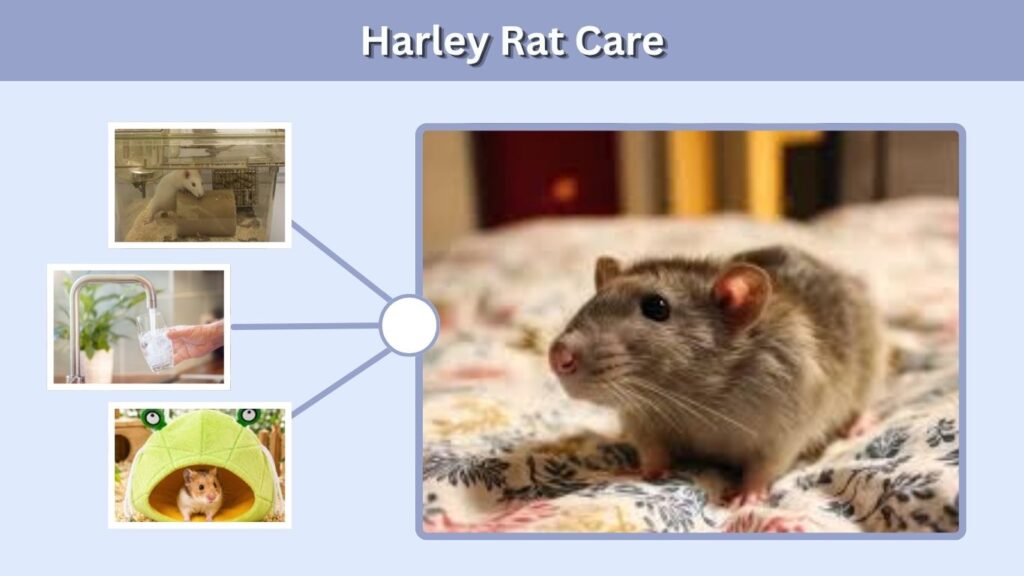
Harley rats require essentially the same social environment, diet, enrichment, veterinary care, and spacious housing as other fancy rats. Their delicate coat and skin deserve some additional observation, but they should not be treated as completely different animals simply because of their fur.
Basic Harley Rat Care
Provide:
- At least one compatible rat companion
- Spacious, well-ventilated housing
- Soft, low-dust bedding
- A nutritionally complete rat diet
- Constant clean drinking water
- Hammocks and comfortable sleeping areas
- Climbing structures and enrichment
- Daily supervised exercise
- Regular gentle handling
- Routine skin and coat checks
Rats are strongly social animals and should generally live with compatible rats rather than alone. Blue Cross also recommends daily interaction and exercise outside the cage.
Skin and Coat Problems
Extra attention to skin condition is worthwhile with Harley rats.
AFRMA notes reports of dry skin, delicate fur, hair loss, and health or breeding problems in some Harley lines. These issues are not necessarily present in every animal, but they make responsible selection of healthy breeding lines important.
There is no good reason to radically alter a Harley’s diet simply because of coat type without veterinary guidance. A balanced rat diet is safer than experimenting with severe nutrient restrictions.
Are Harley Rats Good Pets?
Harleys can make excellent companion animals when they come from healthy, well-socialized lines. Coat type does not determine personality. A Harley can be outgoing, relaxed, energetic, shy, affectionate, or independent just like any other rat.
Temperament and Lifespan
Fancy rats are intelligent and highly social, and many enjoy interacting with people. Harley rats have the same general behavioral needs.
Pet rats average approximately 2–3 years of life, although individual lifespan varies with genetics, disease, veterinary care, and general husbandry. Blue Cross gives an average of roughly two and a half years.
When choosing a Harley, prioritize health and temperament over extreme coat length or unusual color.
FAQs
1. What is a Harley rat?
A Harley rat is a fancy rat with a recessive coat trait producing soft, fine, wispy fur and little or no normal undercoat. It is a coat variety rather than a separate breed.
2. Are Harley rats long-haired?
They are commonly called long-haired rats. However, AFRMA notes that the longer appearance may partly result from loss of the normal undercoat rather than dramatically longer individual hairs.
3. What is a Harley Dumbo rat?
A Harley Dumbo combines the Harley coat with Dumbo ears, which are positioned lower on the sides of the head. The two traits are inherited separately.
4. What is the difference between Harley and Rex rats?
Harley rats generally have fine, wispy, longer-looking coats, while Rex rats have distinctly curly fur and whiskers. The two are genetically separate coat traits.
5. How long do Harley rats live?
Their expected lifespan is similar to other pet rats, usually around 2–3 years. Harley is a coat trait and does not create a separate species with a fundamentally different lifespan.