
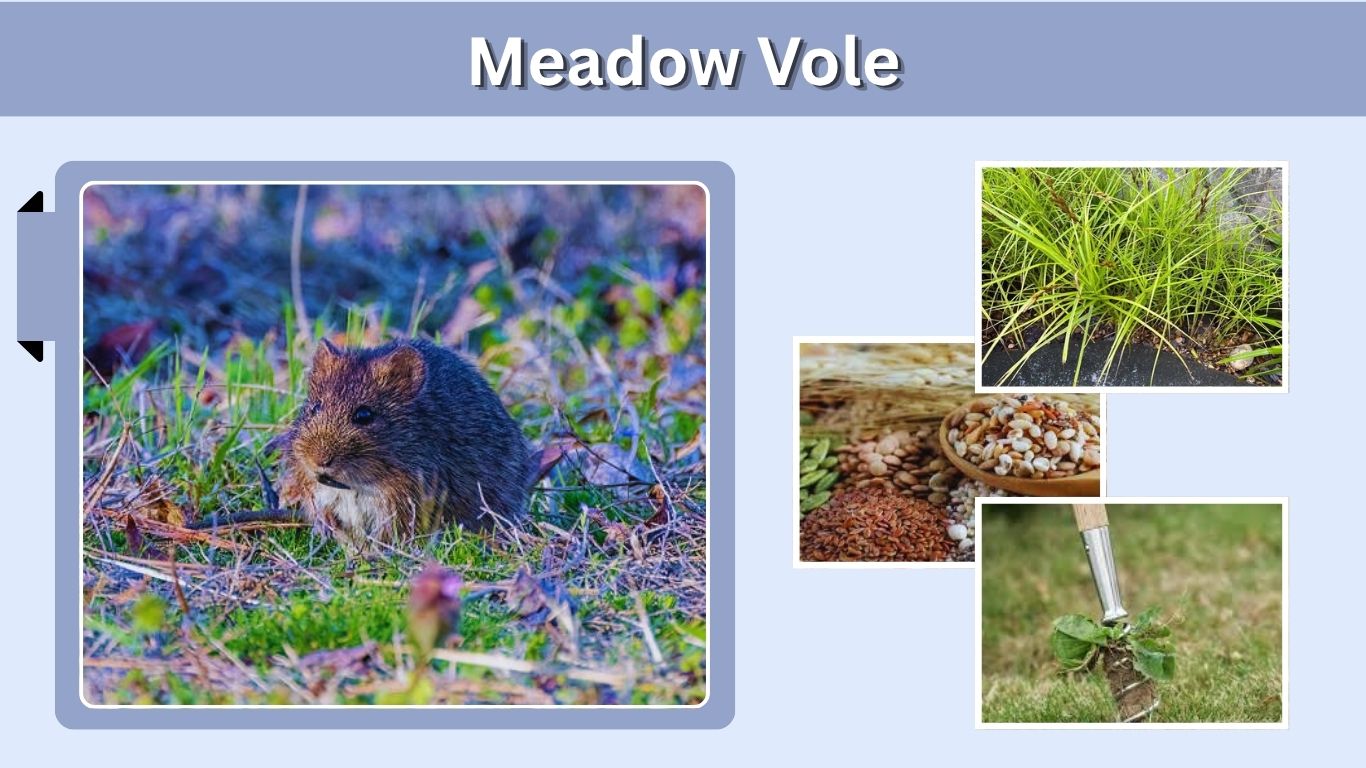
The meadow vole is a small, stocky rodent that lives in grasslands, marshes, fields, orchards, and other places with dense ground cover. It is sometimes called a meadow mouse or field mouse, although it is a vole rather than a true mouse. Meadow voles create narrow surface runways through grass and may damage lawns, crops, bulbs, and young trees when populations become high. However, they also play an important ecological role by feeding numerous predators, including owls, hawks, foxes, snakes, and weasels.
What Is a Meadow Vole?
The name meadow vole traditionally referred broadly to Microtus pennsylvanicus. Modern mammal classifications recognize the eastern meadow vole as Microtus pennsylvanicus and separate some western populations as the western meadow vole, Microtus drummondii. Both are compact, grass-eating rodents adapted to life beneath dense vegetation.
| Feature | Description |
| Scientific name | Microtus pennsylvanicus |
| Family | Cricetidae |
| Other name | Meadow mouse |
| Body shape | Stocky and rounded |
| Color | Brown, gray-brown, or blackish-brown |
| Diet | Primarily grasses and other plants |
| Main habitat | Meadows, fields, marshes, and lawns |
| Activity | Active throughout the year |
Meadow vole populations can rise and fall dramatically. During years of high abundance, large numbers may occupy fields, orchards, and landscaped properties.
Meadow Vole Identification
Meadow voles have compact bodies, short legs, small rounded ears, and relatively blunt faces. Their ears are partly hidden by fur, unlike the large and obvious ears of many mice.
Identification Features
- Body: Rounded, heavy, and compact
- Fur: Coarse brown, reddish-brown, gray-brown, or nearly black
- Underside: Grayish or silvery
- Head: Broad with a blunt muzzle
- Eyes: Small, dark, and round
- Ears: Small and partly concealed in the fur
- Tail: Short, hairy, and usually much shorter than the body
- Teeth: Orange or yellowish front incisors
Meadow voles normally move close to the ground and remain hidden beneath grass or snow. They are better adapted for running through low vegetation than climbing tall structures.
Meadow Vole Size
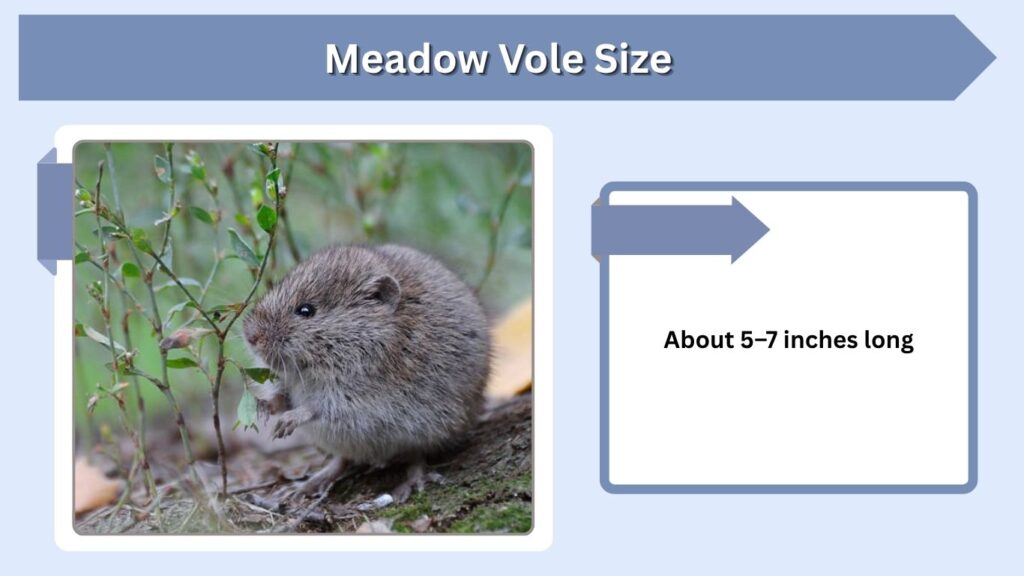
Adult meadow voles are generally about 5–7 inches long, including the tail. The tail is commonly around 1–2½ inches long, making it noticeably shorter than the long, thin tail of a typical mouse.
Most adults weigh approximately 1–3 ounces, although size differs with age, sex, season, and geographic population. Females and males usually look similar, making sex difficult to determine without close examination.
Meadow Vole vs. Mouse
Meadow voles are frequently called field mice, but several physical features distinguish them from true mice.
| Feature | Meadow vole | Typical mouse |
| Body | Stocky and rounded | Slimmer and more delicate |
| Face | Blunt muzzle | More pointed muzzle |
| Ears | Small and partly hidden | Large and prominent |
| Tail | Short and hairy | Long and thin |
| Habitat | Grass and ground-level runways | Fields, buildings, and climbing areas |
| Main food | Grasses and plants | Seeds, grains, and varied foods |
A rodent with a thick body, tiny ears, and a short tail is more likely to be a vole. A slender animal with large ears and a tail nearly as long as its body is more likely to be a mouse.
Meadow Vole Habitat and Range
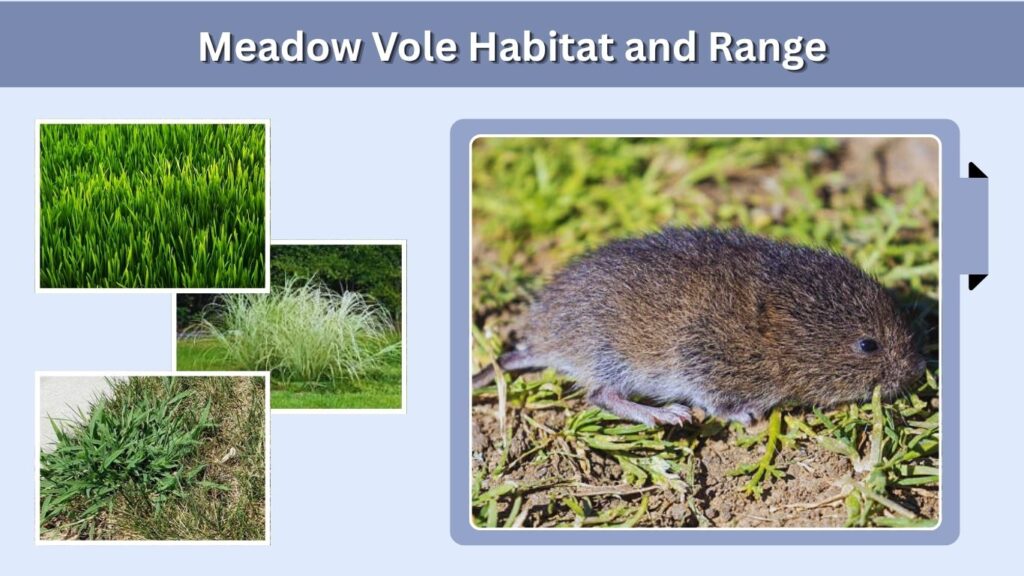
Meadow voles favor open environments with thick grass, weeds, sedges, or plant litter. Typical habitats include moist meadows, old fields, marshes, roadside vegetation, orchards, gardens, pastures, and lawns with tall grass. Dense cover helps conceal them from predators while providing food and nesting material.
Eastern meadow voles occur across eastern Canada and large parts of the eastern United States. The western meadow vole occupies western and northern portions of North America. Exact distribution depends on the species and modern taxonomic treatment.
Do Meadow Voles Live in Houses?
Meadow voles are mainly outdoor rodents. They may occasionally enter a garage, basement, shed, or crawl space, especially during cold weather, but they are less likely than house mice to establish permanent indoor populations.
A vole found indoors may have entered through a foundation opening, open door, damaged vent, or gap around a pipe. Removing vegetation beside the foundation and sealing openings can reduce accidental entry.
Meadow Vole Holes, Tunnels, and Nests
Meadow voles create networks of narrow runways through grass. These paths are generally around 1–2 inches wide and connect feeding areas, burrow entrances, shelters, and nests.
Their burrow openings are small and usually lack the large soil mounds created by moles. Runways often become highly visible in spring after snow melts, revealing winding tracks through flattened or damaged grass.
Nests are made from dry grass and plant fibers. They may be placed underground, beneath logs, inside dense vegetation, or under winter snow. Snow provides insulation and protects voles while they continue feeding during cold weather.
What Do Meadow Voles Eat?

Meadow voles are primarily herbivores. Their diet changes with the season and the plants available in their habitat.
Common foods include:
- Grasses and sedges
- Clover and alfalfa
- Plant stems and leaves
- Seeds and grains
- Roots and bulbs
- Garden vegetables
- Tree bark
- Shrub stems
During spring and summer, they feed heavily on green vegetation. In fall, seeds and grains become more important. During winter, they may gnaw bark, roots, and the lower stems of young trees and shrubs.
They may occasionally consume fungi or small invertebrates, but plant material forms the majority of their diet.
Meadow Vole Damage
Small populations may cause little noticeable harm. Damage becomes more serious when abundant voles settle in lawns, gardens, nurseries, farms, or orchards.
Lawn and Garden Damage
Meadow voles clip grass and create visible surface runways. They may also eat seedlings, flower bulbs, roots, vegetables, ground covers, and newly planted landscaping.
Damaged lawns often contain:
- Flattened grass pathways
- Small burrow entrances
- Clipped vegetation
- Droppings along runways
- Patches of dead or thin turf
Grass damaged by runways often recovers with raking, reseeding, and normal spring growth.
Damage to Trees and Shrubs
During winter, voles may feed on bark at or slightly below ground level. If they remove bark completely around a young trunk—a condition called girdling—the tree’s movement of water and nutrients can be interrupted, potentially killing it. Orchard trees and young landscape plants are especially vulnerable.
How to Control Meadow Voles
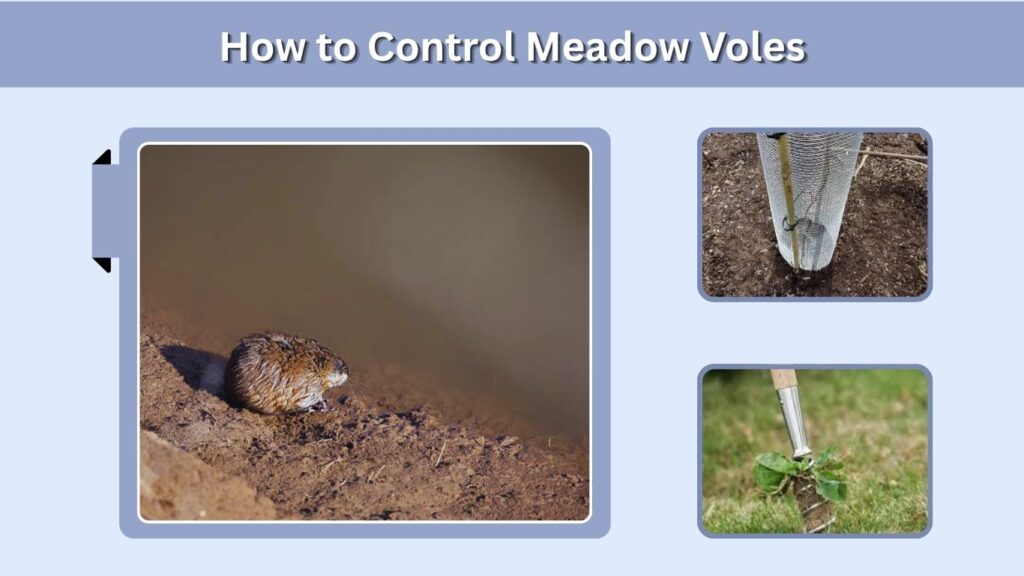
Control should begin by reducing the shelter and food surrounding vulnerable plants. Complete elimination is unnecessary in most locations because voles are natural wildlife and important prey animals.
Reduce Cover
Keep grass mowed and remove weeds, dense ground cover, and plant debris around gardens and young trees. Avoid piling mulch against trunks because deep mulch can shelter feeding voles.
Protect Trees
Install hardware-cloth guards or suitable commercial tree guards around young trunks. The barrier should be buried slightly below the soil and extend high enough to remain above expected snow depth.
Use Traps
Ordinary mouse snap traps can reduce small populations. Place traps perpendicular to active runways, with the trigger positioned in the path. Covering a trap with a box can protect children, pets, birds, and other wildlife.
Avoid Unnecessary Poison
Rodenticides can endanger children, pets, and predators that consume poisoned voles. Product availability and legal restrictions vary by location. Use only products specifically labeled for voles and follow every instruction, or contact a licensed wildlife-control professional.
Habitat management, tree guards, and targeted trapping are generally better starting points for residential properties.
Are Meadow Voles Dangerous?
Meadow voles are shy and usually escape into vegetation when approached. They do not hunt people or intentionally enter homes to attack occupants.
Like other wild rodents, they may bite if captured with bare hands. They can also carry parasites or microorganisms, so avoid direct contact with live animals, dead voles, urine, and droppings. Wear gloves during cleanup and wash your hands afterward.
Their main concern around homes is plant and lawn damage rather than direct danger to people.
Meadow Vole Predators
Meadow voles are a major food source for many predators. Their natural enemies include:
- Owls
- Hawks and harriers
- Foxes
- Coyotes
- Weasels
- Snakes
- Bobcats
- Domestic and feral cats
In some regions, meadow voles form a major part of the diets of short-eared owls, northern harriers, and other grassland predators.
Meadow Vole Lifespan and Reproduction
Most meadow voles have short lives in the wild because predation, severe weather, disease, and food shortages cause high mortality. Individuals that survive may live for about a year or longer, but many die within their first few months.
Females can reproduce rapidly when food and cover are plentiful. They may produce several litters during the breeding season, with multiple young in each litter. This reproductive ability allows depleted populations to recover quickly and sometimes leads to periodic population outbreaks.
FAQs
Are meadow voles nocturnal?
Meadow voles may be active during both day and night. Their activity often occurs in short periods separated by resting and feeding sessions. Dense grass allows them to move while remaining concealed.
Can meadow voles climb?
They can climb short stems, low plants, and obstacles, but they are primarily ground-dwelling rodents. Their compact bodies and short legs are better suited to tunnels and grassy runways.
Are meadow voles good pets?
No. Meadow voles are wild animals with specialized habitat, dietary, and behavioral needs. Keeping wildlife may also be restricted by local law. Domesticated rodents are more appropriate pets.
What do meadow vole tracks look like in snow?
Tracks may appear as small paired footprints connected by narrow trails beneath or across the snow. After melting, networks of flattened grass and runways often become visible.
What is the difference between a meadow vole and a prairie vole?
Meadow voles generally prefer moist grasslands and have slightly longer tails, while prairie voles often inhabit drier prairies and display stronger pair-bonding behavior. Their ranges overlap in parts of North America.