
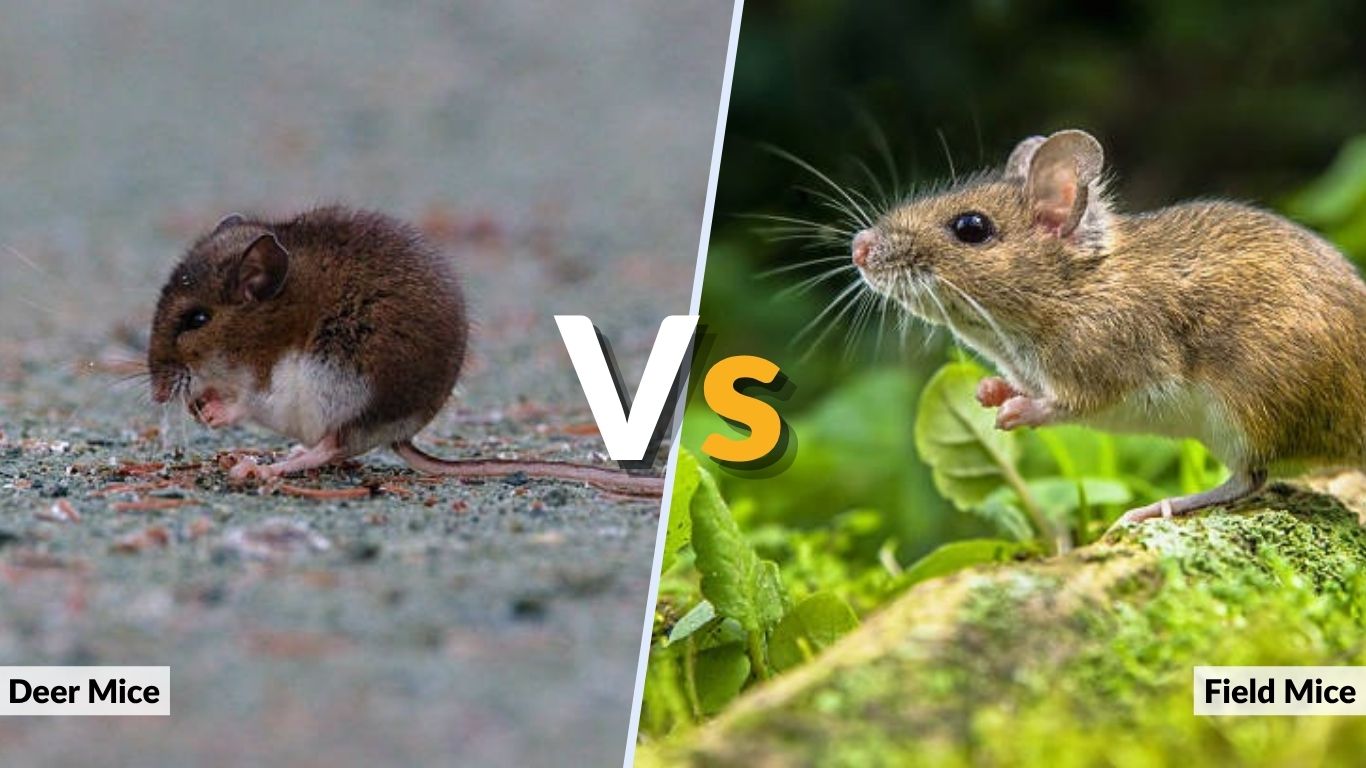
Deer mice and field mice are small rodents that may be found in gardens, barns, sheds, fields, and occasionally homes. However, the names can cause confusion because “field mouse” is not one precise species. In North America, it often refers to voles, especially meadow voles, although people may also use it for any wild mouse found outdoors. Deer mice are true mice with large ears and long tails, while voles have compact bodies and short tails.
Deer Mouse vs Field Mouse Overview
The quickest way to separate them is to examine the tail, ears, eyes, and body shape. Deer mice look more delicate and alert, while voles—often called field mice—look rounder and heavier.
| Feature | Deer Mouse | Field Mouse or Vole |
| Scientific group | Peromyscus | Usually Microtus |
| Body shape | Slender and mouse-like | Stocky and rounded |
| Eyes | Large and prominent | Small |
| Ears | Large and visible | Small and partly hidden |
| Tail | Long and usually two-colored | Short and hairy |
| Belly | Usually white | Gray, tan, or pale brown |
| Main foods | Seeds, insects, fruit, and nuts | Grass, stems, roots, and bark |
| Typical habitat | Fields, forests, sheds, and homes | Fields, lawns, gardens, and wetlands |
Voles are frequently called field mice because they live in grassy yards and fields. They are small brown rodents with short tails and small ears.
What Is a Field Mouse?
“Field mouse” is an informal name rather than a scientifically exact classification. It may refer to several rodents depending on the country and region.
In North America, people commonly use the name for:
- Meadow voles
- Prairie voles
- Deer mice
- White-footed mice
- Harvest mice
- Other small rodents living in fields
For a practical comparison, this article uses field mouse to mean a vole, particularly the meadow vole. Deer mice themselves are sometimes described as field mice, so identification should be based on physical features rather than the common name.
What Does a Deer Mouse Look Like?
A deer mouse has a slender body, pointed nose, large dark eyes, prominent rounded ears, and long whiskers. Its back may be gray, tan, reddish brown, or dark brown, while its belly and feet are usually white.
Deer Mouse Identification
Important features include:
- Large, shiny black eyes
- Large rounded ears
- Pointed snout
- White belly and feet
- Brown or gray upper body
- Long, slender tail
- Dark upper tail and pale underside
The clearly divided dark-and-light tail is one of the best identification clues. Deer mice generally have larger eyes and ears than voles, giving them a more alert appearance.
What Does a Field Mouse or Vole Look Like?
A vole has a compact, heavy-looking body with short legs, dense fur, small eyes, and rounded ears that may be partly hidden in its coat. Its nose is less pointed than that of a deer mouse.
Field Mouse Identification
Look for:
- Stocky, rounded body
- Small eyes
- Short, rounded ears
- Blunt muzzle
- Dense brown or gray fur
- Short, hairy tail
- Short legs
- Low movement through grass
Voles commonly create narrow pathways through lawns and grassy vegetation. Because their tails and ears are much smaller, they can look more like miniature hamsters than ordinary mice.
Deer Mouse vs Field Mouse Size
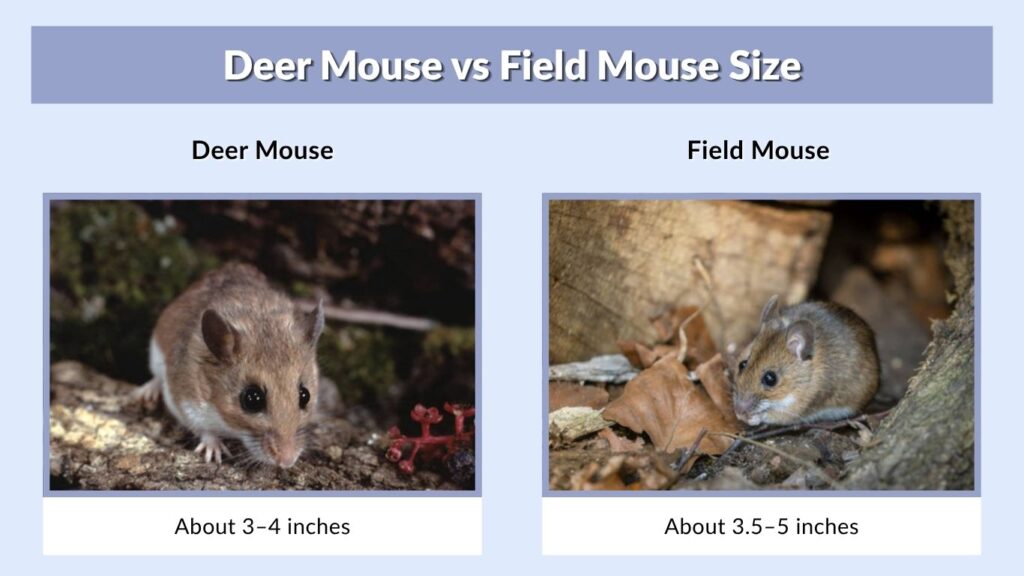
These rodents may have similar body lengths, so overall size is not always the most dependable clue. Tail proportions provide a clearer difference.
| Measurement | Deer Mouse | Field Mouse or Vole |
| Head and body | About 3–4 inches | About 3.5–5 inches |
| Tail | Often 2–5 inches | Usually much shorter than the body |
| Overall build | Light and slender | Thick and compact |
| Legs and feet | Relatively long | Short |
| Apparent size | Looks small and delicate | Looks larger and heavier |
A deer mouse’s tail may be close to the length of its body. A vole’s tail is usually only a small fraction of its total length. Deer mice may measure approximately three to four inches before the tail is included.
Habitat and Behavior

Both rodents can occupy fields, but their preferred shelter and movement differ.
Where Deer Mice Live
Deer mice are highly adaptable and can live in:
- Grasslands
- Forests and woodland edges
- Agricultural fields
- Rock piles
- Hollow logs
- Barns and sheds
- Cabins, garages, and houses
They are excellent climbers and jumpers. They may nest inside boxes, drawers, stored equipment, walls, furniture, or insulation when they enter buildings. Deer mice occupy environments ranging from meadows and forests to human structures.
Where Field Mice Live
Voles usually remain close to the ground. They commonly live in:
- Meadows
- Lawns
- Gardens
- Orchards
- Wetlands
- Crop fields
- Roadside vegetation
- Areas with dense ground cover
They build shallow burrows and travel through narrow surface runways hidden by grass. Unlike deer mice, voles are not especially good climbers and are less likely to establish nests high inside buildings.
Diet and Property Damage

Deer mice are opportunistic omnivores, while voles consume much more green vegetation.
| Category | Deer Mouse | Field Mouse or Vole |
| Main diet | Seeds, grains, nuts, fruit, and insects | Grass, roots, stems, bulbs, and bark |
| Food storage | Frequently caches seeds | Less dependent on stored food |
| Indoor food | Pet food, birdseed, grain, and crumbs | Usually remains outdoors |
| Common damage | Contaminated food and gnawed packaging | Damaged lawns, roots, bulbs, and trees |
| Winter feeding | Stored seeds and available foods | Bark, roots, and remaining vegetation |
Deer mice consume insects heavily during spring and rely more on seeds during fall, often storing seeds for winter.
Voles may damage lawns by forming runways and can chew roots or bark around young plants. This damage is usually concentrated near ground level or beneath snow and vegetation.
Deer Mouse vs Field Mouse Droppings
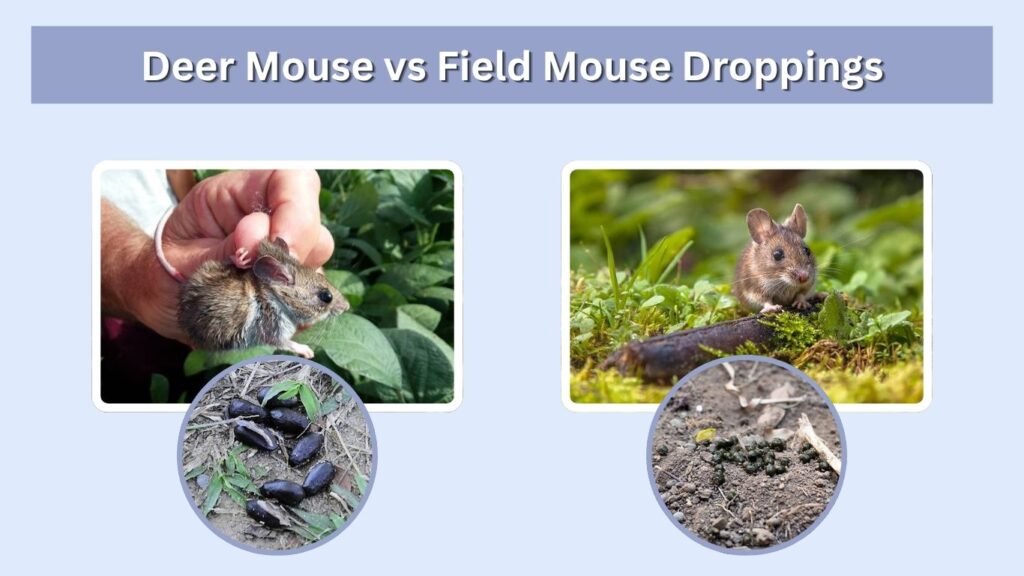
Droppings alone are not a reliable way to identify the exact rodent. Both animals can leave small, dark pellets resembling grains of rice.
Mouse droppings are commonly smooth and oval, with at least one pointed end. They are often approximately ⅛–¼ inch long, although size and color vary with the rodent and its diet.
Use several signs together:
- Tail and ear appearance
- Location of the droppings
- Lawn runways
- Gnawed plants or food packaging
- Burrows or indoor nests
- Tracks and captured images
Never handle wild-rodent droppings with bare hands.
Which One Is More Likely to Enter a House?
A deer mouse is more likely to enter a house, shed, barn, garage, or cabin. It may seek warmth, food, nesting material, and protection from predators or cold weather.
Voles generally stay outdoors because they depend heavily on grass, roots, stems, and ground-level vegetation. A vole may occasionally enter a garage, basement, or other ground-level area, but repeated indoor activity is more likely to involve deer mice, white-footed mice, or house mice.
Health Risks
Deer mice are important from a public-health perspective because some can carry hantaviruses. In the United States, the deer mouse is associated with the virus most commonly responsible for hantavirus pulmonary syndrome. This does not mean every deer mouse is infected, but rodent waste should always be treated cautiously.
Do not sweep or vacuum dry rodent droppings. Ventilate the space, wear gloves, thoroughly wet the waste with disinfectant, allow it to soak, and wipe it up with paper towels. Sweeping or vacuuming can send contaminated particles into the air.
How to Tell Them Apart Quickly
Follow these five identification steps:
- Check the tail: Long and two-colored suggests a deer mouse; short and hairy suggests a vole.
- Look at the ears: Large exposed ears indicate a deer mouse.
- Examine the eyes: Deer mice have much larger, more noticeable eyes.
- Observe the body: A slender body suggests a deer mouse; a stocky body suggests a vole.
- Inspect the habitat: Indoor food damage favors deer mice, while grassy runways and damaged plants favor voles.
FAQs
Are deer mice considered field mice?
Deer mice are sometimes called field mice because they frequently inhabit fields, meadows, and agricultural areas. However, “field mouse” can also refer to voles and several other wild rodents. The term should not be used as a precise species identification.
Are deer mice larger than field mice?
Not necessarily. Their body lengths can overlap, and a mature vole may look heavier than a deer mouse. Deer mice appear longer because they have slender bodies and long tails, while voles have compact bodies and much shorter tails.
Do deer mice and field mice eat the same foods?
Their diets overlap, particularly around seeds and grains. Deer mice are more omnivorous and commonly consume insects, nuts, and fruit. Voles are more strongly herbivorous and eat grasses, stems, roots, bulbs, and tree bark.
Which rodent creates paths through grass?
Voles typically create narrow surface runways through grass and other dense vegetation. These paths connect burrow openings and feeding locations. Deer mice may travel through the same habitat but do not usually produce the obvious clipped-grass runway systems associated with voles.
Is a gray field mouse a deer mouse?
Color alone cannot confirm the species. Deer mice can appear gray or brown, but they usually have white feet, a white belly, large ears, large eyes, and a two-colored tail. A gray rodent with small ears and a short tail is more likely a vole.