
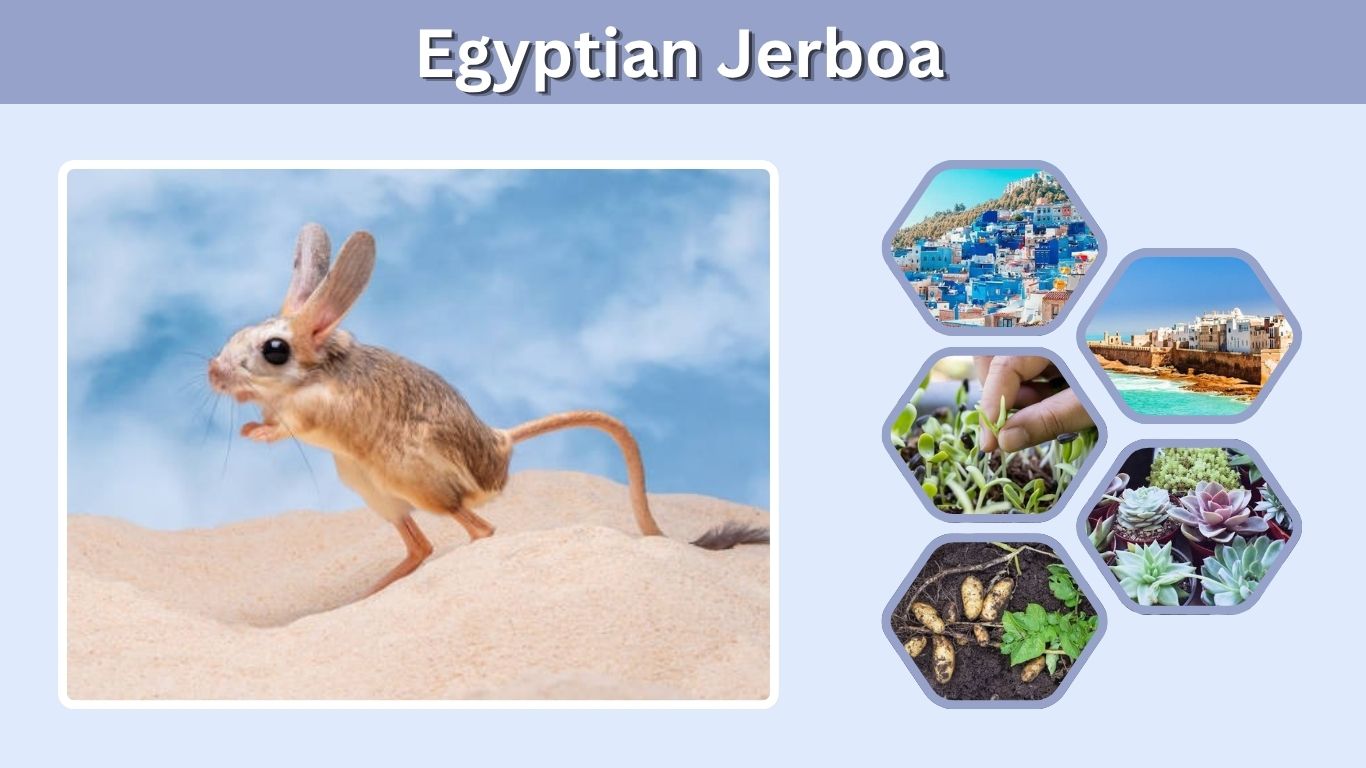
The Egyptian jerboa is a small desert rodent famous for its unusually long hind legs, oversized feet, and kangaroo-like jumps. The name generally refers to two related animals: the greater Egyptian jerboa and the lesser Egyptian jerboa. Both are nocturnal, live in underground burrows, and possess specialized features that help them survive hot, dry environments. Despite their mouse-like faces, jerboas belong to the family Dipodidae, which includes jerboas, jumping mice, and birch mice.
What Is an Egyptian Jerboa?
Egyptian jerboas are bipedal rodents in the genus Jaculus. Instead of running on four feet like ordinary mice, they primarily travel by hopping on their powerful hind legs. Their small front limbs are mainly used for digging, handling food, cleaning, and supporting the body while resting.
The two species commonly called Egyptian jerboas are:
- Greater Egyptian jerboa: Jaculus orientalis
- Lesser Egyptian jerboa: Jaculus jaculus
Both have three functional toes on each hind foot. The middle foot bones are fused into a strong structure sometimes called a cannon bone, while stiff hairs beneath the toes improve movement across loose sand.
Greater vs. Lesser Egyptian Jerboa
Although the two species have similar body shapes, the greater Egyptian jerboa is usually heavier and more robust. The lesser species has a wider geographic distribution and is particularly associated with open desert and semi-desert landscapes.
| Feature | Greater Egyptian Jerboa | Lesser Egyptian Jerboa |
| Scientific name | Jaculus orientalis | Jaculus jaculus |
| Body length | About 9.5–14.5 cm | About 9.5–11 cm |
| Typical weight | Roughly 104–182 g | Roughly 43–73 g |
| Hind toes | Three | Three |
| Social behavior | May be relatively social | Mostly solitary |
| Main habitat | Semi-desert, shrubland and farmland | Sandy or rocky deserts |
| Main range | Primarily North Africa | North Africa, Arabia and parts of Asia |
Measurements can vary by population, sex and source, but the greater species is generally noticeably heavier. Both possess long tails that may be longer than the head and body combined.
Egyptian Jerboa Identification
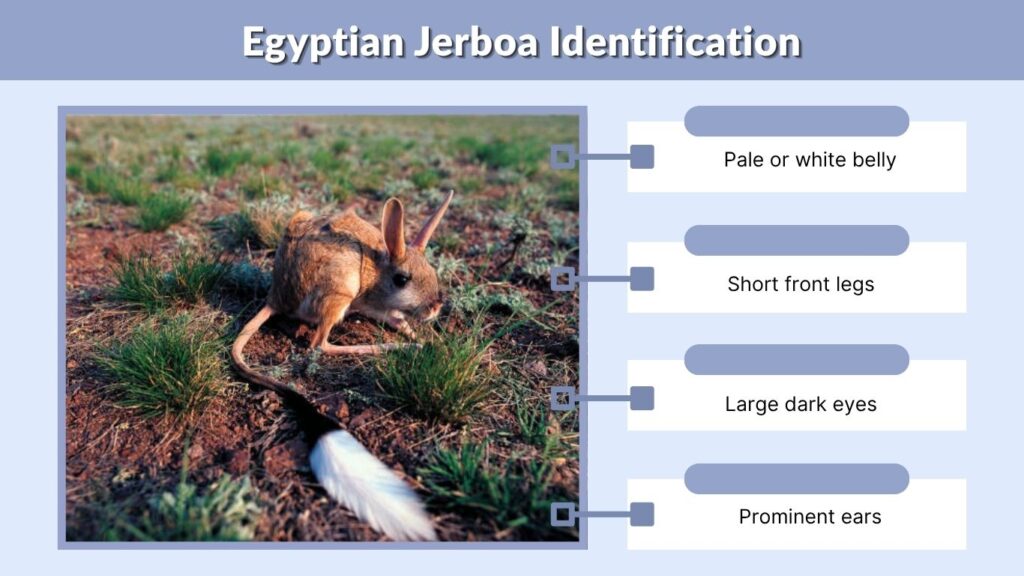
The Egyptian jerboa’s body is built for rapid movement across exposed desert ground. Its appearance combines the face of a small mouse with the hindquarters of a miniature kangaroo.
Key Physical Features
- Sandy, yellowish-brown or gray-brown upper fur
- Pale or white belly
- Extremely long hind legs
- Short front legs
- Three toes on each hind foot
- Large dark eyes
- Prominent ears
- Long tail ending in a dark-and-white tuft
The greater Egyptian jerboa has broad, hairy hind feet that distribute its weight across soft sand. The lesser Egyptian jerboa has a small body, moderately large ears and a tail that can measure approximately 128–250 millimetres.
Purpose of the Long Tail
The tail acts as a counterbalance while the jerboa runs, turns or changes direction during a jump. When the animal stands upright, the tail can also touch the ground and provide additional stability. Its contrasting terminal tuft may make the tail easier to control visually while moving in low light.
Where Do Egyptian Jerboas Live?
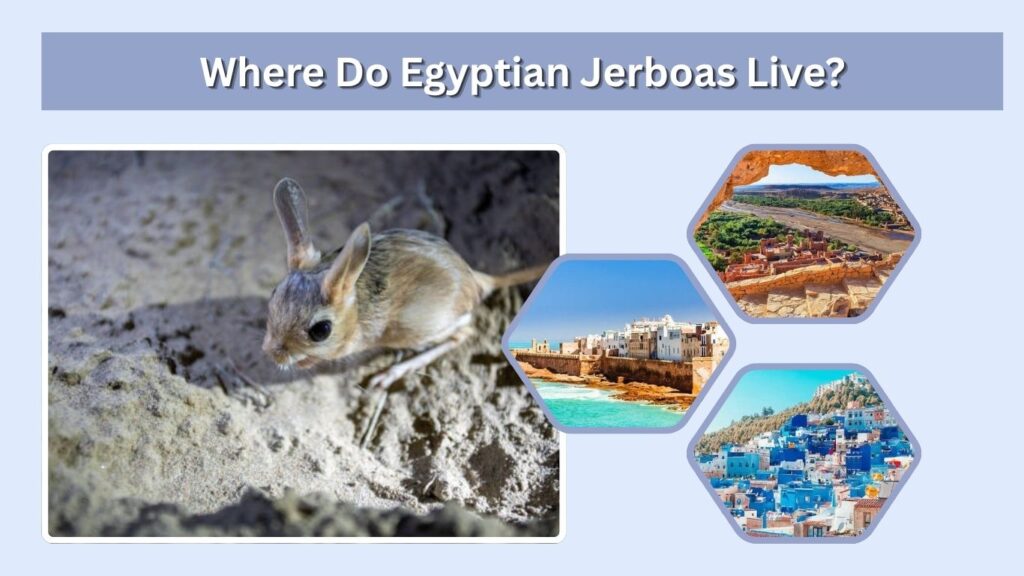
Egyptian jerboas occupy dry regions where vegetation is sparse and rainfall is limited. Their sandy coloring helps them blend into the surrounding ground, while underground burrows protect them from daytime heat.
Greater Egyptian Jerboa Habitat
The greater Egyptian jerboa occurs primarily across northern Africa, including Morocco, Algeria, Tunisia, Libya and Egypt. It has been recorded in deserts, dry shrublands, coastal dunes, pasture and cultivated areas. It generally digs its burrows in firm soil rather than constantly shifting sand.
Lesser Egyptian Jerboa Habitat
The lesser Egyptian jerboa has a broader distribution across North Africa, the Sahara, Arabia, the Middle East and parts of Asia. It inhabits sandy deserts, stony plains, semi-deserts, rocky valleys and occasionally dry meadows.
Underground Burrows
A jerboa spends most daylight hours inside a burrow. Lesser Egyptian jerboas may dig winding burrows in firm sand, with a nesting chamber positioned deep underground and additional passages that can function as escape routes.
During very hot or dry conditions, a burrow provides a cooler and more humid refuge. Some entrances may be sealed with soil or sand to reduce heat entering the tunnel.
What Does an Egyptian Jerboa Eat?
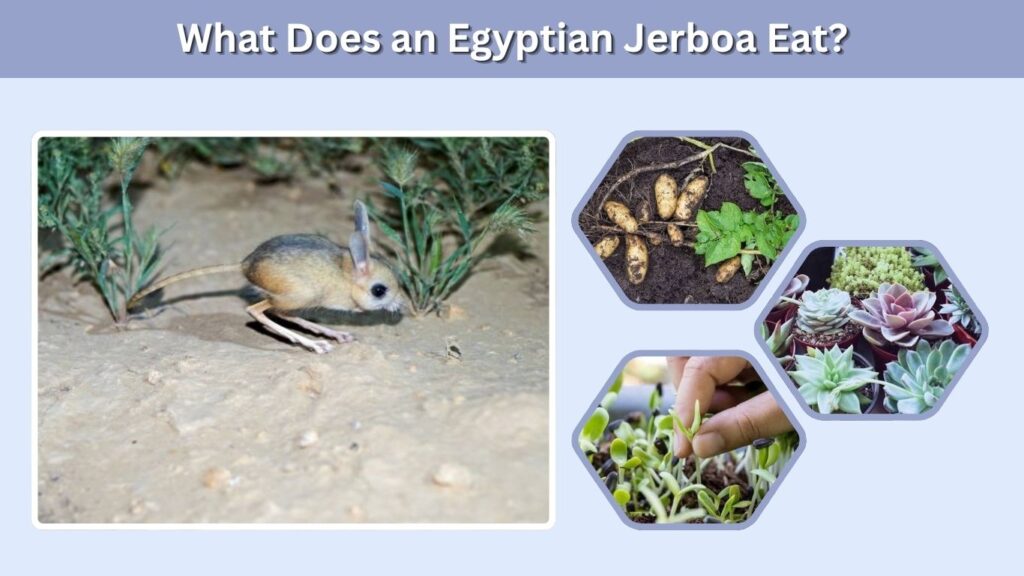
Egyptian jerboas eat mainly plant material, although insects can provide additional protein and moisture. Their exact diet changes according to season and the foods available around their burrows.
Common foods include:
- Grass seeds
- Desert plant seeds
- Grains
- Roots
- Shoots
- Succulent vegetation
- Tubers
- Insects
- Desert fungi and truffles
The greater Egyptian jerboa may collect seeds, roots and plant shoots and sometimes store food in underground chambers. The lesser Egyptian jerboa eats grasses, roots, seeds, grains and occasional insects.
Do Egyptian Jerboas Drink Water?
Jerboas are capable of meeting much of their water requirement through moisture in their food. Succulent plants, roots and insects are particularly valuable during dry periods. This reduces their dependence on open water, which may be rare or absent in their natural habitat.
Egyptian Jerboa Adaptations
Life in the desert exposes animals to intense daytime temperatures, cold nights, loose soil and limited food. Egyptian jerboas possess several adaptations that help them manage these challenges.
Powerful Jumping Legs
The hind limbs are dramatically longer than the front limbs and provide the force needed for bipedal hopping. Jerboas can switch direction rapidly, making their movement unpredictable to predators. Research on Jaculus jaculus has also shown extensive skeletal and muscular specialization associated with bipedal locomotion.
Nocturnal Activity
Egyptian jerboas normally emerge after sunset, when the desert surface is cooler. Large eyes improve vision in low light, while sensitive hearing and smell help them locate food and detect danger. Laboratory research has also documented strongly nocturnal activity in the lesser Egyptian jerboa.
Hairy Feet and Sandy Fur
Hair beneath and around the toes increases the foot’s effective surface area and helps prevent it from sinking deeply into loose sand. Sandy-colored fur provides camouflage against desert soil and dunes.
Escaping Predators
Speed and erratic hopping are the jerboa’s main defenses. When threatened, it may make sudden changes in direction and race toward its burrow. Known predators of lesser Egyptian jerboas include foxes, weasels and desert snakes.
Breeding and Life Cycle
Egyptian jerboas give birth to poorly developed young that remain in the nesting chamber until their bodies and limbs are strong enough for independent movement.
Lesser Egyptian jerboas may reproduce more than once per year. Litters commonly contain around three young, although reported numbers range from one to six. The young are born hairless, with closed eyes and hind limbs that have not yet reached adult proportions. They generally become independent at approximately eight to ten weeks.
Greater Egyptian jerboas have a gestation period of roughly 40 days and may produce two to five young. Their babies initially crawl using the front limbs. The hind legs lengthen during development, and fully bipedal movement develops several weeks after birth.
Can You Keep an Egyptian Jerboa as a Pet?
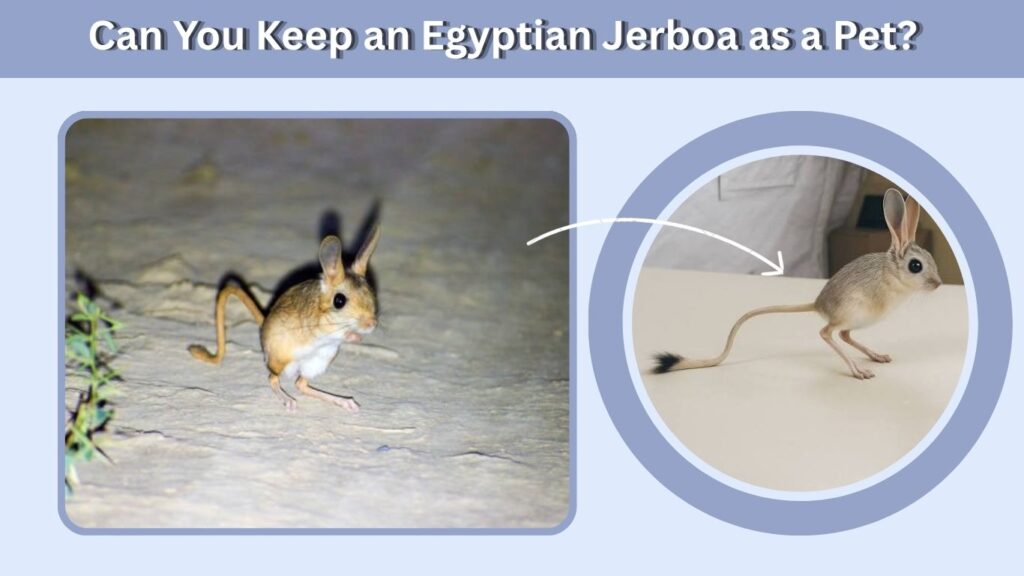
An Egyptian jerboa is a wild animal rather than a domesticated pet. Although some individuals can become accustomed to people, their nocturnal behavior, powerful jumping, digging instinct and specialized environmental requirements make them difficult to house properly.
They require considerably more horizontal space than an ordinary pet mouse or hamster, along with deep digging material, a secure enclosure and opportunities to forage. Captive breeding can also be challenging, particularly because disturbance may affect maternal behavior.
Ownership and import rules vary by country and region. Anyone considering a jerboa should confirm local wildlife laws, import restrictions and veterinary availability before searching for one for sale. Wild-caught animals should never be purchased.
Ecological Importance
Egyptian jerboas play several roles in desert ecosystems. They consume and move seeds, disturb and aerate soil while digging, and provide food for snakes, foxes and other predators. Abandoned burrows may later shelter invertebrates or other small desert animals.
FAQs
Are Egyptian jerboas mice?
No. Egyptian jerboas are rodents, but they are not true mice. They belong to the family Dipodidae, while typical mice belong to the family Muridae. Their long hind limbs, fused foot bones and bipedal hopping distinguish them from ordinary mice.
How many toes does a greater Egyptian jerboa have?
A greater Egyptian jerboa has three functional toes on each hind foot. Its first and fifth hind digits are absent, while the remaining central toes are elongated and supported by fused metatarsal bones.
Is the lesser Egyptian jerboa endangered?
The lesser Egyptian jerboa is classified as Least Concern in the IUCN information referenced by Animal Diversity Web. However, populations can still be affected locally by habitat alteration, agricultural development and human disturbance.
How far can an Egyptian jerboa jump?
A lesser Egyptian jerboa can cover several metres in a powerful leap under suitable conditions. Its speed, long stride and ability to turn suddenly help it escape predators and travel efficiently while searching for food.
What is the main difference between greater and lesser Egyptian jerboas?
The most obvious difference is size. The greater Egyptian jerboa is generally heavier and more robust, while the lesser Egyptian jerboa is smaller and has a wider distribution extending across North Africa, Arabia and parts of Asia.