
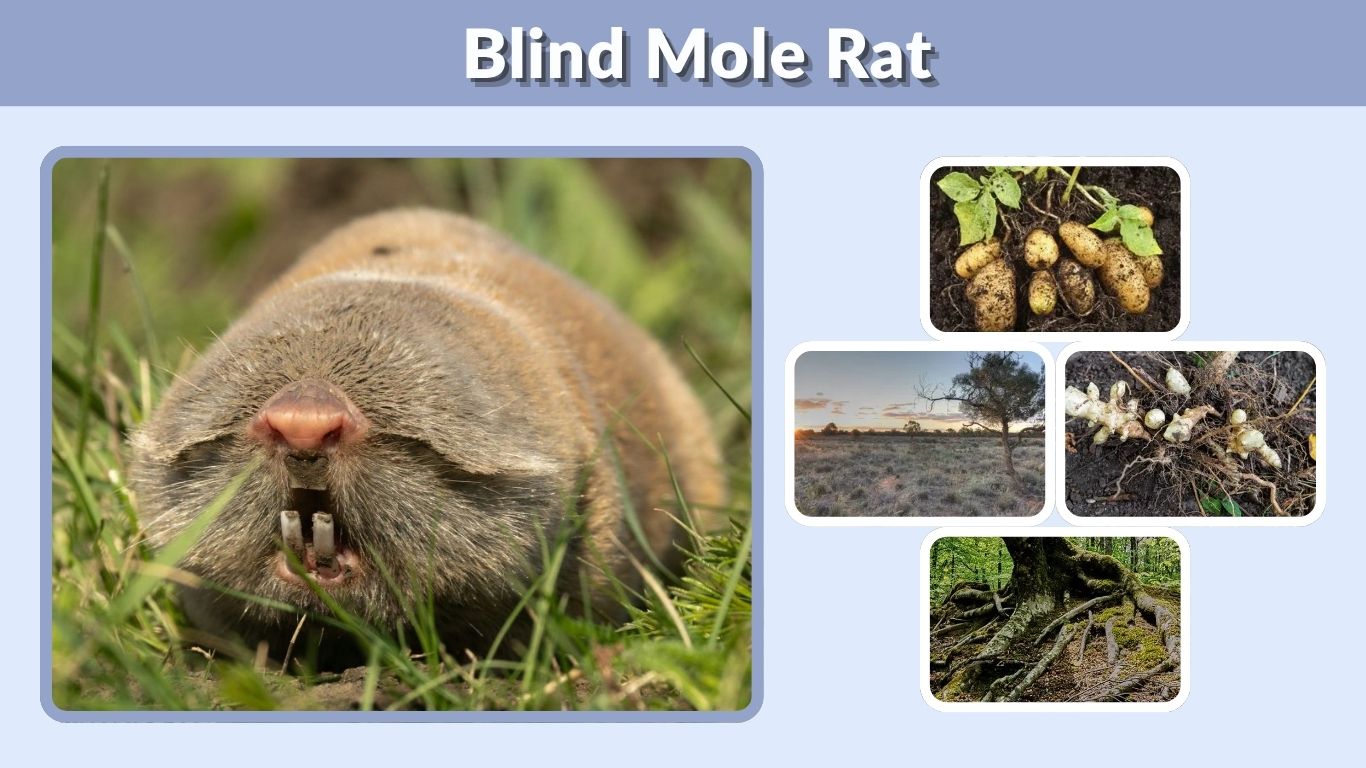
Blind mole-rats are underground rodents known for their hidden eyes, powerful digging bodies, and nearly sightless way of life. They spend most of their lives in tunnels, where touch, smell, hearing, and vibration matter more than vision. Many people confuse blind mole-rats with naked mole-rats, but they are different animals. Blind mole-rats are also important to science because some species show unusual resistance to cancer and low-oxygen underground conditions.
What Is a Blind Mole Rat?
Blind mole-rats are burrowing rodents adapted for life underground. The term often refers to animals in the blind mole-rat group, including Spalax and related species. They are not the same as naked mole-rats, although both are subterranean rodents.
Identification
- Stocky, cylindrical body
- Short legs and strong digging muscles
- Eyes hidden under skin and fur
- No visible external tail
- Small or reduced external ears
- Thick, soft fur
- Broad head and strong front teeth
- Lives mostly underground
- Uses touch, smell, and vibrations more than sight
Animal Diversity Web describes blind mole-rats as chunky, mole-like animals with short legs, reduced ears, subcutaneous eyes, no visible tail, and thick fur that helps them move inside tunnels.
Why Are They Called Blind?
They are called blind because their eyes are extremely reduced and covered by skin. These eyes are not useful for normal vision like the eyes of surface-living rodents. In dark tunnels, sharp eyesight is not very helpful, so blind mole-rats rely more on other senses.
Are Blind Mole-Rats True Moles?
No. Blind mole-rats are rodents, not true moles. True moles belong to a different mammal group. Blind mole-rats are more closely related to other rodents, but their underground lifestyle makes them look somewhat mole-like.
Do Blind Mole Rats Have Eyes?
Blind mole-rats do have eyes, but the eyes are tiny and hidden beneath the skin. This is one of their most famous features.
How Their Eyes Work
Their eyes are not used for detailed vision. Instead, they may help detect light or darkness through the skin. This can still be useful underground because light may signal an opening in the tunnel, which could mean danger.
Blind mole-rats are often described as completely blind because they cannot see in the normal way. Their reduced eyes are an adaptation to underground life, where darkness is constant and vision provides little advantage.
Why Did Their Eyes Become Reduced?
Eyes require energy to develop and maintain. For an animal living underground, strong eyes can be less useful than strong digging ability, good smell, sensitive touch, and awareness of vibrations. Over time, blind mole-rats evolved bodies better suited for tunnels than for open-air movement.
Blind Mole Rat Eyes vs Naked Mole Rat Eyes
| Feature | Blind Mole-Rat | Naked Mole-Rat |
| Eyes | Covered by skin and fur | Tiny but visible |
| Vision | Extremely reduced | Poor eyesight, but not fully blind |
| Body covering | Furred | Nearly hairless |
| Main range | Eastern Europe, western/central Asia, Middle East | Eastern Africa |
| Social life | Often solitary, depending on species | Highly social colonies |
Smithsonian’s National Zoo describes naked mole-rats as pink, nearly hairless subterranean rodents from eastern Africa, which separates them from furred blind mole-rats.
Where Do Blind Mole Rats Live?
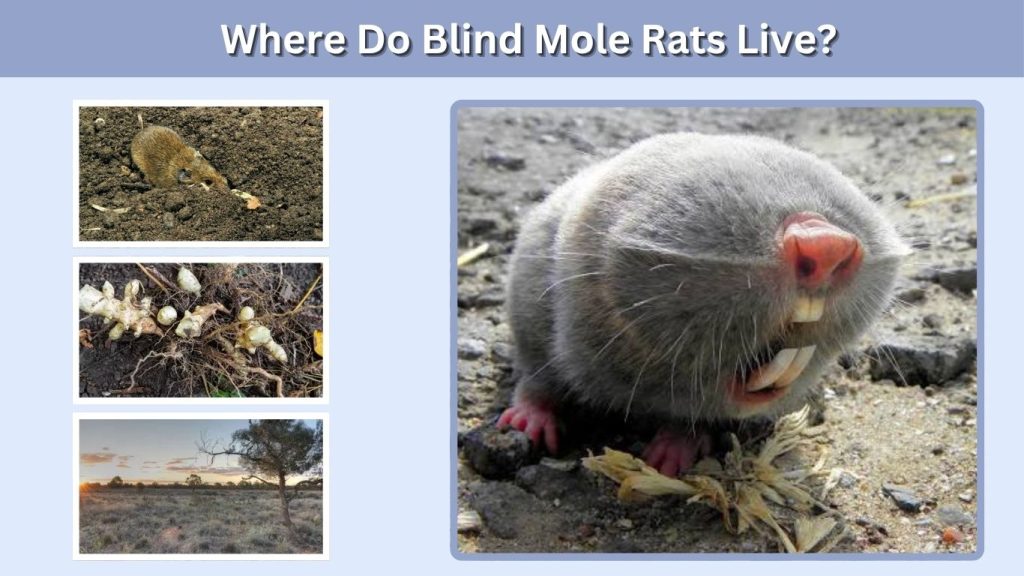
Blind mole-rats live in underground burrow systems. Their exact range depends on the species, but they are commonly associated with parts of eastern Europe, western Asia, central Asia, and the Middle East.
Habitat and Range
Species in the blind mole-rat group are adapted to soil habitats where they can dig tunnel networks. Animal Diversity Web notes that Middle East blind mole-rats are found in areas such as grasslands, agricultural fields, and other habitats where underground plant food is available.
Life Underground
A blind mole-rat’s burrow system is more than a shelter. It is a home, food route, storage area, and protection system. These rodents dig tunnels to reach roots, tubers, stems, and other underground plant parts. Their underground lifestyle also protects them from many predators.
Do Blind Mole-Rats Come Above Ground?
They spend most of their time underground and rarely need to come to the surface. When they do appear above ground, they may be vulnerable because their bodies are built for tunnels, not fast running in open spaces.
What Do Blind Mole Rats Eat?
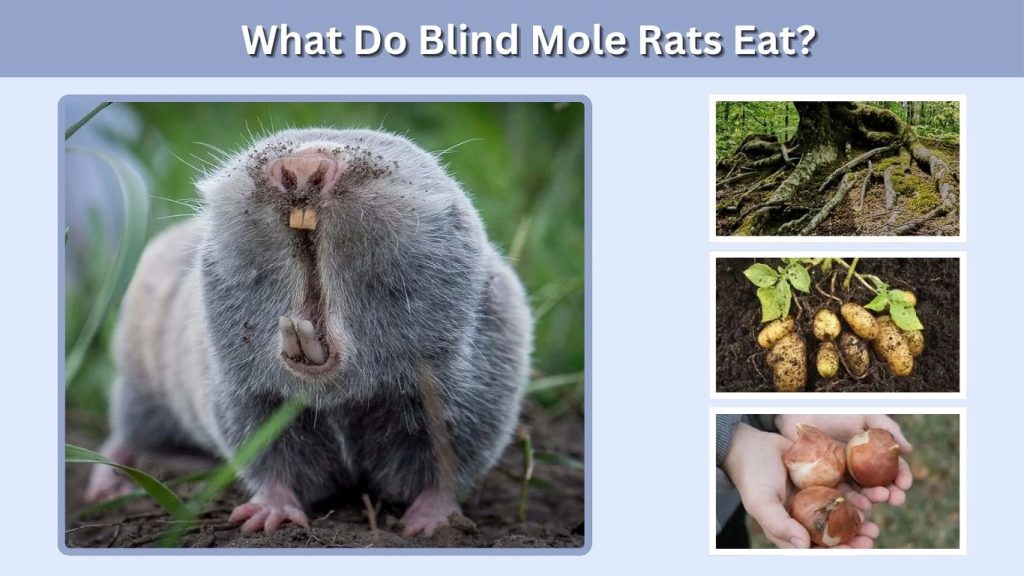
Blind mole-rats are herbivores. They eat plant material, especially underground parts of plants.
Main Diet
- Roots
- Tubers
- Underground stems
- Seeds
- Plant bulbs
- Grains
- Some leaves or surface plant parts near tunnel openings
Animal Diversity Web describes Middle East blind mole-rats as strict herbivores that feed mainly on underground roots, stems, tubers, and seeds, and also store harvested food in underground chambers.
How They Find Food Without Sight
Blind mole-rats do not need eyesight to find food. They dig through soil and use smell, touch, and memory of tunnel routes. Their whiskers and body sensitivity help them move through darkness and detect obstacles.
Why Food Storage Matters
Some blind mole-rats store plant food underground. This helps them survive when surface plants are not easily available. Underground storage also reduces the need to leave the safety of the tunnel system.
Blind Mole Rat Behavior and Adaptations
Blind mole-rats are built for digging and underground survival. Their body shape, senses, and behavior all support life below the surface.
Digging Adaptations
Blind mole-rats have strong heads, powerful jaw muscles, and strong teeth. Their bodies are compact and cylindrical, which makes moving through narrow tunnels easier. Their fur can help them move backward or forward in tight spaces.
Hearing and Vibration
In dark tunnels, vibrations are important. Blind mole-rats can sense movement through soil and tunnel walls. Some species are known for using head-drumming or body vibrations as a form of underground communication.
Low-Oxygen Survival
Underground burrows can have lower oxygen and higher carbon dioxide than open air. Blind mole-rats are studied because they tolerate these harsh underground conditions. A scientific paper on Spalax describes blind mole-rats as hypoxia-tolerant, long-lived subterranean rodents.
Blind Mole Rat vs Naked Mole Rat
Many people search “are naked mole rats blind?” because naked mole-rats also live underground and have poor eyesight. However, blind mole-rats and naked mole-rats are not the same animal.
Key Differences
Naked mole-rats are nearly hairless, social, and famous for colony life with a breeding queen. Blind mole-rats are furred and belong to a different rodent group. Naked mole-rats have tiny visible eyes, while blind mole-rat eyes are covered under the skin.
Smithsonian’s National Zoo says naked mole-rats live in large eusocial colonies where only one female breeds and most individuals work for the colony.
Are Naked Mole-Rats Blind?
Naked mole-rats have poor eyesight, but they are not the same as blind mole-rats. They can detect some light and movement, but they rely heavily on touch, smell, and tunnel awareness.
Which One Is Hairless?
The naked mole-rat is nearly hairless. Blind mole-rats usually have thick fur. This is one of the easiest ways to tell them apart.
Blind Mole Rat Cancer Research
Blind mole-rats are important in medical research because some species show unusual cancer resistance. This does not mean they are magical or that they directly cure cancer, but their biology may help scientists understand natural tumor defense.
Why Scientists Study Them
Blind mole-rats live underground in stressful conditions, including low oxygen. They are also long-lived for rodents. These traits make them interesting for research on aging, oxygen tolerance, and cancer biology.
Cancer Resistance
A PubMed-listed study reports evidence that Spalax blind mole-rats are resistant not only to spontaneous cancer but also to experimentally induced cancer. Another study found that blind mole-rat cells can use an unusual cell-death mechanism that helps stop uncontrolled cell growth.
Can Blind Mole-Rats Cure Cancer?
No. Blind mole-rats do not provide a direct cancer cure. However, studying their cells may help researchers understand cancer resistance and may inspire future medical research. It is better to say they are scientifically valuable, not that they are a cure.
Are Blind Mole Rats Pets?
Blind mole-rats are not normal pets. Searches like “blind mole rat pet” or “blind mole rat for sale” usually come from curiosity, but these animals are highly specialized wild rodents.
Why They Are Not Good Pets
They need underground-style housing, proper soil or burrow systems, controlled diet, and expert care. They are not domesticated like pet rats, mice, hamsters, or guinea pigs. Their natural behavior depends on digging, hiding, and living in tunnel systems.
Are They Dangerous?
Blind mole-rats are not usually dangerous to people, but they can bite if handled or threatened. Their strong teeth are made for digging and chewing plant material, so they should not be treated like tame pets.
Better Pet Alternatives
If someone wants a small mammal pet, domestic rats, mice, gerbils, hamsters, or guinea pigs are much better choices. These animals are bred for pet care and are easier to house responsibly.
Types of Blind Mole-Rats
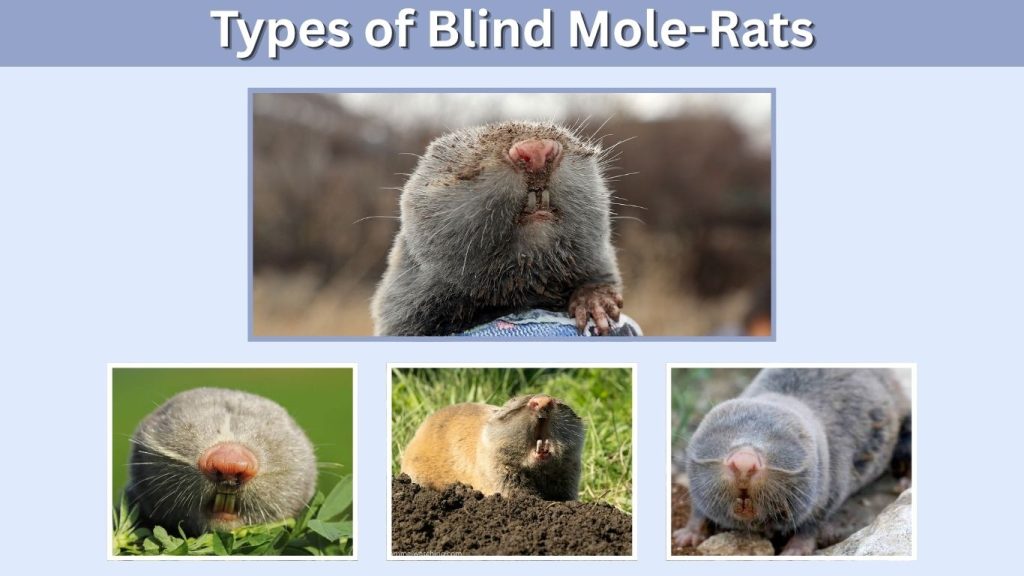
The phrase “blind mole rat” can refer to several species. Some search terms mention greater blind mole-rat, giant blind mole-rat, Balkan blind mole-rat, Anatolian blind mole-rat, Vojvodina blind mole-rat, and Middle East blind mole-rat.
Commonly Searched Types
| Common Name | Notes |
| Middle East blind mole-rat | Often associated with Israel and nearby regions |
| Greater blind mole-rat | Found in parts of eastern Europe, including Russia and Ukraine |
| Giant blind mole-rat | A large blind mole-rat species, different from the Ethiopian giant mole-rat |
| Balkan blind mole-rat | Associated with the Balkan region |
| Anatolian blind mole-rat | Linked with Turkey/Anatolia |
| Vojvodina blind mole-rat | A regional blind mole-rat often mentioned in conservation searches |
The greater blind mole-rat is listed as a rodent species found in Russia and Ukraine, while the broader blind mole-rat group includes species in eastern Europe and western or central Asia.
FAQs
Are blind mole-rats really blind?
Yes, blind mole-rats are functionally blind. They have tiny eyes, but the eyes are covered by skin and fur, so they do not see like normal surface-living rodents.
Do blind mole-rats have eyes?
Yes. They have eyes, but the eyes are reduced and hidden under the skin. These eyes may help detect light, but they are not useful for clear vision.
Are naked mole-rats blind?
Naked mole-rats have poor eyesight, but they are different from blind mole-rats. Naked mole-rats have tiny visible eyes and nearly hairless bodies, while blind mole-rats usually have fur and hidden eyes.
What do blind mole-rats eat?
Blind mole-rats are herbivores. They eat roots, tubers, underground stems, seeds, bulbs, and other plant material. Some species store food in underground chambers.
Can you keep a blind mole-rat as a pet?
A blind mole-rat is not a good pet. It is a wild burrowing rodent with specialized underground needs. Domestic rats, hamsters, gerbils, or guinea pigs are much better pet choices.