
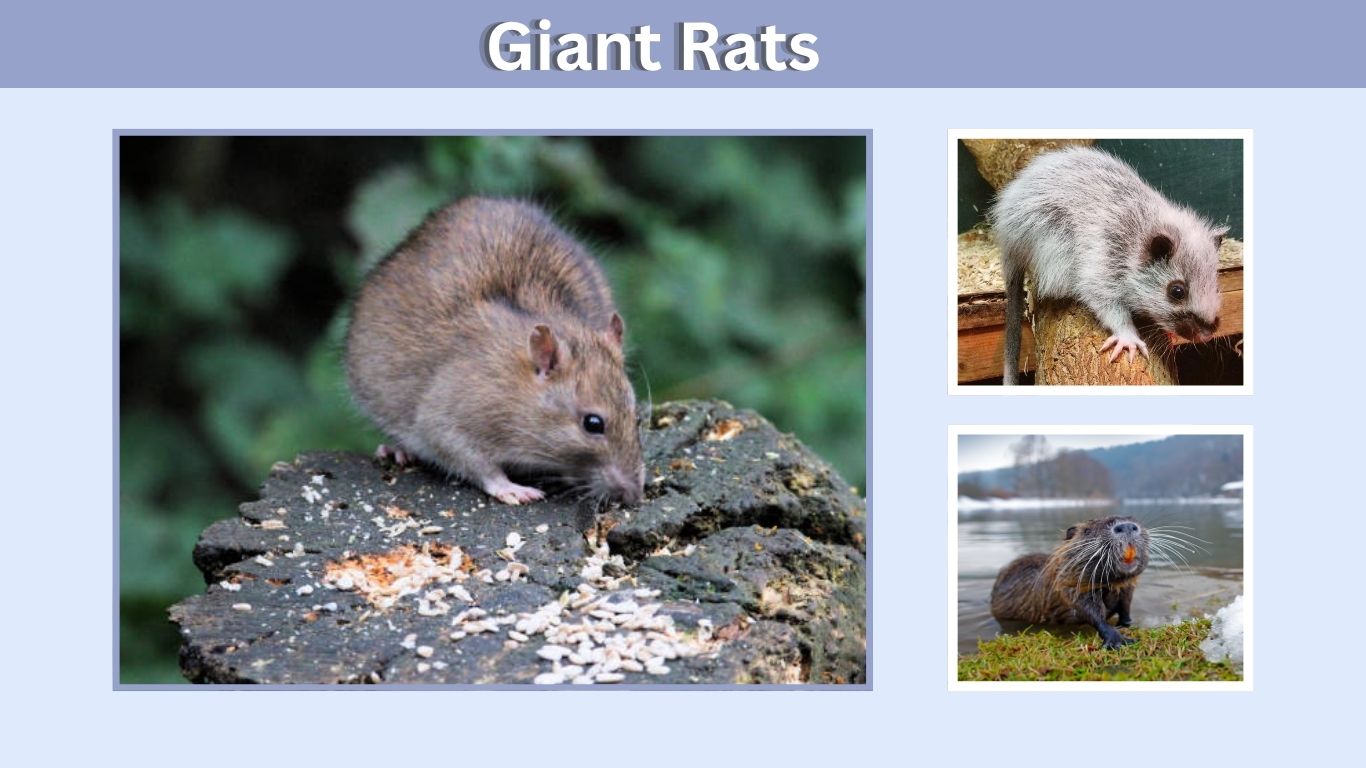
Giant rats may sound like creatures from movies, but several unusually large rodents really do exist around the world. Some are true rats, while others—such as nutria and giant pouched rats—only resemble oversized city rats. Stories about enormous sewer rats in New York, giant rats in Florida, and African rats trained to detect landmines have also increased curiosity about these animals. This guide explains which giant rats are real, how large they become, where they live, and whether they are dangerous.
Are Giant Rats Real?
Yes, giant rats are real, although the term can be misleading. People often use “giant rat” for any unusually large rodent, even when the animal is not technically a true rat. African giant pouched rats are among the best-known examples, while nutria, cloud rats, cane rats, and giant kangaroo rats can also appear remarkably large compared with ordinary house rats.
Common Animals Called Giant Rats
Animals frequently described as giant rats include:
- African giant pouched rat
- Gambian pouched rat
- Southern giant pouched rat
- Nutria
- Greater cane rat
- Giant cloud rat
- Giant kangaroo rat
- Large Norway rat
- Large roof rat
These animals vary greatly in appearance, biology, and habitat. Some are closely related to rats, while others belong to completely different rodent families.
How Big Can Giant Rats Get?
Ordinary Norway rats generally look large because of their heavy bodies and long tails, but wild urban rats rarely approach the extraordinary sizes claimed in viral photographs.
African giant pouched rats are substantially larger. Including their tails, some can approach roughly three feet in total length. Their bodies are also noticeably longer and more slender than those of typical brown rats.
Nutria can appear even more impressive, often weighing well over 10 pounds. However, nutria are semiaquatic rodents rather than true giant rats.
African Giant Pouched Rats
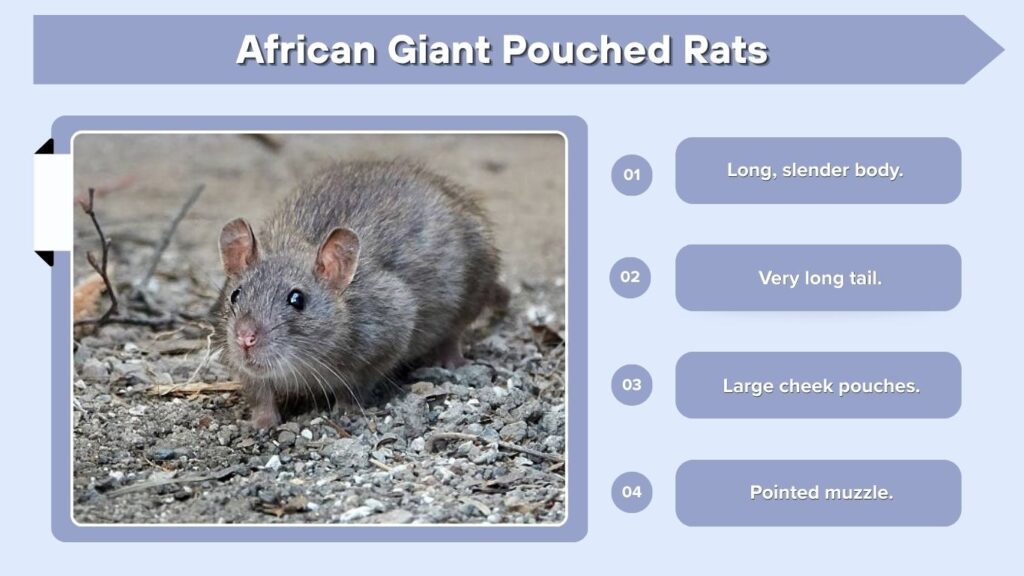
African giant pouched rats are among the animals most closely associated with the phrase “giant rats.” Native to parts of Africa, these intelligent rodents possess large cheek pouches that allow them to carry food. Their strong sense of smell has also made them useful in specialized detection programs.
Giant African Rat Identification
African giant pouched rats can usually be recognized by several characteristics:
- Long, slender body
- Very long tail
- Large cheek pouches
- Pointed muzzle
- Prominent ears
- Strong sense of smell
- Brown or grayish coat
- Much larger size than common house rats
Despite their nickname, giant pouched rats belong to a different rodent family from the familiar Norway and roof rats.
Giant Rats That Detect Landmines
One of the most unusual uses of African giant pouched rats involves scent detection. Specially trained rats can search areas suspected of containing landmines and signal when they detect explosive material.
Their light body weight is useful because they can move across areas containing mines without exerting the same pressure as humans or heavier animals. Their sensitive noses and ability to learn repetitive detection tasks make them particularly effective.
These rats have also been trained for other scent-detection work, demonstrating how intelligent and adaptable large rodents can be.
Can African Giant Rats Be Pets?
African giant pouched rats have occasionally been kept as exotic pets, but they are very different from domesticated fancy rats. They grow much larger, need substantial housing, and can display stronger natural behaviors.
Ownership may also be restricted depending on local regulations. Anyone considering an exotic rodent must first investigate wildlife laws, veterinary availability, enclosure requirements, diet, and long-term care.
Giant Rats in New York City
New York’s rats have become almost legendary. Videos of large rats running through subway stations, garbage areas, parks, and alleys frequently circulate online. Most giant New York rats, however, are ordinary Norway rats benefiting from abundant food and shelter rather than a mysterious supersized species.
Giant NYC Subway Rats
Subways provide many conditions attractive to rats. Underground tunnels offer warmth and shelter, while nearby restaurants, garbage, food scraps, and human activity provide reliable feeding opportunities.
A particularly well-fed adult rat can look enormous when photographed from a close angle. Factors contributing to their visibility include abundant food, hidden nesting locations, underground infrastructure, and dense human populations.
Giant Sewer Rats in New York
The phrase “giant sewer rat” creates images of enormous rodents living entirely underground. Norway rats can indeed use sewers, drainage systems, basements, tunnels, and utility spaces for shelter and movement.
However, sensational claims about 20-, 30-, or 40-pound New York sewer rats should be treated skeptically. Photographic perspective, forced perspective, and confusion with animals such as nutria can make rodents appear far larger than they actually are.
Why NYC Rats Can Look So Large
Several factors make city rats appear unusually big:
- Constant access to discarded food
- Mature adults with heavy bodies
- Thick winter fur
- Close-up photography
- Camera perspective
- Long tails increasing apparent size
- Confusion with other rodents
An individual rat can certainly become large, but viral claims should not automatically be taken as evidence of a new giant species.
Giant Roof Rats and Other Urban Rats
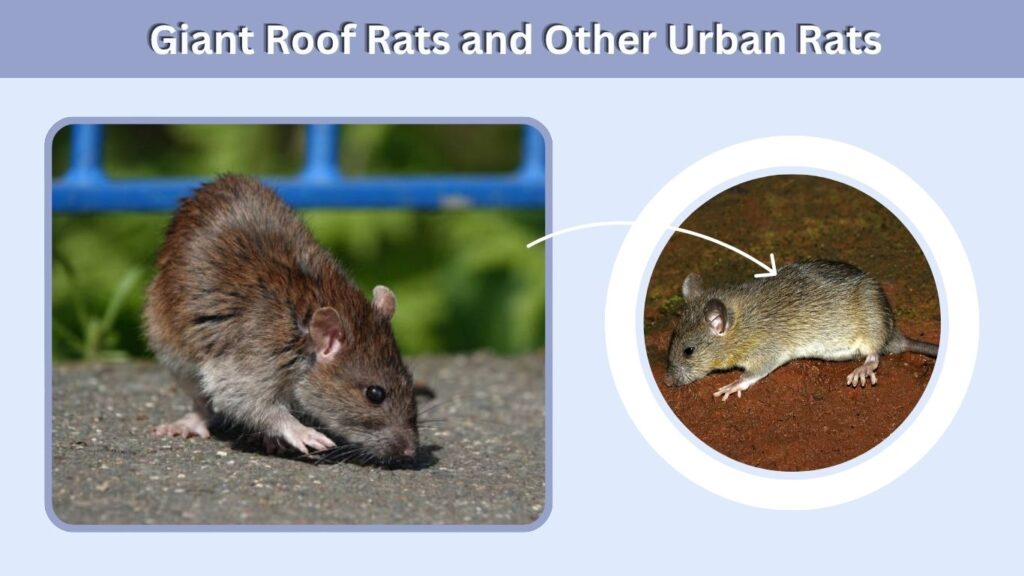
Roof rats are generally slimmer and more agile than Norway rats. They are skilled climbers and commonly occupy roofs, attics, trees, rafters, and upper levels of buildings. Reports of “giant roof rats” usually involve mature animals seen from close range rather than a separate giant variety.
Roof Rat vs. Norway Rat
A roof rat typically has a slender body, pointed face, relatively large ears, and a tail longer than its body. Norway rats are heavier, more robust, and more strongly associated with ground-level burrows and underground locations.
Because Norway rats have stockier bodies, they are more likely to produce the classic appearance people associate with giant city or sewer rats.
Are Giant Urban Rats Dangerous?
Large rats are normally more interested in finding food and shelter than confronting humans. Nevertheless, wild rodents should never be handled or cornered.
Rats can contaminate food or surfaces, damage property through gnawing, and introduce parasites into buildings. People should avoid direct contact with rats, droppings, urine, nesting material, or dead rodents.
Giant Rats in Florida and Louisiana
Reports of giant rats in Florida and Louisiana sometimes involve actual rats, but they can also involve invasive or semiaquatic rodents. Warm climates, wetlands, canals, and abundant vegetation support several large rodent species that may be mistaken for supersized rats.
Giant Rats in Florida
Florida became well known for reports of Gambian giant pouched rats, particularly in the Florida Keys. These introduced rodents attracted attention because they were much larger than common rats.
Florida also has ordinary roof and Norway rats. In photographs or nighttime encounters, distinguishing among species can be difficult without considering body proportions, tail characteristics, location, and habitat.
Giant Louisiana Rats
Many reports of giant Louisiana rats involve nutria. Nutria are large semiaquatic rodents that thrive around marshes, waterways, ponds, and wetlands.
They resemble oversized rats because they have large bodies, long tails, and prominent front teeth, but they are not giant Norway rats. Their feeding and burrowing can damage wetland vegetation and contribute to erosion.
Other Giant Rat-Like Rodents Around the World
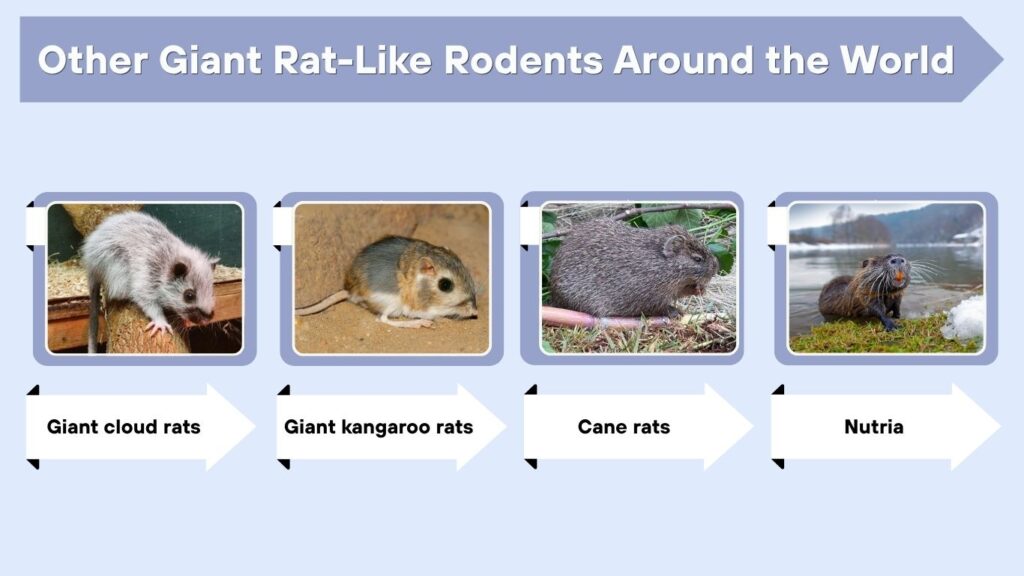
Large rat-like rodents occur in many regions. Evolution has produced remarkable differences in size, habitat, and lifestyle, from tree-dwelling cloud rats to desert-adapted giant kangaroo rats.
Giant Rat-Like Species
Some interesting examples include:
- Giant cloud rats: Large tree-dwelling rodents native to the Philippines.
- Giant kangaroo rats: Burrowing rodents adapted to dry regions of California.
- Cane rats: Large African rodents that feed heavily on vegetation.
- Nutria: Large semiaquatic rodents introduced into many regions.
- Pouched rats: Large African rodents known for their cheek pouches.
- Capybaras: The world’s largest living rodents, although they are not rats.
Are Capybaras Giant Rats?
No. Capybaras are rodents, but they are not rats. They belong to a different family and are more closely associated with guinea pig-like rodents.
Calling a capybara a giant rat may describe its general rodent appearance, but it is scientifically inaccurate.
Giant Rats: Reality vs. Myths
Giant rats have become popular in movies, urban legends, games, and social media. Fiction often exaggerates their size and aggressive behavior, while photographs can create misleading impressions. Real large rodents are fascinating enough without adding myths about mutant sewer animals.
Common Giant Rat Myths
Some frequently repeated claims include:
- Sewer rats regularly grow to 40 pounds.
- New York has a secret species of enormous rat.
- Every large wetland rodent is a rat.
- Giant African rats are simply oversized pet rats.
- Urban rats continually grow throughout their lives.
None of these ideas accurately explains the variety of large rodents people encounter.
A giant-looking animal may instead be a nutria, pouched rat, cane rat, or another rodent entirely.
FAQs
Giant rats attract attention because the phrase includes both genuinely large rodents and exaggerated urban stories. Understanding species, body size, and habitat helps separate real animals from viral myths and mistaken identification.
1. What is the biggest type of giant rat?
African giant pouched rats are among the largest animals commonly called rats. They can reach impressive lengths when their long tails are included.
2. Are giant sewer rats in New York real?
Large Norway rats certainly live around New York’s underground infrastructure, but stories describing 20- to 40-pound sewer rats are usually exaggerated or involve mistaken identification.
3. Are there giant rats in Florida?
Yes. Florida has ordinary rat species and has also experienced populations of large Gambian pouched rats. Other large rodents can sometimes be mistaken for giant rats.
4. Are African giant pouched rats dangerous?
They are not naturally man-eating or monster-like animals, but they are powerful wild or exotic rodents. They should be treated with caution and handled only by knowledgeable people.
5. Why are giant rats used to detect landmines?
African giant pouched rats have an excellent sense of smell and can be trained to recognize explosive odors. Their relatively low body weight also makes them useful for carefully searching potentially mined areas.