
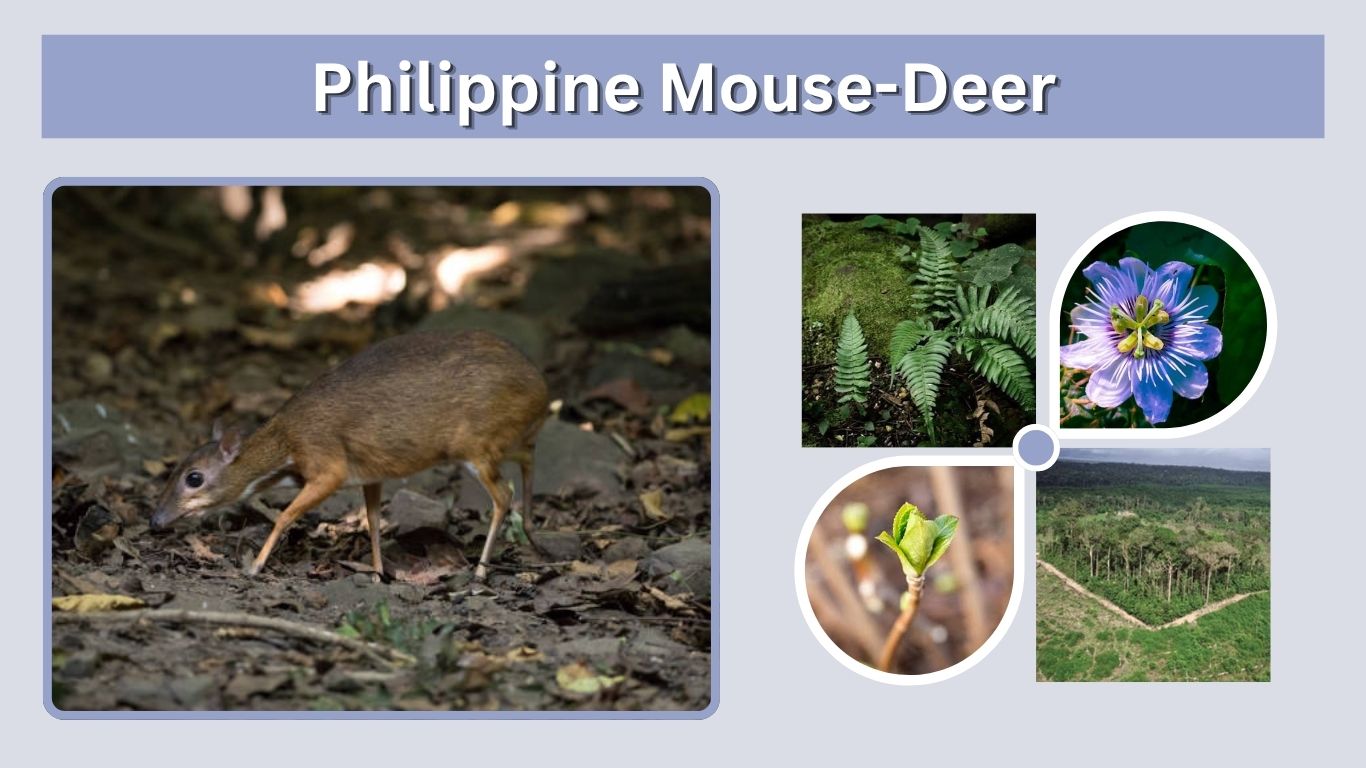
The Philippine mouse-deer is a tiny, secretive hoofed mammal found only in a small part of the Philippines. Locally known as the pilandok and also called the Balabac chevrotain, it has a dark coat, slender legs, large eyes, and distinctive white markings across its throat. Despite its name, it is neither a mouse nor a true deer. This endangered species belongs to the ancient chevrotain family and survives mainly in the remaining forests of the Balabac Island Group.
What Is the Philippine Mouse-Deer?
The Philippine mouse-deer’s scientific name is Tragulus nigricans. It belongs to the family Tragulidae, a group of small hoofed mammals known as mouse-deer or chevrotains. Current mammal taxonomy recognizes it as a separate species rather than a subspecies of the greater mouse-deer.
| Feature | Description |
| Scientific name | Tragulus nigricans |
| Common names | Philippine mouse-deer, Balabac chevrotain |
| Local name | Pilandok |
| Family | Tragulidae |
| Body length | About 40–50 cm |
| Shoulder height | About 18 cm |
| Weight | Up to approximately 3 kg |
| Diet | Mainly leaves and other vegetation |
| Activity | Primarily nocturnal |
| Conservation status | Endangered |
The pilandok is the only naturally occurring member of the chevrotain family in the Philippines. Its limited distribution makes it particularly vulnerable to habitat destruction and hunting.
What Does a Philippine Mouse-Deer Look Like?
The Philippine mouse-deer has a compact, rounded body supported by four very slender legs. Its fur is generally dark brown, blackish brown, or reddish brown. Individual hairs have differently colored sections, producing a dark, slightly grizzled appearance across the back.
Main Identification Features
A Philippine mouse-deer can be identified by:
- A body measuring approximately 40–50 cm long
- A shoulder height of about 18 cm
- A short tail measuring around 8 cm
- Dark brown or nearly black upper fur
- Large, dark eyes and small rounded ears
- Three narrow white stripes across the throat
- White areas beneath the body and inside the legs
- Four toes on each foot, although only two normally reach the ground
Its small size makes it one of the world’s smallest hoofed mammals. It may look rodent-like from a distance, but its feet end in tiny hooves rather than claws.
Does the Pilandok Have Fangs?
Male Philippine mouse-deer do not grow antlers. Instead, they have enlarged upper canine teeth that project below the lips. These fang-like teeth may be used for defense and during conflicts with other males.
Females also possess canine teeth, but those of males are usually longer and more noticeable. The presence of these sharp canines is normal and does not mean the animal is a predator.
Where Does the Philippine Mouse-Deer Live?

The Philippine mouse-deer is endemic to the Balabac Island Group at the southern end of Palawan Province. Historically, it was reported from mainland Balabac, Bugsuk, and Ramos islands. There are no confirmed natural populations on mainland Palawan.
A field study published in 2021 recorded Philippine mouse-deer on mainland Balabac and Bugsuk. Researchers did not record the species on the other surveyed islands, possibly because extensive habitat conversion had reduced or eliminated suitable populations there.
Philippine Mouse-Deer Habitat
The pilandok occupies:
- Primary lowland forest
- Secondary or recovering forest
- Dense forest fragments
- Shrubland
- Areas near mangroves
- Vegetated clearings used for feeding
Dense vegetation provides cover during daylight hours. The animals generally leave their resting places after dark to forage in clearer areas, forest edges, and occasionally near coastal habitats.
What Does the Philippine Mouse-Deer Eat?

The Philippine mouse-deer is primarily herbivorous. Its diet consists mainly of soft vegetation available close to the forest floor.
Common foods include:
- Young leaves
- Forest plants
- Flowers
- Tender shoots
- Fallen plant material
- Other soft vegetation
Specific feeding studies of wild pilandok remain limited. Available accounts consistently describe leaves and other forest vegetation as their main foods.
How Does It Find Food?
The pilandok usually forages at night, when lower light levels provide some protection from people and predators. Its large eyes help it move through dim forest conditions, while its small body allows it to pass through dense undergrowth.
It is a ruminant with a multi-chambered stomach, enabling it to digest leafy plant material more efficiently than rodents can.
Philippine Mouse-Deer Behavior
The Philippine mouse-deer is mainly nocturnal and usually solitary. Individuals spend much of the day concealed in thick vegetation before emerging at night to feed. Pairs are occasionally observed, but they do not normally form large herds.
When caught in vehicle headlights, a pilandok may remain motionless for a short time before running into vegetation. Its main defenses are camouflage, alertness, speed, and access to dense forest cover.
Pilandok in Philippine Folklore
The pilandok is also an important character in Philippine folklore. In traditional stories, particularly those associated with parts of Mindanao, it is often portrayed as a small but clever trickster that escapes danger by outsmarting larger and more powerful animals or people.
Reproduction and Baby Philippine Mouse-Deer
The reproductive biology of wild Philippine mouse-deer has not been studied as thoroughly as that of several related chevrotains. Available information indicates that females normally produce one offspring, although twins may occur rarely.
Information from related Tragulus species suggests a gestation period of approximately 140–177 days, but this range should not be treated as a precisely confirmed figure for every wild Philippine mouse-deer.
A baby pilandok is born relatively well developed and can stand and move soon after birth, as is typical among hoofed mammals. Its small body and dark coloration help it remain concealed in vegetation.
Philippine Mouse-Deer Predators
Detailed research identifying every natural predator of the Philippine mouse-deer is limited. Like other small forest ungulates, it may be vulnerable to large snakes, birds of prey, and carnivorous mammals where these predators occur.
Dense vegetation is an important defense because it allows the pilandok to hide and quickly disappear from view. However, human hunting currently presents a more clearly documented threat than any particular natural predator.
How Many Philippine Mouse-Deer Are Left?
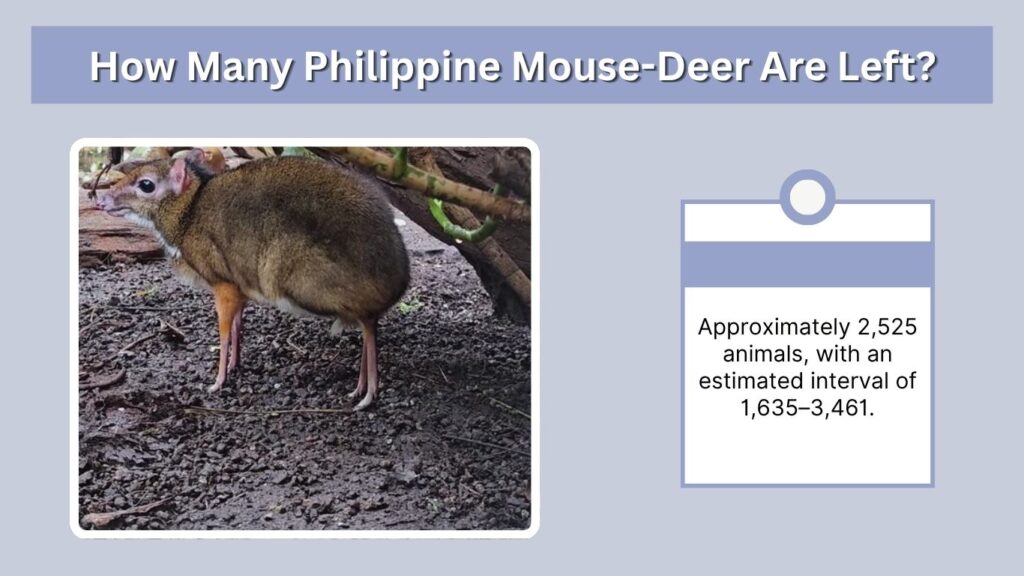
There is no exact current count of every Philippine mouse-deer in the wild. A field assessment reported 25 direct sightings and produced a statistical mean estimate of approximately 2,525 animals, with an estimated interval of 1,635–3,461.
However, the researchers emphasized that this estimate was highly uncertain because the species was detected infrequently and only limited areas could be surveyed. It should therefore not be presented as a precise current population count.
Is the Philippine Mouse-Deer Endangered?
The Philippine mouse-deer is currently classified as Endangered. Its natural range is extremely restricted, its populations occur in very few locations, and the extent and quality of its habitat continue to decline.
Main Threats
The most serious threats include:
- Forest clearing for agriculture
- Conversion of habitat into coconut plantations
- Hunting for meat
- Snaring and other forms of poaching
- Capture for private collections
- Small-scale live-animal trade
- Fragmentation of remaining forest
Researchers have called for stronger habitat protection, more extensive monitoring, local education, and better in-place conservation programs throughout the Balabac Island Group.
FAQs
Is the Philippine mouse-deer a real deer?
It is a real hoofed mammal but not a member of the true deer family, Cervidae. It belongs to Tragulidae, an ancient group known as chevrotains. Philippine mouse-deer do not have antlers, and males instead possess enlarged upper canine teeth.
What is the local name of the Philippine mouse-deer?
Its best-known local name is pilandok. It is also called the Balabac mouse-deer or Balabac chevrotain because its natural distribution is centered on the Balabac Island Group in southern Palawan Province.
How big is a Philippine mouse-deer?
An adult is approximately 40–50 cm long, stands about 18 cm at the shoulder, and may weigh up to around 3 kg. Its tail measures approximately 8 cm, making it much smaller than any true Philippine deer.
Can a Philippine mouse-deer be kept as a pet?
The pilandok is an endangered wild animal with specialized habitat, dietary, and behavioral needs. It is unsuitable as a household pet. Capture and live trade also contribute to pressure on remaining populations, so wild animals should never be purchased or collected.
Does the Philippine mouse-deer live throughout the Philippines?
No. Its natural range is restricted to the Balabac Island Group in the far southwest of the country. A 2021 survey confirmed records on mainland Balabac and Bugsuk, while no animals were detected on several other surveyed islands.