
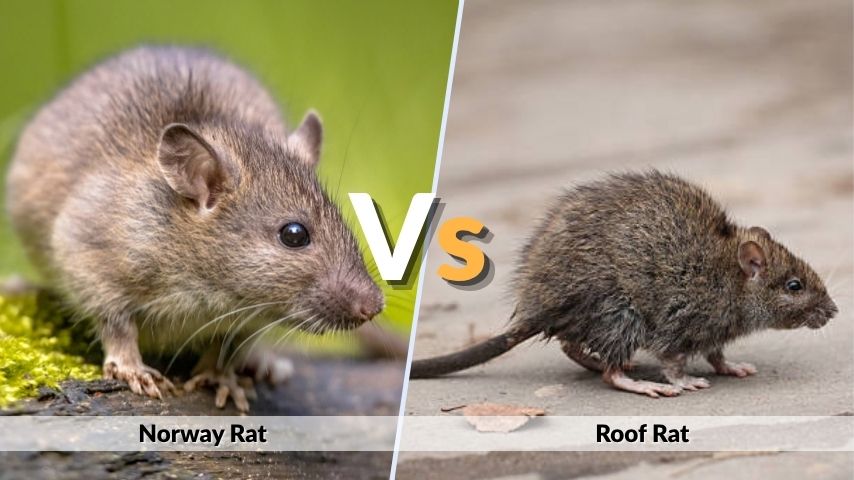
Roof rats and Norway rats are two of the most common pest rodents found around homes, buildings, and businesses. Although they may appear similar at first glance, these rats differ greatly in size, behavior, nesting habits, and appearance. Correct identification is important because each species requires different control and prevention methods.
Many homeowners search for roof rat vs Norway rat differences after noticing droppings, scratching sounds, or property damage. Understanding how these rodents behave, where they live, and how to identify them can help prevent infestations and reduce health risks associated with rats.
What Are Roof Rats and Norway Rats?
Roof rats and Norway rats are invasive rodent species commonly associated with human structures and food sources. Both animals belong to the rat family, but they prefer different habitats and show different physical traits. Roof rats are excellent climbers that prefer elevated areas, while Norway rats are larger burrowing rodents usually found near the ground.
Scientific Classification
- Roof rat scientific name: Rattus rattus
- Norway rat scientific name: Rattus norvegicus
- Family: Muridae
- Mammal type: Rodent
- Common pest species worldwide
Why Proper Identification Matters
- Different nesting locations
- Different trapping methods
- Different movement patterns
- Unique property damage risks
- Better pest control success
Roof Rat vs Norway Rat Overview
| Feature | Roof Rat | Norway Rat |
| Body Shape | Slim and narrow | Thick and stocky |
| Tail Length | Longer than body | Shorter than body |
| Preferred Habitat | Roofs and trees | Burrows and basements |
| Climbing Ability | Excellent climber | Poor climber |
Roof Rat vs Norway Rat Identification
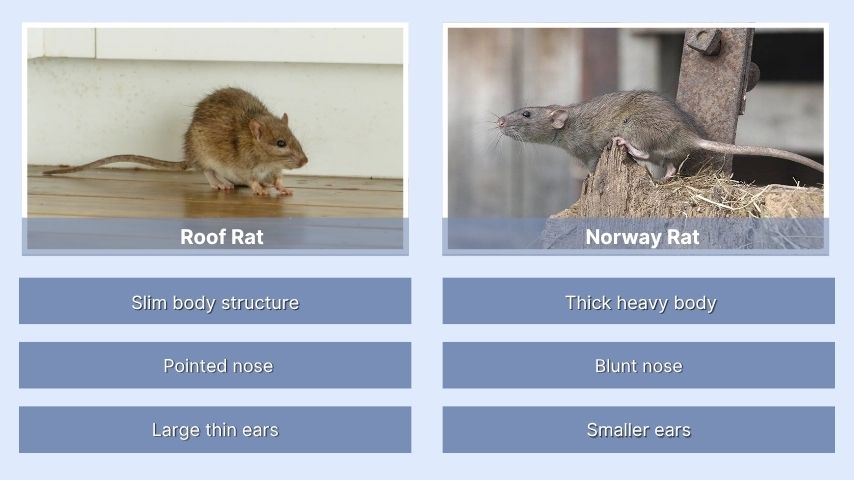
Roof rats and Norway rats can often be identified by body shape, tail size, ear shape, and overall appearance. While roof rats appear more slender and agile, Norway rats are heavier and more muscular.
Roof Rat Appearance
- Slim body structure
- Pointed nose
- Large thin ears
- Dark gray or black fur
- Long thin tail
Norway Rat Appearance
- Thick heavy body
- Blunt nose
- Smaller ears
- Brown or gray fur
- Shorter thicker tail
Norway Rat Size vs Roof Rat Size
| Feature | Roof Rat | Norway Rat |
| Body Length | Smaller | Larger |
| Weight | Lighter | Heavier |
| Tail Length | Longer | Shorter |
| Build | Slim | Stocky |
Roof Rat vs Norway Rat Habitat
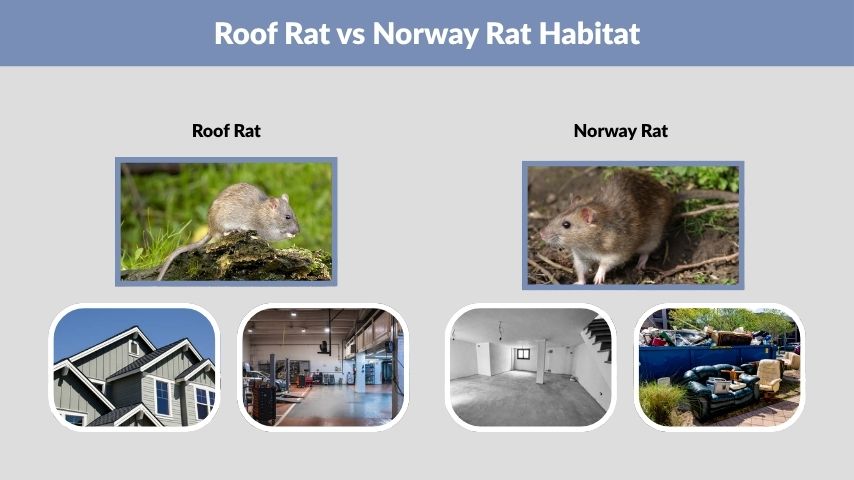
The habitats of roof rats and Norway rats are one of their biggest differences. Roof rats prefer higher nesting locations, while Norway rats stay closer to the ground and often create burrows.
Roof Rat Habitat
- Attics
- Roof spaces
- Trees
- Upper floors
- Garages and ceilings
Norway Rat Habitat
- Basements
- Sewers
- Crawl spaces
- Ground burrows
- Garbage areas
Indoor vs Outdoor Activity
Roof rats are skilled climbers that easily travel along fences, utility wires, and tree branches. Norway rats are stronger burrowers and commonly move along walls and lower levels while searching for food and shelter.
Roof Rat vs Norway Rat Droppings
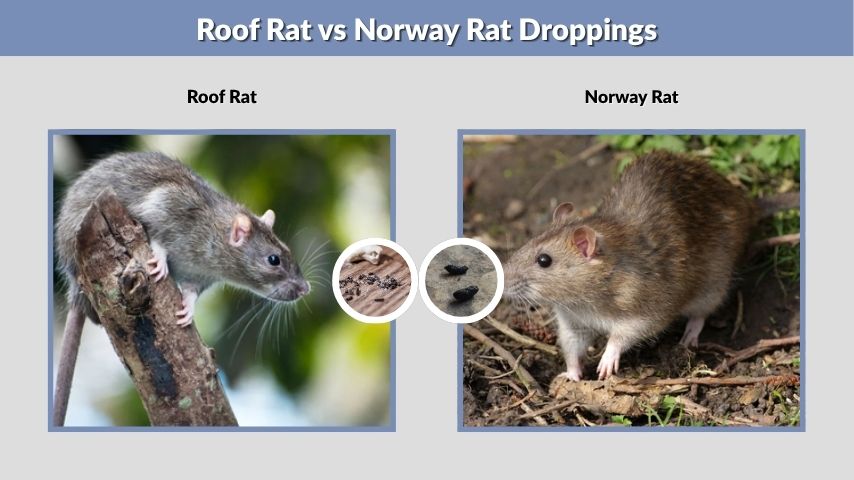
Rat droppings are often one of the first signs of infestation. Roof rat and Norway rat droppings differ in size and shape, making them useful for identifying which species is present inside a home or building.
Roof Rat Droppings
- Small spindle-shaped droppings
- Pointed ends
- Usually dark in color
- Found in elevated areas
- Scattered along travel routes
Norway Rat Droppings
- Larger capsule-shaped droppings
- Blunt ends
- Thicker appearance
- Found near ground level
- Common near food sources
Why Dropping Identification Matters
Identifying droppings correctly helps locate nesting areas and determine the best trapping and prevention methods. It also helps homeowners recognize possible contamination risks caused by rat infestations.
Roof Rat vs Norway Rat Behavior
Roof rats and Norway rats behave differently when searching for food, avoiding danger, and building nests. These differences strongly affect how infestations spread and how rodent control should be handled.
Roof Rat Behavior
- Excellent climbers
- Prefer elevated nesting areas
- More cautious around traps
- Active during nighttime
- Travel along overhead pathways
Norway Rat Behavior
Norway rats are aggressive scavengers that stay close to the ground. They often dig burrows near foundations, garbage piles, and sewers. Unlike roof rats, they are stronger swimmers and may travel through drainage systems searching for food.
Roof Rat vs Norway Rat Fight Behavior
- Compete for food and shelter
- Norway rats often dominate because of larger size
- Roof rats avoid direct confrontation
- Territorial conflicts may occur
- Larger infestations increase competition
Diet and Feeding Habits

Roof rats and Norway rats are opportunistic feeders, but their preferred foods can differ slightly. Their eating habits influence where they nest and how they invade homes and businesses.
Roof Rat Diet
- Fruits
- Nuts
- Seeds
- Plant materials
- Bird food
Norway Rat Diet
- Garbage scraps
- Meat
- Pet food
- Grains
- Human food waste
Feeding Damage Around Homes
Both rat species contaminate food, chew electrical wiring, and damage insulation or storage areas. Their constant gnawing behavior may also create fire hazards by damaging electrical systems inside buildings.
Roof Rat vs Norway Rat Damage
Roof rats and Norway rats can both cause serious property damage and health problems. Their nesting habits and chewing behavior make infestations dangerous when left untreated.
Roof Rat Damage
- Chewed attic wiring
- Damaged insulation
- Fruit tree destruction
- Noise inside ceilings
- Contaminated storage areas
Norway Rat Damage
- Burrow damage near foundations
- Sewer contamination
- Destroyed food storage
- Structural weakening
- Ground-level gnawing damage
Health Risks
Rats spread bacteria, parasites, and diseases through urine, droppings, and contaminated food. Fleas and mites carried by rats may also create additional health concerns for humans and pets.
How to Get Rid of Roof Rats and Norway Rats
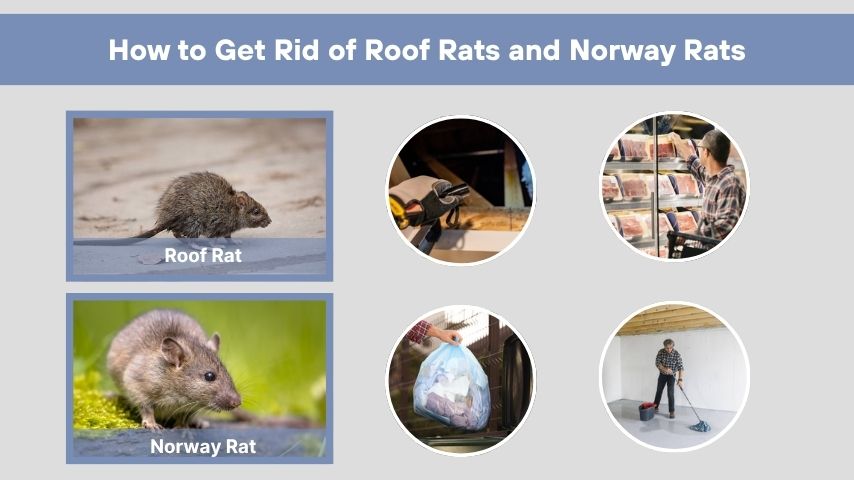
Successful rat control depends on proper identification and eliminating food, water, and shelter sources. Roof rats and Norway rats often require different prevention methods because of their unique nesting habits.
Roof Rat Control Tips
- Trim tree branches near roofs
- Seal attic entry points
- Remove rooftop food sources
- Store food securely
- Repair damaged vents
Norway Rat Control Tips
- Seal foundation openings
- Remove outdoor garbage access
- Eliminate standing water
- Destroy burrows safely
- Keep basements clean
Best Traps and Prevention Methods
Snap traps, bait stations, and sanitation improvements are among the most effective rodent control methods. Regular inspections around homes and businesses help detect infestations before populations grow larger.
Interesting Facts About Roof Rats and Norway Rats
Roof rats and Norway rats are highly adaptable rodents capable of surviving in cities, farms, forests, and coastal regions. Their intelligence and reproductive speed make them difficult pests to control.
Fun Facts
- Roof rats are skilled climbers
- Norway rats are powerful swimmers
- Both species reproduce rapidly
- Rats constantly gnaw to control tooth growth
- Norway rats are generally larger
- Roof rats prefer warmer climates
- Both species can spread diseases
FAQs
What is the difference between a roof rat and a Norway rat?
Roof rats are slimmer climbers that prefer elevated areas, while Norway rats are larger burrowing rodents usually found near the ground.
Which rat is bigger, roof rat or Norway rat?
Norway rats are typically larger, heavier, and stockier than roof rats.
How do roof rat and Norway rat droppings differ?
Roof rat droppings are smaller with pointed ends, while Norway rat droppings are larger with blunt ends.
Are roof rats more dangerous than Norway rats?
Both species can spread diseases and damage property, although Norway rats are usually more aggressive because of their larger size.
How do you get rid of roof rats and Norway rats?
Effective control includes sealing entry points, removing food sources, setting traps, improving sanitation, and eliminating nesting areas.