
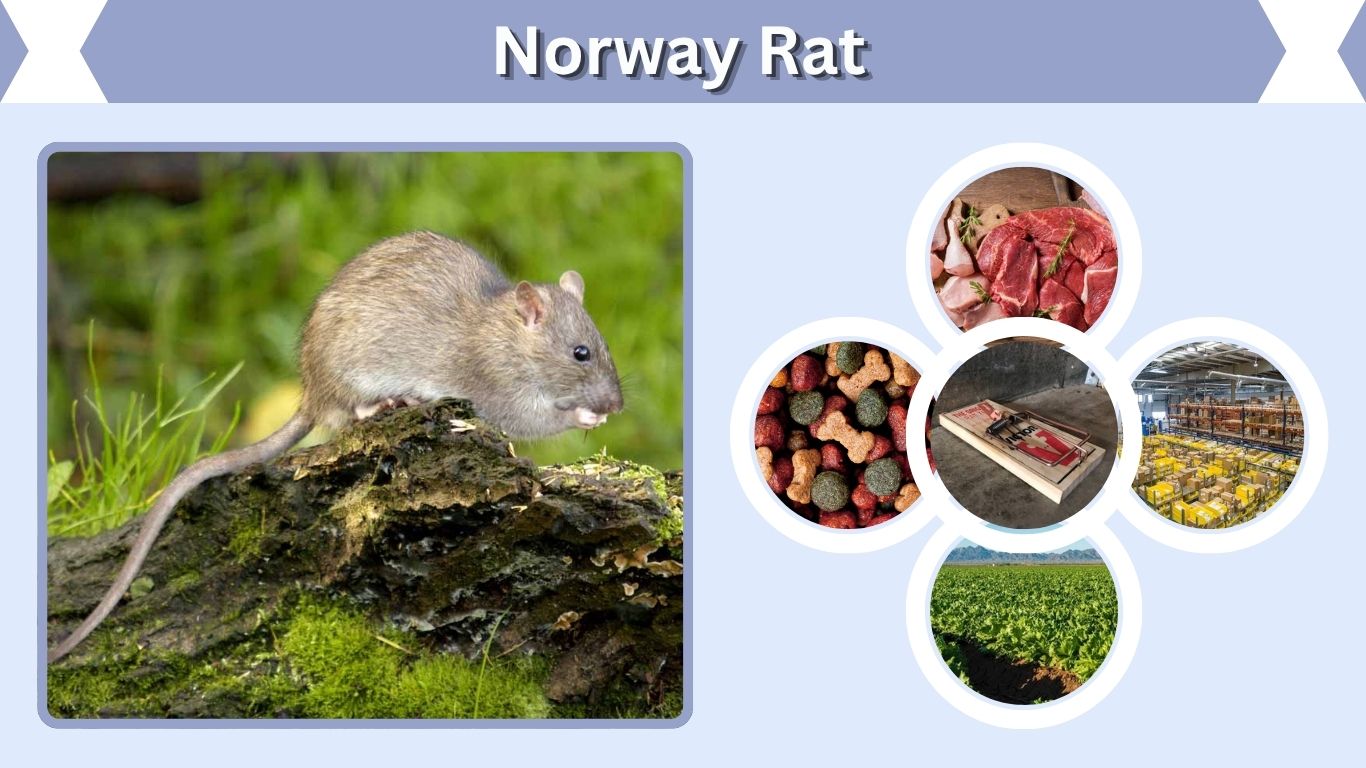
The Norway rat is one of the world’s most widespread rodents and a common pest around homes, farms, restaurants, warehouses, and sewer systems. Also called the brown rat or sewer rat, this stocky rodent is recognized by its blunt nose, relatively small ears, heavy body, and tail that is shorter than its head and body combined. Understanding Norway rat size, droppings, habitat, burrows, behavior, and signs of infestation can make identification easier and help homeowners choose effective control methods.
What Is a Norway Rat?
The Norway rat, scientifically known as Rattus norvegicus, is a large commensal rodent that commonly lives near people. Despite its name, the species did not originate in Norway. Today, it has spread through much of the world and is particularly successful in cities, agricultural areas, ports, and other places where food and shelter are readily available.
Norway Rat Characteristics
Norway rats have thick, powerful bodies with coarse brownish or gray-brown fur. Their undersides are usually lighter, while the muzzle is relatively blunt. Compared with roof rats, their ears and eyes appear smaller in relation to the head.
Another useful identification feature is the tail. A Norway rat’s tail is generally shorter than the combined length of its head and body, whereas a roof rat typically has a proportionally longer tail. UC IPM also describes Norway rats as large and robust, with adult body weights commonly around 7–18 ounces.
How Big Is a Norway Rat?
The Norway rat size is one reason this animal is sometimes described as a “giant Norway rat.” Adults are noticeably larger and heavier than house mice and often look particularly substantial when their thick body and long tail are viewed together.
Norway Rat Size and Weight
Adult Norway rats commonly weigh several hundred grams, although size varies according to sex, food availability, genetics, age, and local conditions. Males are often larger than females.
Older public-health identification guidance describes adults as averaging around a pound, while modern UC IPM guidance gives an adult range of roughly 7–18 ounces.
Reports of an unusually large Norway rat can sometimes be exaggerated because the tail adds considerable apparent length. Perspective in photographs can also make a normal adult look enormous.
Norway Rat vs House Mouse
A Norway rat is much larger and heavier than an adult house mouse. Young rats, however, can occasionally be mistaken for mice.
One useful difference is proportion. Juvenile rats tend to have relatively large heads and feet compared with their bodies, whereas adult mice have smaller feet and a more delicate overall appearance.
Norway Rat vs Roof Rat
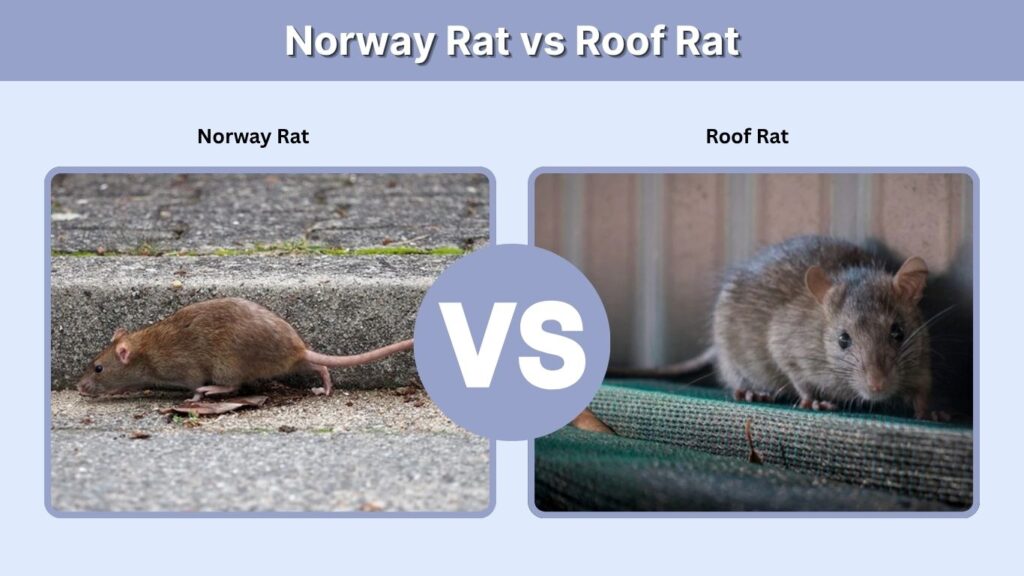
The roof rat vs Norway rat comparison is one of the most useful ways to identify a rodent infestation because the two species favor different nesting areas and may require different trap placement.
Norway rats are generally stockier, heavier, and more adapted to living at or below ground level. Roof rats are slimmer and more agile climbers.
Key Differences
| Feature | Norway Rat | Roof Rat |
| Body | Heavy and stocky | Slim and agile |
| Muzzle | Blunt | More pointed |
| Ears | Relatively small | Relatively large |
| Tail | Shorter than head + body | Longer than head + body |
| Common nesting | Ground, burrows, basements | Trees, attics, upper structures |
| Climbing ability | Capable climber | Excellent climber |
Norway rats frequently occupy basements and ground floors, while roof rats are more strongly associated with attics, ceilings, trees, and other elevated locations. Norway rats are also powerful swimmers.
Where Do Norway Rats Live?
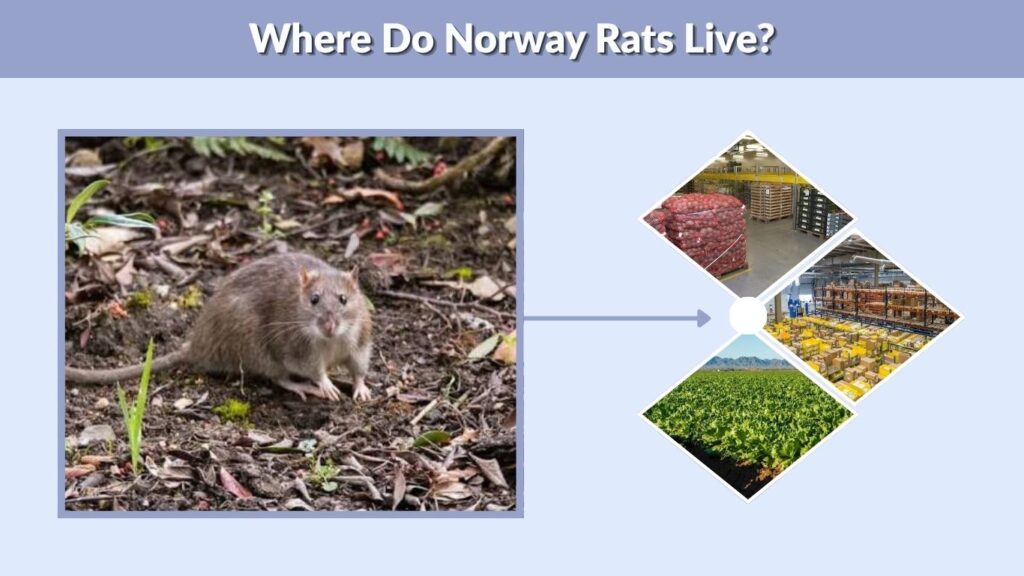
The Norway rat habitat is closely associated with human activity. These rodents thrive wherever they can obtain reliable food, water, and protected nesting locations.
They commonly occur around houses, food facilities, farms, warehouses, dumpsters, sewers, riverbanks, gardens, livestock areas, and commercial properties.
Norway Rat Burrows
One of the most characteristic Norway rat behaviors is burrowing. Burrows may occur along foundations, beneath piles of rubbish or firewood, around gardens, underneath sheds, or near other protected areas.
A Norway rat hole in a yard may lead to a more complex underground nesting system. Active areas can sometimes show worn pathways, freshly disturbed soil, droppings, gnawing, or greasy marks where rats repeatedly travel.
Finding burrows near food waste or building foundations is a particularly useful sign that Norway rats rather than roof rats may be present.
What Do Norway Rat Droppings Look Like?
Norway rat droppings are another useful identification clue. They are considerably larger than house-mouse droppings and are generally elongated or capsule-shaped.
Older CDC identification material describes Norway rat droppings as reaching about ¾ inch in length. However, pellet size can vary, especially between adults and young rats, so shape, location, and other infestation signs should also be considered.
Where Is Norway Rat Poop Found?
Droppings may appear near stored food, pet-food containers, cupboards, basements, garages, dumpsters, walls, and known rodent travel routes.
Fresh droppings can indicate recent activity, but droppings alone should not be used to estimate exactly how many rats are present.
When cleaning rodent-contaminated areas, avoid handling waste with bare hands and follow appropriate sanitation guidance because rodents can contaminate surfaces and food.
Norway Rat Diet and Behavior
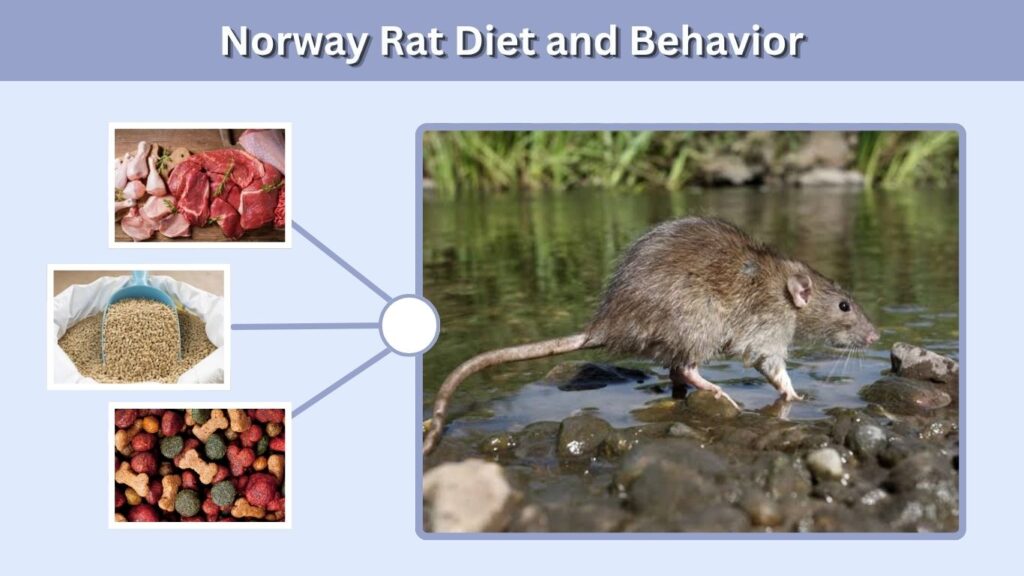
Norway rats are opportunistic feeders. They consume many foods and readily exploit whatever is abundant around human settlements.
Grains, meat, fish, nuts, fruits, pet food, livestock feed, garbage, and discarded food can all support populations. UC IPM notes that Norway rats often remain relatively close to their nests when reliable food is nearby, although foraging distances can become much greater when resources are scattered.
Are Norway Rats Nocturnal?
Norway rats are primarily active at night. They rely heavily on smell, hearing, touch, and learned travel routes when moving through their environment.
They are also cautious about unfamiliar objects. This behavior, known as neophobia, explains why a newly placed trap may sometimes be ignored initially.
Norway Rat Life Cycle
Norway rats can reproduce rapidly when food, water, shelter, and temperatures are favorable.
Females may produce several litters during a year. UC IPM reports an average of approximately four to six litters annually, with a female potentially weaning 20 or more offspring per year.
Older CDC biological guidance gives a gestation period of roughly 22 days and commonly eight to twelve young per litter.
This reproductive potential is why a small, unnoticed infestation can become considerably more difficult to manage when food and nesting areas remain available.
Signs of a Norway Rat Infestation
The most useful approach is to look for several signs together rather than relying on a single clue.
- Large capsule-shaped droppings around food or travel areas
- Burrows beside foundations, gardens, rubbish, or woodpiles
- Gnaw marks on wood, plastic, food packaging, or wiring
- Greasy rub marks along frequently used pathways
- Scratching or movement sounds, particularly at night
- Damaged food containers or stored feed
- Rat tracks or worn travel routes
- Rats seen around basements, ground floors, yards, or dumpsters
Norway rats can also damage structures by gnawing and by creating burrows beneath slabs or foundations.
How to Get Rid of Norway Rats
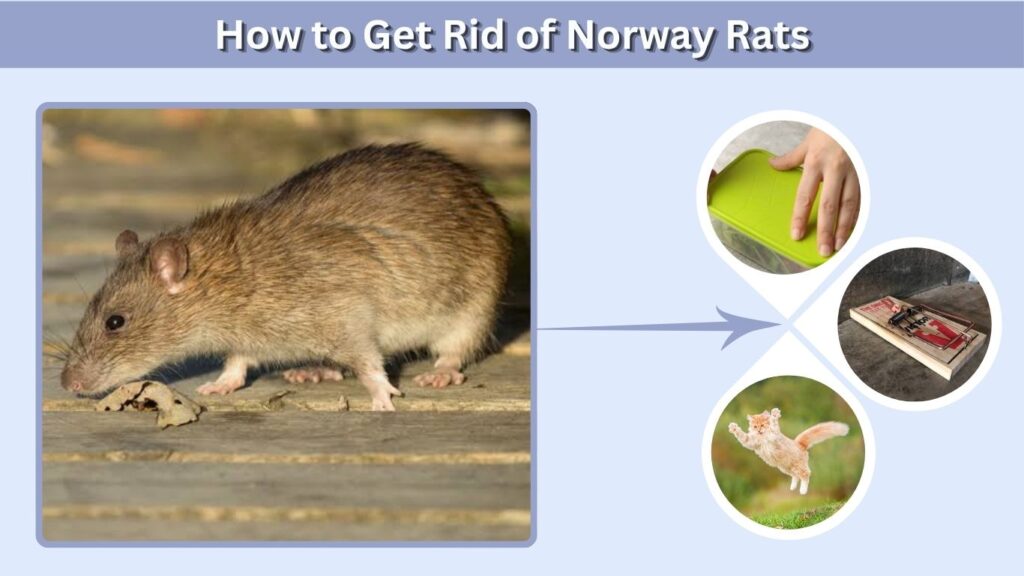
Successful Norway rat control works best when food, shelter, access points, and the existing rat population are addressed together.
Remove Food and Shelter
Store garbage, animal feed, and human food in tightly closed containers. Clean up spilled birdseed, fallen fruit, pet food, and other accessible food sources.
Reduce clutter, debris, heavy vegetation, and unused materials that provide protected hiding locations.
Seal Entry Points
Inspect doors, vents, utility openings, foundations, drains, and other gaps.
Because rats can enlarge weak openings by gnawing, durable rodent-resistant materials are preferable to foam or soft filler alone. UC IPM recommends sealing openings and maintaining tightly fitting doors, windows, and screens.
Use Norway Rat Traps Correctly
Snap traps can be an effective option when properly positioned. For Norway rats, traps are usually most productive close to walls, behind objects, beside known runways, near droppings, or close to burrows rather than placed randomly in open rooms.
Keep all traps inaccessible to children and pets.
Rodenticides require additional caution because they can poison people, pets, and wildlife. Always follow local regulations and the product label, or use a qualified pest-control professional when an infestation is extensive.
Are Norway Rats Dangerous?
Norway rats can create both sanitation and structural concerns. They may contaminate food and surfaces, damage packaging and building materials, and gnaw electrical wiring.
Wild rat populations can also carry parasites and infectious agents, although finding a rat does not automatically mean a particular disease is present. The practical response is to avoid direct contact with wild rodents, clean contaminated areas appropriately, remove food sources, and control infestations promptly.
FAQs
1. What is a Norway rat?
A Norway rat is a large brown or gray-brown rodent scientifically known as Rattus norvegicus. It is also commonly called the brown rat or sewer rat. Norway rats usually live close to people and are frequently found around buildings, farms, basements, sewers, dumpsters, and outdoor burrows.
2. How big can a Norway rat get?
Adult Norway rats are much larger than house mice and usually have thick, stocky bodies. Their exact size varies with age, sex, genetics, and food availability. Large males can appear especially impressive, but claims of “giant Norway rats” are often exaggerated by camera angle or by including the tail in total length.
3. What is the difference between a Norway rat and a roof rat?
Norway rats are generally heavier, stockier, and more likely to live near ground level or in burrows. Roof rats have slimmer bodies, more pointed noses, larger ears, and longer tails relative to body length. Roof rats also tend to spend more time in trees, attics, ceilings, and other elevated areas.
4. What do Norway rat droppings look like?
Norway rat droppings are relatively large, dark, and elongated or capsule-shaped. They are noticeably larger than typical house-mouse droppings. Droppings are often found near feeding areas, walls, basements, storage rooms, garages, or other frequently used travel routes.
5. How do you get rid of Norway rats?
Effective Norway rat control usually combines sanitation, exclusion, and population control. Remove accessible food and water, store garbage securely, reduce clutter, seal entry points, and place suitable traps along active runways or near burrows. Large or persistent infestations may require help from a professional pest-control service.