
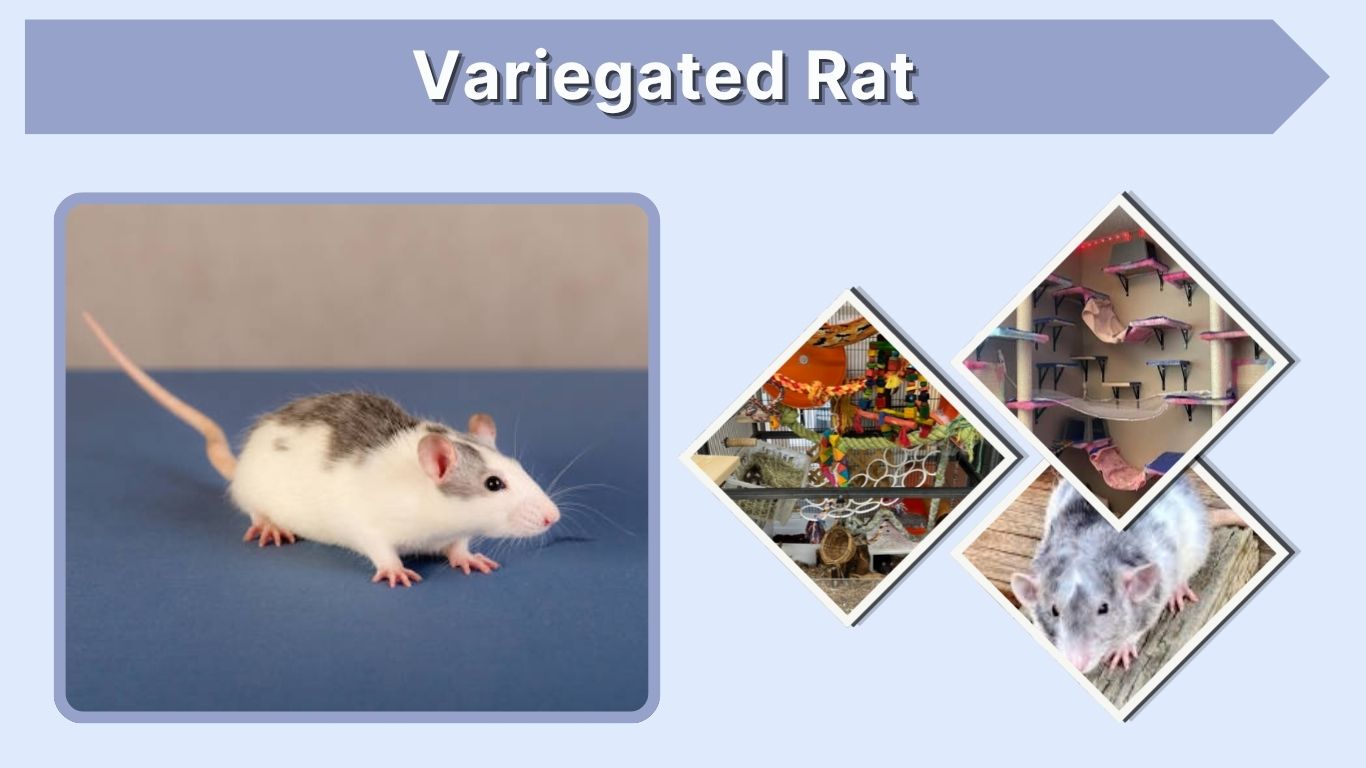
The variegated rat is a distinctive fancy rat recognized by its irregular patches and flecks of color over a mostly white body. Unlike a Hooded rat with a more defined stripe or saddle, the Variegated pattern has scattered markings that create a unique appearance on every individual. Variegated rats can appear in fawn, black, agouti, chocolate, Russian blue, and other colors, and the pattern may also be combined with traits such as Dumbo ears or Rex coats. Despite their unusual markings, their temperament and care requirements are the same as those of other domestic fancy rats.
What Is a Variegated Rat?
A Variegated rat is a domestic fancy rat defined primarily by its marking pattern, rather than being a separate breed. Fancy rat organizations classify rats according to combinations of coat type, color, markings, and physical characteristics.
An ideal Variegated pattern includes a colored head and shoulder region with a white spot or blaze on the forehead. The remaining upper body is mainly white with irregular patches and flecks of color distributed over the back and sides. The underside should generally remain white.
Variegated Rat Identification
Common characteristics include:
- Colored head and shoulder area
- White body with scattered colored patches
- White spot or blaze on the forehead
- Irregular flecks rather than a continuous back stripe
- White chest, belly, and throat
- Color may extend in patches toward the tail
- Available in numerous recognized fancy-rat colors
- May occur with Standard, Rex, Dumbo, or other physical varieties
The exact location and amount of spotting can vary considerably between individual rats.
Variegated Rat Colors
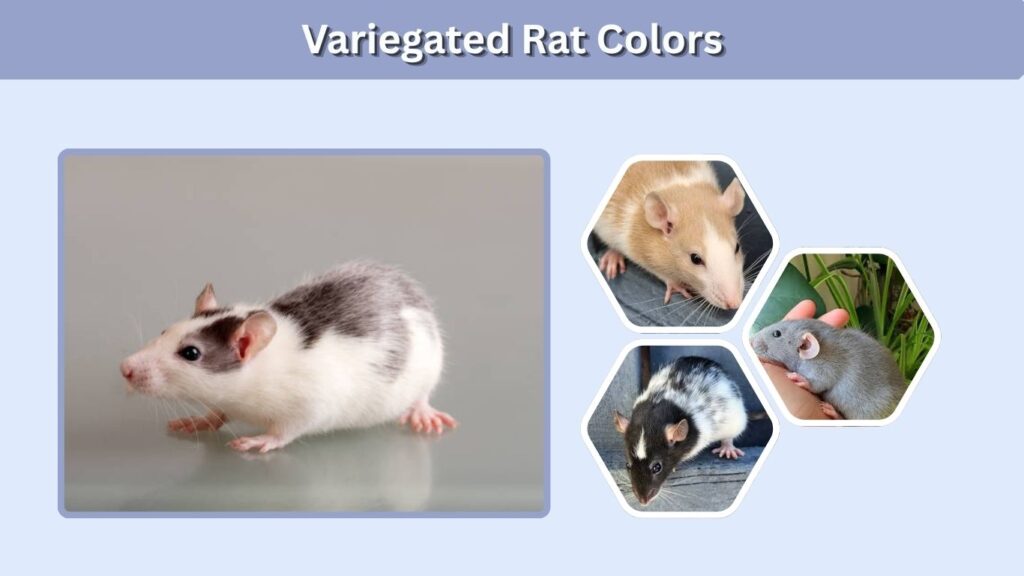
Variegated describes the distribution of markings, so it can be combined with many different base colors. This produces a wide range of appearances while retaining the recognizable white-and-spotted pattern.
Fawn Variegated Rat
A fawn Variegated rat combines warm orange or golden-fawn coloration with white areas. Instead of dark black patches, the colored regions have a softer golden appearance.
The contrast can be less dramatic than in black Variegated rats, but the irregular distribution of colored patches still makes the pattern easy to recognize.
Black Variegated Rat
Black is one of the most noticeable combinations. These rats typically have a black head and shoulder area followed by irregular black flecks or patches over a white background.
Black and white provide strong contrast, so individual markings are usually especially visible.
Agouti Variegated Rat
An agouti Variegated rat combines the spotted pattern with agouti coloration, in which individual colored hairs have bands that create a naturally ticked brown appearance.
The resulting patches may appear brown, gray-brown, or mixed rather than having the uniform appearance of black markings.
Russian Blue Variegated Rat
Russian blue Variegated rats have blue-gray colored patches against white areas. This produces a cooler and often softer-looking pattern than traditional black-and-white Variegated rats.
Chocolate Variegated Rat
Chocolate Variegated rats display rich brown markings rather than black ones. Like the other colors, the placement of the patches depends on the Variegated marking pattern rather than the color itself.
Variegated Rat Markings
The arrangement of color is what separates a Variegated rat from several similar fancy-rat patterns.
According to the National Fancy Rat Society standard, the head and shoulders should be distinctly colored, while the remaining upper body should have colored patches and flecks on a white background. A forehead spot or wedge-shaped blaze may also be present.
What Is an Undermarked Variegated Rat?
An undermarked Variegated rat has less color or fewer spots than would be preferred for an ideal show-standard pattern.
A rat can still have Variegated ancestry or characteristics even if its markings are sparse. “Undermarked” primarily describes how much visible pigmentation appears rather than identifying a completely separate variety.
What Is a Mismarked Variegated Rat?
A mismarked rat has markings that differ from the preferred exhibition standard.
For example, the colored patches may be unevenly distributed, the head marking may have an unusual shape, or there may be too much or too little pigment in particular areas.
These differences generally matter mainly for exhibition standards. They do not make a rat less suitable as a companion animal.
Variegated Rat vs. Hooded Rat
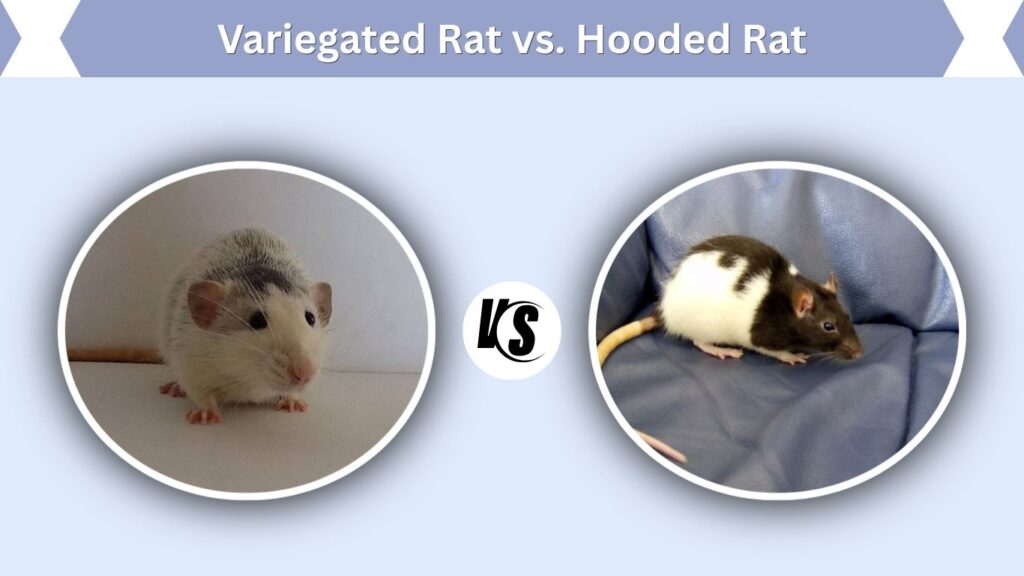
Variegated and Hooded rats can sometimes be confused because both usually have considerable amounts of white.
A Hooded rat normally has a colored hood covering the head and shoulders with a relatively defined stripe running along the spine toward the tail.
A Variegated rat has a colored head-and-shoulder region followed by scattered patches and flecks rather than a clean, continuous spinal stripe.
Therefore, Variegated markings tend to look more irregular and broken.
Variegated Rat vs. Dalmatian Rat
Dalmatian rats are also spotted, but their ideal pattern differs.
Dalmatian rats have numerous relatively independent splashes or spots distributed over a white background without the clearly defined colored head-and-shoulder area expected in Variegated rats. AFRMA notes that the Dalmatian variety originally developed from Variegated stock, which helps explain their visual similarities.
Variegated Blaze Rat
A Variegated rat can also have a blaze.
A blaze is a white facial marking that generally starts near the muzzle and extends upward toward the forehead. Under fancy-rat standards, Blaze can occur with Variegated markings.
This creates a particularly noticeable facial pattern because the white blaze contrasts with the otherwise colored head.
Variegated Berkshire Rat
Variegated and Berkshire are distinct marking descriptions, although breeding lines may produce animals with characteristics that appear intermediate or are described informally using both terms.
A Berkshire rat normally has a mostly colored upper body with a white underside, whereas a Variegated rat has considerably more white across its back and sides with broken patches of color.
For accurately identifying a show variety, the overall distribution of pigment is more useful than relying on casual breeder terminology.
Variegated Down Under Rat
The Down Under trait creates additional coloration on the underside of a rat.
A Variegated Down Under may therefore have the usual Variegated pattern on the upper body combined with a broken colored line or spots along the belly. The NFRS provisional standard describes Variegated Down Under rats as having Variegated-style upper markings together with markings through the underside.
This differs from ordinary Variegated rats, whose bellies are expected to remain white.
Dumbo Variegated Rat
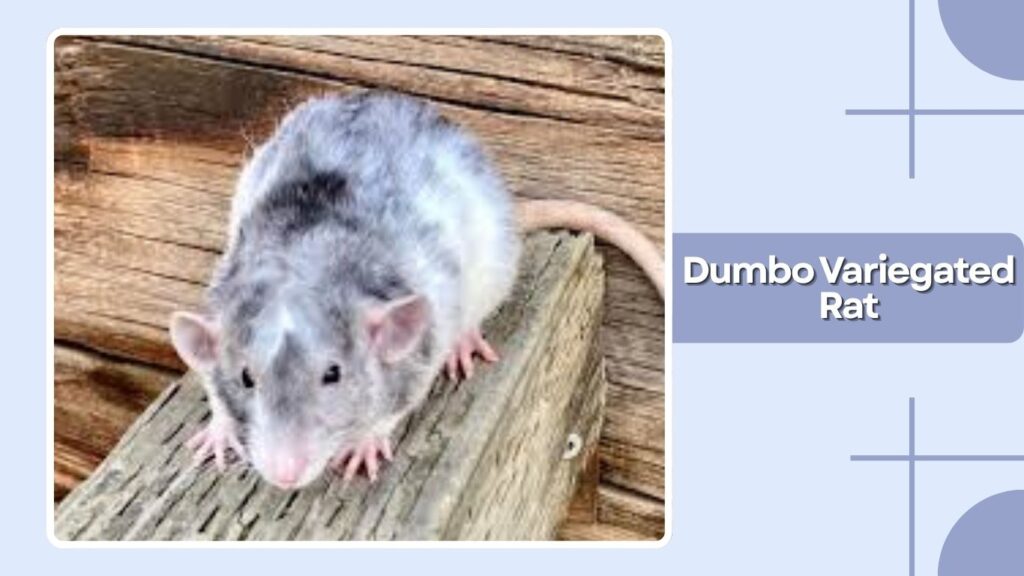
“Dumbo” and “Variegated” describe different characteristics.
A Dumbo Variegated rat has the Variegated coat pattern along with Dumbo ears, which are positioned lower on the sides of the head.
The markings do not determine ear type, so Variegated rats can occur with either standard or Dumbo-style ears. Fancy-rat organizations likewise recognize Dumbo as a physical variety separate from markings and colors.
Variegated Rat Genetics
Fancy-rat spotting genetics can be complicated, and not every marking has been completely characterized scientifically.
AFRMA currently lists the precise genetics of the Variegated marking as unknown, noting that many fancy-rat colors and varieties have not been formally studied by geneticists.
The NFRS show standard describes Variegated rats using hooded-series genetics together with possible modifiers, illustrating that standards and breeder genetic models can differ depending on the organization and breeding population.
Because of this complexity, coat appearance alone cannot always reveal an animal’s complete genotype.
Variegated Rat Temperament
Coat patterns do not determine personality.
Variegated rats can be just as social, intelligent, curious, and trainable as other domestic rats. Individual temperament is influenced much more by breeding, early handling, socialization, environment, and health.
A well-socialized rat may enjoy interacting with people, exploring new objects, climbing, learning simple behaviors, and searching for hidden food.
Variegated Rat Care
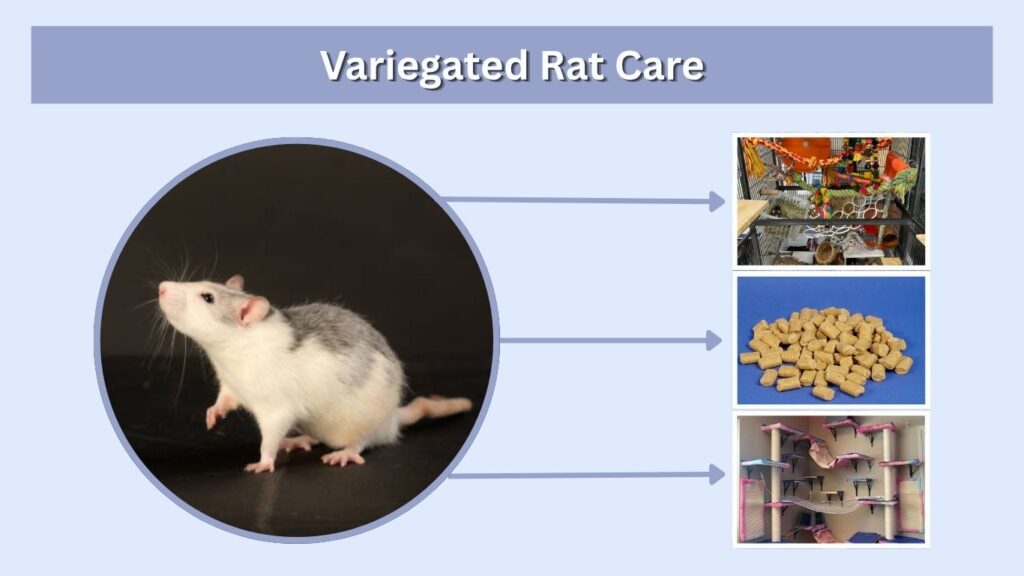
Variegated rats require the same care as other fancy rats.
Housing and Enrichment
Provide a spacious, secure, well-ventilated cage with multiple levels or climbing opportunities. Rats benefit from hammocks, ropes, tunnels, nesting materials, hides, chew toys, and opportunities to forage.
Regular supervised exercise outside the cage can provide additional physical activity and mental stimulation.
Social Needs
Rats are highly social and generally should be kept with compatible rats rather than living alone. Human interaction is valuable, but it does not completely replace companionship from another rat.
Diet and Water
A nutritionally complete rat food should form the foundation of the diet. Suitable vegetables and other safe foods can provide additional variety.
Clean drinking water should always be available.
How Long Do Variegated Rats Live?
The Variegated pattern does not give rats a different expected lifespan from other pet rats.
Domestic fancy rats commonly live around two to three years, although lifespan can vary depending on genetics, veterinary care, nutrition, housing, disease, and general living conditions.
Choosing animals from health-conscious breeding lines and maintaining good husbandry can help support quality of life throughout this relatively short lifespan.
FAQs
Are Variegated rats a separate breed?
No. Variegated refers to a coat-marking pattern found in domestic fancy rats rather than a separate rat breed.
Can a Variegated rat be fawn?
Yes. Fawn Variegated rats have warm fawn-colored markings distributed over a mostly white body.
Can Variegated rats have Dumbo ears?
Yes. Dumbo describes ear placement, while Variegated describes markings, so both traits can appear in the same rat.
What is the difference between Variegated and Hooded rats?
Hooded rats usually have a more continuous colored stripe along the back. Variegated rats have irregular patches and flecks of color over a mostly white body.
Are Variegated rats good pets?
Yes. Their coat markings do not negatively affect their suitability as companions. When properly socialized and cared for, Variegated rats can be intelligent, interactive, and affectionate pets just like other fancy rats.