
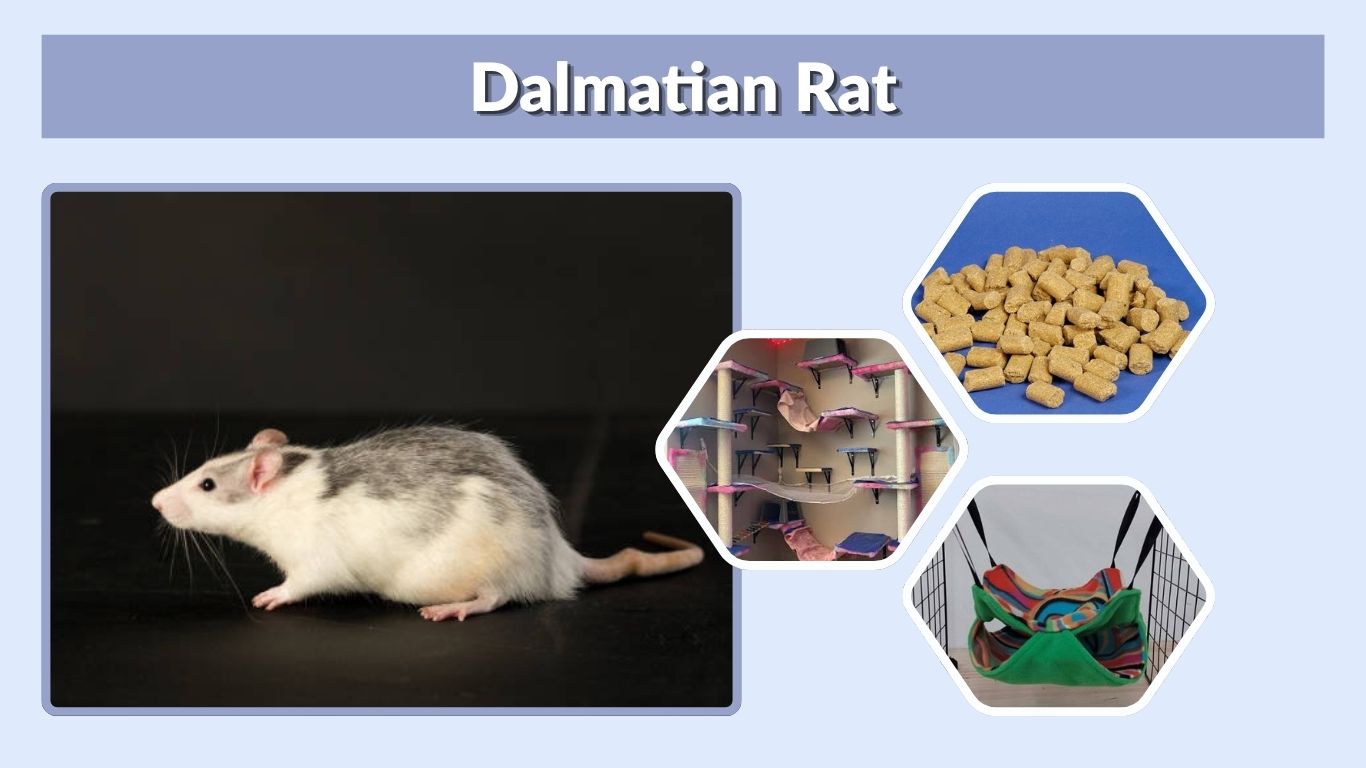
The Dalmatian rat is a distinctive fancy rat known for irregular colored spots scattered across a mostly white coat. Its markings resemble the spotted appearance of a Dalmatian dog, which explains the name. Dalmatian rats are not a separate species or breed; they are domesticated Norway rats with a particular marking pattern. They can occur in several colors and may also have Dumbo ears or different coat types. Besides their unusual appearance, they have the same social, intelligent, and active nature that makes fancy rats popular companion animals.
What Is a Dalmatian Rat?
A Dalmatian rat is a marked variety of fancy rat. The American Fancy Rat and Mouse Association (AFRMA) describes the ideal Dalmatian pattern as colored splashes or spots distributed over a white background without large, clearly defined solid markings. The spots should be numerous, irregular around the edges, and spread across the body.
The name describes the animal’s coat pattern rather than its species. Like other fancy rats, Dalmatian rats descend from the domesticated form of the brown or Norway rat.
What Does a Dalmatian Rat Look Like?
The most obvious feature is the contrast between the white base coat and scattered colored markings. No two animals are likely to have exactly the same spot arrangement.
Typical characteristics include:
- Mostly white background color
- Numerous irregular spots or splashes
- Spots distributed over the head and body
- Pink feet and tail in many individuals
- Standard or Dumbo-style ears
- Standard, Rex, or other coat types depending on genetics
- Multiple possible spot colors
AFRMA notes that Dalmatian markings can occur with recognized rat colors rather than being limited to black.
Dalmatian Rat Colors
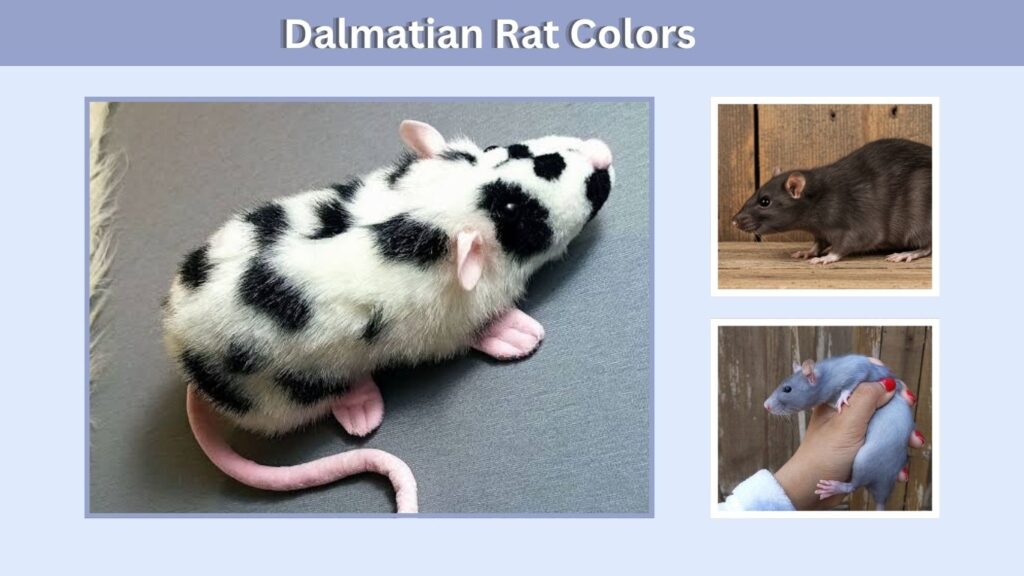
Although a black Dalmatian rat creates the strongest dog-like black-and-white contrast, other colors are possible.
Russian Blue Dalmatian Rat
A Russian Blue Dalmatian combines the spotted pattern with Russian Blue coloration. The resulting patches may appear smoky blue-gray rather than solid black.
Because the Dalmatian factor can affect how colored areas appear, some spots may look lighter or more silvered than the same color would appear on a self-colored rat. AFRMA’s historical genetics material specifically notes that Dalmatian markings can dilute and silver colored hairs.
Fawn and Other Dalmatian Rats
Dalmatian markings may also occur with lighter colors. In principle, the pattern can be shown in recognized colors, so appearance can range considerably between individual animals.
This variety is therefore defined more by where color appears than by one specific coat color.
Dalmatian Rat Genetics
Dalmatian genetics are more complicated than simply breeding two spotted rats and expecting identical offspring.
AFRMA currently lists the Dalmatian genetic notation as Daldal and describes the variety as originating from Variegated stock. Its standard notes also describe the Dalmatian factor as dominant lethal and associated with breaking colored areas into patches while diluting and silvering them.
Older AFRMA material also emphasizes that the complete inheritance pattern has historically been difficult to establish and that some explanations were based on breeding observations rather than a fully resolved genetic mechanism.
Dalmatian vs. Variegated Rat
These two markings can look similar, but they are not considered identical varieties.
A Variegated rat normally has a more recognizable colored head area combined with markings extending across a white body. A Dalmatian ideally has numerous separate, ragged-edged splashes without a large, clean solid marking dominating the pattern.
Dalmatian rats originally developed from Variegated stock, which helps explain why the two patterns may sometimes be confused.
Dumbo Dalmatian Rat
A Dumbo Dalmatian rat combines Dalmatian markings with the Dumbo ear trait.
Dumbo rats have ears positioned lower on the sides of the head rather than high on top like standard-eared rats. AFRMA lists Dumbo separately as an ear gene, meaning “Dumbo” describes ear structure rather than coat markings.
Therefore, a rat can be both Dalmatian and Dumbo at the same time.
Rex Dalmatian Rat
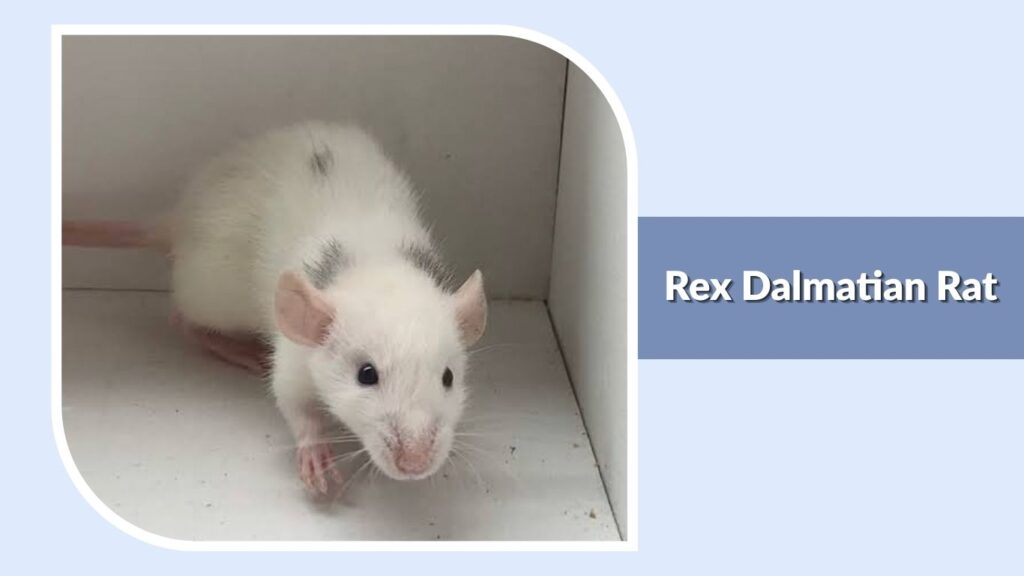
Similarly, a Rex Dalmatian rat has the spotted Dalmatian pattern combined with a curly or wavy coat.
“Rex” describes coat texture, while “Dalmatian” describes markings. Combining traits like these can create rats with very different appearances even though their basic care needs remain essentially the same.
Dalmatian Rat Temperament
Dalmatian markings do not create a special personality type. Temperament depends much more on genetics, early handling, socialization, health, and the individual rat.
Fancy rats are generally intelligent, curious, interactive animals that can learn routines and form strong relationships with people. They are also highly social and need companionship from other compatible rats. Both the RSPCA and Blue Cross recommend keeping rats in pairs or groups rather than alone.
Are Dalmatian Rats Good Pets?
They can make excellent companion animals for people prepared to meet normal pet-rat needs.
Well-socialized rats often enjoy exploring, climbing, playing, accepting treats, and interacting with their keepers. However, their unusual coat does not make them easier to care for than other fancy rats.
Dalmatian Rat Care
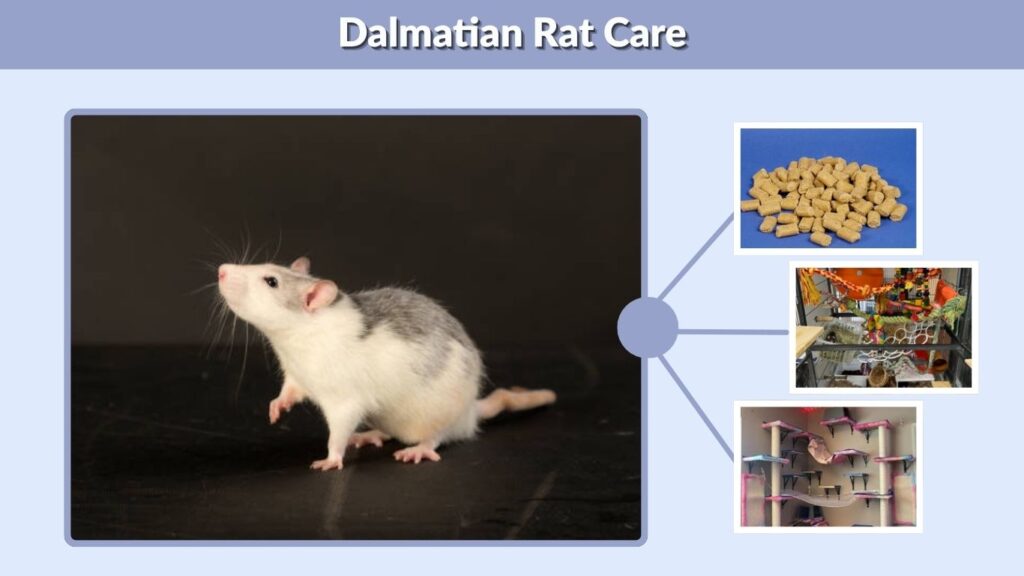
A Dalmatian fancy rat requires the same housing, diet, enrichment, and veterinary attention as any other domesticated rat.
Housing
Rats need a spacious, well-ventilated enclosure with a solid floor. Vertical room is valuable because rats enjoy climbing, and the cage should include hides, hammocks, tunnels, ropes, and other enrichment.
Blue Cross recommends a cage measuring at least about 90 × 60 × 120 cm for two to five rats and advises against aquarium-style glass housing because of inadequate ventilation.
Diet
A balanced rat-specific diet should form the basis of feeding, supplemented appropriately with vegetables and other suitable foods.
Fresh drinking water should always be available. High-fat and sugary treats should remain occasional because rats can gain excessive weight relatively easily.
Exercise and Enrichment
Rats are active and intelligent, so an empty cage is insufficient.
Provide climbing structures, tunnels, chewable materials, hiding places, nesting material, and opportunities to forage. Blue Cross also recommends daily exercise and interaction outside the cage in a safe, rat-proofed environment.
How Long Do Dalmatian Rats Live?
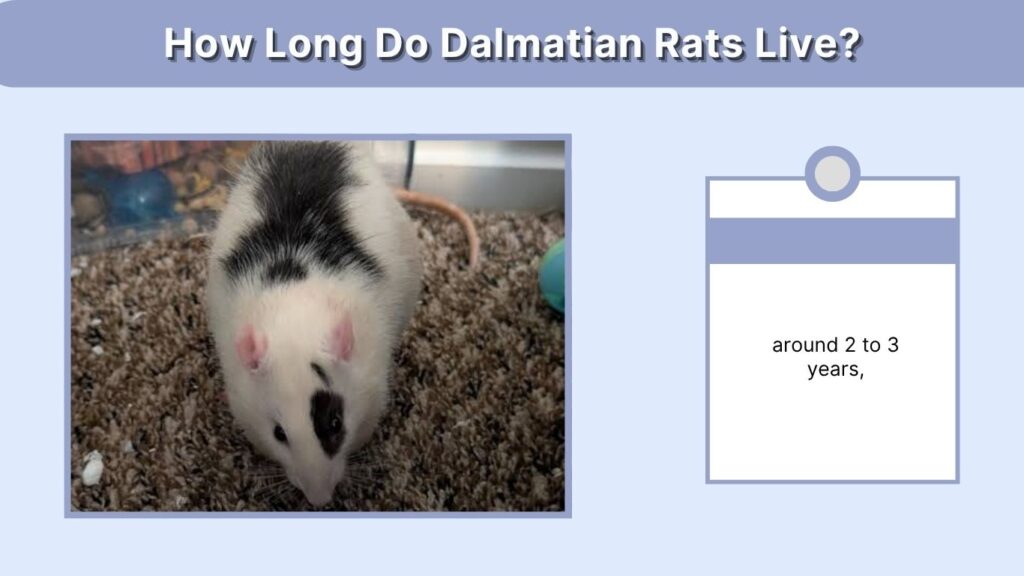
A Dalmatian rat’s lifespan is similar to that of other pet rats.
Most pet rats live around 2 to 3 years, although some individuals may live longer with favorable genetics, nutrition, housing, and veterinary care.
The Dalmatian coat pattern itself should not be used as a predictor of how long an individual rat will live.
Breeding Dalmatian Rats
Breeding Dalmatian rats requires more knowledge than simply selecting animals with attractive spots.
Their marking inheritance has been associated with particular genetic complications, and breeders must also consider overall health, temperament, reproductive history, respiratory health, and the genetics of other coat and color traits.
Because AFRMA describes the Dalmatian factor as having a dominant-lethal genetic component, inexperienced pairing based purely on appearance is not advisable.
Responsible breeding places health and temperament ahead of producing more dramatic markings.
Choosing a Dalmatian Rat
Someone searching for a Dalmatian rat for sale should pay more attention to health and breeder practices than to achieving a perfect spot pattern.
Look for rats that are alert, curious, moving normally, and free from obvious respiratory symptoms. Avoid animals showing persistent noisy breathing, heavy sneezing, or discharge around the eyes and nose. Blue Cross also recommends checking that young rats are appropriately aged, correctly sexed, and healthy before bringing them home.
Rescue organizations can also be worth checking because fancy rats of many colors and markings need homes.
Dalmatian Rat Facts
- Dalmatian is a marking variety, not a separate rat species.
- The pattern consists of irregular spots on a white background.
- Dalmatian rats can occur in multiple colors.
- Black is not the only possible spot color.
- Russian Blue Dalmatian rats can have blue-gray markings.
- Dumbo Dalmatian rats combine spotted markings with Dumbo ears.
- Rex Dalmatian rats combine the pattern with a curly coat.
- The Dalmatian variety originated from Variegated rat stock.
- Like other fancy rats, they are highly social animals.
- Pet rats generally live around two to three years.
FAQs
Are Dalmatian rats rare?
They are less commonly encountered than basic markings such as Hooded or Berkshire rats, particularly in areas without breeders specializing in unusual fancy-rat varieties.
Is a Dalmatian rat the same as a Dalmatian Rat Terrier mix?
No. A Dalmatian rat is a domesticated fancy rat with spotted markings. A Dalmatian–Rat Terrier mix is a cross between two dog breeds and is completely unrelated.
Can Dalmatian rats have Dumbo ears?
Yes. Dalmatian describes the markings, while Dumbo describes the ear type, so both traits can occur in the same animal.
Can a Dalmatian rat be Russian Blue?
Yes. Dalmatian markings can be combined with different recognized colors, including blue-gray shades.
Do Dalmatian rats need another rat as a companion?
Yes. Like other pet rats, they are highly social and should normally live with compatible rats rather than being housed alone.