

The western harvest mouse is a tiny North American rodent that lives mainly in grasslands, meadows, marshes, shrublands, and other areas with dense ground vegetation. Its brownish coat, pale underside, narrow body, and faint dark stripe help it disappear among grasses. Although it resembles deer mice and other small rodents, its grooved upper incisors are an important identifying feature. The species is mostly nocturnal and feeds primarily on seeds, supplemented by insects and fresh plant material.
Western Harvest Mouse Facts
The scientific name of the western harvest mouse is Reithrodontomys megalotis. It belongs to the Cricetidae family and the genus Reithrodontomys, a group commonly known as harvest mice.
| Feature | Description |
| Scientific name | Reithrodontomys megalotis |
| Order | Rodentia |
| Family | Cricetidae |
| Total length | About 118–170 mm |
| Weight | Approximately 8–17 grams |
| Activity | Primarily nocturnal |
| Main food | Seeds |
| Habitat | Grasslands, meadows, marshes, and shrublands |
| Typical lifespan | Less than one year |
| Maximum reported lifespan | Around 18 months |
Western harvest mice are among the smallest rodents in many parts of their range. Males and females are generally similar in size and coloration.
Western Harvest Mouse Identification
The western harvest mouse has a slender body, relatively large ears, dark eyes, and a long, narrow tail. Its upper fur may vary from pale gray to brown, while the underside ranges from whitish to gray. Many individuals have a darker stripe extending along the center of the back and onto the forehead.
Identifying Features
- Small, delicate body
- Brown, gray-brown, or buff upper fur
- Pale gray or whitish underside
- Narrow dark stripe along the back
- Large, mostly hairless ears
- Slender tail that is usually shorter than the body
- White or pale feet
- Upper incisors with lengthwise grooves
The grooved incisors are especially useful for distinguishing harvest mice from similar rodents, although examining the teeth should be left to trained wildlife professionals.
Size and Body Length
A western harvest mouse usually measures approximately 118–170 mm from its nose to the end of its tail. Its tail measures roughly 50–96 mm, and adults generally weigh between 8 and 17 grams. The average total length is about 140 mm.
Juveniles tend to have short, woolly, gray-brown fur. Adults develop different seasonal coats, with thicker and paler fur during winter and shorter, thinner fur during summer.
Western Harvest Mouse Habitat

Western harvest mice occupy open environments containing enough vegetation to provide food, nesting material, and protection from predators. They are commonly associated with grasslands, prairies, meadows, marshes, shrublands, sand dunes, agricultural edges, and streamside vegetation.
Habitat Requirements
Dense grasses and low shrubs are important because the mice build nests close to the ground and travel through covered runways. They may also occupy dry shrub-steppe environments when sufficient vegetation is present. Canadian recovery documents describe suitable habitat as grassland or shrub-grassland with extensive cover and a mixture of grasses and shrubs.
The species can tolerate different climates and elevations. It has been recorded from below sea level in Death Valley to mountainous regions approximately 4,000 meters above sea level in Mexico.
Western Harvest Mouse Range
The western harvest mouse occurs across a large portion of western and central North America. Its distribution extends from parts of Canada through much of the western United States and into central Mexico. It occurs from the Great Lakes region westward to the Pacific Coast.
Populations can be found in states such as Washington, California, Colorado, Wisconsin, Minnesota, and Illinois, provided suitable grassy habitat is available. However, distribution and abundance vary considerably between regions.
What Do Western Harvest Mice Eat?

Western harvest mice are primarily seed eaters, but they have an adaptable diet. Their food choices depend on season, habitat, and availability.
Western Harvest Mouse Diet
Their natural diet may include:
- Grass seeds
- Weed seeds
- Grains
- Young plant growth
- Leaves
- Flowers
- Fruit
- Grasshoppers
- Moths
- Other small insects
Seeds provide much of their energy, particularly when grasses and other plants produce abundant seed heads. Insects offer additional protein and may become more important when readily available. The mice sometimes carry food back to their nests and store it for later use.
Behavior and Adaptations
Western harvest mice are mainly active at night, particularly before midnight. Research summarized by Animal Diversity Web indicates that activity can increase on dark, moonless, or rainy nights, possibly because reduced visibility helps them avoid visually hunting predators.
They typically remain within a relatively limited home area and move along established runways beneath grasses. They may also use pathways created by voles and other small mammals.
Important Adaptations
Their brown coloration provides camouflage among soil, dry grass, and plant stems. Their small body allows them to move through narrow spaces, while their large ears help detect surrounding sounds.
During periods of cold weather, western harvest mice may enter torpor, temporarily reducing their activity and energy use. However, they are not known to undergo regular, prolonged hibernation.
Nesting Habits
Western harvest mice normally construct round nests from grasses and other plant fibers. The nest is often placed directly on the ground beneath weeds, bushes, grasses, fallen logs, or other protective cover. Some nests are built slightly above ground in shrubs, while others may be placed inside burrows.
A typical nest is approximately 125 mm across. Coarser plant material forms the outside, while softer grass and fibers line the interior. One or more openings near the base allow the mouse to enter and leave.
Reproduction and Young
Breeding usually occurs from early spring through late autumn, although populations in mild climates may reproduce for much of the year. Females have a gestation period of approximately 23–25 days and usually produce around four young, although litters may contain one to nine pups.
Newborn western harvest mice are blind, pink, hairless, and completely dependent on their mother. Their eyes and ears open at approximately 11 days, and they are generally weaned by around 24 days. Young mice may leave the nest at about three weeks old.
Western Harvest Mouse Lifespan
Western harvest mice have short lives. Few survive for more than one year in the wild, and the maximum reported lifespan is approximately 18 months. Predation, severe weather, habitat disturbance, disease, and food shortages all contribute to mortality.
Their short lifespan is balanced by rapid reproduction and the ability to produce multiple litters when environmental conditions are favorable.
Western Harvest Mouse vs Deer Mouse
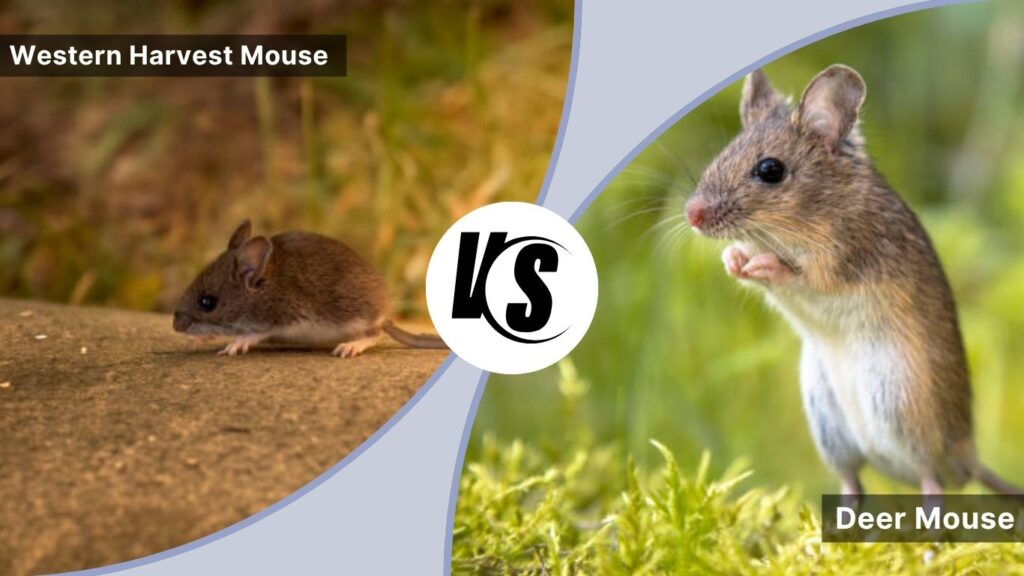
Western harvest mice and deer mice may live in some of the same regions, but several features can help separate them.
| Feature | Western Harvest Mouse | Deer Mouse |
| Scientific genus | Reithrodontomys | Peromyscus |
| General build | Very small and slender | Usually larger and more robust |
| Back | Often has a dark stripe | Usually lacks a central stripe |
| Incisors | Grooved upper incisors | Incisors not similarly grooved |
| Tail | Narrow and less sharply divided in color | Often sharply dark above and pale below |
| Feet | Small and pale | Usually noticeably white |
A deer mouse commonly has a clearly two-colored tail, with dark fur above and pale fur below. Western harvest mice are often smaller and may show a narrow dorsal stripe.
Predators and Role in the Food Chain
Western harvest mice are important prey for many animals, including owls, hawks, snakes, foxes, coyotes, weasels, skunks, cats, and some larger predatory invertebrates. Their abundance can influence the survival of predators that depend on small mammals for food.
They may also help disperse plant seeds by carrying and storing them. Forgotten seeds can sometimes germinate away from the parent plant.
Diseases and Hantavirus
Western harvest mice have been identified as natural hosts of El Moro Canyon virus, a type of hantavirus found in North America. Deer mice remain the primary reservoir associated with most Sin Nombre virus infections and hantavirus pulmonary syndrome in the United States.
People should avoid touching wild rodents, nests, urine, or droppings with bare hands. Rodent-contaminated spaces should be ventilated and cleaned using recommended wet-disinfection methods rather than sweeping dry material into the air.
Is the Western Harvest Mouse Endangered?
The species as a whole is widespread and not generally considered endangered. However, conservation status differs by location and subspecies. The dychei subspecies is listed as endangered under Canada’s Species at Risk Act because of its limited Canadian distribution, isolation, restricted movement, and fluctuating population size.
Habitat loss, agricultural development, urban growth, excessive grazing, and the removal of dense grass or shrub cover may threaten vulnerable local populations.
FAQs
Can a western harvest mouse be kept as a pet?
Western harvest mice are wild animals and are not suitable conventional pets. They have specialized habitat needs, are easily stressed, and may carry parasites or pathogens. A wild mouse should not be captured or handled except by a qualified wildlife professional.
Does the western harvest mouse enter houses?
It is primarily associated with outdoor grasslands and dense vegetation. However, an individual may occasionally enter a building while searching for food or shelter, especially when natural cover is disturbed.
When are western harvest mice active?
They are primarily nocturnal and are often most active during the earlier part of the night. They travel through grass runways to search for seeds, insects, and plant material.
What is the western harvest mouse’s scientific name?
Its scientific name is Reithrodontomys megalotis. It belongs to the harvest mouse genus Reithrodontomys and the rodent family Cricetidae.
Why is the western harvest mouse important?
It supports grassland food webs by providing food for birds, snakes, and mammalian predators. Its seed-eating and food-caching habits may also contribute to seed movement and plant regeneration.