
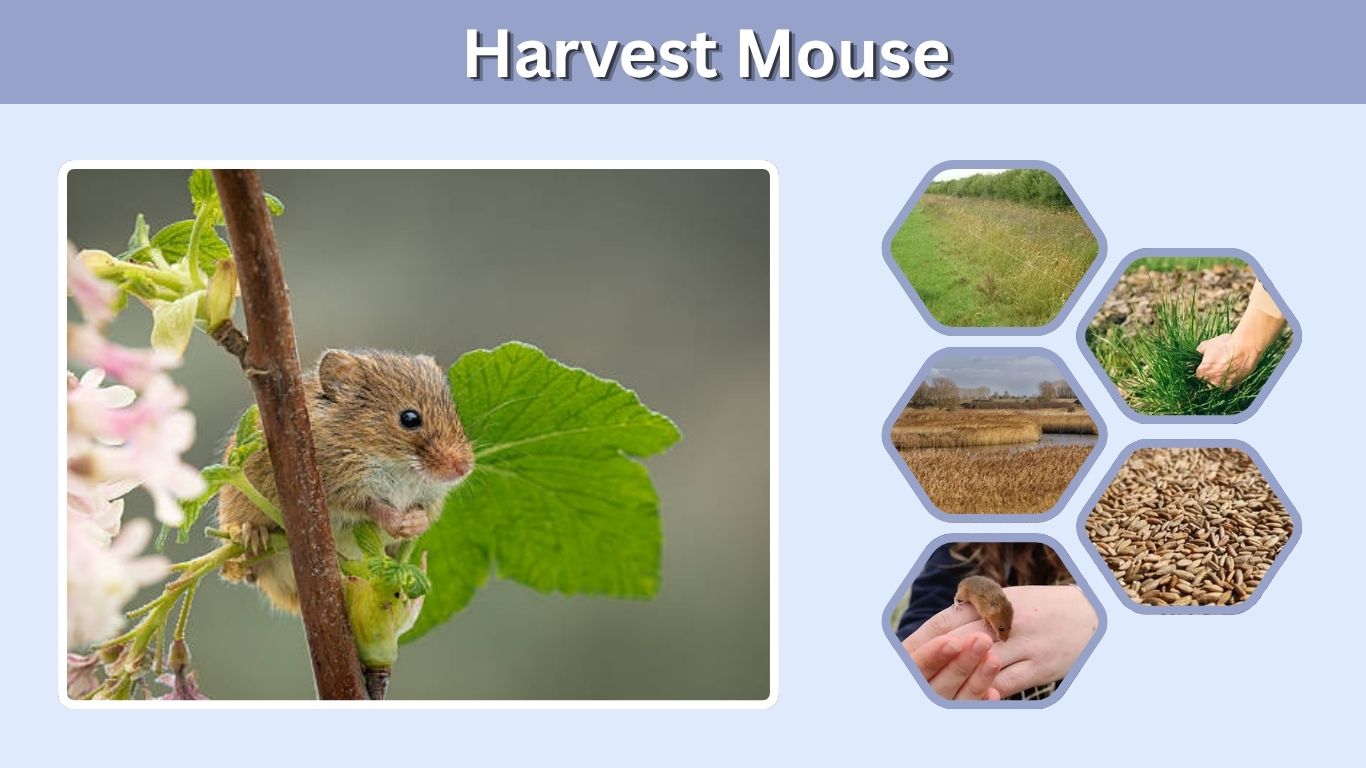
The harvest mouse is a tiny, agile rodent recognized for its reddish-brown coat, pale underside and remarkable climbing ability. However, “harvest mouse” can refer to the Eurasian harvest mouse or several related-looking American species. The Eurasian harvest mouse is especially distinctive because it uses its prehensile tail like an additional limb while moving through tall grasses. Harvest mice inhabit fields, wetlands and dense vegetation, where they eat seeds, plant material and small invertebrates.
What Is a Harvest Mouse?
The name harvest mouse does not identify one universal species. In Europe and Asia, it normally means the Eurasian harvest mouse. In North America, it refers to several members of the genus Reithrodontomys.
Common Harvest Mouse Species
| Common name | Scientific name | Primary range |
| Eurasian harvest mouse | Micromys minutus | Europe and Asia |
| Western harvest mouse | Reithrodontomys megalotis | Western and central North America |
| Eastern harvest mouse | Reithrodontomys humulis | Eastern United States |
| Plains harvest mouse | Reithrodontomys montanus | Central North America |
| Fulvous harvest mouse | Reithrodontomys fulvescens | Southern United States to Central America |
| Salt marsh harvest mouse | Reithrodontomys raviventris | San Francisco Bay region |
The Eurasian harvest mouse is also called the European, Old World or common harvest mouse. American harvest mice belong to a different genus and do not share every physical adaptation of the Eurasian species.
Harvest Mouse Identification and Size
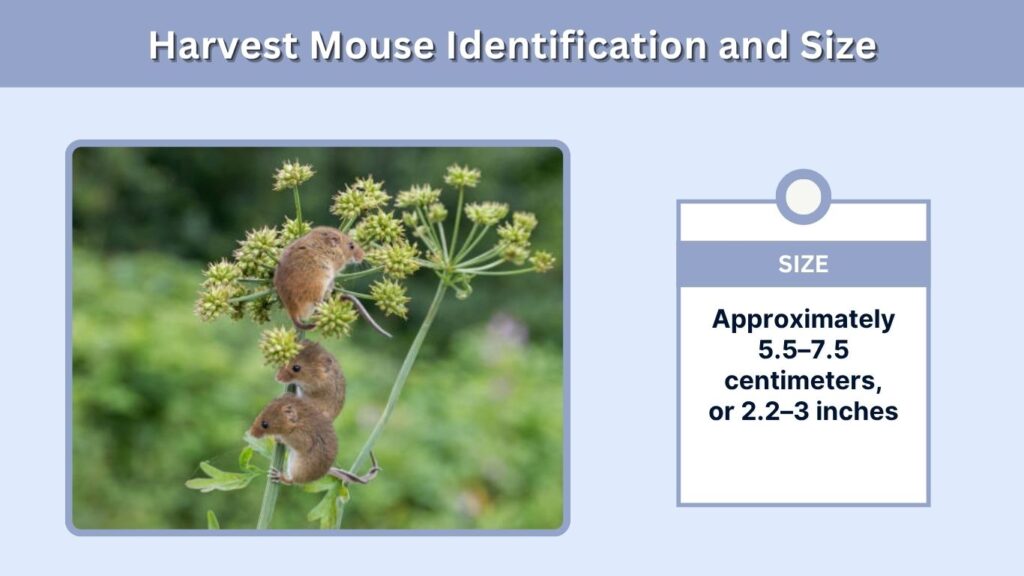
Harvest mice are among the smallest rodents in their respective ranges. Their light bodies allow them to climb thin stems that would bend under the weight of larger mice.
Identification Features
A Eurasian harvest mouse can be identified by these characteristics:
- Golden-brown, orange-brown or reddish upper fur
- White or cream-colored underside
- Small, rounded ears covered with fine hair
- Relatively blunt snout with short whiskers
- Dark eyes positioned prominently on the head
- Broad hind feet adapted for gripping vegetation
- Long, flexible prehensile tail
- No strongly defined stripe along the back
Harvest Mouse Size and Weight
An adult Eurasian harvest mouse has a head-and-body length of approximately 5.5–7.5 centimeters, or 2.2–3 inches. Its tail adds another 5–7.5 centimeters. Adults commonly weigh only 4–11 grams.
The Wildlife Trusts lists a typical weight of 4–6 grams, making the animal considerably lighter than an ordinary house mouse. American species are generally larger. Western harvest mice often weigh approximately 8–17 grams.
The Prehensile Tail
The Eurasian harvest mouse’s most famous adaptation is its prehensile tail. The mouse curls its tail around grass stems for balance and support, allowing its front feet to remain free for collecting food.
American harvest mice have long tails, but they are not known for the same highly developed gripping ability. Tail structure is therefore useful when distinguishing an Eurasian harvest mouse from similarly colored field mice.
Habitat and Distribution
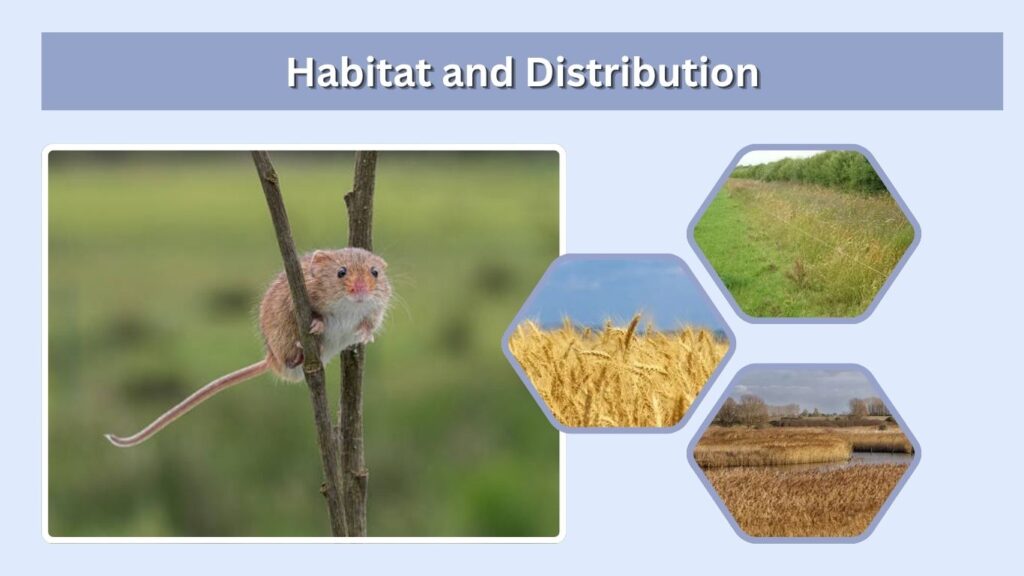
Harvest mice depend on dense vegetation for food, nesting material, shelter and safe travel. Removing tall grasses or repeatedly disturbing field margins can make otherwise suitable habitat unusable.
Eurasian Harvest Mouse Habitat
The Eurasian harvest mouse occurs across parts of Europe and Asia. Typical habitats include:
- Cereal fields
- Reedbeds and wetlands
- Tall grasslands
- Hedgerows and field margins
- Roadside and railway embankments
- Ditches, rushes and sedge beds
- Areas containing brambles or dense weeds
Although associated with cereal crops, the mouse does not survive exclusively in cultivated fields. Permanent grass margins, wetlands and hedgerows become particularly important after crops are harvested.
American Harvest Mouse Habitat
Western, eastern and plains harvest mice generally occupy grasslands, meadows, marsh edges, shrublands and agricultural areas. They usually remain near dense ground cover that protects them from predators.
The salt marsh harvest mouse has a much more restricted range. It lives primarily in saline and brackish wetlands around San Francisco Bay, especially areas containing dense pickleweed and bulrush vegetation.
What Do Harvest Mice Eat?
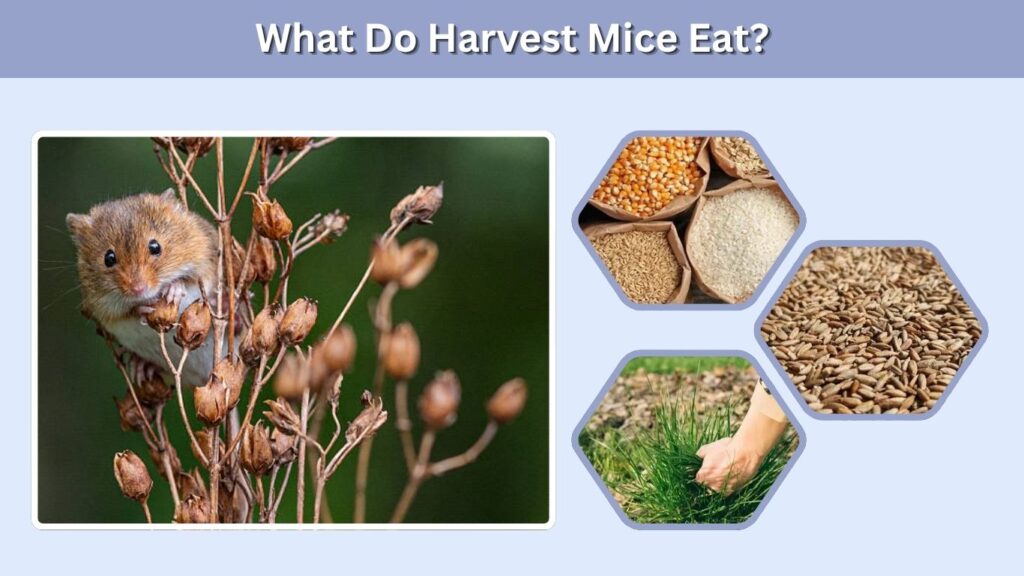
Harvest mice are omnivorous, although seeds and other plant foods form a large portion of their diet. Their diet changes with season, habitat and food availability.
Natural Diet
Eurasian harvest mice eat grass seeds, cereal grains, berries, fruits, shoots and other tender plant material. They may also consume caterpillars, beetles, moths, grasshoppers and other small invertebrates.
During summer, insects provide useful protein. Seeds become particularly important during late summer, autumn and winter. Harvest mice occasionally climb flowering plants, but they are usually searching for seeds, pollen, nectar or insects rather than eating the entire flower.
Do Harvest Mice Damage Crops?
Harvest mice may consume small quantities of wheat, oats and other grains, but they are not normally considered major agricultural pests. Their small populations and body size limit the amount of crop damage they cause.
They also eat insects and weed seeds. Consequently, their ecological role is more complex than simply feeding on cultivated grain.
Harvest Mouse Nest
The spherical nest of the Eurasian harvest mouse is one of the clearest signs of its presence. Searching for empty nests after vegetation dies back is often more successful than trying to observe the mouse itself.
What Does a Harvest Mouse Nest Look Like?
A breeding nest is a compact ball woven from living grass leaves and attached securely to several upright stems. It is commonly found 30–100 centimeters above ground, although height varies with vegetation.
The nest is approximately the size of a tennis ball and contains a soft inner lining. Fresh breeding nests usually have no obvious entrance because the female closes the opening after entering or leaving.
Smaller, less carefully constructed nests may be used by individual mice for resting. During cold periods, harvest mice can also shelter closer to the ground beneath dense vegetation or inside existing cavities.
Should You Disturb a Nest?
Do not open, collect or move an occupied nest. Young harvest mice are born blind, hairless and completely dependent on their mother. Disturbance may damage the supporting vegetation, expose the litter to predators or cause the female to abandon the site.
Life Cycle and Reproduction
Harvest mice have short natural lives, but they compensate through relatively rapid development and the ability to produce multiple litters during favorable conditions.
Breeding Season
Eurasian harvest mice generally breed from late spring into autumn. Timing depends on climate, vegetation and food availability. Females may produce several litters during a productive season.
Gestation lasts approximately 17–19 days. A typical litter contains three to eight pups, although numbers vary. The female cares for the young inside the woven breeding nest without assistance from the male.
Development of the Young
Newborn harvest mice are pink, blind and hairless. Fur begins developing during their first week, and their eyes usually open after approximately eight to ten days.
Young mice are weaned after about two weeks and soon begin climbing nearby vegetation. They reach independence rapidly because the exposed grassland environment provides limited long-term protection.
Harvest Mouse Lifespan
The average Eurasian harvest mouse lifespan is approximately 18 months, although many wild individuals survive for a much shorter period. Predation, severe weather, farming activity and habitat loss contribute to early mortality. Individuals kept under specialized captive conditions may live longer.
Behavior and Adaptations
Harvest mice are secretive animals that rely on balance, camouflage and dense vegetation. They may be active during the day and night, with activity often increasing around dusk and dawn.
Climbing Through Vegetation
The Eurasian harvest mouse grips stems with its broad hind feet and wraps its tail around vegetation for support. Its low body weight allows it to move through grasses, reeds and grain heads without falling.
It does not truly hibernate. During cold weather, it reduces activity and shelters within thick vegetation or nests closer to the ground.
Do Harvest Mice Sleep in Flowers?
Pictures of harvest mice sleeping in flowers are popular, and a mouse may occasionally rest or forage inside a large flower. However, flowers are not their normal breeding or winter shelters. Many close-up photographs are taken in controlled wildlife-photography settings rather than documenting a permanent natural nest.
Predators and Ecological Importance
Because of their tiny size, harvest mice provide food for numerous grassland and wetland predators. Dense vegetation is their main defense.
Common Predators
Harvest mouse predators include owls, hawks, kestrels, foxes, weasels, stoats, snakes and domestic cats. Nestlings may also be vulnerable to small mammals and ground-feeding birds.
Harvest mice help move seeds through their habitats and transfer energy from plants and insects to larger predators. Their presence can also indicate healthy, structurally diverse grassland.
Harvest Mice as Pets
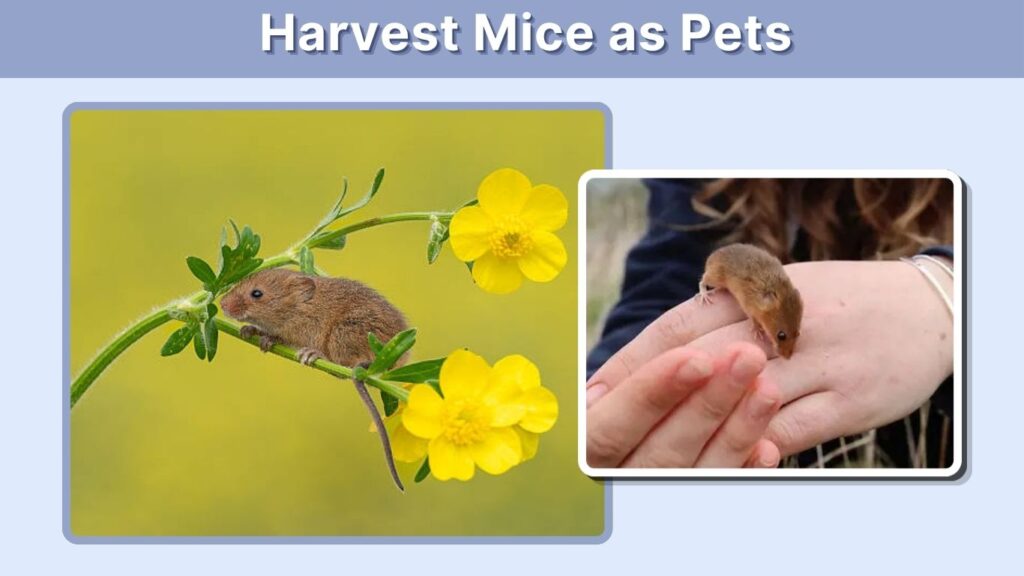
Their small size and attractive appearance may make harvest mice seem like suitable pets. However, wild individuals have specialized needs and should not be captured.
Can You Keep a Harvest Mouse as a Pet?
Legality varies by country and species. Some harvest mice are protected, while the sale or possession of native wildlife may require permits. Wild-caught animals are easily stressed and may carry parasites.
Where ownership is legal, only responsibly captive-bred mice should be considered. They require a tall, escape-proof enclosure containing dense climbing vegetation, nesting material, hiding places, a varied diet and carefully controlled temperature.
Harvest Mouse vs House Mouse
| Feature | Eurasian harvest mouse | House mouse |
| Typical weight | 4–11 grams | 12–30 grams |
| Upper color | Golden or reddish brown | Grayish brown |
| Underside | Clearly white or cream | Gray or buff |
| Tail | Prehensile and used for climbing | Non-prehensile |
| Main habitat | Tall grass, reeds and crops | Buildings and areas near people |
| Nest | Woven above ground in vegetation | Hidden in cavities or structures |
Harvest mice rarely become persistent household pests. A mouse repeatedly seen in a kitchen, pantry, ceiling or wall is more likely to be a house mouse.
Conservation Status
The Eurasian harvest mouse has a broad global range, but local populations can decline when grasslands, reedbeds and hedgerows disappear. Intensive mowing, wetland drainage, pesticide use and the removal of field margins reduce food and nesting cover.
The salt marsh harvest mouse faces greater danger. It remains federally endangered and is restricted largely to tidal wetlands around San Francisco Bay. Habitat loss, fragmentation, pollution and sea-level rise are major threats, according to the U.S. Fish and Wildlife Service.
FAQs
What is the scientific name of the harvest mouse?
The Eurasian harvest mouse has the scientific name Micromys minutus. American harvest mice belong primarily to the genus Reithrodontomys. Therefore, the correct scientific name depends on the species and geographic region being discussed.
How big is a harvest mouse?
An adult Eurasian harvest mouse has a body approximately 5.5–7.5 centimeters long and commonly weighs 4–11 grams. Its tail is roughly as long as its body. Western and other American harvest mice are generally somewhat larger.
What do harvest mice eat?
Harvest mice eat seeds, grains, berries, tender shoots and small fruits. They supplement these foods with insects such as caterpillars, beetles and grasshoppers. The proportions change seasonally as seeds, green vegetation and invertebrates become available.
Where do harvest mice build their nests?
Eurasian harvest mice weave spherical breeding nests between upright grass, reed or cereal stems. These nests are usually positioned above ground and are about the size of a tennis ball. Winter shelters may be constructed closer to the ground.
Are salt marsh harvest mice endangered?
Yes. The salt marsh harvest mouse is federally endangered in the United States. It occupies a restricted area of saline and brackish wetlands around San Francisco Bay, where habitat loss, fragmentation, flooding and rising sea levels threaten its survival.