
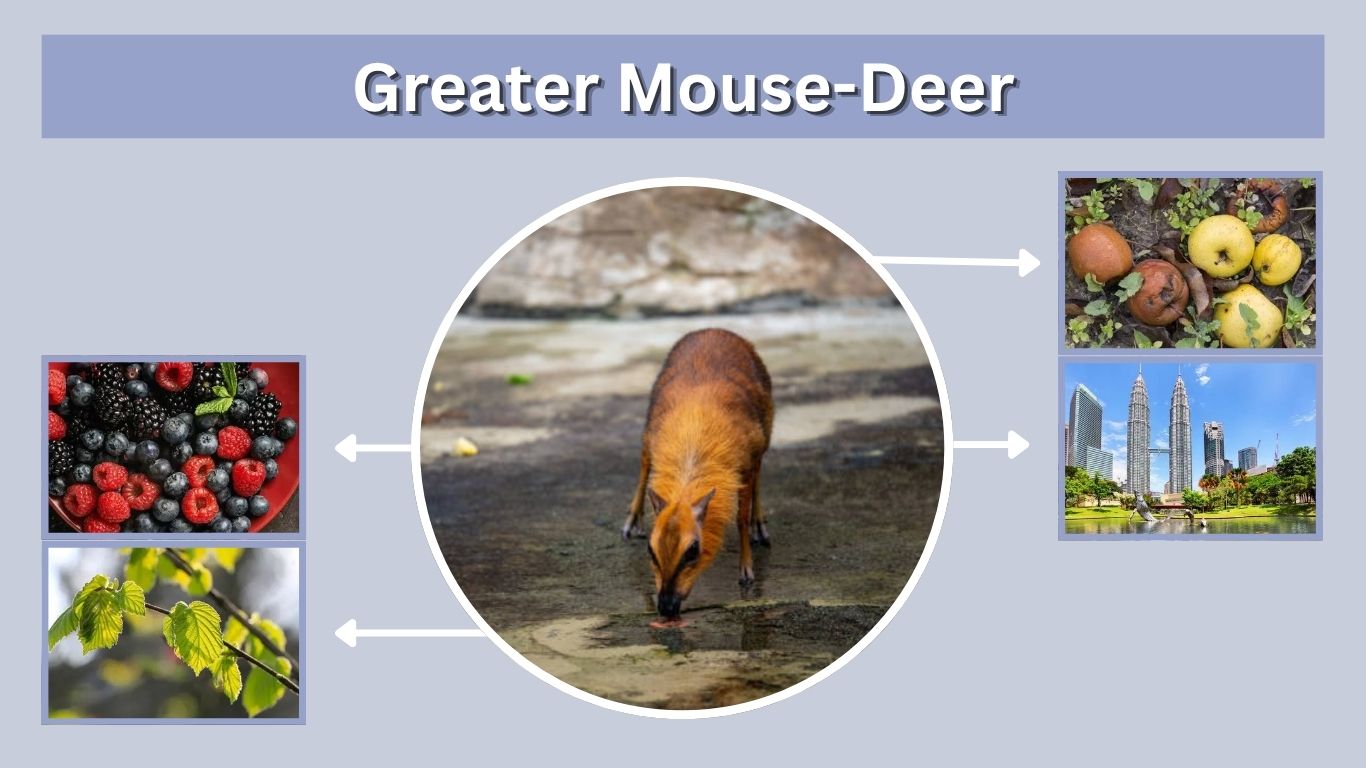
The greater mouse-deer is a small, secretive hoofed mammal native to Southeast Asia. Also called the greater Malay mouse-deer, greater Indo-Malayan chevrotain or napu, it has a rounded reddish-brown body, thin legs, large eyes and distinctive white throat markings. Despite its name, it is neither a mouse nor a true deer. It belongs to Tragulidae, an ancient family of small ruminants known as chevrotains.
What Is a Greater Mouse-Deer?
The scientific name of the greater mouse-deer is Tragulus napu. It belongs to the order Artiodactyla and family Tragulidae. It is one of the largest members of the genus Tragulus, although it remains one of the world’s smallest hoofed mammals.
| Feature | Description |
| Scientific name | Tragulus napu |
| Family | Tragulidae |
| Body length | About 50–75 cm |
| Shoulder height | Around 30–35 cm |
| Weight | Approximately 3.5–8 kg |
| Diet | Fruits, leaves, shoots and other vegetation |
| Activity | Mainly nocturnal |
| Global conservation status | Least Concern |
Published measurements vary among populations and sources. Malaysian biodiversity information gives a head-and-body length of about 50–60 centimetres and a weight of 3.5–4.5 kilograms, while the Smithsonian reports animals reaching approximately 75 centimetres in body length.
Greater Mouse-Deer Identification
The greater mouse-deer has a compact, rounded body with a small triangular head. Its upper coat is usually orange-brown, rufous or mottled brown, while the belly, chest and parts of the throat are white.
Key Identification Features
- Rounded, rabbit-sized body
- Long, extremely thin legs
- Hindquarters positioned higher than the shoulders
- Large dark eyes
- Small pointed black nose
- Rufous or orange-brown coat
- White belly and throat markings
- No horns or antlers
- Long upper canine teeth in males
Greater mouse-deer usually have more extensive white throat markings than lesser mouse-deer. Malaysian identification information describes five throat stripes in the greater species, compared with three in the lesser mouse-deer.
Does a Greater Mouse-Deer Have Fangs?
Male greater mouse-deer possess elongated upper canine teeth that may project below the lips like small fangs. They do not use these teeth to hunt because the species primarily eats plants.
The canines are mainly used during disputes between males. When a confrontation becomes physical, males may deliver short bites with these sharp teeth. Females have smaller canines.
Where Do Greater Mouse-Deer Live?
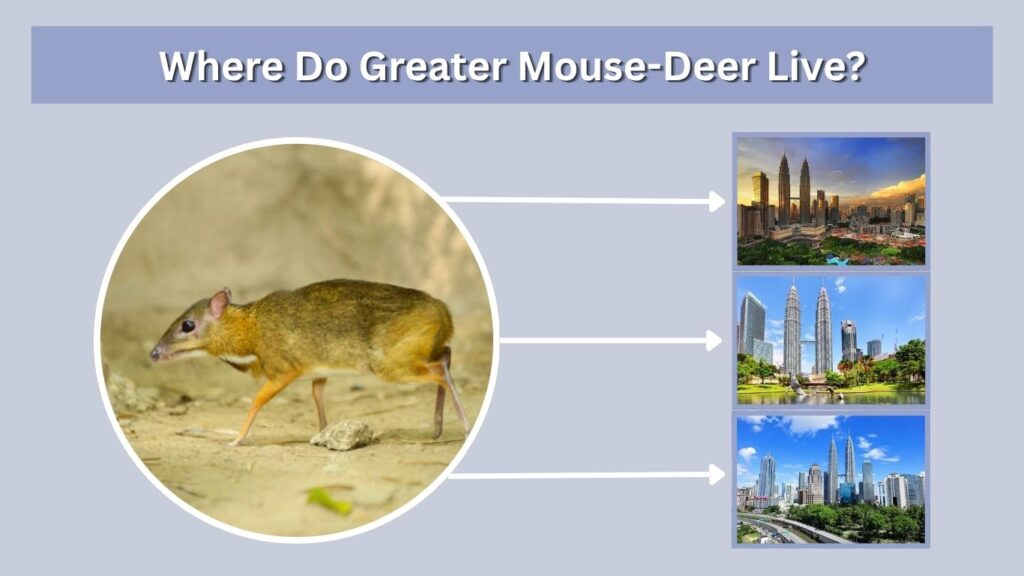
Greater mouse-deer occur across parts of Southeast Asia, including southern Myanmar, Thailand, Cambodia, Laos, Vietnam, Peninsular Malaysia, Brunei, Singapore, Sumatra, Borneo and several nearby islands. Their modern range does not include the Americas, Europe or Africa.
Habitat and Biome
Their principal biome is tropical or subtropical moist forest. They inhabit primary forest, secondary woodland and some logged forest, generally preferring dense undergrowth that provides cover.
Greater mouse-deer are often associated with areas close to water. They may occur from lowland forest to elevations of approximately 1,000 metres and occasionally enter gardens near forest habitat to eat fallen fruit and fresh vegetation.
Greater Mouse-Deer in Singapore
The greater mouse-deer is native to Singapore but has a very restricted local distribution. Singapore’s official mammal list classifies it as Critically Endangered nationally, even though the species is considered less threatened across its much larger global range.
It is known particularly from Pulau Ubin, where surveys have shown that it is more common than previously believed. Its nocturnal behavior and preference for dense vegetation make it difficult to observe directly.
What Do Greater Mouse-Deer Eat?
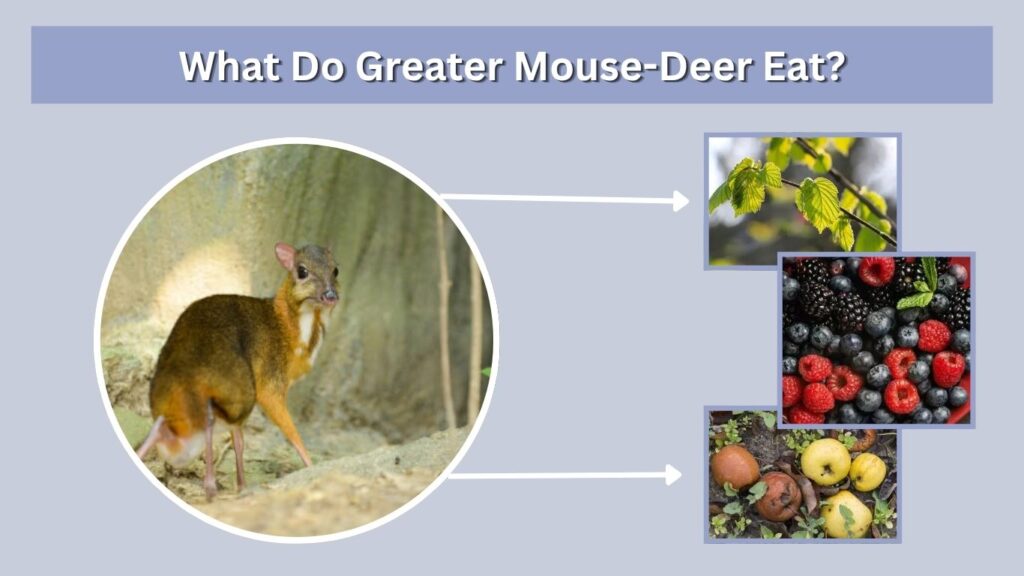
The greater mouse-deer is mainly herbivorous. It searches the forest floor and low vegetation for plant foods.
Common Foods
- Fallen fruits
- Berries
- Young leaves
- Plant shoots and buds
- Shrubs
- Grasses
- Aquatic vegetation
Fallen fruit is particularly important because it provides concentrated energy without requiring the animal to climb. Greater mouse-deer may also browse on soft understorey leaves and other easily digested plant matter.
Greater Mouse-Deer Behavior
Greater mouse-deer are primarily nocturnal and usually feed alone. They remain concealed during daylight and become active after dark, moving along narrow paths through thick forest vegetation.
Both males and females can be territorial. They communicate using scent from urine, droppings and glands located beneath the jaw. Except during courtship and breeding, adults are generally solitary.
How Fast Can a Greater Mouse-Deer Run?
A dependable maximum running speed has not been scientifically established. Claims assigning a precise speed should therefore be treated cautiously.
Its slender legs and higher hindquarters allow quick bursts of movement through forest undergrowth. However, its survival depends as much on remaining hidden and escaping into dense vegetation as on sustained speed.
Greater Mouse-Deer Defense Mechanisms
Greater mouse-deers are shy rather than aggressive. Their first defense is usually avoiding detection through nocturnal activity, brown camouflage and motionless hiding among leaves and undergrowth.
Main Defenses
When discovered, a greater mouse-deer can run into thick cover using its narrow body and slender legs. It is also a capable swimmer, which may help it cross waterways or escape threats in wet forest habitats.
A challenged mouse-deer may rapidly beat or stamp the ground with its hooves. Males can defend themselves with their projecting canine teeth, although these teeth are most commonly associated with competition between males.
Are Greater Mouse-Deer Dangerous?
Greater mouse-deer are not poisonous and do not normally pose a danger to humans. They are small, secretive plant-eaters that usually attempt to escape when approached.
A frightened or restrained male could potentially inflict an injury with its sharp canine teeth. Wild individuals should therefore not be chased, cornered or handled.
Reproduction and Lifespan
Greater mouse-deer can reproduce throughout the year. Pregnancy lasts approximately five months, and females usually deliver one calf, although twins occasionally occur.
Newborn calves are unusually well developed. They may stand and move within about 30 minutes of birth, are weaned at two to three months and can reach sexual maturity at around four and a half months.
The maximum recorded lifespan in managed care is approximately 16 years. Wild individuals may live for less time because of predators, hunting, disease and environmental pressures.
Greater Mouse-Deer Predators and Threats
Likely natural predators include large snakes, wild cats and other Southeast Asian carnivores capable of catching a small hoofed mammal. Dense vegetation, nocturnal activity and rapid escape help reduce this risk.
The species is globally classified as Least Concern, but habitat loss, forest degradation, hunting and capture for the pet trade remain significant threats. Some regional populations are more vulnerable than the global assessment suggests; Malaysia, for example, has assessed the species as Near Threatened nationally.
Greater Mouse-Deer vs Paca
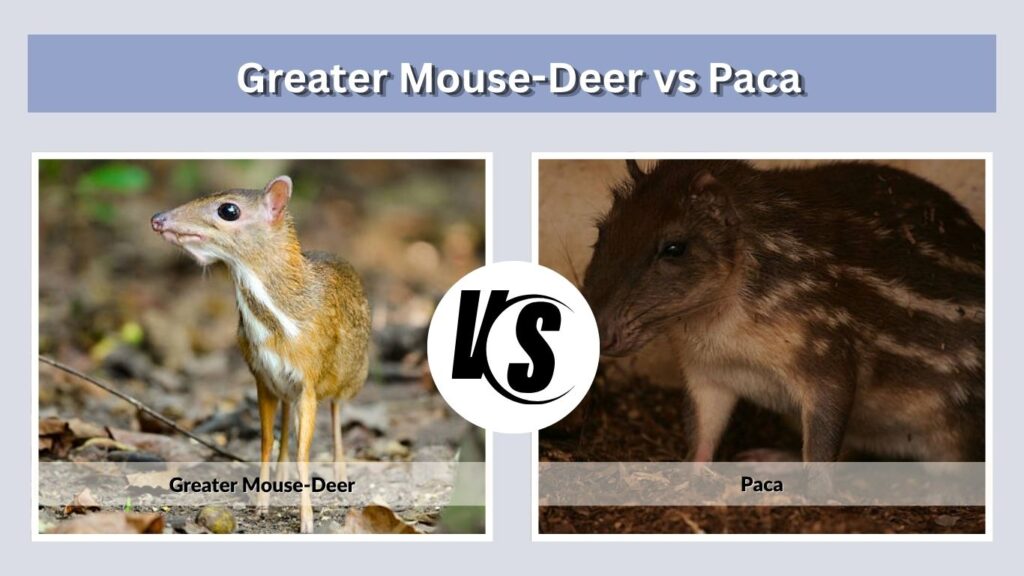
The greater mouse-deer and paca may appear similar because both have rounded bodies, short tails and slender legs. However, they are unrelated animals from different parts of the world.
| Feature | Greater mouse-deer | Lowland paca |
| Animal group | Hoofed ruminant | Rodent |
| Native range | Southeast Asia | Central and South America |
| Typical weight | About 3.5–8 kg | About 6–12 kg |
| Feet | Small hooves | Toes with claws |
| Coat | Brown with white throat markings | Brown with rows of white side spots |
| Main defense | Hiding and quick escape | Hiding, swimming and physical strength |
A paca is generally heavier and more powerfully built. However, asking which would “win” is not biologically meaningful because the two species do not naturally meet, and neither should be forced into an encounter.
FAQs
Is a greater mouse-deer a deer?
It is a hoofed ruminant but not a member of the true deer family Cervidae. It belongs to Tragulidae, a separate family commonly known as mouse-deer or chevrotains.
Why is it called the greater mouse-deer?
“Greater” distinguishes it from smaller Tragulus species such as the lesser mouse-deer. The word “mouse” refers to its small body and pointed face, not to a relationship with rodents.
Can a greater mouse-deer swim?
Yes. The species is known to swim and commonly inhabits forests near water. Swimming may help it move through wet habitats and escape certain threats.
Can you keep a greater mouse-deer as a pet?
It is not an appropriate household pet. It is a shy wild ungulate requiring specialized habitat, diet and veterinary care. Capture and trade may also be controlled by wildlife laws.
Does a greater mouse-deer have antlers?
No. Neither sex grows antlers or horns. Adult males instead possess elongated upper canine teeth used mainly during competition with other males.