
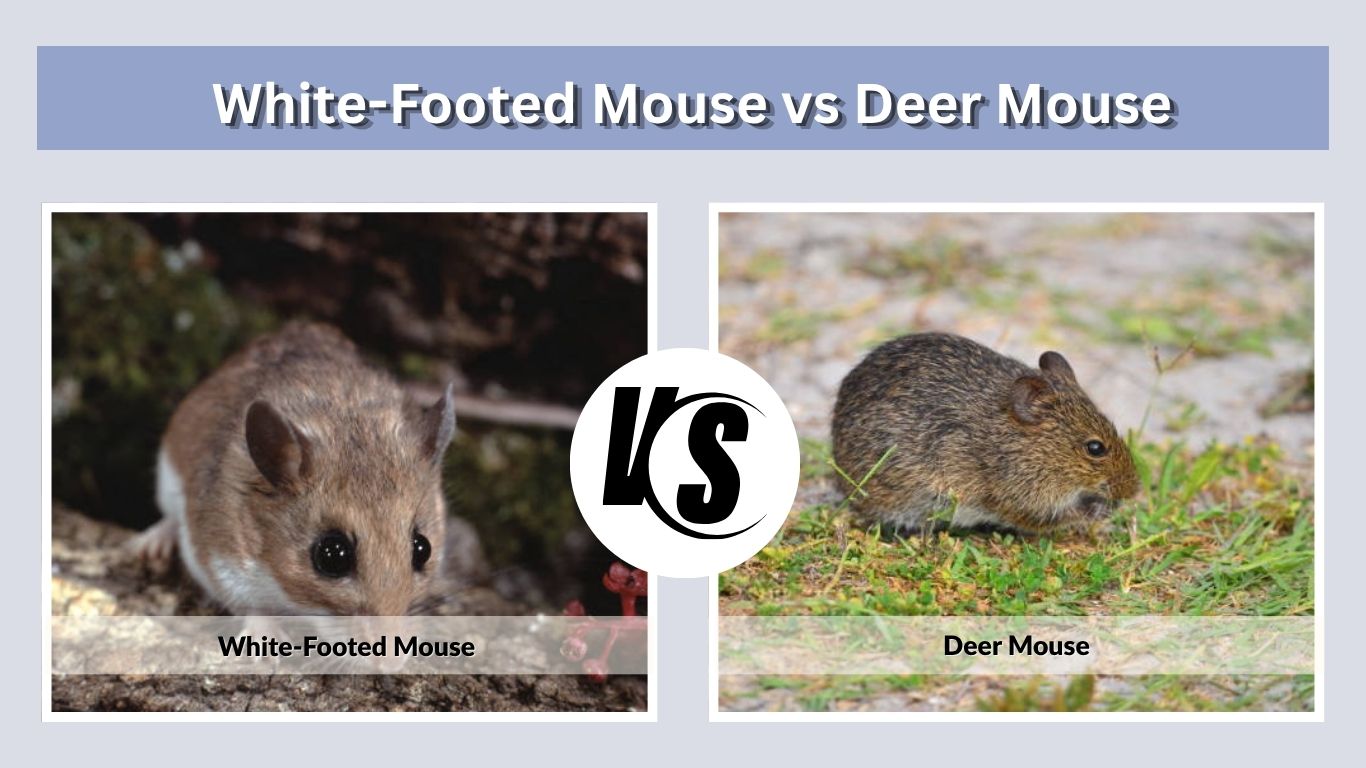
The white-footed mouse and deer mouse are two closely related North American rodents that are often confused. Both have brown upper fur, white feet, pale bellies, large eyes and rounded ears. The easiest visible difference is usually the tail: a deer mouse generally has a sharply divided dark upper side and white underside, while a white-footed mouse has a less distinct color division. However, their appearance varies by region, so photographs alone may not always provide a certain identification.
White-Footed Mouse vs Deer Mouse Comparison
The white-footed mouse is Peromyscus leucopus, while the deer mouse is Peromyscus maniculatus. Both belong to the genus Peromyscus, but they are separate species. The phrase “white-footed deer mouse” is sometimes used informally, although it can create confusion between them.
| Feature | White-footed mouse | Deer mouse |
| Scientific name | Peromyscus leucopus | Peromyscus maniculatus |
| Upper fur | Reddish-brown, grayish or buff | Grayish, brown or reddish-brown |
| Belly and feet | White | White |
| Tail | Usually less distinctly bicolored | Usually sharply dark above and pale below |
| Tail proportions | Often shorter relative to the body | Frequently longer, especially in woodland populations |
| Main habitat | Deciduous and mixed woodland | Forests, fields, grasslands and other habitats |
| North American range | Mainly eastern and central areas | Much broader northern and western range |
| Important disease link | Lyme disease ecology and New York hantavirus | Primary reservoir of Sin Nombre hantavirus |
Identification Differences
Both mice have a pointed muzzle, prominent whiskers, large black eyes and relatively large ears. Their pale bellies contrast strongly with the darker fur on their backs.
White-Footed Mouse Identification
- Reddish-brown, buff or gray-brown upper fur
- Clearly white belly and feet
- Large black eyes
- Rounded, prominent ears
- Tail usually shorter than the combined head-and-body length
- Tail colors blend together more gradually
- Excellent climbing ability
Adult white-footed mice generally measure about 150–205 millimetres in total length and weigh approximately 15–25 grams. Their appearance varies geographically, and they can be extremely difficult to separate from deer mice in areas where both species occur.
Deer Mouse Identification
- Gray, tawny or reddish-brown back
- White belly and feet
- Large ears and dark eyes
- Slender body with strong hind legs
- Sharply bicolored tail
- Dark fur on top of the tail and pale fur below
- Woodland forms may have especially long tails
Deer mice measure approximately 119–222 millimetres in total length and usually weigh 10–24 grams. Size varies considerably because numerous populations occupy different environments across North America.
Does a Deer Mouse Have a White-Tipped Tail?
A deer mouse does not necessarily have a clearly white tail tip. Its more useful feature is the sharp division between the dark upper surface and pale or white underside of the tail.
A white tip may occur in some individuals, but it should not be used alone for identification. Tail length, color separation, geographic location and other body features should be considered together.
White-Footed Mouse vs Deer Mouse Habitat and Range
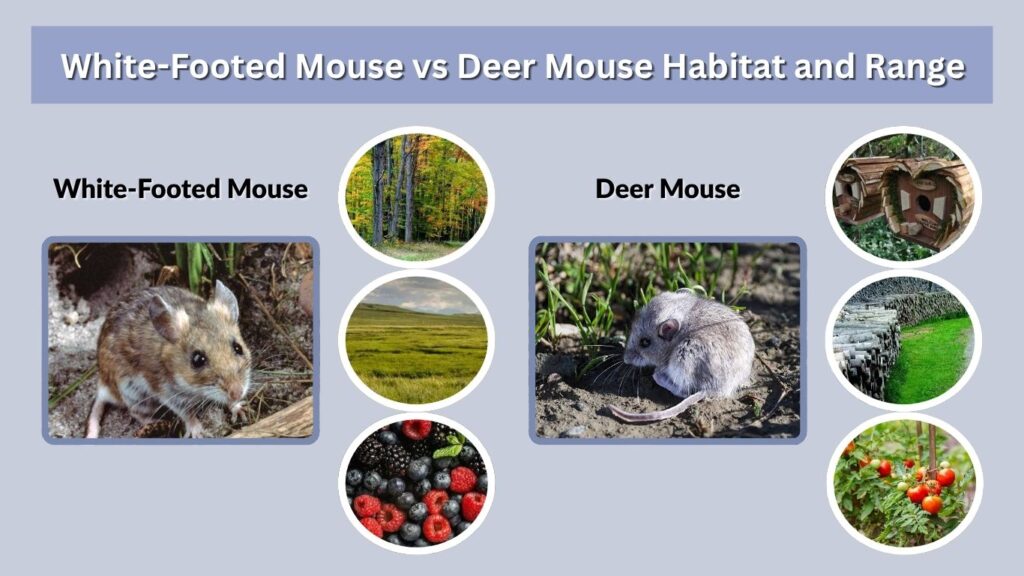
White-footed mice are strongly associated with deciduous and mixed forests. They also inhabit woodland edges, brushy land, farms, gardens and suburban properties. They are skilled climbers and may nest in tree cavities, bird boxes, wood piles and buildings.
Deer mice have a broader North American distribution, extending from northern Canada and Alaska through much of the United States and into Mexico. Depending on the population, they may occupy forests, grasslands, farmland, deserts, mountains and brushy habitats.
Neither species is native to the United Kingdom. A small mouse found in the UK is more likely to be a native species such as the wood mouse or yellow-necked mouse rather than a North American Peromyscus.
Diet
White-footed mice mainly eat seeds, nuts, berries and fungi. They may also consume insects and other small invertebrates when available. Food is often collected and stored inside nests or protected hiding places.
Deer mice have a similarly flexible diet consisting of seeds, grains, fruits, fungi and invertebrates. Their ability to use many foods allows them to survive in habitats ranging from forests to agricultural land.
Both species can be attracted to birdseed, pet food, stored grain and crumbs around human buildings.
White-Footed and Deer Mice in Houses
Both mice may enter houses, cabins, garages, sheds and barns while searching for warmth, nesting materials or food. White-footed mice are particularly adaptable around human environments, while woodland deer mice commonly enter seasonal cabins and outbuildings.
Signs may include:
- Small dark droppings
- Gnawed food packages
- Shredded nesting material
- Scratching sounds at night
- Food stored in hidden spaces
- Urine stains or odors
Droppings cannot reliably distinguish a deer mouse from a white-footed mouse. Treat waste from any unidentified wild mouse carefully.
Disease Risks
Deer Mouse and Hantavirus
The deer mouse is the principal reservoir of Sin Nombre virus, the most common cause of hantavirus pulmonary syndrome in the United States. Exposure can occur when contaminated urine, droppings or nesting material is disturbed and virus-containing particles enter the air.
White-Footed Mouse and Hantavirus
White-footed mice can carry New York virus, another hantavirus associated with human illness, particularly in the northeastern United States. However, most reported American hantavirus pulmonary syndrome cases are associated with viruses carried by deer mice.
White-Footed Mice and Lyme Disease
White-footed mice are important reservoir hosts for the bacteria that cause Lyme disease. Larval blacklegged ticks may feed on infected mice, acquire the bacteria and later transmit them to people after developing into nymphs. The mouse does not transmit Lyme disease directly through ordinary contact with humans.
How to Clean Mouse Droppings Safely

Do not sweep or vacuum dry rodent droppings, urine or nesting material. This can release contaminated particles into the air.
Wear rubber or plastic gloves, soak the waste thoroughly with an appropriate disinfectant and leave it wet for the time stated on the label. Wipe it up with paper towels, place the waste in a covered garbage container and disinfect the surrounding surface. Wash gloved hands before removing the gloves, and then wash bare hands with soap and warm water.
FAQs
Which is bigger, a white-footed mouse or a deer mouse?
Their sizes overlap significantly. White-footed mice may appear slightly more robust, but certain woodland deer mice have longer bodies, tails and feet. Size alone is not a dependable identification method.
What is the easiest way to tell them apart?
Look closely at the tail. Deer mice usually have a sharply bicolored tail, with a dark upper side and white underside. White-footed mice normally have a less sharply divided tail.
Are white-footed mice and deer mice dangerous?
They are not normally aggressive toward humans. The primary concern is exposure to urine, droppings, saliva and nesting materials, which may contain disease-causing organisms.
Can both species live inside a house?
Yes. Both may enter houses, cabins, garages and sheds. They usually seek shelter, stored food and protected nesting locations, especially as outdoor conditions become colder.
Is a white-footed mouse the same as a house mouse?
No. The white-footed mouse is a native North American Peromyscus species. The house mouse, Mus musculus, is a separate species that generally has a more uniformly colored body and tail.