
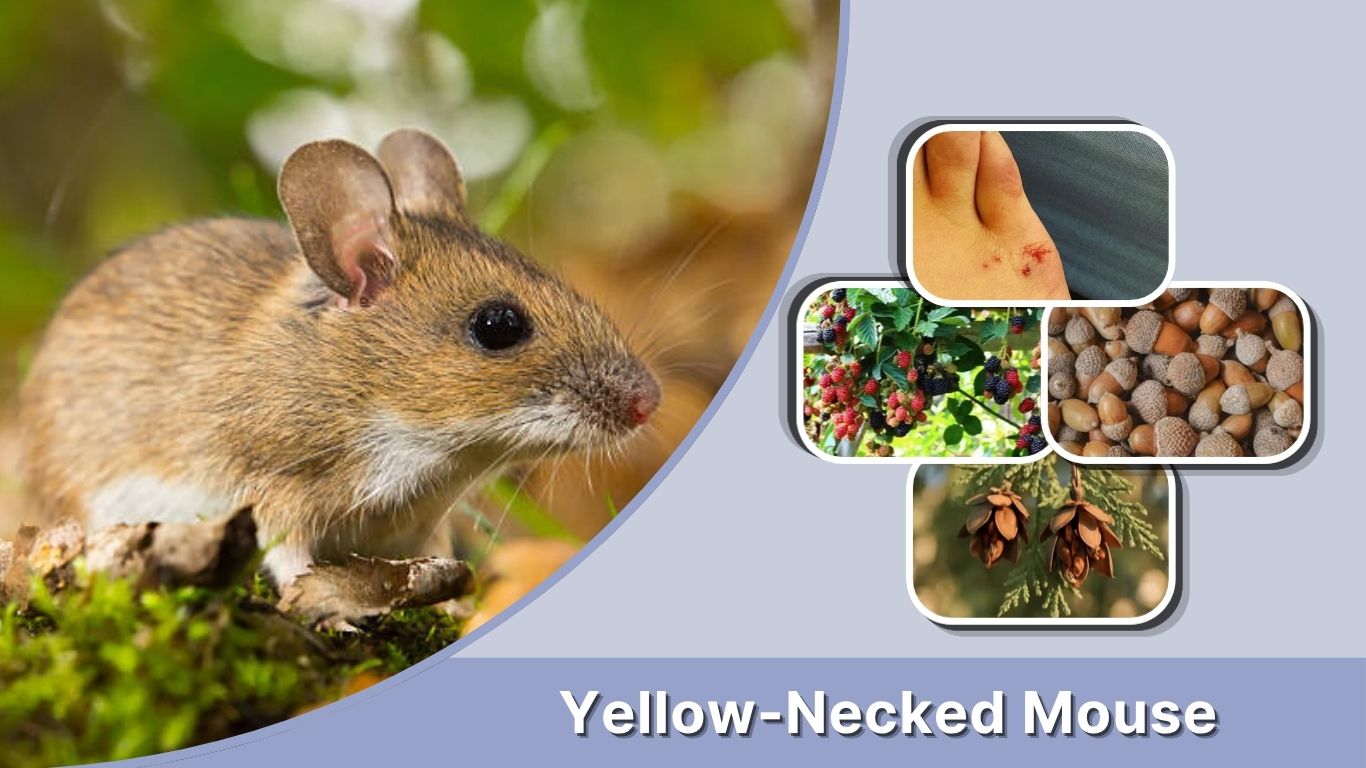
The yellow-necked mouse is an agile woodland rodent recognised by the yellow-brown band crossing its chest. It looks remarkably similar to the wood mouse but is generally larger, with more prominent ears, eyes and hind legs. Although widespread across much of Europe, its British distribution is mainly limited to southern England, parts of the Midlands and Wales. This nocturnal mouse feeds on seeds, fruits and invertebrates and occasionally enters buildings during colder weather.
What Is a Yellow-Necked Mouse?
The yellow-necked mouse, scientifically named Apodemus flavicollis, belongs to the mouse family Muridae. It is also called the yellow-necked field mouse or yellow-necked wood mouse, although “yellow-necked mouse” is the standard common name.
| Feature | Description |
| Scientific name | Apodemus flavicollis |
| Family | Muridae |
| Order | Rodentia |
| Body length | About 9.5–12 cm |
| Tail length | About 7.7–11.8 cm |
| Weight | Approximately 14–45 g |
| Diet | Seeds, nuts, fruits, plants and invertebrates |
| Conservation status | Least Concern |
Its classification is Animalia, Chordata, Mammalia, Rodentia, Muridae, Apodemus and A. flavicollis. The species is currently assessed as Least Concern in Britain, Europe and globally.
Yellow-Necked Mouse Identification
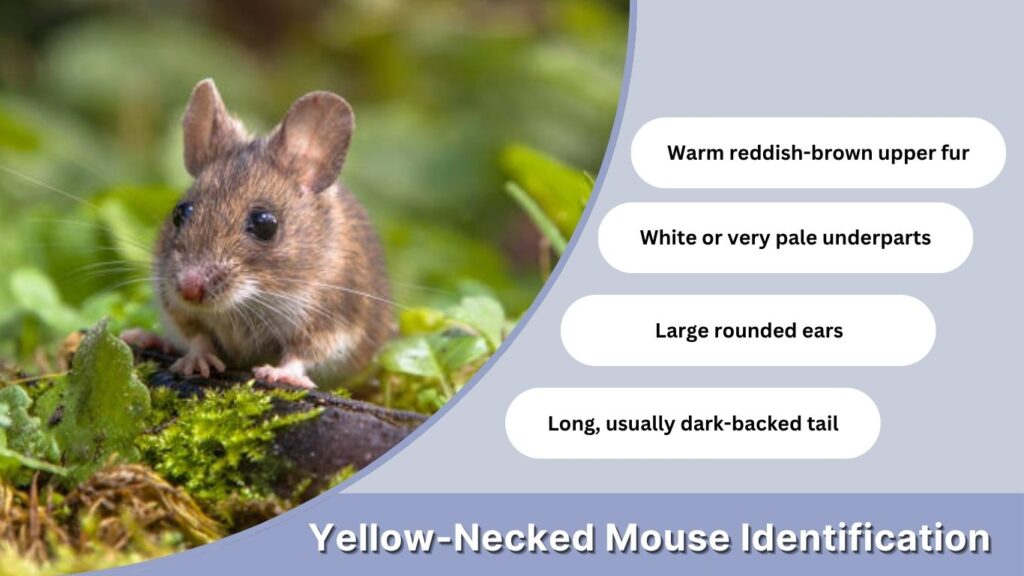
The yellow-necked mouse has reddish-brown or warm brown fur across its back. Its underside is usually sharply contrasting white, and a yellow or orange-brown band extends across the lower neck or chest.
Key Identification Features
- Warm reddish-brown upper fur
- White or very pale underparts
- Complete yellow-brown band across the chest
- Large, prominent dark eyes
- Large rounded ears
- Long, usually dark-backed tail
- Strong hind legs adapted for jumping
- Larger body than the typical wood mouse
The chest band is the most reliable visible feature. Size and colour can vary, so distinguishing this species from a wood mouse may require a clear view of the underside.
Size and Appearance
Adults generally measure around 9.5–12 cm from the nose to the base of the tail. The tail can be almost as long as the body and helps the mouse balance while running and climbing.
Its large eyes and ears are adaptations for detecting predators during nocturnal activity. Powerful hind legs also allow it to make impressive leaps when escaping danger.
Yellow-Necked Mouse vs. Wood Mouse
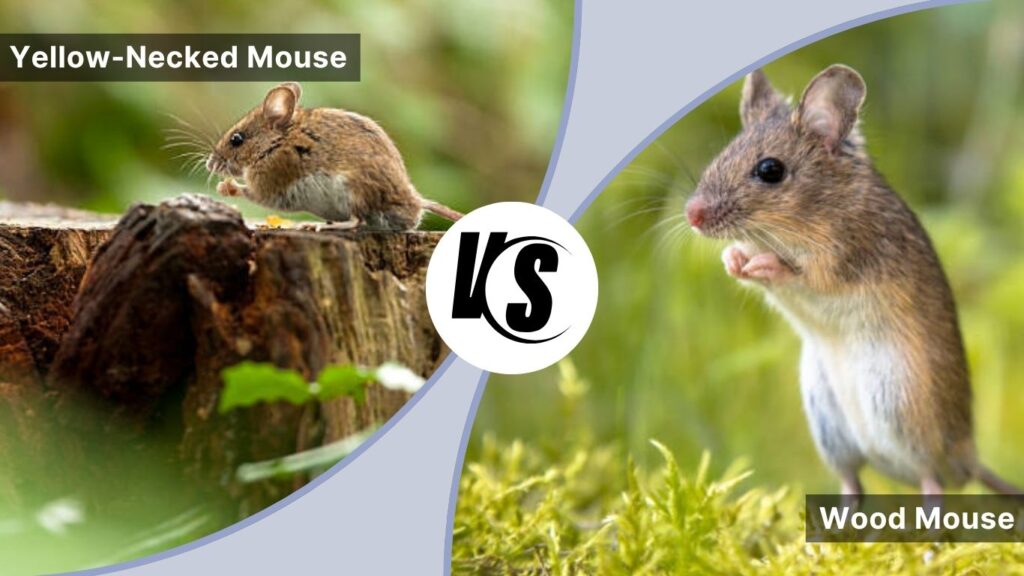
The yellow-necked mouse and wood mouse belong to the same genus and may live in the same habitats. Identifying them from a distant photograph can therefore be difficult.
| Feature | Yellow-necked mouse | Wood mouse |
| Scientific name | Apodemus flavicollis | Apodemus sylvaticus |
| General size | Slightly larger | Slightly smaller |
| Chest marking | Unbroken yellow band joining the forelegs | Small yellow streak or patch |
| Eyes and ears | Usually more prominent | Proportionately smaller |
| British range | Mainly southern Britain | Widespread across Britain |
| Preferred habitat | Strongly associated with mature woodland | Woodland, farmland, gardens and grassland |
A wood mouse may have a yellow-orange chest mark, but it normally forms a vertical streak rather than a complete band. The Mammal Society advises against identifying the two species confidently without seeing this chest pattern clearly.
Habitat and Nesting Behaviour
Yellow-necked mice are strongly associated with deciduous, mixed, mature and ancient woodlands. They may also occur in hedgerows, gardens, agricultural mosaics and urban areas where suitable woodland remains nearby.
Where Do They Build Nests?
They construct extensive underground burrows among tree roots, fallen timber and dense vegetation. A burrow may have several entrances and contain chambers lined with grass, leaves and other plant material.
Nests may also be placed above ground in tree holes, nest boxes or buildings. Food can be stored inside underground tunnels for periods when natural supplies are limited.
Do Yellow-Necked Mice Enter Houses?
They occasionally enter houses, sheds and other buildings, particularly during winter. A mouse inside a building may be seeking warmth, shelter or stored food rather than permanently abandoning its woodland habitat.
Entry points should be sealed, and food should be kept in rodent-proof containers. Wild mice should not be handled directly because they may bite when frightened and can contaminate surfaces with urine or droppings.
Yellow-Necked Mouse Distribution
The species has a broad range covering much of mainland Europe and extending into parts of western Asia. Recorded countries include France, Germany, Italy, Poland, Scandinavia, the Balkans, Turkey and areas farther east.
Distribution in the UK
In Britain, yellow-necked mice have a more restricted range. They occur mainly from Dorset eastward toward Kent and Suffolk, as well as through the Severn basin from Gloucestershire toward Staffordshire. Populations are also found in southern and central Wales.
Their British distribution is closely linked to long-established woodland. Habitat loss and fragmentation can therefore isolate populations, even though the species is not currently considered threatened.
What Do Yellow-Necked Mice Eat?
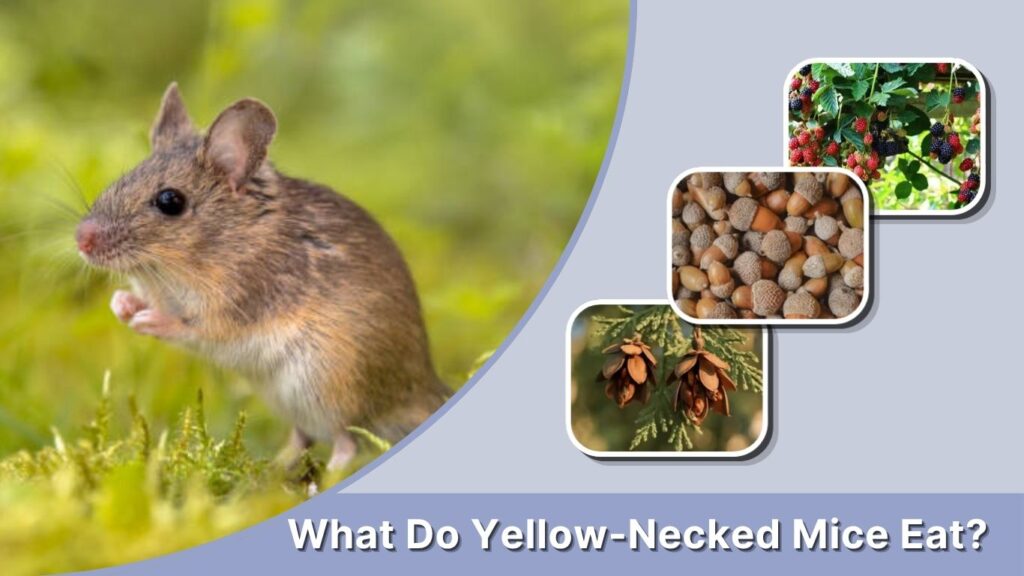
Yellow-necked mice are omnivores with a seasonal diet.
Common Foods
- Tree seeds
- Acorns and other nuts
- Berries and fruits
- Bulbs and green plant material
- Insects
- Spiders and other invertebrates
Tree seeds are especially important, and the mice may select energy-rich seeds when several foods are available. They forage both on the woodland floor and in trees, sometimes carrying food back to underground stores.
Activity and Hibernation
Yellow-necked mice are mainly nocturnal. They spend the night climbing, jumping, searching for food and moving between ground-level cover and the woodland canopy.
They do not undergo true hibernation. Instead, they remain active throughout winter, relying on stored food and protected nesting sites. Their activity may decrease during severe weather, and some individuals move into buildings for shelter.
Reproduction and Life Cycle
Breeding generally takes place from February through October. Females can produce several litters, with approximately 2–11 young in each litter.
Newborn mice are naked, blind and dependent on their mother. Their eyes usually open after about two weeks, by which time the developing chest collar may begin to become visible. Few wild individuals survive longer than one year because they face predation, disease and harsh environmental conditions.
Predators and Ecological Importance
Owls, foxes and weasels are among the main predators of yellow-necked mice. Other predators can include domestic cats, snakes and larger woodland carnivores.
The mice help woodland ecosystems by moving and storing seeds. Forgotten food caches may germinate, contributing to plant dispersal. They are also an important food source for many woodland predators.
Do Yellow-Necked Mice Carry Viruses?
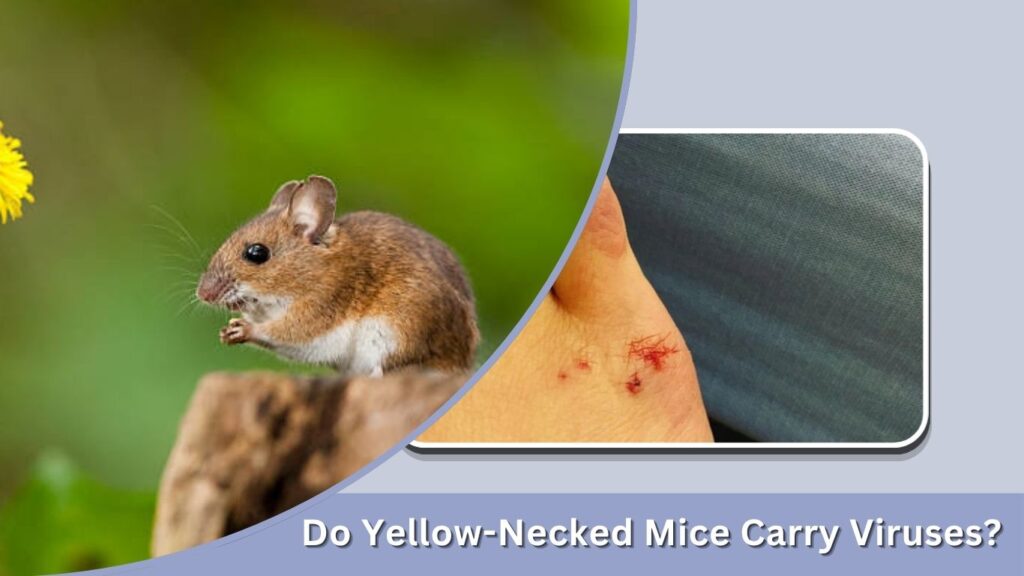
Yellow-necked mice can act as hosts for Dobrava hantavirus in parts of the Balkans and southeastern Europe. Human infection usually occurs through exposure to contaminated rodent urine, droppings or dust—not simply from seeing a mouse.
The UK Health Security Agency states that the public risk from hantavirus in the UK is very low and that the hantavirus identified locally is primarily associated with rats rather than yellow-necked mice. Avoid sweeping dry droppings, ventilate enclosed areas and use appropriate protection when cleaning significant rodent contamination.
FAQs
Is the yellow-necked mouse a field mouse?
It is sometimes called the yellow-necked field mouse, but its accepted common name is the yellow-necked mouse. “Field mouse” is also commonly applied to the wood mouse, which can create confusion between the two species.
Are yellow-necked mice found throughout the UK?
No. Their British range is concentrated mainly in southern England, parts of the Midlands and southern and central Wales. They are much less widely distributed than wood mice.
Do yellow-necked mice hibernate?
They do not truly hibernate. They remain active throughout the year but may reduce their movement during cold weather and depend more heavily on stored seeds and sheltered nests.
Can yellow-necked mice climb trees?
Yes. They are skilled climbers that use woodland floors, shrubs and tree canopies while searching for food. Their long tails and strong hind legs provide balance and support during climbing and jumping.
How long does a yellow-necked mouse live?
Most wild yellow-necked mice do not survive beyond one year, and average life expectancy may be only a few months. Predators, food shortages, weather and disease contribute to their short lifespan.