
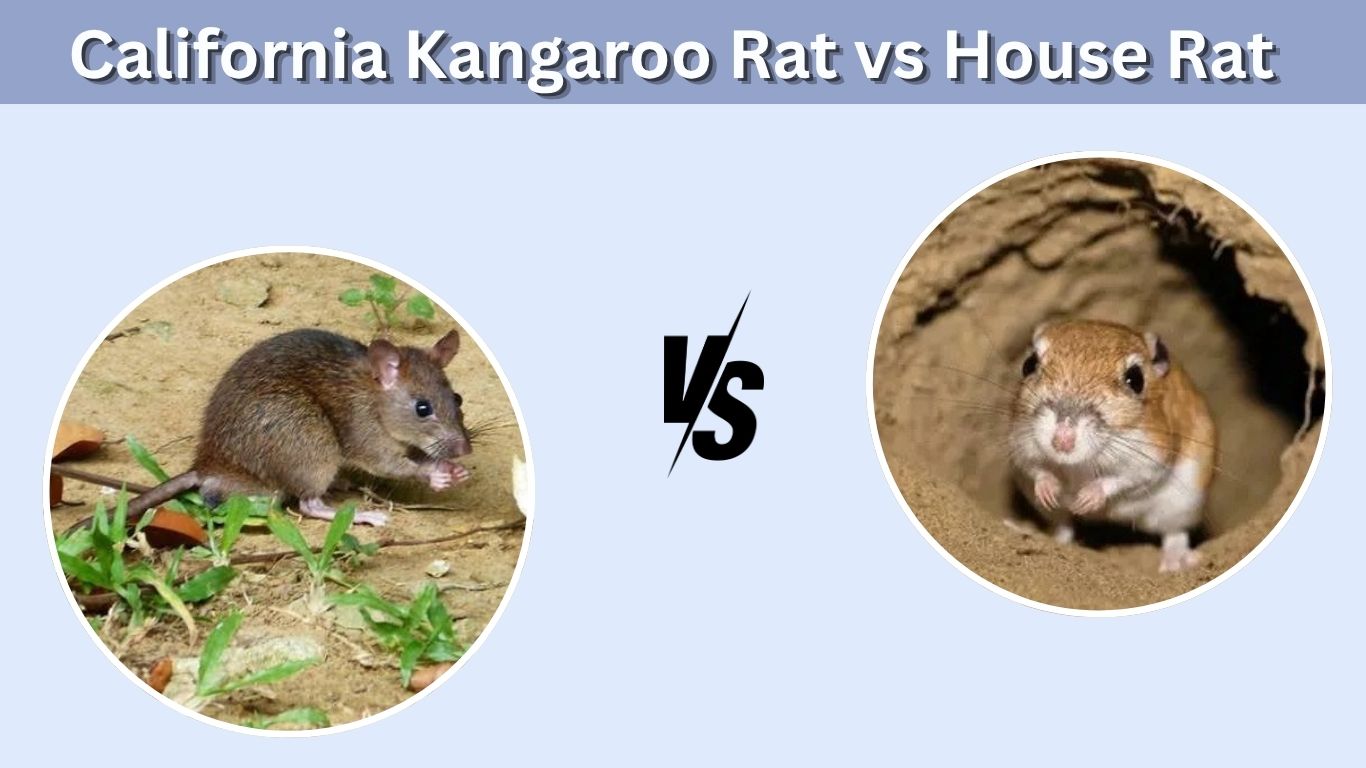
Jerboas and kangaroo rats look similar because both are small desert rodents with long hind legs, long tails, and a hopping style of movement. However, they are not the same animal. Jerboas live mainly in parts of Africa and Asia, while kangaroo rats live in North America. They also belong to different rodent families and have different body shapes, diets, and survival habits.
Jerboa vs Kangaroo Rat: Quick Comparison
Jerboas and kangaroo rats are often confused because both are adapted for dry habitats and fast jumping. The easiest way to separate them is by looking at their location, ears, tail, body shape, and cheek pouches.
| Feature | Jerboa | Kangaroo Rat |
| Family | Dipodidae | Heteromyidae |
| Range | North Africa and Asia | Western North America |
| Ears | Often very large | Smaller and rounded |
| Tail | Long, often tufted | Long, usually tufted |
| Cheek pouches | No external fur-lined pouches | Has fur-lined cheek pouches |
| Main diet | Seeds, plants, insects depending on species | Mostly seeds |
| Movement | Long bipedal leaps | Hopping and quick jumps |
Kangaroo rats are members of the family Heteromyidae, a group that includes kangaroo rats, kangaroo mice, and pocket mice. Many of these rodents live in deserts and dry grasslands of western North America and have strong hind legs, long tufted tails, and short front limbs.
What Is a Jerboa?
A jerboa is a small jumping rodent known for its long back legs, tiny front legs, large eyes, and often oversized ears. Jerboas are built for life in open, dry landscapes where fast movement helps them escape predators.
Identification
- Long hind legs and tiny front legs
- Very long tail, often with a dark or pale tuft
- Large eyes for nighttime activity
- Many species have very large ears
- Small, delicate body compared with many rats
- Moves by hopping or leaping on the back legs
Habitat and Range
Jerboas are mostly found in desert and semi-desert regions of North Africa, the Middle East, and parts of Asia. For example, the greater Egyptian jerboa occurs across North Africa and extends into parts of the Sinai and southern Israel.
Diet
Jerboa diets vary by species. Some eat seeds and desert plants, while others eat insects. The long-eared jerboa, for example, is described as insectivorous and may catch flying insects with quick leaps.
What Is a Kangaroo Rat?
A kangaroo rat is a small North American desert rodent in the genus Dipodomys. It gets its name from its powerful hind legs and hopping movement, which resemble a tiny kangaroo.
Identification
- Compact body with large back feet
- Long tail with a tufted tip
- Fur-lined cheek pouches for carrying seeds
- Short front legs
- Large eyes and rounded ears
- Usually sandy, tan, gray, or brown in color
Habitat and Range
Kangaroo rats live in arid and semi-arid areas of western North America. They are common in desert scrub, sandy soils, grasslands, washes, and creosote flats. The Arizona-Sonora Desert Museum notes that Merriam’s kangaroo rats inhabit several desert niches, including open desert scrub and sandy soils.
Diet
Kangaroo rats are mostly seed eaters. They collect seeds in their cheek pouches and carry them back to burrows or storage areas. Their seed-based diet and water-saving body adaptations help them survive in dry environments.
Main Differences Between Jerboa and Kangaroo Rat
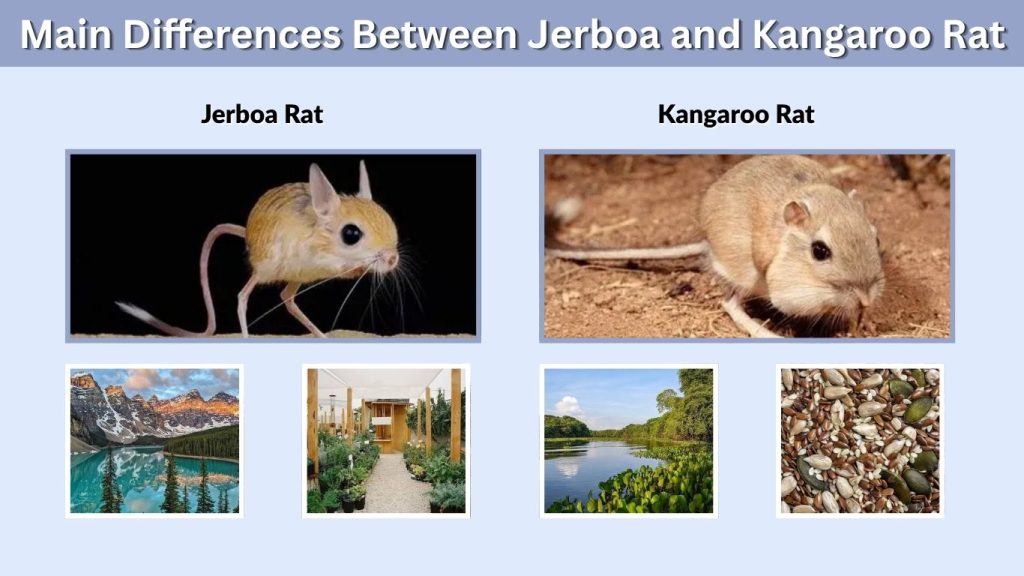
Although they look alike, jerboas and kangaroo rats evolved similar traits separately. This is called convergent evolution: unrelated animals develop similar features because they live in similar environments.
1. They Live on Different Continents
The biggest difference is location. Jerboas are Old World rodents found in Africa and Asia. Kangaroo rats are New World rodents found in North America. So, if you see a hopping desert rodent in the wild in the United States or Mexico, it is more likely a kangaroo rat or kangaroo mouse, not a jerboa.
2. Their Ears Are Different
Jerboas often have much larger ears, especially species like the long-eared jerboa. Kangaroo rats have noticeable ears too, but they are usually shorter and rounder. A jerboa can look more “rabbit-like,” while a kangaroo rat often looks more like a compact desert mouse.
3. Kangaroo Rats Have Cheek Pouches
One of the clearest kangaroo rat features is the presence of fur-lined cheek pouches. These pouches help them carry seeds without losing much moisture from the mouth. Jerboas do not have the same external fur-lined cheek pouch system.
4. Their Diets Can Be Different
Kangaroo rats are mainly granivores, meaning they mostly eat seeds. Jerboas may eat seeds, plant material, or insects depending on the species. This makes “jerboa vs kangaroo rat” not only a body-shape comparison but also a lifestyle comparison.
Kangaroo Mouse vs Kangaroo Rat
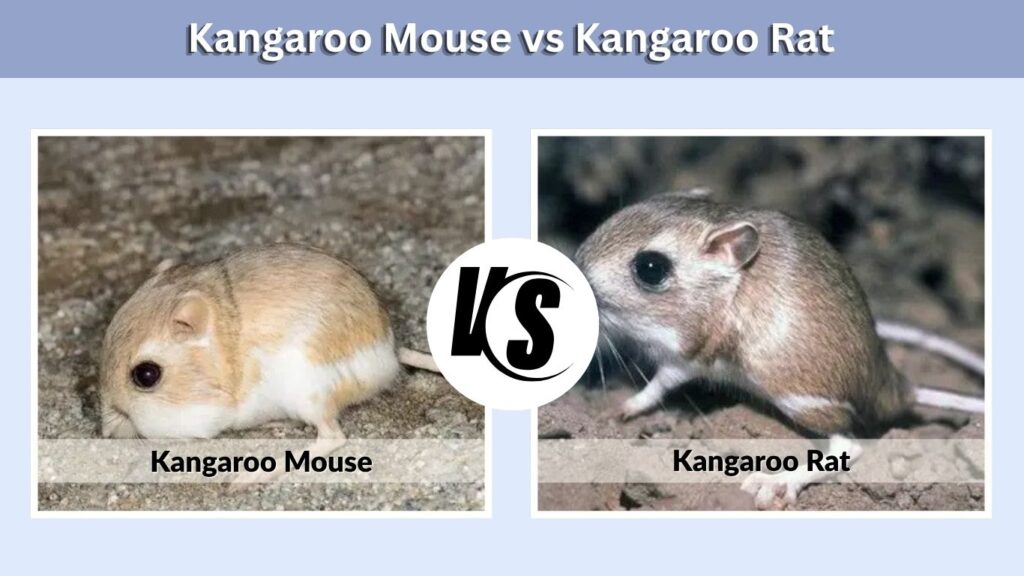
Kangaroo mice are close relatives of kangaroo rats, but they are smaller and belong to the genus Microdipodops. They also live in dry habitats and use hopping movements.
The pale kangaroo mouse lives in arid environments such as sand dunes, gravelly soil, and lowlands, often digging simple burrows near shrubs.
| Feature | Kangaroo Mouse | Kangaroo Rat |
| Size | Smaller | Larger |
| Genus | Microdipodops | Dipodomys |
| Habitat | Great Basin and desert areas | Wider western North American deserts |
| Body | Mouse-like | Rat-like but compact |
| Movement | Hopping | Stronger bipedal hopping |
Kangaroo Rat vs Gerbil
A gerbil and a kangaroo rat may look similar because both can live in dry places and have long tails. However, gerbils are Old World rodents, while kangaroo rats are North American heteromyid rodents.
Gerbils usually have a more typical mouse-like or rat-like body. Kangaroo rats have much stronger hind legs, larger back feet, and cheek pouches. Gerbils are also far more common in the pet trade, while kangaroo rats are wild animals and generally not suitable as pets.
Pack Rat vs Kangaroo Rat
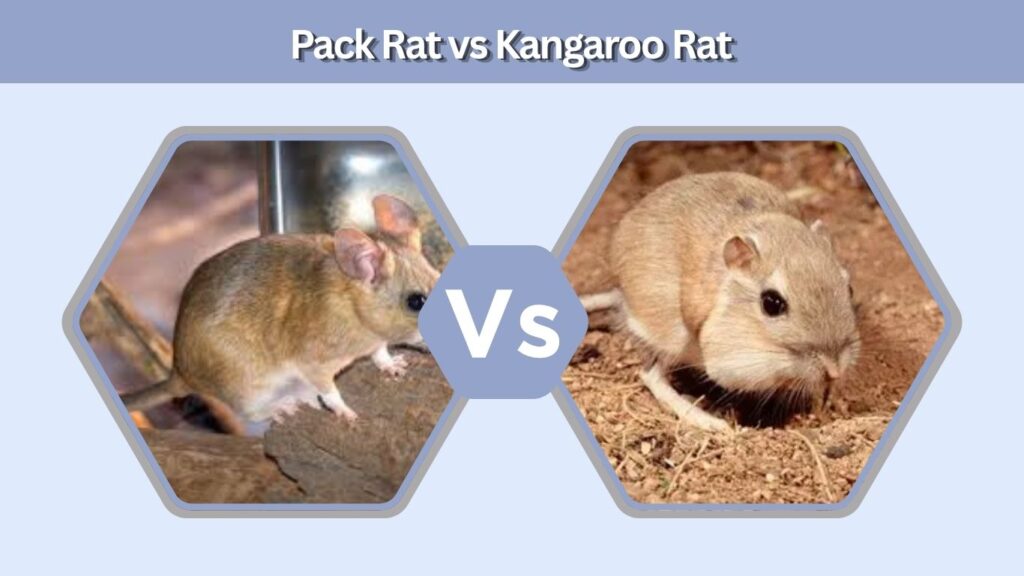
Pack rats, also called woodrats, belong to the genus Neotoma. They look more like ordinary rats, with larger bodies, long tails, big ears, and dark eyes. Kangaroo rats are smaller, more bipedal, and built for jumping.
Pack rats are famous for collecting objects and building nests or middens. Kangaroo rats are better known for seed storage, desert burrows, and fast jumping escapes.
Kangaroo Rat vs Snake
“Kangaroo rat vs snake” is a popular search because kangaroo rats are famous for escaping rattlesnake strikes. They use sharp hearing, fast reaction time, powerful jumps, and sometimes mid-air kicks to avoid predators.
High-speed research has shown kangaroo rats can leap away from rattlesnake attacks and may even kick a snake during escape.
FAQs
Are jerboas and kangaroo rats related?
They are both rodents, but they are not close relatives. Jerboas belong to the family Dipodidae, while kangaroo rats belong to the family Heteromyidae. They look similar because both adapted to dry habitats and jumping movement.
Is a kangaroo mouse the same as a kangaroo rat?
No. Kangaroo mice and kangaroo rats are related but different animals. Kangaroo mice are smaller and belong to the genus Microdipodops, while kangaroo rats belong to the genus Dipodomys.
Can you keep a kangaroo rat as a pet?
Kangaroo rats are wild desert rodents and are not common pets. In many places, native wildlife is protected or regulated. A gerbil is a much more common and practical pet rodent than a kangaroo rat.
Who would win: kangaroo rat vs rattlesnake?
A rattlesnake is the predator, but a kangaroo rat can sometimes escape with quick jumps and defensive kicks. The result depends on distance, timing, species, and terrain. Kangaroo rats are prey animals, not snake hunters.
What is the easiest way to identify a jerboa vs kangaroo rat?
Look at location first. Jerboas live in Africa and Asia, while kangaroo rats live in North America. Then check the ears and cheek pouches. Jerboas often have larger ears, while kangaroo rats have fur-lined cheek pouches for carrying seeds.