

A mouse in your home can be hard to identify, especially when people use the term field mouse for several wild mice. In most cases, “field mouse” means an outdoor mouse such as a deer mouse, wood mouse, or other wild species, while a house mouse is the common indoor pest that lives close to humans. This guide compares field mouse vs house mouse, including appearance, size, droppings, behavior, habitat, and health risks.
Field Mouse vs House Mouse at a Glance
Field mice and house mice may look similar, but their color, habits, and preferred habitats are different.
| Feature | Field Mouse | House Mouse |
| Common meaning | Wild outdoor mouse | Indoor pest mouse |
| Color | Brown, reddish-brown, or gray-brown | Gray, brown, or dusty black |
| Belly | Often lighter or white | Usually gray or cream |
| Eyes | Usually larger | Smaller |
| Ears | Often larger | Smaller |
| Tail | May be two-toned or hairy | Mostly dark and nearly hairless |
| Habitat | Fields, woods, sheds, barns | Homes, kitchens, walls, buildings |
| Indoor behavior | Enters seasonally | Lives indoors year-round |
| Main concern | Disease risk, contamination | Fast infestation, food contamination |
What Is a Field Mouse?
“Field mouse” is not always one exact species. It usually refers to small wild mice that live outdoors in fields, grasslands, forests, farms, and gardens.
Common Field Mouse Traits
Field mice often have:
- Brown or reddish-brown fur
- A lighter belly
- Large eyes
- Larger ears
- Long tail
- Strong climbing and jumping ability
- Outdoor nesting habits
In North America, people often call deer mice or white-footed mice “field mice.” In the UK, the term may refer to the wood mouse.
What Is a House Mouse?
The house mouse is a specific species, Mus musculus. It is one of the most common rodents found inside homes, apartments, restaurants, warehouses, and farms.
House mice are highly adapted to human buildings. They can live indoors all year, nest near food, and reproduce quickly.
Field Mouse vs House Mouse Identification
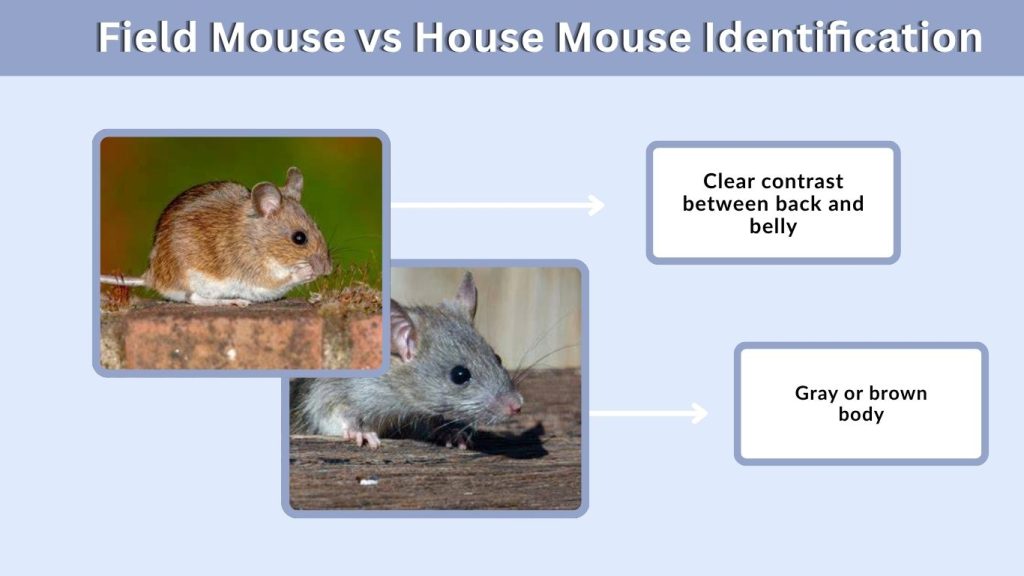
Appearance is one of the easiest ways to compare them.
Field Mouse Identification
Field mice usually look more “wild” than house mice. They may have a brown back, white or pale underside, and larger eyes.
Look for:
- Clear contrast between back and belly
- White or pale feet
- Larger rounded ears
- Large black eyes
- Longer-looking tail
- Quick jumping movements
House Mouse Identification
House mice usually have a more uniform body color. Their belly may be slightly lighter, but it does not usually have the sharp white contrast seen in many field mice.
Look for:
- Gray or brown body
- Smaller eyes
- Smaller ears
- Pointed nose
- Thin, dark tail
- Slender body
- Activity near kitchens, pantries, walls, and appliances
Field Mouse vs House Mouse Size
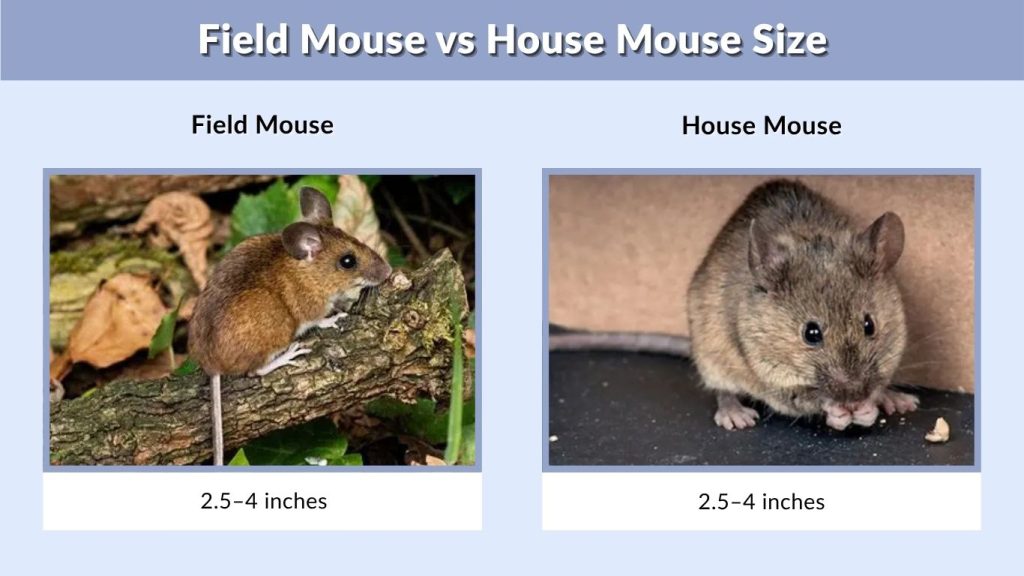
Size alone is not the best way to identify them because they overlap.
| Measurement | Field Mouse | House Mouse |
| Body length | About 2.5–4 inches | About 2.5–4 inches |
| Tail length | About 2–4 inches | About 2.5–4 inches |
| Total length | About 5–8 inches | About 5–7.5 inches |
| Weight | About 15–35 grams | About 12–30 grams |
A field mouse may appear larger because of its ears, eyes, and tail, but many house mice are similar in body length.
Field Mouse vs House Mouse Droppings
Mouse droppings are a common sign of activity, but they can be difficult to identify by species.
Field Mouse Droppings
Field mouse droppings are usually:
- Small and dark
- About ⅛–¼ inch long
- Rice-shaped
- Often pointed at the ends
- Found in sheds, garages, cabins, barns, and storage boxes
House Mouse Droppings
House mouse droppings are usually:
- Small and dark when fresh
- Grayish as they age
- About ⅛–¼ inch long
- Rod-shaped
- Found near food, cabinets, baseboards, drawers, and appliances
Can You Tell the Difference by Poop?
Sometimes, but not always. Field mouse vs house mouse droppings look very similar. Location gives better clues. Droppings in a remote shed or cabin may point to field mice, while droppings in a kitchen or pantry are more likely from house mice.
Habitat and Nesting Differences
Habitat is one of the strongest clues.
Field Mouse Habitat
Field mice usually live outdoors in:
- Fields
- Meadows
- Forest edges
- Gardens
- Farms
- Woodpiles
- Sheds
- Barns
- Cabins
They may enter buildings during cold weather but often remain connected to outdoor spaces.
House Mouse Habitat
House mice prefer human buildings, including:
- Homes
- Apartments
- Restaurants
- Warehouses
- Grocery stores
- Offices
- Farm buildings
They often nest inside wall voids, insulation, furniture, cabinets, and appliance spaces.
Behavior Differences
Field mice and house mice behave differently around people and buildings.
Field Mouse Behavior
Field mice are more likely to:
- Enter homes seasonally
- Store seeds and food
- Jump and climb well
- Use sheds, garages, and cabins
- Avoid busy human areas
- Nest in hidden outdoor spaces
House Mouse Behavior
House mice are more likely to:
- Stay indoors permanently
- Nest close to food
- Reproduce quickly
- Travel along walls
- Chew packaging, wires, and insulation
- Create larger infestations inside homes
Field Mouse vs House Mouse vs Deer Mouse

Many people search for field mouse vs house mouse vs deer mouse because the names overlap.
| Mouse Type | Meaning | Key Feature |
| Field mouse | General term for wild outdoor mice | Outdoor habitat, lighter belly |
| Deer mouse | Specific wild mouse species | White belly and two-toned tail |
| House mouse | Common indoor pest species | Uniform gray-brown body |
A deer mouse can be called a field mouse, but a field mouse is not always a deer mouse.
Health Risks
Both mice can contaminate food and surfaces with urine, droppings, and nesting material.
Field mice may carry parasites and diseases from outdoor environments. In some regions, certain wild mice, especially deer mice, can carry hantavirus. House mice are more commonly linked with indoor contamination, allergies, and bacteria such as Salmonella.
Never sweep or vacuum mouse droppings dry. Spray the area with disinfectant first, let it sit, then wipe carefully while wearing gloves.
How to Keep Field Mice and House Mice Out

Prevention is similar for both types.
- Seal holes and cracks larger than ¼ inch.
- Add door sweeps to exterior doors.
- Store food in airtight containers.
- Clean crumbs and pet food.
- Keep firewood away from the house.
- Remove clutter from garages and sheds.
- Trim weeds and grass near foundations.
- Repair damaged vents and screens.
- Use traps where mouse activity is visible.
For heavy infestations or repeated droppings, professional pest control may be needed.
Which Mouse Is in Your House?
If the mouse lives mainly in your kitchen, walls, pantry, or attic, it is probably a house mouse. If you see it in a shed, garage, cabin, barn, or rural building during colder months, it may be a field mouse.
The best identification clues are color pattern, tail, ears, eyes, droppings location, and nesting area.
FAQs
Is a field mouse the same as a house mouse?
No. A field mouse usually means a wild outdoor mouse, while a house mouse is a specific species that commonly lives inside homes and buildings. Field mice may enter houses, but house mice are better adapted to indoor living.
How do I tell a field mouse from a house mouse?
Look at the color, eyes, ears, and location. Field mice often have larger eyes, larger ears, and a lighter belly. House mice usually have a more uniform gray or brown body and are commonly found near indoor food sources.
Are field mouse droppings different from house mouse droppings?
They are very similar. Both are small, dark, and rice-shaped. Dropping location is often more helpful than shape. Droppings in kitchens suggest house mice, while droppings in sheds or cabins may suggest field mice.
Do field mice come into houses?
Yes. Field mice may enter houses, garages, sheds, and cabins, especially in cold weather. However, they usually prefer outdoor habitats, while house mice can live indoors throughout the year.
Which is worse, a field mouse or house mouse?
Both can be a problem. Field mice may carry outdoor diseases and parasites, while house mice reproduce quickly indoors and contaminate food. Any mouse activity inside your home should be handled quickly and safely.