
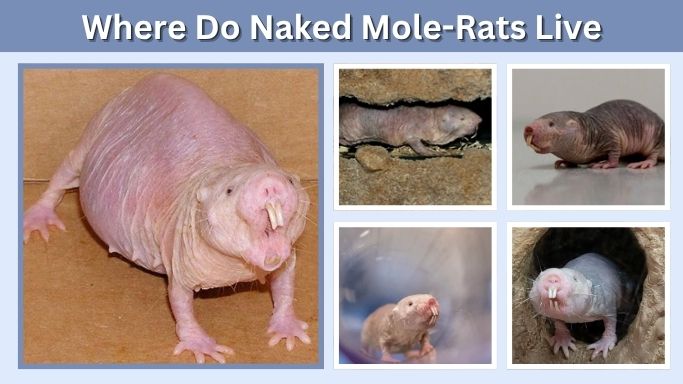
Naked mole-rats live underground in dry parts of East Africa, where they build large tunnel systems beneath grasslands and semi-arid soils. These unusual rodents spend almost their whole lives in darkness, searching for roots and tubers while living in colonies with a queen, workers, and soldiers. They are also famous for their long lifespan, low-oxygen survival, and strange resistance to many age-related problems.
Where Does a Naked Mole-Rat Live?
Naked mole-rats live in underground burrows in eastern Africa. Their habitat is not a beach, forest canopy, taiga, or open surface home. They are subterranean animals, meaning they are specially adapted to life below the ground.
The Smithsonian National Zoo describes naked mole-rats as pink, nearly hairless subterranean rodents that live in burrows in eastern Africa. It also notes that they are one of the only true eusocial mammals, living in large colonies where one female breeds and most others work for the colony.
Native Range in East Africa
Naked mole-rats are native to dry regions of East Africa. They are most closely associated with countries such as Ethiopia, Kenya, and Somalia. In these areas, they live below the soil rather than moving around openly on the surface.
They are hard to spot in the wild because they rarely come above ground. A person could walk over a colony without seeing a single animal. Their tunnels may stretch through soil beneath dry grasslands, savannas, and scrubby areas where underground plant parts are available.
Underground Burrow Systems
The true home of a naked mole-rat is its tunnel network. These burrows include narrow travel tunnels, nesting chambers, food storage areas, toilet chambers, and deeper spaces where the colony can stay safe from heat and predators.
Their underground lifestyle helps them avoid many dangers, including birds of prey, snakes, mammals, and harsh surface temperatures. The tunnels also keep the colony close to its food supply. Instead of searching above ground, they dig through soil until they find large roots and tubers.
Dry Grasslands and Semi-Arid Soil
Naked mole-rats do not need wet forests or riverside habitats. They are adapted to dry grasslands and semi-arid environments. Smithsonian’s naked mole-rat cam page says they are native to the dry grasslands of East Africa and spend their lives tunneling through soil in almost complete darkness.
This environment may sound difficult, but it works well for them. The soil hides them, plant roots feed them, and their social colony structure helps them survive in a place where food may be spread out underground.
How Do Naked Mole-Rats Survive Underground?
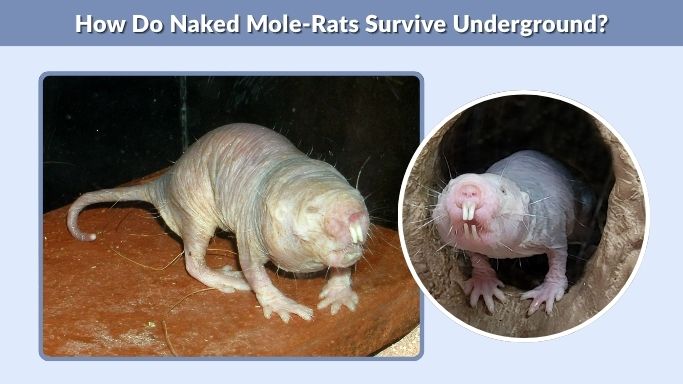
Living underground is not easy. There is little light, limited airflow, high carbon dioxide, and sometimes very low oxygen. Naked mole-rats survive because their bodies and behavior are built for this hidden world.
They are not beautiful in the usual sense, but every unusual feature has a purpose. Their tiny eyes, nearly hairless skin, strong teeth, and social teamwork all help them live in a dark tunnel system.
Body Adaptations for Burrowing
Naked mole-rats have several features that help them move through soil and live in tight tunnels.
Important adaptations include:
- Large front teeth for digging
- Lips that close behind the teeth to keep dirt out
- Small eyes because vision is less useful underground
- Sensitive whiskers and body hairs for feeling tunnel walls
- Loose skin that helps them turn in narrow spaces
- Strong jaws for chewing roots and soil
- Ability to move forward and backward through tunnels
Their front teeth are especially important. San Diego Zoo explains that naked mole-rats use their front teeth to tunnel through dirt while looking for large underground roots and tubers.
Food in Their Habitat
Naked mole-rats mainly eat underground plant parts, especially roots and tubers. These foods can be tough, but their strong teeth allow them to chew through them. Large tubers are valuable because one tuber can feed many colony members for a long time.
They also get much of their moisture from food. This is important because they live in dry places and do not usually need to search for open water. Their diet helps them survive in habitats where surface water may be rare.
Life in Darkness
Naked mole-rats spend almost their whole lives in darkness. Their eyes are small, and they do not rely strongly on vision. Instead, they use touch, smell, sound, and social signals to move around and communicate.
Inside the tunnels, colony members may pass one another constantly. They dig, carry soil, guard tunnels, care for young, find food, and maintain chambers. Their world is dark, crowded, warm, and low in fresh air, but they are built for it.
How Long Do Naked Mole-Rats Live?
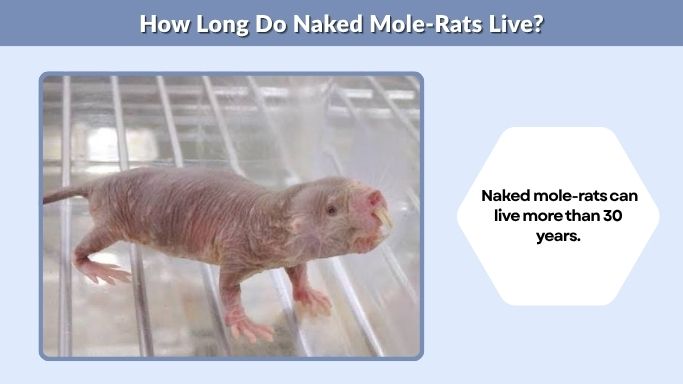
Naked mole-rats live much longer than most rodents. Many small rodents live only a few years, but naked mole-rats can live for decades. This is one reason scientists study them closely.
A 2024 Nature Communications paper describes the naked mole-rat as a eusocial mammal with extreme longevity, mentioning a 37-year lifespan, hypoxia resistance, and absence of cardiovascular disease in the studied context.
Average Lifespan
In captivity, naked mole-rats can live more than 30 years. This is extraordinary for a small rodent. Mice and rats often live only 2–4 years, but naked mole-rats can remain alive and active far longer.
Their lifespan in the wild is harder to measure because they live underground and are difficult to track. However, their natural burrow life, social protection, and unusual biology likely help them survive longer than many similarly sized mammals.
Can Naked Mole-Rats Live Forever?
No, naked mole-rats do not live forever. The idea that “naked mole-rats live forever” is a myth. They are extremely long-lived for rodents, and they show unusual resistance to some signs of aging, but they still die.
A better way to say it is that naked mole-rats age differently from most mammals. Scientists often study them because their risk of death does not seem to rise with age in the same simple way seen in many other mammals. That does not make them immortal.
Why Do Naked Mole-Rats Live So Long?
Naked mole-rats may live so long because of a mix of biology and lifestyle. Their bodies show unusual resistance to low oxygen, certain cancers, and age-related decline. Their underground colonies also protect them from many predators and extreme surface conditions.
Possible reasons include:
- Low metabolic rate
- Strong stress resistance
- Adaptation to low oxygen
- Unusual cancer resistance
- Protected underground lifestyle
- Cooperative colony structure
- Efficient use of food and energy
- Reduced exposure to sunlight and some surface dangers
Researchers still do not fully understand every reason for their long life. Their lifespan remains an active topic in aging science.
Naked Mole-Rat Habitat and Lifespan at a Glance
Naked mole-rats are often confusing because their lifestyle is so different from common rats and mice. They are rodents, but they live more like underground social insects in many ways.
| Topic | Naked Mole-Rat Facts |
| Main habitat | Underground burrows |
| Native region | East Africa |
| Common environment | Dry grasslands and semi-arid soils |
| Surface activity | Very rare |
| Main food | Roots and tubers |
| Colony style | Eusocial, with one breeding queen |
| Lifespan | Often over 30 years in captivity |
| Special survival ability | Tolerates low oxygen and high carbon dioxide |
Do Naked Mole-Rats Live in Groups?
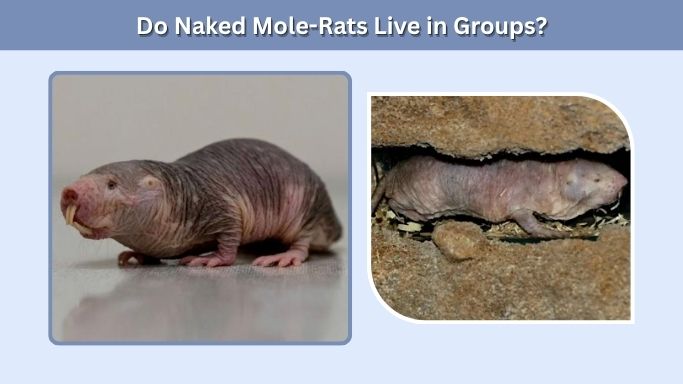
Yes, naked mole-rats live in large colonies. Their social system is one of the most interesting things about them. Like ants, bees, and termites, they have a colony structure where not every individual breeds.
This social system is called eusociality. It is rare in mammals, which makes naked mole-rats especially important to scientists.
Queen and Breeding Males
A naked mole-rat colony usually has one breeding female called the queen. She mates with a few males. The other colony members do not usually reproduce while the queen is present.
The queen is dominant and can keep other females from breeding. This creates a colony where most individuals support the survival of the group rather than producing their own young.
Workers and Soldiers
Most naked mole-rats in a colony are workers or defenders. Smaller individuals often dig tunnels, move soil, collect food, and care for young. Larger individuals may help defend the colony from predators or intruding mole-rats.
Common colony jobs include:
- Digging tunnels
- Carrying soil
- Finding food
- Cleaning chambers
- Caring for pups
- Defending tunnel entrances
- Maintaining nest areas
- Helping regulate warmth by huddling
This teamwork allows the colony to survive in a difficult underground environment.
Colony Size
Naked mole-rat colonies can be large. Some colonies may have dozens of individuals, while others may have more than 100. Colony size depends on food supply, tunnel space, queen productivity, and survival conditions.
Large colonies create another challenge: oxygen can become limited. Many animals breathing in a sealed underground space can lower oxygen and increase carbon dioxide. Naked mole-rats are unusually good at handling these conditions.
What Oxygen Level Can Naked Mole-Rats Live At?
Naked mole-rats are famous for surviving low-oxygen environments. Their underground burrows can have air that would be stressful or deadly for many surface mammals. They are also tolerant of high carbon dioxide.
A scientific review explains that naked mole-rats live in deep, poorly ventilated nests where many animals can deplete oxygen and increase carbon dioxide. It also says they tolerate low oxygen and high carbon dioxide levels that are deadly to most surface-dwelling mammals.
Low-Oxygen Burrows
In a crowded tunnel system, fresh air does not move freely. Oxygen may drop, especially in deep nest chambers where many animals huddle together. Instead of avoiding this completely, naked mole-rats are adapted to live with it.
Their bodies can reduce energy use when oxygen is scarce. They can slow some body functions, lower activity, and survive conditions that would quickly harm many other mammals.
High Carbon Dioxide Tolerance
High carbon dioxide is another challenge underground. When many animals breathe in a closed space, carbon dioxide rises. Most mammals find this uncomfortable and dangerous, but naked mole-rats tolerate it unusually well.
This adaptation matters because they live in crowded colonies. Without high carbon dioxide tolerance, their deep nests would be much harder to survive.
Why This Matters to Science
Scientists study naked mole-rats because their oxygen tolerance may help researchers understand brain protection, heart function, aging, and survival under stress. Their biology is unusual, and it may offer clues for medical research.
However, it is important not to exaggerate. Naked mole-rats are not magic animals. They have evolved specific traits for their underground life, and researchers are still learning how those traits work.
Do Naked Mole-Rats Live in the Taiga or on the Beach?
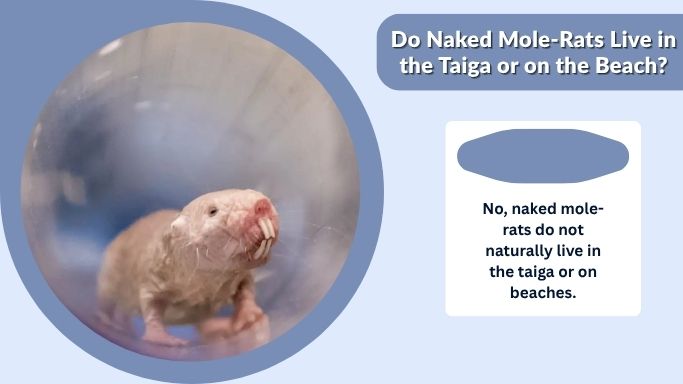
No, naked mole-rats do not naturally live in the taiga or on beaches. These are common search questions, but they do not match the animal’s true habitat.
Naked mole-rats are dryland underground rodents from East Africa. They are not cold-climate animals and not coastal beach animals.
Not a Taiga Animal
The taiga is a cold northern forest biome with long winters, conifer trees, snow, and low temperatures. Naked mole-rats are not built for that environment. Their nearly hairless bodies and underground African habitat make them very different from animals adapted to northern forests.
They need soil where they can tunnel and underground plant food such as roots and tubers. The taiga does not match their natural range.
Not a Beach Animal
Naked mole-rats also do not live on beaches. Some burrowing animals live in sandy coastal habitats, but naked mole-rats are not one of them. They live underground in dry grassland and semi-arid soil systems.
They may be called “sand puppies” in some casual descriptions, but that does not mean they are beach animals. It refers more to their appearance and burrowing lifestyle.
Captive Naked Mole-Rats
Outside East Africa, people may see naked mole-rats in zoos, research centers, or live cams. The Smithsonian has a naked mole-rat cam because the species is kept and studied in managed colonies. These captive environments copy parts of their tunnel lifestyle so visitors and scientists can observe them.
FAQs
Where do naked mole-rats live?
Naked mole-rats live underground in dry regions of East Africa. They build tunnel systems beneath grasslands and semi-arid soils. Their burrows include travel tunnels, nesting chambers, toilet areas, and food spaces. They rarely come above ground because their bodies are adapted for darkness, digging, and life below the soil.
How long do naked mole-rats live?
Naked mole-rats can live for more than 30 years in captivity, which is extremely long for a small rodent. Some records and studies mention lifespans around 37 years. Their wild lifespan is harder to measure because they live underground and are difficult to follow over time.
Why do naked mole-rats live so long?
Naked mole-rats may live so long because they have unusual resistance to low oxygen, some cancers, and age-related decline. Their low metabolism, protected underground lifestyle, and social colony structure may also help. Scientists still study them because their aging pattern is very different from most rodents.
Can naked mole-rats live forever?
No, naked mole-rats cannot live forever. They are famous for long life and unusual aging biology, but they are not immortal. The phrase “live forever” is an exaggeration. They can still die from disease, injury, colony conflict, old age, or other natural causes.
What oxygen level can naked mole-rats live at?
Naked mole-rats can tolerate very low oxygen compared with most mammals. Their underground tunnels may have poor airflow, low oxygen, and high carbon dioxide. They survive by reducing energy use and changing body functions during low-oxygen stress. This ability is one reason scientists study them closely.